Home » 2015 (Page 17)
Yearly Archives: 2015
St. Patrick’s Day — Searching for the way out of exile
 At first glance, the soggy, green downs of Ulster bear little resemblance to the parched and craggy hills of Israel. But a gentle tugging at the cultural fabric of either place unravels an unmistakable common thread: two peoples, impossibly close geographically, impossibly distant ideologically, with more than enough fuel for hatred between them to burn until the coming of the Messiah. Tromping over hills and through city streets, however, first in one place and then in the other, I discovered a more compelling similarity: the bitter struggle of humanity in exile.
“Which are the bad parts of town, the ones I should avoid?” I asked the owner of the bed-and-breakfast where I passed my first night in Belfast.
She dutifully pointed out the Shankhill neighborhood on my map, cautioning me to steer clear of it. I thanked her and, with sophomoric self-confidence, proceeded there directly.
 It was the summer of 1984, in the midst of “the Troubles,” and central Belfast exuded all the charm of a city under martial law. Policemen on patrol wore flack jackets. An armored personnel carrier idled at a major intersection waiting for the signal to change. Blown out shells of buildings sprouted weeds, and street signs warned, DO NOT LEAVE CAR UNATTENDED. But as I worked my way up Shankhill, I discovered even more disconcerting landmarks: elementary school yards swathed in barbed-wire and churches pocked with scars from automatic-rifle fire.
I stopped in at a corner pub and took a seat at the bar beside two locals. Each was nursing a pint of Guinness. Another glass, two-thirds full with boiled snails, rested between them. The men took turns using a bent eight-penny nail to dig each snail out of its shell before popping the meat into their mouths.
I was half-way through my own pint of ale when the nearest one began chatting me up. “Yootoorin?” he said.
“I beg your pardon?”
“Yootoorin?” he repeated.
“I’m sorry, I don’t understand.”
“You touring? You traveling around?”
I needed several minutes to adjust to his accent. I never did get used to his indifference to life in a war zone.
“It’s no big deal,” he said with a wave of his hand. “There’s not many bombs going off any more, except on the big anniversaries, and everyone expects it then.” He extracted another snail from its shell, tossed it into his mouth, and chased it down with a swig of Guinness.
“Nobody lets the fighting get in the way of their getting on with life,” my friend continued. “You get used to it, you know?”
 I was carried away to captivity in Ireland with so many thousands of persons, as we deserved, because we departed away from the Almighty … [and He] brought upon us the fury of His anger and scattered us among many nations as far as the end of the earth…
So writes St. Patrick, Ireland’s patron saint, echoing the prophecy in Deuteronomy 28 according to which, four centuries earlier, the Children of Israel had been exiled at the beginning of the great Diaspora. Yet Patrick applied it without hesitation to his own time and place, presuming that the right of a nation to reside peacefully in its land depends upon the character and integrity of its people.
My wanderings ultimately led me from Belfast to Jerusalem, where I also found people living amidst violence and without fear. And there, as St. Patrick had done in Ireland, I discovered the ancient lessons of my own people, who have found neither peace with their neighbors nor peace with one another.
Exile, I gradually came to understand, does not require banishment to the ends of the earth. It can happen right at home, and it can take many forms. Indeed, which is the more profound Diaspora: being scattered to distant lands, or living under siege in one’s own home? And if we do find ourselves exiles in our own land, to where can we escape?
Today, the residents of both Israel and Northern Ireland fight among themselves over definitions, over identity, and over direction. In this they are like so many other peoples in this uncertain world, laboring to learn that the only way any of us can find the path leading out of exile is by shouldering the responsibilities of freedom.
Originally published in the St. Louis Post-Dispatch, 1999.
Before it’s too late
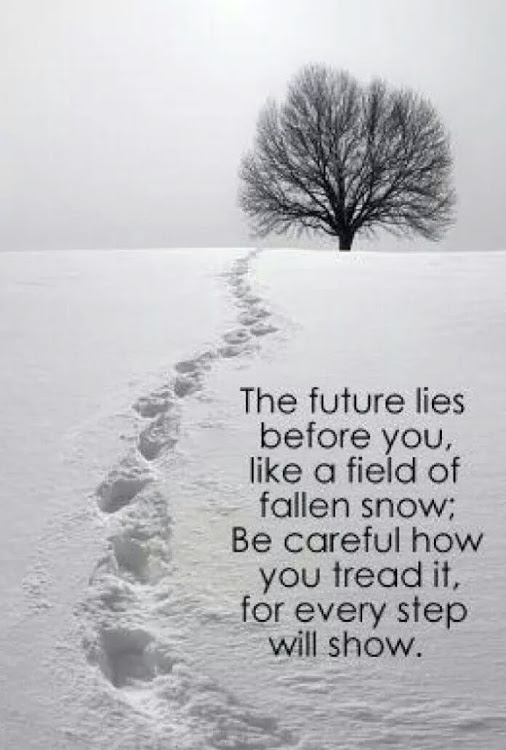 Like the genie let out of the bottle, words can never be taken back once they leave our lips, and actions cannot be undone once we’ve done them.
There are few sadder feelings than the regret of wishing to undo the past.
Think first. Then think again.
But don’t overthink. Inaction can be worse than the wrong action.
Yes, life is complicated.
Settled Science?
 Last March, scientists believed they had discovered evidence of the Big Bang. Early this year, analysis raised new doubts about the soundness of the Big Bang Theory altogether, according to an article in Quanta Magazine.
The issue here is not whether to believe in Big Bang. I have no skin in the game, since Creationism can work with or without it. The real issue is the unshakable certainty of so many in the scientific community despite a history of mistaken hypotheses that goes back at least as far as Aristotle.
Whether it’s Big Bang, evolution, or climate change, it is disingenuous for ideologues to quash open debate by proclaiming any of these as “settled science.” They are not. Each faces serious logical and scientific challenges that may not refute them but certainly demand acknowledgment and honest investigation. To claim “case closed” when so many legitimate objections remain unanswered is hardly a responsible application of scientific method.
Which begs the question: why are so many in the scientific community afraid of the truth?
Read the whole article here. Here are a few excerpts:
No one has devised an alternative to inflation [the exponential expansion of the universe following the initial “big bang”] that explains so many observations with so much economy. For a decade, Paul Steinhardt of Princeton University, an early pioneer of inflation who has since become one of its most vocal critics, has championed the “ekpyrotic model,” a cyclical picture in which the universe executes an eternal series of expansions and contractions. In this scenario, any unevenness that develops in the cosmos as it expands gets compressed as it contracts. The slate is wiped clean for each cosmic rebirth, accounting in this way for the exceptional uniformity observed early on in this latest iteration.
But the ekpyrotic model has few subscribers. It hinges on the idea that the universe will bounce, rather than bang, each time it shrinks to a point. The theoretical arguments for why it should bounce strike most experts as highly speculative. And the non-bounciness of black holes suggests it would not do so.
At present, inflation has cornered the market on Big Bang theories, and yet there is still room for doubt. “The fact that we don’t have an alternative doesn’t mean we know the truth,” said Avi Loeb, a theoretical astrophysicist at Harvard University.
The theory’s triumphs are undercut by a strange detail: If inflation works the way it’s supposed to, it seems that it should never have happened at all.
Inflation now seems less likely than ever, the critics say.
The New Narcissism
 Have we finally reached the point where narcissism is no longer an epidemic but an institution? Is this the legacy of the “Me Generation” of the ’70s, bequeathing a cultural norm of such enormous self-absorption that self-absorption has itself become a virtue?
Joe Holleman asks the question. I fear that the answer is self-evident. The mantra of our generation has become:
Ask not what you can do for others; ask what you can demand that others must do for you.
Paradoxical Truths to Embrace for a Meaningful Life
 I’ve been telling my students for years that to live a successful life one has to be a little bit schizophrenic. We live in a world filled with contradictions that we have to acknowledge, attempt to reconcile, and sometimes accept as irreconcilable.
This article does a wonderful job of spelling it out. Definitely worth reading.
Courage
 Doing what’s right instead of what’s popular;
doing what’s important instead of what’s convenient;
doing what’s necessary instead of what feels good;
doing what’s risky instead of what’s comfortable;
doing what’s challenging instead of what’s easy;
doing what’s best for everyone instead of what’s best for yourself;
doing what others will condemn instead of what others will applaud;
following the heart when the mind is misguided;
following the mind when the heart is seduced;
persevering when others tell you to turn back;
turning back when it’s clear you’ve taken the wrong path;
speaking out against evil;
keeping silent in the face of insult;
telling those you love how much they mean to you.
Visionaries and Ideology: a study in contrasts
 Who knew a trip to New York could be so emotional?
I didn’t want to go in the first place. As my 92-year-old student likes to quote: Travelling is for peasants.
But my wife convinced me with simple arithmetic. Four tickets to bring three kids and son-in-law home or two tickets to visit them. No-brainer.
So I went grudgingly, confirming in the end the truism that some of life’s most profound moments come not only unexpected but against our will.
Our first stop was the 9/11 museum. I marveled at the artistic vision that had conceived the memorial pools, the water channeling down in rivulets that mirrored the face of the fallen towers, the continuous downward rush balanced by the redemptive feeling of water — the source of life — returning to the heart of the world. Here there was solace, closure, and consolation.
But a very different feeling accosted me inside. Almost upon entering the doors a single word brandished itself across my mind’s eye: Holocaust.
Let me explain.
Read the whole article here.

The Grateful Whale
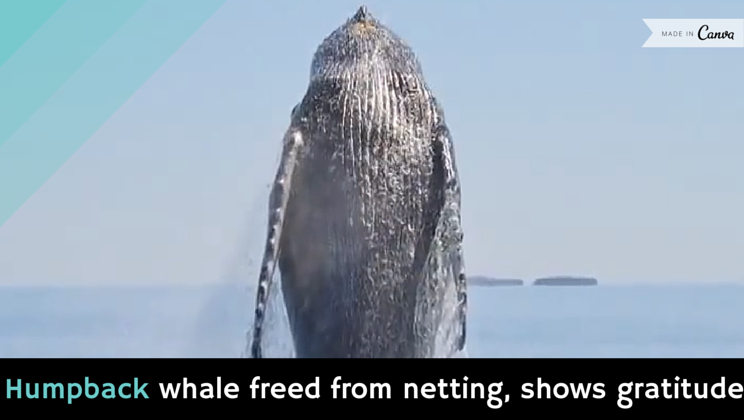 Swimmers worked an hour to free this humpback whale tangled in fishing net. To see the whale’s reaction, skip to 6:40 on the video. Perhaps the display was one of sheer elation at being freed, or perhaps an unbridled expression of gratitude.
This whale knows something too many of us have forgotten. Our society has embraced the culture of convenience, entitlement, and victimization to the point where we barely feel appreciation anymore. In a world where everything is supposed to be available and instantaneous, we’ve responded with the attitude that everything takes too long, takes too much thought, takes too much effort. Our expectations are so high that we are forever frustrated and disgruntled.
In biblical Hebrew, the term for gratitude is hakoras hatov — literally, “recognizing the good.” Before we can appreciate, we have to look for the good in our lives, see it as good, recognize how we have benefited from it as good; once we have that recognition, not only can we experience true appreciation but we inevitably will feel appreciative. How can we not, with that which has benefited us so clear before our eyes?
“The wise man’s eyes are in his head,” says King Solomon in Proverbs. Only if we see through the lens of our minds’ eye can we truly perceive, truly understand, and truly achieve the lofty human reactions that should be uniquely ours, but which sometimes we have to learn from the creatures with which we share our world.
How sad for us if they get it and we don’t.
Just who are “we”?
Tonto: What is wrong, Kimosabe?
Lone Ranger: We’re surrounded by bloodthirsty indians, Tonto. What are we going to do?
Tonto: What you mean, “we,” white man?
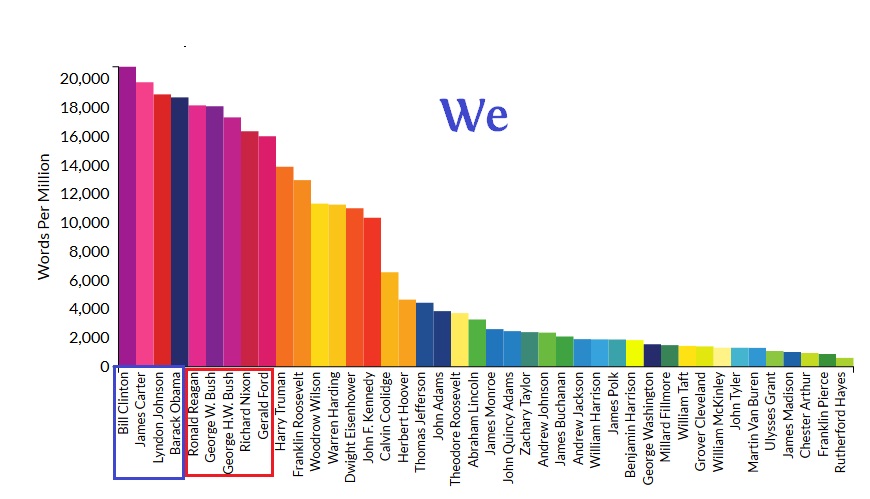 Thanks to Jay Livingston for this post on behalf of the Montclair State Sociology Department. He paints a compelling picture of how the collective language of “we” has been increasingly conscripted by modern politicians to create — or fabricate — an impression of common purpose and common allegiance.
With politics dividing us more deeply than ever, it might seem beneficial to employ rhetoric designed to bridge the ideology gap. In practice, however, disingenuous expressions of harmony and unified vision can do a lot more harm than good.
For one, when a demonstrably divisive leader — a U. S. president, for example — claims that he is the leading advocate of unity and cooperation, he makes himself a lightning rod for accusations of hypocrisy and manipulation that breed cynicism in place of optimism. For another, by claiming the high ground, he implicitly vilifies all who oppose him, even if they do so from positions of principle. Either way, the ideological rift grows wider, not narrower.
Perhaps worst of all, the collective “we” diffuses responsibility from the individual onto the collective: since all of us are responsible, none of us is responsible. This produces the effective equivalent of such politicalisms as “Mistakes were made.” Somewhere, someone did something wrong. There’s plenty of blame to go around, but nowhere for it to stick.
In short, fake unity achieves the opposite of unification.
But when there really is cohesion, whether within a team, a business, a community, or a society, the collective “we” becomes a priceless asset, including the lowly with the high, the rank and file with the leaders, the grunts with the visionaries. Like it or not, we’re all in it together. And the more we try to shoulder our collective burdens with one mind and one heart, the more we will succeed.
 Yonason Goldson