Home » Articles posted by Yonason Goldson (Page 48)
Author Archives: Yonason Goldson

The Road to Compromise
 After last week’s “historic” Obama-Kerry Compromise with Iran, it’s instructive to take a look back to see how little has changed. I published this op-ed in the St. Louis Post-Dispatch on 2 August 2002.
Henry Clay earned his reputation as “the great compromiser” when he forestalled the outbreak of the Civil War by ten years. Even so, one has to wonder whether even Mr. Clay’s genius for mediation could save the Mideast peace process from becoming a towering embarrassment to US foreign policy.
Compromise, according to Webster’s, is “a method of reaching agreement in a dispute, by which each side surrenders something that it wants.” This shouldn’t be hard to comprehend for anyone with a background in high school civics. What does remain incomprehensible is how otherwise reasonable people might seriously apply the term “compromise” to past peace proposals, and why anyone thinks it will be different the next time around.
Definitions notwithstanding, immediately after the Camp David negotiations in the summer of 2000 the New York Times observed that Yasir Arafat’s “willingness for more talks suggests room for compromise.”
The Times deserved credit for optimism and imagination, but won few points for objective editorial insight. Indeed, only a month earlier (on July 11 of that year), the Times reported that, “The Palestinians want a settlement based on United Nations Resolution 242,” implying that if not for Israeli intransigence, there would have been peace in the region long before.
Let’s see. Resolution 242 mandates 1) the “withdrawal of Israeli armed forces from territories occupied in the recent conflict,” and 2) the “termination of all claims or states of belligerency and respect for and acknowledgement of the sovereignty, territorial integrity and political independence of every State in the area and their right to live in peace within secure and recognized boundaries free from threats or acts of force.”
For its part, Israel returned more than 90% of the Sinai to Egypt in 1981, and offered to give more than 90% of Judea and Samaria to the Palestinians under former Prime Minister Ehud Barak. Pretty good, for a compromise.
From the Palestinian side, however, it’s been hard to detect even a whiff of compliance. Rather, these are the ways the Palestinian Authority has terminated its claims and belligerency: all government and schoolbook maps, as well as children’s television programs, identify the whole of Israel as “Palestine;” teenagers at Palestinian “summer camps” train with automatic weapons to fight Israelis; Arafat has named squares and streets after Hamas suicide bombers; Israeli security has caught PA officials smuggling numerous weapons, including anti-tank weapons, into Israel. The list could easily fill this column.
Ehud Barak had been prepared to overlook all that. But then the Camp David talks broke down anyway, largely because of Palestinian insistence of absolute sovereignty over East Jerusalem. Yet Jerusalem has been the heart and soul of Israel for over 3000 years, the holiest site on earth according to Jewish tradition and the Old Testament. The Arab’s spiritual capital is Mecca, whereas Jerusalem is merely a religious and historical footnote, not mentioned by name even once in the Quran. What’s more, from 1948 to 1967, when Jordan controlled East Jerusalem, not one Arab ruler visited the city, except Jordon’s own King Hussein. Electricity and water services were neglected, and no government offices or cultural centers were set up there.
So what does the Palestinian Authority want? What it has always wanted: everything. The very concept of compromise appears utterly foreign to the thinking of Palestinian leaders, and is entirely absent from their behavior. It’s hard to see what the PA has ever thought it’s bringing to the negotiating table, except for the vague promise of controlling terrorism and the hazy commitment of conceding Israel’s right to exist, a right already granted by the United Nations over half a century ago.
In hindsight, it’s also hard to see what Ehud Barak hoped to accomplish by bargaining away so much for so little. According to Mideast analyst David Makovsky, Mr. Barak’s objective was “peace without illusions.” Peace between governments, the former Prime Minister believed, is the only possible goal presently within grasp; peace between peoples is generations away.
Mr. Barak assumed that once a treaty is signed, all of Israel’s Arab neighbors will abide by its conditions, gradually leading to normalization and the eventual cessation of the hateful rhetoric that foments Arab violence.
The trouble is, there’s no evidence it would work. Whatever the terms, any deal that produces even the coldest peace must rest on the foundation of compromise, a foundation that doesn’t exist. The indoctrination of children with hatred of Israel continues, even in Egypt, nearly three decades after it grudgingly traded political recognition for the return of its land.
 Other Arab nations have refused to offer even this little olive branch; they have never demonstrated the slightest willingness to compromise. Neither Israel nor the United States should take another step forward until they do. Let us hope that the new U. S. president will learn from the errors of his failed namesake and not put his hope in false promises that have already led nowhere.
Respect the boundaries of the world…

Proverbial Beauty now available on Amazon.com

No one is so strong…
 Back in college, when everyone’s goal was “self-actualization,” we used to joke that the curse of actually becoming self-actualized would be having to live in a world where no one else was.
Strength doesn’t mean not needing anyone else. It means not being a slave to internal or external forces.
“Who is mighty?” asks the Talmud. “The one who masters his impulses and inclinations.”
But we still need other people, and the downside of being strong is the presumption by others that everything is always okay.
So don’t forget to ask the people close to you how they’re doing, even when they seem to be on top of the world. Sometimes strength is a burden that we can’t carry alone.

Can we Stay Honest in a Dishonest World?

The biggest tragedy of the Supreme Court decisions on Obamacare and gay marriage was not the decisions themselves. It was the perception, by both winners and losers, that these decisions were not reached based on legal principle but upon political ideology and personal bias.
Which means that, regardless of which side won, the country as a whole lost.
Honesty has seen its market value tumble over the years with countless reports of plagiarism, factual carelessness, and blatant fabrication. It’s bad enough when such prevarication comes from the media. But what’s really cause for alarm when it becomes the norm among our political leaders.
The sad truth is that truth from our politicians has become far more the exception than the rule. But the brazenness with which they conjure up easily verifiable falsehoods grows ever more astonishing.
Once integrity disappears, the only motive not to lie is fear of not getting away with it — and get away with they have, in a society that has grown indifferent to lying.
We may not be able to stop the lying in politics. But here are ten ways we can prevent the erosion of our own integrity.
Expanded and updated from an article published earlier this year. Click here to read the whole article.

How to Survive the Age of Advertising
 After the Stone Age came the Iron Age, then the Industrial Age, and now the Age of Advertising. Regardless of what the experts say, we are not living in the age of a consumer economy, but of an advertising economy.
With companies trading for billions without producing proportional revenue — or any at all — we can only imagine how far things can go and how far the markets will climb before this latest bubble bursts, exposed for the pyramid scheme that it is. Indeed, the inability to distinguish between reality and illusion is precisely the goal of modern advertising.
Nevertheless, there is some small hope that escape from its influence might still be possible, no matter how far its tendrils have reached. That evidence comes in the person of Julian Keonig, perhaps the greatest legend in advertising history, who passed away last year at age 93.
Readers of a certain age will remember the classic Timex slogan, “It takes a licking and keeps on ticking,” and the self-validating tagline for the Volkswagen Beetle — think small — voted the most successful ad of the last century. Both were the creations of Julian Keonig; but neither was what he considered his most inspired brainstorm.
And neither provides us with an insight into his most important legacy.

What do you mean, “You don’t have a cellphone”?
 I’ve always known this day would arrive. But it lay too far off in the future to worry about.
I sat safely atop my own personal promontory, even as the tide surged forward to swallow lesser souls who tested the waters and were lost.
But you can’t stop a tsunami. The Day of Reckoning is at hand. And even if I can hold out a little longer, after all these years of holding out now I feel like I’m selling out. It’s hard to even articulate the words.
Still… here it goes. It may finally be time to get a cellphone.
Click here to read the whole article.
 Proverbial Beauty at Amazon.com

Elbowing God Out
 Back when I possessed the charming innocence of a twelve-year-old, I took offense at the wording of the Pledge of Allegiance. Why, I wondered, was I expected to pledge my allegiance to a flag? Proclaiming loyalty to my country I could understand, but to a piece of fabric?
Moreover, as I had concluded with unshakable, preadolescent self-confidence that human existence was nothing more than a cosmic accident, I found the phrase “under God” equally offensive.
So while my classmates were loudly reciting the full text of the Pledge of Allegiance, I was quietly editing my own recitation: I pledge allegiance… to the United States of America… one nation… indivisible, with liberty and justice for all.
By my final year in high school, however, having acquired a sufficient measure of sophistication to appreciate the importance of symbolism, I no longer resented being asked to swear loyalty to a flag. But we weren’t reciting the Pledge of Allegiance any more, so I had no chance to mend my ways.
I was also less certain concerning the existence of a Creator. Six years of secondary education had opened my eyes to a universe so enormously complex that to embrace any world view as extreme as atheism seemed the height of arrogance. The phrase “under God,” therefore, struck me as a comforting expression of humility, that we as a nation recognized the grandeur of our universe and conceded its unfathomability.
Perhaps the circuit court judges who ruled the phrase “under God” unconstitutional might have interpreted the law with more humility if they had familiarized themselves not only with the letter, but with the spirit of the Constitution. Perhaps they might have better understood the intent of the Framers if they had read, or remembered, the words of Alexander Hamilton: “The sacred rights of mankind… are written, as with a sun beam in the whole of human nature, by the hand of the divinity itself; and can never be erased or obscured by mortal power.”
 Considering the many references to the Almighty among the writings of the Framers of the Constitution, it’s astonishing how often we hear the Constitution invoked as the basis for expurgating every reference to God from the public arena. If the founding fathers weren’t afraid of mentioning God in the Declaration of Independence, why should we fear the utterance of His name in our courthouses or schools? But many among us are afraid, afraid with a fear born of insecurity.
Indeed, what is more terrifying than the unknown, and what is less known than what awaits us when we depart this mortal coil? As Prince Hamlet pondered: “To sleep? Perchance to dream! Ay, there’s the rub.” For the devout atheist, there is no greater dread than the haunting suspicion that he might be wrong, that there might truly be a Creator and an accounting before Him upon arrival in the hereafter. To the atheist, every reference to God is an unwelcome reminder that the rest of the world is not so certain that our existence is random and without purpose.
The great Rabbi Joseph B. Soloveitchik summed it up like this: “All extremism, fanaticism and obscurantism come from a lack of security. A person who is secure cannot be an extremist.” And, indeed, extremism in the form of radical religion or radical nihilism is one and the same. The 19th century anarchist used techniques not unlike the suicide bomber of today to advance his own variety of jihad. The modern anarchist uses manipulation of the law to advance his cause, supremely confidant that he understands the Constitution better than its authors.
The Talmud describes how, during the last days of the second Temple in Jerusalem, the Jewish people observed the law of the Torah meticulously according to its letter. But they failed to look beyond the letter of the law, to strive for understanding and fulfilling of the spirit of the law, to labor in applying the essence of the law toward the transformation of their character. This failure, together with a senseless hatred born of mutual suspicion, mutual contempt and, ultimately, the uncompromising assertion of their own egos, resulted in the destruction of the Temple, the deaths of millions of Jews, and the beginning of our long, dark exile scattered among the nations of the earth.
It has been observed that the word ego is in fact an acronym for Elbow God Out. A daily reminder that we should receive our national freedoms with humility is among the surest means of preserving those freedoms for our children. Close to two thousand years ago, instead of subduing their egos before the Highest Authority, instead of subjugating their ideological differences to the pursuit of shalom, peace, the Jews distorted Divine law to serve their own agendas, thereby sealing their fate and the fate of the Temple.
The sages teach that any generation that does not rebuild the Temple is considered to have destroyed it. But if we return to the law with humility and reverence, then we can truly hope to rebuild that which for so long has been lost.
Adapted from an article previously published by the St. Louis Post-Dispatch, the Baltimore Sun, and Aish.com.

In Memoriam: Nicholas Winton, 1909-2015
 Nicholas Winton, a Briton who said nothing for a half-century about his role in organizing the escape of 669 mostly Jewish children from Czechoslovakia on the eve of World War II, a righteous deed like those of Oskar Schindler and Raoul Wallenberg, died on Wednesday in Maidenhead, England. He was 106.
It was only after Mr. Winton’s wife found a scrapbook in the attic of their home at Maidenhead, in 1988 — a dusty record of names, pictures and documents detailing a story of redemption from the Holocaust — that he spoke of his all-but-forgotten work in the deliverance of children who, like the parents who gave them up to save their lives, were destined for Nazi concentration camps and extermination.
For all his ensuing honors and accolades in books and films, Mr. Winton was a reluctant hero, often compared to Schindler, the ethnic German who saved 1,200 Jews by employing them in his enamelware and munitions factories in Poland and Czechoslovakia, and to Wallenberg, the Swedish businessman and diplomat who used illegal passports and legation hideaways to save tens of thousands of Jews in Nazi-occupied Hungary.
May we all be inspired by a life of extraordinary heroism and modesty. Click here to read the New York Times retrospective.

Why Marriage Matters

From the United States Constitution to the French Revolution, from the Emancipation Proclamation to the 19th Amendment, from the Civil Rights Act to last week’s Supreme Court decision affirming the right to gay marriage, the world has taken (by a vote of 5 to 4) another great step forward on the road to universal equality and justice.
That’s what the pundits would like us to think. Except that it wasn’t a step forward.
And, more important, it was never about the right to marry…
As an institution, marriage created a moral structure upon which all other moral structures found purchase: Partnership, self-sacrifice and, perhaps most critically, respect for the natural boundaries and limits imposed by the design of the universe in which we live. Human beings took for granted the imperative to conform to nature’s laws and nature’s plan. Individual desire and ambition learned to submit to a higher reality and universal truths. Personal gratification was not the ultimate arbiter of right and wrong in a society that required cooperative spirit and collective commitment to ideals that extended beyond oneself.
Success in Failure
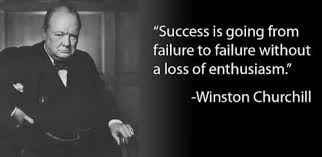 A righteous man falls seven times.
~Proverbs
But failure only leads to success if we learn the lessons it tries to teach us. Otherwise we prove the wisdom not of Solomon or Churchill but of Einstein and Hegel:
Insanity is doing the same thing over and over and expecting different results.
What experience and history teach is this — that people and governments never have learned anything from history, or acted on principles deduced from it.
 Yonason Goldson