Home » Articles posted by Yonason Goldson (Page 53)
Author Archives: Yonason Goldson

The Grass is Always Greener After the Apocalypse
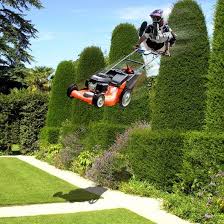 Well, there goes the neighborhood. Well, there goes the neighborhood.
That’s what I thought when I came home to find my next-door neighbor cutting his grass – for the first time since autumn. This was bad news. With the front yard of my other neighbor already short-cropped and neatly clipped, my own bedraggled lawn now stood out in sharp, unpretty relief. For some mysterious reason, the zoysia grass that dominates my front lawn is the last in the neighborhood to awaken each year from dormancy. Even worse, a variety of other grasses shoot up energetically with the outbreak of spring, speckling my lawn in malignant clumps that make the zoysia appear all the more anemic. In contrast to the golf course-like greens on either side of me, my patch of stringy yellow turf seemed to beckon for a rough-cut, whitewashed sign proclaiming CONDEMNED! My yard guys had yet to appear after the winter hiatus and hadn’t returned my phone calls. Were they out of town? Had they given up yard work for house painting or auto repair? It didn’t matter. Only one course of action remained: I would have to cut the grass myself. My sensibilities cried out against the wrongness of it all. The Creator did not plant grass upon His earth that it should be cut. He intended that it should grow, that it should go to seed, that it should produce new grass, and that the cycle should continue, uninterrupted by the meddling hands of Man. Cutting the lawn was a symbol of the same intrusive practices responsible for the destruction of the ozone layer and global warming, for deforestation and the extinction of new species every day, for Japanese kudzu smothering the southwest and Venezuelan hyacinths choking the Everglades. It all starts here, hacking down new growth sown by the Divine Hand to conform to some arbitrary aesthetic mean, branding every bayou a quagmire to justify turning it into a landfill or a parking lot. Was I now to become a part of this? “How about doing mine when you finish yours?” I called to my neighbor. Let him be the one to destroy the planet. “You’re welcome to borrow my mower when I finish,” he said. Terrific. Out of the frying pan, into the quagmire. Should I leave my lawn uncut to protest the destruction of the world’s ecosystem? No, my neighbors wouldn’t understand that I was making a political statement. Even worse, I would likely be cited by the city for crimes against civilization. And, worst of all, a small inner voice insisted that as an upstanding community member, as a father and a teacher, I had an obligation to uphold standards and preserve the status quo for the general welfare of the collective. Bah. Humbug. My neighbor finished. “You want to use it now?” he asked. Of course not, you infidel. But I didn’t say that: he would only have thought me rude. Instead I just smiled and nodded. He showed me how to operate the mower then went inside, mercifully, so not to behold me in my degradation. You know what? It wasn’t so bad. I even felt a kind of thrill as I assumed mastery over nature, subduing the power of the untamed wilderness, imposing order upon chaos. In fifteen minutes, the lawn looked great. I felt great. Maybe I should buy shares in John Deere. My only worry was that my wife might now expect me to mow the grass every two weeks. Well, maybe she wouldn’t notice. Half an hour later, as I was throwing the baseball with my son on our newly manicured front yard, my wife pulled into the driveway. “Honey,” she cried. “The lawn looks great. You cut it yourself?” Rats. She noticed. Previously published by the St. Louis Post-Dispatch and Jewish World Review |

The War on Women Continues
From the Huffington Post:
 British chess grandmaster Nigel Short is responding to criticism after recently arguing that inherent differences in men’s and women’s brains may explain why there are fewer female chess champions than males ones.
“Men and women’s brains are hard-wired very differently, so why should they function in the same way? I don’t have the slightest problem in acknowledging that my wife possesses a much higher degree of emotional intelligence than I do,” he wrote in the February issue of New In Chess magazine. “One is not better than the other, we just have different skills.”
“It would be wonderful to see more girls playing chess, and at a higher level, but rather than fretting about inequality, perhaps we should just gracefully accept it as a fact,” he added.
So why would Huff Post run such a blatantly chauvinistic report? Well, obviously, for the counter-offensive that makes up the last 60% of the article. Then, of course, you have the comments, which fluctuate wildly between the apoplectic, the apologetic, the politically correct, and the well-reasoned.
Anyone who has raised children or taught school knows that males and females are more different than some species. We have different strengths and weaknesses, which is why it makes sense that we form partnerships called “the family.”
It’s both fascinating and disturbing that so many people are offended by those who say so.

A Dybbuk in the White House?
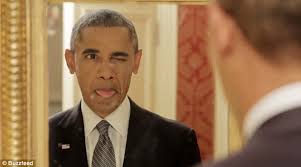 “What gives in the White House? If the genie is out the bottle what made, of all world leaders the most powerful, let it out? Who, or what, is the mischief maker behind the nuclear talks? What spirit runs amok in the corridors of power? The freak alignments lately fashioned point to some fiend on a depraved mission. American bombers now support Iranian troops to keep a chemical-weapon-dropping Syrian madman in power. Saudis and Israelis co-operate to stymie an American-made pact. An emissary from the White House supposedly told the Argentine government not to pursue Iranian murderers of eighty-odd Jews in Buenos Aries. Obama gives tacit blessing to the sale of a Russian ground-to-air missile system to Iran, which will make it more difficult for Israel to flatten those nuclear sites. A US President who sets all this, and more, in motion would have to be possessed.”
Read the rest of Steve Apfel’s inspired op-ed here.
Hat tip: Steve Glassman
Turnaround, or fair play?
 Last week, John Roberts reported for jury duty, not as Chief Justice of the Supreme Court, but as John Q. Public at Maryland’s Montgomery County courthouse. He wasn’t selected in the end, but he came within measurable distance of serving as an ordinary juror on a case that would determine damages in an automobile accident.
Does this reflect what’s best in America, that no one is exempt from performing his civic duty? Or is it symptomatic of the most absurd form of political correctness, which demands equivalence in all arenas and all situations, no matter how un-equivalent they may be?
So what do you think: would it have been worth shutting down the highest court in the land so that our top jurist could sit in the place of an average citizen? Leave a comment with your take on the question.
How Ants Survive Rush Hour…
… and why putting your ego in check will change your life
 It’s everyone’s nightmare. Rush hour. Inching along interminably as too many cars navigate too few lanes, with too many merging in and too few turning off.
Who would have imagined that King Solomon already anticipated the chaos of our highways when he declared, Go, sluggard, and learn from the ant?
As it turns out, ants are better drivers than we are. And the lessons of their highway habits offer some valuable lessons that extend far beyond the way we drive.
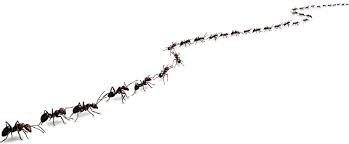
According to NPR, Apoorva Nagar discovered the connection in a study by German and Indian researchers. Apparently, traveling ants are able to maintain a constant speed regardless of the number of ants on the path. In other words, even at rush hour, ant traffic carries on unimpeded.
Sanity vs. Compassion — how to choose?
 Would you accept an invitation to the Mind and Life Institute’s International Symposium for Contemplative Studies? Or does it all sound too flaky?
It’s hard not to sound pretentious when trying to be substantive in a superficial world. I might easily have dismissed the headline — Creating a Caring Society — as so much new-age twaddle… but if I had I’d have been guilty of the same superficiality that I frequently decry.
Citing Tania Singer, a social neuroscientist from The Max Planck Institute, the article offers an intriguing distinction between empathy and compassion. The first is a mere sharing of feelings; the second is an impulse to turn feelings into action. Sure, empathy is a good start. But feeling another’s pain doesn’t help feed the poor, shelter the homeless, enlighten the ignorant, or comfort the bereaved.
In fact, failure to take action may actually cause distress and suffering to the empathizer, who feels frustrated and inadequate for having provided no relief to the one in need.
The more pervasive problem, however, is our increased detachment from the plight of others so that we don’t feel at all. No surprise there… if we responded as we should to every news story of poverty, illness, and violence, we’d all be on a perpetual Valium drip. So instead we plug into our electronic kaleidoscopes and tune out the real world.
We can only preserve our sanity by deadening ourselves to the flood of human suffering that washes over us day and night. But to ignore the call of compassion leaves us less than human.
As with so many things, the answer lies somewhere in the middle. Feel pain, but not too much pain. Respond to the pain of others with concrete action. No, it’s not easy. But it’s the only avenue we have for restoring an emotionally and morally healthy society.
Bad Hair Day at CSI
 Since 2012, the FBI has been reviewing some 2600 convictions from the ’80s and ’90s that depended on hair analysis. With 268 cases reviewed so far, more than 95% have been called into question, according to NewScientist.
This doesn’t mean that science is unreliable. Rather, it reinforces the well-known computer adage of GIGO — garbage in, garbage out. In other words, technology is only as good as the people using it.
So when it comes to understanding the origins of the universe, the evolution of man, the nature of human psychology, or the changing climate patterns of our planet, perhaps a bit more humility is in order before we jump to conclusions that new discoveries might force us to reverse tomorrow or the next day.
Our world is a complicated place. Instead of insisting that we have everything figured out, let’s watch the sun rise and listen to the rain fall while we enjoy the mystery of it all.
The New Polarization
 A college student who rarely attended classes and turned in assignments poorly done or not at all, emailed his professor after receiving his final grade to ask if there was any way he could raise his grade — an F earned with a 25% average — to a C. Even grade inflation couldn’t help this hapless soul.
But hope springs eternal, and wishful thinking has become so pervasive that it has a new name: magical thinking, as if wishing just isn’t enough anymore.
It’s everywhere. Government programs with no revenue to pay for them. Students acquiring massive debt from loans to procure degrees in art history, classical philosophy or — no joke — viking studies. State sponsored alternative energy schemes built on nothing but high-minded intentions. School boards hiring puppet administrators and then firing them when student performance crashes.
On the one hand, we indulge in the most irrational flights of fancy with no concern for the consequences. On the other, we resist thinking out of the box by denying ourselves the opportunity to engage people with opposing viewpoints in civil discourse.
Is this the new face of polarization? Not just between groups, but within our own minds?
Instead, let’s turn it around: challenge yourself to seek out new viewpoints and strategies, not to escape from reality but to deal with it and succeed.
Just Plain Ugly
 Here’s another lovely headline:
Top 15 Celebrities who are Just Plain Ugly
And no, I’m not including the link.
Why would anyone write an article like this? Why would anyone read it?
Sadly, the answers are obvious. Someone wrote it because he knew people would read it. And people read it either out of pure voyeurism or, even worse, because they need to tear down others to feel good about themselves.
Maybe we should revisit some old cliches:
- Don’t judge a book by its cover
- Beauty is only skin deep
- All that glitters is not gold
Sure, they’re cliches. But remember: cliches become cliches because people recognize their truth enough to repeat them over and over and over.
When we make the effort to see the best in others, that makes our world brighter. With practice, recognizing what’s good in others can motivate us to be like them, which will make us feel better about ourselves.
After all, the grass isn’t really greener on the other side of the fence.
Holocaust Day — Visionaries and Ideology
 Who knew a trip to New York could be so emotional?
I didn’t want to go in the first place. As my 92-year-old student likes to quote: Travelling is for peasants.
But my wife convinced me with simple arithmetic. Four tickets to bring three kids and son-in-law home or two tickets to visit them. No-brainer.
So I went grudgingly, confirming in the end the truism that some of life’s most profound moments come not only unexpected but against our will.
Our first stop was the 9/11 museum. I marveled at the artistic vision that had conceived the memorial pools, the water channeling down in rivulets that mirrored the face of the fallen towers, the continuous downward rush balanced by the redemptive feeling of water — the source of life — returning to the heart of the world. Here there was solace, closure, and consolation.
But a very different feeling accosted me inside. Almost upon entering the doors a single word brandished itself across my mind’s eye: Holocaust.
Let me explain.
Read the whole article here.
 Yonason Goldson