Home » Culture (Page 3)
Category Archives: Culture

My Son, the Lone Soldier
 Parents worry about children. It’s what we do.
When they’re infants, we worry about every sniffle and cough. When they’re in grade school, we worry about bumps and bruises. When they enter adolescence, we worry about their hormones and teenage angst. As they become young adults, we worry about them finding their way in life.
So I understand it when people ask if I’m worried about my son in the Israeli army. But many of them don’t understand my answer.
All in all, I think he’s safer than he’s ever been.
It wasn’t part of the plan. After college, with a good job waiting for him in New York, he went to Israel for a few months of spiritual R & R in the Jewish homeland. But almost from the moment he arrived, he knew that he wanted to stay. And if he was going to live as an Israeli, he wanted to do his part to defend his country and his fellow Jews.
With barely a second thought, he became a Lone Soldier.
He found the unit he wanted – the Gadsar Reconnaissance Division of the Nahal Brigade. He was attracted by the division’s reputation for quiet determination, and he eagerly awaited the challenge of proving himself fit for an elite combat unit.
His first goal was to complete the gibush – a 3 ½ day selection trial of relentless physical rigor. Of the 15 prospective soldiers in his group, four dropped out after three hours. The rest made it all the way to the end. And in the end, he made the cut.
My son was five years older than most of the other guys – a huge difference at that age – and had to obey and respect commanders much younger than himself. But he also found that his age elicited among his peers an expectation of maturity. With that perception came a sense of responsibility to live up to what others expected.
The 14-month training proved always demanding, frequently tedious, sometimes painful and – on occasion – seemingly pointless. But he soon recognized the advantages of discipline and learned to trust the wisdom of his commanders. As his taskmasters drove him to do things he would never have done on his own and develop skills he never imagined he would want or need, he began to discover his own extraordinary potential.
He mastered weaponry, marksmanship, navigation, camouflage, demolition, and hand-to-hand combat. Above all, he acquired the self-confidence that comes from having been trained and tested – and, with it, the mindset for success in every aspect of life.
He came to value the camaraderie that comes from a shared sense of purpose. His world view grew broader and deeper. He learned to sympathize with the plight of the Palestinian people and to simultaneously loathe the corruption of Palestinian leaders who exploit their own people by perpetuating a culture of terror for political advantage.
As a Lone Soldier, having left his own parents and siblings halfway around the world, he found himself in a strange twilight zone of independence without isolation. He enjoyed the warm affection of an Israeli family that adopted him as a son, and the security of knowing that his superiors were always looking out for his welfare. And from the comments of his fellows, he gained new insights about himself:
“You chose to come over and do this – that’s absolutely crazy.”
“What is it with you? You act like you enjoy being here.”
“Dude, you have really good table manners.”
In a world of distracted, spoiled, and self-absorbed adult-children who don’t know who they are and don’t care where they’re going, my son has been trained to look for opportunities, respond to the unexpected, and navigate his way through any challenges and around any obstacles that life may throw at him.
 More important, he has cultivated a sense of personal and national identity, an awareness that he is not just an individual but part of something far greater than himself – which makes him greater than anything he could become on his own. He has learned to take responsibility for himself and has developed a desire to engage the future rather than merely wait for it to arrive. He wants to make the world a better place, and he understands that the best way to do that is by making himself a better person.
In many ways I envy him and his comrades the opportunity they have, and it saddens me that more young people don’t choose to similarly challenge themselves. Most of us don’t begin life well-prepared for life, irrespective of our schooling or our vocational training. We squander so much thought and effort trying to figure things out on the fly, trying to play catch-up as we struggle with our careers and in our relationships.
We are all soldiers in the army of Mankind, all warriors on the battlefield of life. I’m grateful that my son has what so few of us have – the training and experience to meet those battles, to step forward into life with skill and self-assurance. And I’m proud that he has discovered that true joy comes from commitment to a higher purpose and higher values.
So to those who wonder why I’m not more worried about my son, all I can say is this: what on earth do I have to worry about?


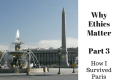
Why Ethics Matter, Part 3: How I Survived Paris
You learn a lot when you travel. And the lessons you learn may include valuable tips on self-preservation.
My experience on the famous Champs-Elysee offers an entertaining look at our we can discover life-lessons in the most unlikely places.
Click here to enjoy another 2-minute video. Share your own account of some unexpected lesson learned in the comments section.


The One Best Way to Win
 Hindsight is 20/20, and Monday morning quarterbacks are never wrong. But back when democrats and republicans agreed that Hillary Clinton’s election was a foregone conclusion, the few voices predicting Trumpian triumph were drowned out in a chorus of Clintonian inevitability.
Of course everything looked different on the first Wednesday in November, and it came as no surprise that as soon as the shock wore off pundits began reverse engineering the former first lady’s defeat .
It’s a bit embarrassing how, a year after the election, Mrs. Clinton is still casting about to blame others for her cataclysmic upset. Perhaps she should read, “Shattered,” in which Jonathan Allen and Amie Parnes attribute Mrs. Clinton’s undoing primarily on what was obvious to everyone from beginning to end —

Stop Squabbling, Start Succeeding
 In 1932, President Herbert Hoover appointed Benjamin Cardozo to the Supreme Court. The president was a conservative Republican. Justice Cardozo was seen as a liberal Democrat — but he was also recognized as the greatest legal mind in the country.
President Hoover certainly would have preferred a conservative, but he knew the country wouldn’t stand for him to choose a supreme court nominee based on politics. He nominated Benjamin Cardozo, who was approved by the Senate — unanimously .
As recently as 1986, the Senate confirmed Antonin Scalia without a single opposing vote, and in 1993 Ruth Bader Ginsburg sailed through confirmation with only 3 dissensions. It wasn’t so long ago that our politicians’ top priority was to keep the system working.
But times have changed.


Why Ethics Matter: Part 2 — Peruvian Beauties
Beauty contests aren’t PC anymore, but this year’s Miss Peru pageant was truly a thing of beauty.
Instead of headlines filled with accusations of sex scandals and kneejerk denials, as well as unfocused protests turning violent, contest contestants in Peru found a way to elevate an exercise in objectification into a show of civic responsibility, ethical accountability, and social conscience.
What does it say when beauty queens have more moral authority than politicians? Their initiative and resolution should be an inspiration to all of us.
Click to watch my 2-minute video. And please subscribe to my channel by clicking here. Thanks!

The Aftermath of Abuse
 Feeding frenzy might be the best caption for our scandal-ridden headlines. Paradoxically, the designation fasting frenzy would be equally suitable.
Let me explain.
In recent weeks and months, reports of sexual misconduct have propagated faster than entries on a nine-year-old’s birthday wish list. Roger Ailes, Bill O’Reilly, Steven Seagal and, of course, Harvey Weinstein are just a few of the 33 alleged predators listed in a recent L.A. Times article. Since then, accusations have been leveled Roy Moore, Richard Dreyfuss, George Takei, and Louis CK.
Perhaps the brightest silver lining is the extraordinary speed with which Kevin Spacey succeeded in destroying his own career. It’s reassuring to know that there are still forms of behavior sufficiently deviant to evoke universal condemnation.
In most cases, the alleged perpetrators have either fired back with furious rebuttals or dissembled with transparent evasions. Sadly but unsurprisingly, they remain unrepentant despite multitudinous plaintiffs or even their own court settlements.
Given the venal culture of both Washington and Hollywood, many of us are eager to believe every indictment and highly skeptical of the denials. But not all of us.
THE DARKER SIDE OF THE DARK SIDE
What effect do these scandals have on our culture? As with so many things, there’s good and there’s bad. The real question is: which outweighs the other?

On the positive side, when predators see that society will expose them and hold them accountable for their actions, the safer all potential victims become. On the other hand, the more such incidents are reported, the more degenerate behavior appears to become the norm. The result, perversely, could be to destigmatize and even enable similar behavior.
Then there is the sheer number of accusers. With so many plaintiffs, it’s hard not to wonder if some might be opportunists, simply piling on to genuine claims in hope of cashing in on the misfortunes of others. The frequency of such claims also increases the likelihood of defamation becoming a popular form of harassment itself, with baseless accusation converted into a weapon for character assassination.
Moreover, there’s the problem of exaggeration, of innocuous episodes unreasonably magnified. To wit, when former President George H. W. Bush – 93 years old and no longer fully in command of his faculties – pats a woman on her backside, this does not rise to level of abuses currently dominating the news cycles. We do real victims a disservice when lurid headlines paint every indiscretion with the same brush.
LESS THAN CHARMING
Depravity is bad enough. But the preponderance of charges, the kneejerk denials, and the moral equivalence of the petty and the abhorrent – these form a caustic trifecta of venality that sows cynicism all across the social landscape. With tragic irony, we can become so disgusted that we no longer care.
King Solomon says, If the snake bites because it was not charmed, there is no benefit to the charmer’s art.
How easily we convince ourselves that whatever we want is ours for the taking, that with craft and persuasion we can win anything we desire with no concern for risks and consequences. And when we overreach and fall victim to our own devices, the venomous destruction we let loose not only endangers us but all around us as well. In our arrogance we free the viper from its pit, and no one knows where it will strike.
Most of us will never come close to committing acts as horrific as those that fill the headlines. But without positive action, the persistence of such stories can erode our own commitment to ethics and set our own moral compass spinning in all directions.
 So how do we protect ourselves? First, by taking responsibility for even the smallest of our own actions. Second, by refusing to excuse the misdeeds of others – regardless of station or alliance – and, simultaneously, refusing to accept unsubstantiated accusations until all the evidence is in.
To see that all people are treated with the respect they deserve, to always rise to the defense of the defenseless, to hold ourselves and all others to a higher standard of personal conduct – this is the formula for a healthy, respectful, and civil society.
Published in Jewish World Review

Flying in the Dark
 In 1954, Jim Lovell, who would later lead the Apollo 13 space mission, was flying his Banshee night fighter when his plane experienced a total electrical failure.
There he was, the middle of the ocean in the middle of the night, with no instrumentation and no way to find his ship. But as he looked out into the darkness, he noticed a glimmer of photo luminescent algae that had been stirred up in the wake of his aircraft carrier. He followed the trail back to his ship and landed safely.
If the lights hadn’t gone out, he never would have found his way home.
It’s fascinating to consider how our eyes are designed.


 Yonason Goldson