Home » Personal Development (Page 9)

Category Archives: Personal Development

The Perils of Social Grade Inflation

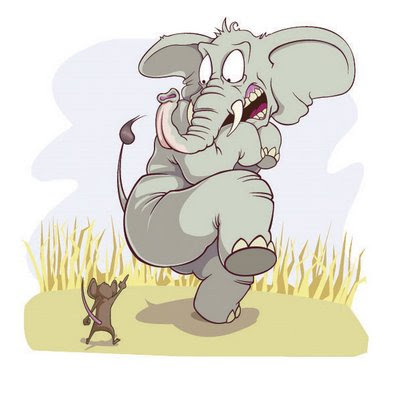
Elephant n MouseHere’s a no-brainer.

You want to improve your basketball game. Would you rather practice one-on-one with your older brother, who’s on the JV team, or with Kobe Bryant?

Unless you possess a serious streak of masochism, you did not choose Kobe Bryant — for reasons that should be obvious: while you will definitely improve playing with someone marginally better than yourself, you will accomplish nothing by playing with someone exponentially better than you are. Except, in all likelihood, the rapid deflation of your self-esteem.

Applying this principle more broadly, it’s easy to see how associating with peers slightly better than ourselves — whether academically, professionally, or morally — will push us to higher levels in our own conduct and performance. But the benefits of implied social pressure disappear when we perceive our peer group to be functioning on a higher level than it actually is.

Read the whole article here.

Before the Flood

apresmoi“Things will last my time,” said the Marquise de Pompadour, “But after me, le deluge.”

More prophetic words were never spoken. The mistress of Louis XV foresaw clearly the collapse of the French monarchy and the flood of violence and chaos that would engulf the next generation. But that was the future’s problem. Why should she care?

In some ways, her brutal disregard for future suffering is more palatable than the utopian fantasies and rhetorical flourishes of modern leaders. At least the Marquise knew what lay ahead, and at least she didn’t pretend that she had an easy fix to prevent the future from arriving on tomorrow’s doorstep.

But today we face an impending crisis no less ominous. Our expectations for national leadership have sunk so low that we are willing to overlook pathological, craven, and unapologetic dishonesty from one presidential candidate and volcanic, adolescent recklessness from the other. One can scour the nation’s capital without turning up even a smidgen of character and statesmanship, evidence of a political culture rife with cronyism, gridlock, and groupthink.

Click here to read the whole article.

In Memorium

Yesterday, we held a memorial service for Rita Cholet White, one of Block Yeshiva High School’s most beloved teachers for over 20 years.  After hearing the many stories and reflections, it’s hard to know whether she loved more or was loved more by her students.  Perhaps the question contains its own answer.  She was 85 years old.

Several years ago, when Madame White was honored by the school, I was asked to write her  bio for the Scholarship Gala journal.

I present the text here as it appeared.  She loved it then.  I have no doubt that she will love it now.

Rita Cholet White has been involved in primary, secondary, and higher education for over half a century (an extraordinary achievement, especially for a woman who is only 49 years old).  A Fulbright scholar, Madame White has appeared in Who’s Who in Education, Who’s Who in American Women, and Who’s Who International.  Presumably, one of these organizations will eventually discover who Madame White truly is.

A stalwart member of Block Yeshiva’s distinguished faculty since 1992, Madame White demonstrates her pedagogical dexterity by wearing many hats – as French teacher, English teacher, college adviser, and yearbook adviser.  Fortunately, the French like to wear hats.

More than just a faculty member, Madame White adds flare and panache to the halls of Block Yeshiva, dazzling students and staff alike with her sense of style and fashion, her stratified vocabulary in several languages, her pluck, her wit, her irrepressible good humor, and her remembrances of the McKinley administration.

Additional distinctions include a degree from the Sorbonne and the University of Nice, the HEW Certificate of Merit, the University of Richmond Certificate of Recognition as an outstanding teacher, and numerous honors that are beyond the capacity of our computer’s spell-check software.

Persistent rumors that Madame White posed as a model for the Mona Lisa and has BASE jumped from the Eiffel Tower remain unconfirmed.

Adieu, Madame.  We will miss you with all our hearts.

Spiritual Impressionism

?

?

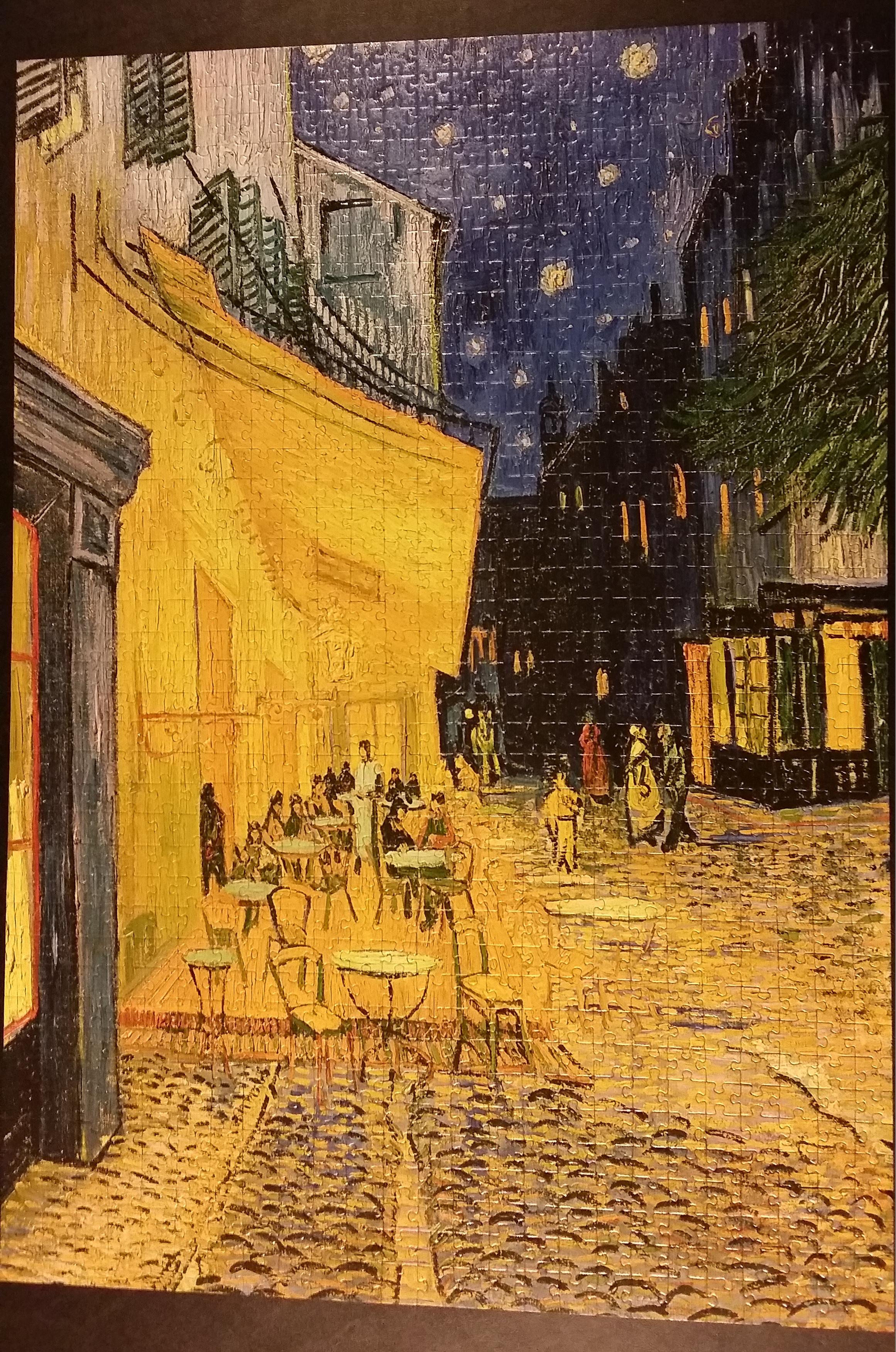
My wife and I finished this 1000 piece jigsaw of Vincent Van Gogh’s “Cafe Terrace at Night,” providing an excuse to revisit this essay from 2011.

210 years as slaves in Egypt. 40 years wandering in the desert. 70 years of suffering in Babylon. 1,931 years scattered to the far ends of the earth… and counting.

Exile has defined most of the history of Jewish people, always as a response to our failure to value our relationship with the Almighty. When we turn our backs on Him (or on one another), He responds by allowing us to experience the consequences of separation through the loneliness of exile.

How remarkable, then, that at times extraordinarily pious have undertaken journeys of self-imposed exile, wandering anonymously from place to place, begging for bread and lodging, concealing their true character and brilliance, and never knowing what awaited them around the next corner. There was nothing remotely romantic about these adventures. They were intended to inure budding Torah leaders against attachment to material comforts, and also to teach them humility as a safeguard against the reverence and adulation showered upon the learned. During the days of the Chassidic masters of the 18th and 19th centuries, stories of the tribulations of exile abounded.

I knew nothing of this when I embarked upon the most foolhardy undertaking of my life and set off to hitchhike across the United States after I finished college. What I did know was that my existence had become too comfortable and too easy. I had never had to overcome serious obstacles or grapple with substantial challenges. I had spent five years acquiring a degree that prepared me for nothing, and I lacked even the faintest outline of a plan for the future.

As I had approached the culmination of my college career, I found myself disconcerted — not because I had no idea what I would do next, but because my lack of prospects didn’t seem to bother me at all. I had been carried by the current along the River of Least Resistance, without ever learning to navigate or deciding upon a destination. Now the river was about to empty into the Sea of Countless Possibilities, and my boat was not seaworthy.

hitchhiker_thinkstock630_1a3p7rp-1a3p7snSo I slung a pack over my back and hit the road. I didn’t think of it as exile, but as escape. Escape from too much comfort and too much security; escape from too little responsibility and too little accountability. And as much as I tried to make it sound romantic, all such illusions were swept away my first night on the road clambering out into the cold to stake out my tent as it buckled before the November wind that swept out of a still evening sky.

I wasn’t Jack Kerouac — indeed, I was already old enough to see through Kerouac, whose revelations had lost their drama by the early eighties and who, when he ran out of money the first time out, caught a bus back home to his mother.

I wasn’t Christopher McCandless, who walked away from his prospects and possessions to go off into the wild. After all, I had $500 in traveler’s checks, carried two credit cards, and I was never far from a phone in case of emergency. On the other hand, I didn’t die of exposure after eating poison berries.

And I certainly wasn’t Rabbi Zusia of Annipoli, whose secret acts of piety in the face of astonishing adversity have become legend.

But I did learn to look at myself and at the world around me through different eyes. And one of the most powerful lessons came, albeit inadvertently, from a most unlikely teacher.

I met Steve at a youth hostel in Santa Fe, New Mexico, from where he agreed to drive me as far as Fort Worth, Texas. I remember the blue desert sky and dazzling sun that morning, and I remember going out in shirt sleeves as I would have in California, only to be driven back inside by an air temperature ten degrees below freezing. I was already starting to learn.

Steve was in no hurry. He was taking the two weeks before starting a new job to see the country, but he was on a budget and insisted upon driving 50 miles per hour to save on gas. Having begged my ride I was in no position to argue. I certainly wasn’t in a hurry myself, except to keep pace with the advancing cold front as I headed south.

Nevertheless, I gritted my teeth in frustration as we crawled along the highway. Cars, trucks, and trailers sped past us, each a blur of motion, as did birds and tumbleweeds — or so I imagined. But it was going to be a long trip, and as I forced myself to make peace with the inevitable, I began to notice something completely unexpected:

Detail.

oil-paintings-art-gallery-paintings-by-claude-monet-1840-1926-1345044100_bBy slowing down a mere fifteen miles per hour, the world beyond the roadside changed from a blur into a sharply defined landscape; trees and shrubs transformed from shapeless, green masses into a nuanced tapestries of leaves reflecting sunlight in infinite combinations as they rippled softly in the breeze; every lonely farmhouse acquired a unique character, whether from weathered paint or strewn tractor parts or kitschy statuary or slung hammocks and yard swings. Even the gray asphalt of the highway and the painted white lines took on texture and depth.

Stripped completely of any control over our rate of progress, I relaxed enough to recognize the view beyond my window not as a continuously rolling panorama but as a carefully fashioned composition of myriad parts and variegated pieces. Like an impressionist masterpiece, the apparent randomness of details up close belied the order of design revealed by distance, and the holism achieved at a distance belied the attention to detail that only became recognizable up close.

The wise man’s eyes are in his head, says King Solomon. Well, where else would they be? As the wisest of all men, Solomon never wasted time stating the obvious. Rather, he was commenting on the Creator’s placement of the eyes, upon which we rely most for sensory input, adjacent to the brain, which enables us to process and interpret the information we acquire.

A wise may does not merely look, nor does he merely see. He perceives. And he understands that perception requires looking at the world in many different ways, from different directions, and in different environments. As the great impressionists demonstrated through an innovative style that was originally derided by traditionalists, the appearance of any object or phenomenon can change dramatically depending on how we view them. Things do not look the same at morning as they do in the afternoon, or in the afternoon as they do at evening. Light, shadow, angle, context — these are the elements that create perspective, which is the key to genuine understanding.

It might seem logical to race through the exile of this world in order to more quickly escape its travails and come out on the other side. But only by paying attention to where we are can we chart a course toward where we need to go. As we race through our lives, too busy to notice the subtleties that make our world a place of limitless fascination, too preoccupied to take revel in the development of our own children and the maturing of our own relationships, too distracted by the blur of ephemeral attractions to contemplate the eternal complexion of our souls, we cheat ourselves of the opportunity to learn the lessons of exile. And it is only by learning those lessons that we can truly shorten the road that leads us home.

Originally published by Jewish World Review.

The Search for Nothing

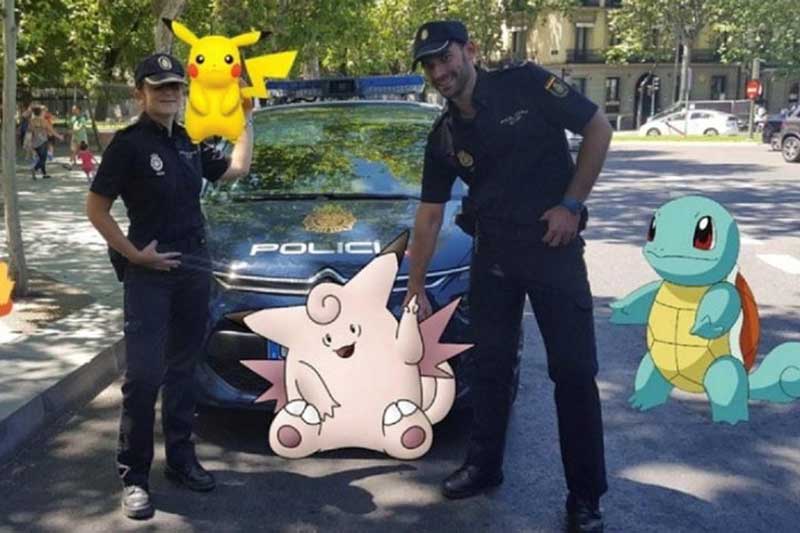
pokemon-reutersOf course, you know all about it. It has overshadowed all other headline news. It has become everyone’s passion. There’s no escaping it.

No, I’m not talking about the presidential elections, climate change, or global terror. I’m talking about something really important:

Pokemon Go.

If you haven’t heard of it, you probably live in a cave and won’t be reading this anyway. If you don’t understand what it is… well, that’s a different story.

For people of a certain age — not to mention a certain level of maturity and common sense — the latest tech-fad is barely comprehensible. Countless denizens of the virtual world have crawled out of the darkness and into the sunlight to search for animated characters that can only be seen on their cell phone screens in undisclosed locations. By wandering about pointing their phones hither and thither, players find cartoon critters, then take aim and “shoot” to catch their pixilated prey.

As inane as it may sound, the game seems relatively harmless. It also has the benefit of drawing participants off their couches and encouraging them to put their atrophying appendages back into use, sometimes by walking miles in pursuit of quarry. Guided by an all-knowing, all-seeing cosmic GPS mastermind, Pokemon creatures may crop up anywhere, leading players on quests of “augmented reality.”

But is it really harmless?

Read the whole article here.

The Humpty Dumpty Deception

hump“When I use a word,” Humpty Dumpty said, in rather a scornful tone, “it means just what I choose it to mean — neither more nor less.”

This would appear to be a powerful statement of personal empowerment and forward-thinking vision.  In fact, it is precisely the opposite.

The truth is this:  if we don’t master our language, we can’t be masters of ourselves.  Because we think in words, sloppy speaking will inevitably produce sloppy thinking.  And if we aren’t thinking clearly, then we don’t know who we are, what we believe in, or what we stand for.

Clichés, sound-bites, political correctness — these are all our enemies.  The reflexive recitation of words bereft of authentic meaning constitutes much of talk radio, and it may offer a convenient refuge from having to defend our opinions with hard facts and sound reasoning.  But we don’t open up lines of communication and cooperation by hiding from clarity and logic.

Verbal interchanges have become so glib, so vapid, and so superficial, that anything short of a complete overhaul of our language will not do.  But some popular expressions are worse than others, and here is my short list of the worst offenders, phrases that should be punishable by law.

Click here to read the whole article.

Which Road Not Taken?

tel Dan 3jpg

Tel Dan Nature Preserve in northern Israel

I recently read an account of a girls’ high school graduation ceremony. The writer described the collective sigh of resignation that whispered through the assembled relatives and friends as one of the graduate-speakers began by reciting Robert Frost’s classic poem, “The Road Not Taken.” The captive audience seemed to anticipate a predictable excursion along the overly well-trodden road of invoking Frost’s verse as a paean to individuality and non-conformism.

Instead, the writer was pleasantly surprised. Departing from the expected formula, the young speaker argued with Frost’s message by defending those with the courage to walk the well-traveled road of tradition in the face of social pressure to reject establishment and convention. It is indeed refreshing to hear the voice of youth, albeit second hand, recognizing the fallacy of a new conformism that preaches non-conformity — or, even worse, anti-conformity.

However, in my days as a student of literature at the University of California, I learned that Robert Frost is among the most famously misunderstood of poets. The attentive reader discovers that it was never Frost’s style to merely paint landscapes out of words or to render such trite messages as “favor the road less-traveled.” Frost had a sharp, unforgiving eye that focused not on the beauties of nature but upon man’s frequent failure to recognize his own place in the natural world.

And so “The Road Not Taken,” like so many of Frost’s poems, ripples with subtle but troubling inconsistencies. Frost asserts that he chose the road

having perhaps the better claim Because it was grassy and wanted wear.

However, he immediately contradicts himself by declaring,

Though as for that the passing there Had worn them really about the same.

So which is it? Were the roads the same or were they different? And if they were the same, then what did it matter which one he chose?

Frost offers his first clue in his first line:

Two roads diverged in a yellow wood…

tel Dan 4jpgWhy did the wood have to be yellow? Since we generally visualize forests as green, would we not expect the wood to be described as emerald, or verdant, or leafy? Why did Frost choose to depict his forest as yellow, the color of the first turning of the leaves with the onset of autumn?

Since Frost is clearly describing not a ramble through the woods but a journey through life, the autumnal image of the yellow wood suggests the last years of middle age, the time when one is set in his ways and resistant to — but not yet incapable of — change. It may be a time when one begins to reflect upon opportunities missed, upon chances not taken, upon the caution that urges the traveler to consider the roads ahead and look

down one as far as I could To where it bent in the undergrowth.

As his choices and options diminish with the anticipated approach of his twilight years, it is here that the traveler through life hopes to catch sight of his final destination before committing himself irrevocably to one path or the other.

Taken thus, the yellow wood represents not the habit of age but the habit of human nature. We favor the familiar, the easy, the undemanding. We resist the unknown, the untried, the untested. When facing decision, human nature prods us along the path of least resistance, the path that poses the least danger, the least challenge and, consequently, the least opportunity for personal growth.

rock path

The two roads diverging in Frost’s yellow wood lay equally trodden in absolute terms. But for the narrator, the inclination born of habit predisposed him in one direction, where a different traveler inclined by his own forces of habit might find himself predisposed to take the other path.

And so Frost does not ponder the choice between roads more or less traveled by others, but contemplates which kind of road he has traveled more or less himself. To challenge ourselves with the unfamiliar, to force ourselves to overcome new obstacles, to seek out opportunities to discover new resources of talent, ability, and creativity — these are the pathways that, “somewhere ages and ages hence” will be what “has made all the difference.”

Who is mighty? asks the Talmud. The one who conquers his inclination. Traditionally, we apply this statement to the battle against the desire for physical gratification and amoral self-interest. But perhaps it applies equally well to the inclination of habit and routine. When we fear the unfamiliar, when we refuse to look down new roads for no reason other than because we have never traveled them before, we rob ourselves of the chance to discover the limitless potential with which the Creator has endowed every one of us.

Originally published in 2008 by Aish.com.

Near-death experience

1You’re ten years old and a sound sleeper, so it’s already unusual that something has woken you up in the middle of the night.  You go out into the hall to investigate.  There are strangers in the house and flashing lights out the window.  Your father tells you to go back to bed.

When you wake up the next morning, your mother has disappeared from your life.

It’s 1970, before school counselors or lettered conditions like PTSD.  Your father means well, but he’s not the communicative type, not one for expressing his feelings to others or eliciting others to share their feelings with him.  He’s from the Depression Era, and he barely saw his own father growing up during those desperate years.  He’s a veteran of the Second World War; difficulties are part of life.

He’s also dealing with his own trauma, as his wife lingers between life and death.

You get shipped off to stay with friends, or with your grandmother.  Very little is explained to you, and you understand even less.  Years later, there won’t be much that you remember, aside from the indelible images of that first night.

You won’t remember waking up the next morning to find your grandmother home with you instead of you parents.  You won’t remember when they took you to visit your mother one last time because no one thought she had much time left.  You won’t remember shouting at her for having abandoned you.  You won’t remember the outgoing, cheerful little boy you were before that cold, winter’s night.

You only remember how hard it was for you to talk to people from that moment forward.  You remember how easily you cried during the years that followed, and how much you hated yourself for crying so easily without understanding what made you that way.  You remember how you considered taking your own life, but always managed to convince yourself that you could do it tomorrow.

A decade passes before you really recover.  In some ways, you never recover at all.

Click here to read the whole essay.

The House

nad0-018“You’ll leave here after four years with an education few people have had access to in the history of mankind.  What are you planning to do with it?”

It was a good question, set forth by consumer advocate Ralph Nader as he spoke before an embarrassingly empty hall at our conservative university.  I was pretty conservative myself, and certainly no fan of the wildly liberal public avenger.  But I had found the opportunity to hear such an iconic figure irresistible, even if most of my fellow students felt otherwise.

“There’s a world out there filled with problems and suffering and injustice,” Mr. Nader continued.   “There’s a desperate need for crusaders, and you just want to get a job?”

The derision Mr. Nader injected into those last three words reverberated inside the echo chamber of my mind, etching upon my psyche an unequivocal contempt toward employment for the sake of mere employment.

It was 1981, during my junior year at the University of California, Davis, and I still had no idea what I wanted to do when I grew up.  But during those closing moments of his address, Mr. Nader awakened within me the passionate desire to do something – anything – as long as it might make a difference, as long as it would truly matter.

And so I left the lecture hall that evening feeling like Archimedes, looking for my fulcrum to move the world.  And my search led me to The House.

The HouseNo other name could have better described it:  here was an actual house – still thriving in the shadow of university office-buildings, lecture halls, and dormitories – with its modest front porch, unaffected wooden shingles, and single-pane windows opaque with dust around the corners.  Its official designation was Temporary Building-16.  But to everyone who worked there, and to anyone who patronized its services, TB-16 was simply called The House.

Fifteen or twenty years earlier, the thought had occurred to someone at Student Services to create an informal atmosphere where students could commiserate about the problems and stresses of college without having to endure the formality of an adviser, the social pressure of a dormitory, or the stigma of a psychologist.  In the course of its various incarnations, the project acquired a director, instituted a thorough course of preparatory and continuous training, and acquired TB-16.  The House opened its doors.

Karen was the House director, a position she had taken over from her husband, Kennebec.  His name was really Ken, but he had fallen in love with the Kennebec River and used its name as his own – at least in the company of friends and close acquaintances.  Student Services had brought him in to assume the directorship “after The House’s last nude retreat,” in hope of imposing greater structure upon the fledgling peer counseling facility.

Not that Ken was all that conventional himself.  His hobby was jumping freight trains, and he hadn’t thought it at all inappropriate to use this informal style of transportation for his own staff retreats.  I nagged Ken every time I saw him to take me train-jumping, but he was settling into the routine of responsible middle age, and never found time to take a weekend off to travel as undeclared baggage.

So Ken, it’s your fault that I later became a hitchhiker and not a hobo.

Click here to read the whole essay.

Congratulations, Dr. Schreiber

Avigayil Graduation

After graduates from MIT and the University of California, lawyers, businessmen, teachers, a concert violinist, and a rabbi, we have our first doctor in the family.

May you hear nothing but the sounds of success and happiness.

So proud!