Home » Philosophy (Page 7)

Category Archives: Philosophy

Louisiana and the Waters of Life and Death

As residents across Louisiana struggle against catastrophic flooding, we should all take a few moments to contemplate how quickly nature can become our greatest adversary.  Water is both the source of all life and the greatest destructive force on earth.  I ponder the paradox in these reflections from after the Pacific Rim tsunami of 2005.

maxresdefaultVolcanoes. Hurricanes. Earthquakes. Fires. Tornadoes. Blizzards. Drought.

In a time when reports of terrorism have become all too common, it is sobering to consider the myriad ways nature possesses to inflict death and violence on a scale surpassing the most destructive instruments devised by man. Of all these, however, destruction by water, whether from the sea or from the sky, holds a unique terror in the scope and measure of its devastation.

Aside from the 150,000 lives already reported lost across nearly a dozen countries along the Indian Ocean, dehydration, disease and hunger threaten as many as 5 million more in the wake of the recent tsunami. And rare though tidal waves may be, the more familiar trial-by-water of floods has, with much greater frequency, left similar numbers homeless and in danger of starvation.

It seems ironic that water, the source and foundation of all life upon our planet, can become nature’s most malevolent instrument against the beings whose lives depend upon it.

Devastation by water occupies a prominent place in human history. Virtually every ancient culture records the tradition of a great flood that inundated the world, lending credence to the biblical account of Noah and the ark. Jewish tradition describes this not as a random event, but as a divine response to the corruption of mankind.

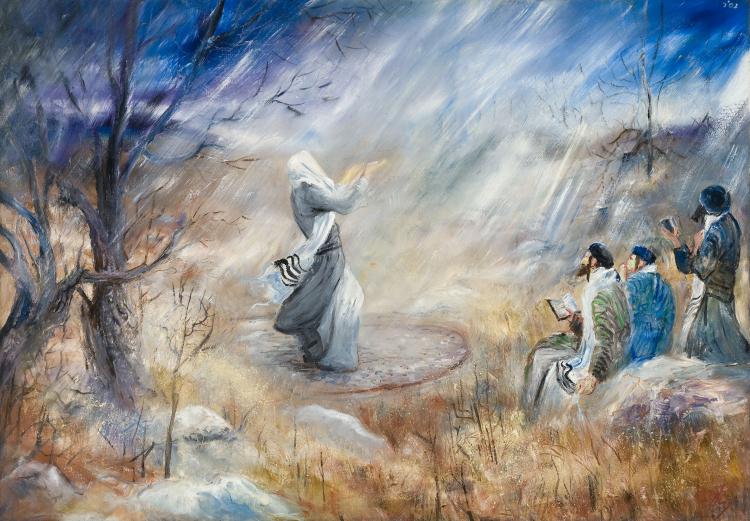
The Talmud, however, reports a much more enigmatic account of divine intervention through water. It was in a time of terrible drought that the Jewish people approached the sage Choni HaMagil and beseeched him to pray for rain on their behalf. When Choni’s supplications to the Almighty went unanswered, he drew a circle in the dust and stepped inside of it, vowing not to leave the circle until G-d bestowed rain upon His people.

Immediately, a fine mist settled upon the earth, too little to alleviate the drought but sufficient to free Choni from his vow.

Choni called out to heaven: “I asked not for this, but for a rain to fill all the wells and cisterns.” Immediately, raindrops larger than melons began to fall, wreaking destruction upon homes and fields.
120831085605-01-isaac-landov-fri-horizontal-galleryAgain Choni called out to heaven: “Neither did I ask for this, but for a rain of blessing.” Immediately a normal rain began to fall, filling the wells and cisterns of the people as Choni had requested. But the rain did not stop, and soon the entire population of the land feared that they would drown in the rising waters.

One last time Choni called out heavenward: “Master of the World, Your people, Israel, whom You brought out from Egypt, can tolerate neither too much blessing nor too much misfortune.” Immediately the waters abated, and the people returned to their fields. From this time onward, people referred to Choni by the name HaMagil   —   the Circle-maker.

What was the point of G-d’s demonstration to the people of Israel? What did Choni mean that the people could not tolerate too much blessing? And why did Choni find it necessary to remind the Almighty, at this particular moment, that He had brought the Jewish people out from Egypt?

The Exodus from Egypt may be described, in commercial terms, as the largest loan ever extended in the history of man. During the generations of slavery in Egypt, the Jewish people had forgotten their Creator and lapsed into the same idolatries as their Egyptian masters. And although, to their credit, the Jews had guarded themselves against assimilation, this alone was insufficient to earn them the privilege of miraculous redemption. Nevertheless, G-d gave them an incalculable line of credit: Freedom from slavery, freedom from oppression, freedom to chart their own course into the future.

Moreover, He promised them immeasurable blessing and unbounded prosperity, on condition that they would repay their loan   —   repay it by living according to G-d’s law, repay it by rising above material pursuits and petty self-interest, repay it by using all the blessing that G-d would bestow upon them to aspire to moral, ethical, and spiritual perfection.

In this light, blessing may be understood as a double-edged sword. Wielded in one direction, it cuts down all enemies and obstacles that stand before us. Wielded in another, it obligates us to a standard of righteousness and moral behavior that we may find nearly impossible to meet.

This was the meaning behind the Almighty’s response to Choni the Circle-maker’s plea:

Two roads lie before My people, and it is their choice which to follow. One leads back to Egypt, back to the oppression of materialism and the slavery of self-indulgence, back to spiritual emptiness and the absence of all blessing. The other road leads forward, to spiritual fulfillment and spiritual greatness, if My people will only find within themselves the potential to seek greatness and discard all lesser goals. It is for this that I redeemed them, that they might cast off the chains of physicality and reach for the heavens.

H19060-L75167491And this too was the meaning behind Choni’s appeal to the Almighty:

Master of the World, You brought your people out from slavery and oppression on condition that they would use their freedom and the blessings to strive for spiritual heights. Your people, however, have demonstrated from their beginnings that, whatever their potential may be, they still suffer from human failings and human shortcomings. They cannot tolerate too little material blessing, lest the struggle to survive overwhelms them and they abandon all higher aspirations. And they cannot tolerate too much blessing, lest they cower before the goal set for them and lose all hope of its attainment.

By all accounts, the world that we live in today enjoys a level of material affluence unattained and unimagined by previous generations. Such basic necessities as rapid transit, instantaneous communication, indoor plumbing, electrical lighting and refrigeration, which we take for granted, provide us with an ease of living simply unavailable to even the wealthiest, most powerful monarchs until the last century. The very existence of an “entertainment industry,” much less the staggering sums of money devoted to it, testifies to our abundance of resources   —   which is to say, our abundance of material blessing.

Nowhere does Jewish tradition teach the condemnation of wealth or of recreation.

Nowhere does Jewish law mandate the forcible redistribution of wealth from those blessed with good fortune to those less fortunate. But Jewish tradition does warn us of the responsibilities of prosperity. It warns us in the narrative of the flood, in the story of Choni HaMagil, and also in the Hebrew word for charity: tzedakah, derived from the word tzedek, or justice.

It is only just that those who are blessed share a portion of their blessing with their less fortunate neighbors. It is only just that, before overindulging in one’s own good fortune, he ponders why he deserves having received such blessing while his neighbor has not. And it is only just that he ask himself how, even in the absences of tax incentives or legal mandate, he might reach out with his blessing to ease his neighbor’s plight.

If the waters of the earth, the life-giving waters that are the source of our greatest blessing   —   life itself   —   have risen up to inflict enormous tragedy, swallowing human life and draining billions of dollars of aid to spare human suffering, we will all be remiss if we do not pause to consider whether we have used our blessings wisely, and what we must do to ensure that we will continue to deserve them.

Originally published by Jewish World Review.

My interview with Bill Martinez

Bill_Martinez_210x174Listen to my recent interview about faith and politics on Bill Martinez live.

Interview begins about 32:30 here.

Falling Skies

Screen shot 2015-11-16 at 12_44_36 PMThe death of any young person is tragic, and all the more tragic when unnecessary.  In today’s world where sensory-gratification is king and accountability is unknown, few question the wisdom of jumping out of an airplane for kicks, especially when the chances of anything going awry are so small.

But those odds assert themselves eventually, as they did last month in Acampo, California.  The two young men who lost their lives were jumping about an hour’s drive from where I jumped myself almost four decades ago.  It seemed like a good idea at the time.  But I’ve come to reconsider, as I explain in this essay from 1999, originally published in the St. Louis Post-Dispatch.

“Middle age has finally arrived,” I said to myself as I confronted a life insurance application form for the first time ever. But as I filled in the blanks and checked off the boxes, I suddenly paused, suspended between youth and old age, as I read and reread one question midway through the form: Have you ever been skydiving?

I consider myself an honest person, so I found myself in the midst of a moral struggle as I contemplated how I should answer. The reasoning behind the question seemed obvious: why should any business gamble a quarter of a million dollars on the life of someone foolish enough to jump out of an airplane?

The way I figured it, however, there are three reasonable explanations why an otherwise sane person would do such a thing.

One, as in the case of former President George Bush, to save his life when his plane has been hit by enemy fire in WWII.

Two, also as in the case of George Bush celebrating his 75th birthday, when one is winding down his life and figures he hasn’t much of it left to lose anyway.

And three, as in my own case, when one is not yet sufficiently mature to appreciate that his life is far too precious a thing to be thrown casually out of an open hatch at 3000 feet.

Barring any of these three excuses, an insurer would be entirely justified in refusing coverage or inflating charges. But why, since I now regard jumping from an airplane as ample cause for mandatory psychiatric observation, should I be burdened with doubled insurance premiums because of a momentary lapse in good sense when I was half my present age?

As it turned out, I went with a different company, one whose application phrased the question this way: “Have you been skydiving in the last ten years?” That’s much more fair, I think.

Of course, insurance companies may just be looking for excuses to jack up their prices. After all, compared to BASE jumping, ice climbing, and other extreme sports, skydiving is positively run of the mill. Could George Bush, a former president of the United States, former director of the CIA, and former member of the NRA, be so completely off-the-wall? (Never mind that the poor former first lady could hardly bear to watch her husband’s escapades.)

Indeed, my diving instructor (whose name was also George) told us repeatedly: “Skydiving is no riskier than crossing the street!”

George isn’t alive any more. He wasn’t killed crossing the street, either.

Cool-Skydiving-Desktop-Wallpaper-With-Sunset-ViewAs a 19-year-old undergraduate still looking for a major course of study, life seemed to have little to offer me except cheap thrills. If something would go wrong, and I would splatter against the plowed earth of the Sacramento valley, well, what was the point of being alive if I didn’t experience all life had to offer?It goes without saying that children of all ages will be drawn like moths to the fire of every kind of sensory stimuli. It is our job as responsible adults to shield them from the flames of both real danger or virtual thrills, to gently prod them along the road to wisdom by exposing them to more rewarding and enduring highs than those brought on by adrenaline rush.

In the same way that chomping on spearmint gum deadens the palate to the subtle complexities of fine food and wine, the instant gratification of putting one’s life at risk may, in the end, kill off any hope of ever savoring the subtle joys of maturity, even if those dangerous pastimes do not themselves prove fatal.

The Talmud offers the following insight into human nature: “If someone says, ‘I struggled but did not achieve,’ don’t believe him; if he says, ‘I achieved without struggle,’ don’t believe him; but if he says, ‘I struggled and achieved,’ believe him.”

The Talmud goes beyond the simple axiom that there is no sense of accomplishment without exertion. It tells us that exertion and effort will inevitably produce a sense of accomplishment. And unlike the transient high produced by LSD, PCP, or any contrived brush with danger, the sense of accomplishment produced by struggle will not vanish into nothingness, leaving behind an emotional void or the anguish of physical or psychological withdrawal. It will endure, and spur us on to greater struggles and greater accomplishments.

Without intellectual effort, we would never graduate from Dr. Seuss to Shakespeare, from Marvel Comics to Monet, or from music videos to Mozart. Without psychological effort we would never learn the practical skills to succeed professionally or the interpersonal skills to succeed as spouses and parents and friends and neighbors. Without effort we would never learn to appreciate the small, subtle pleasures life has to offer because we would be ever waiting impatiently for the next emotional quick-fix.

Acquired taste is accessible to the young. As parents, we must not shy away from the challenge of inculcating patience and prudence in our children. Through persistent effort we can teach them that cultivating a taste for the more refined pleasures of life is not so hard, no harder really than falling out of an airplane.

Spiritual Impressionism

?

?

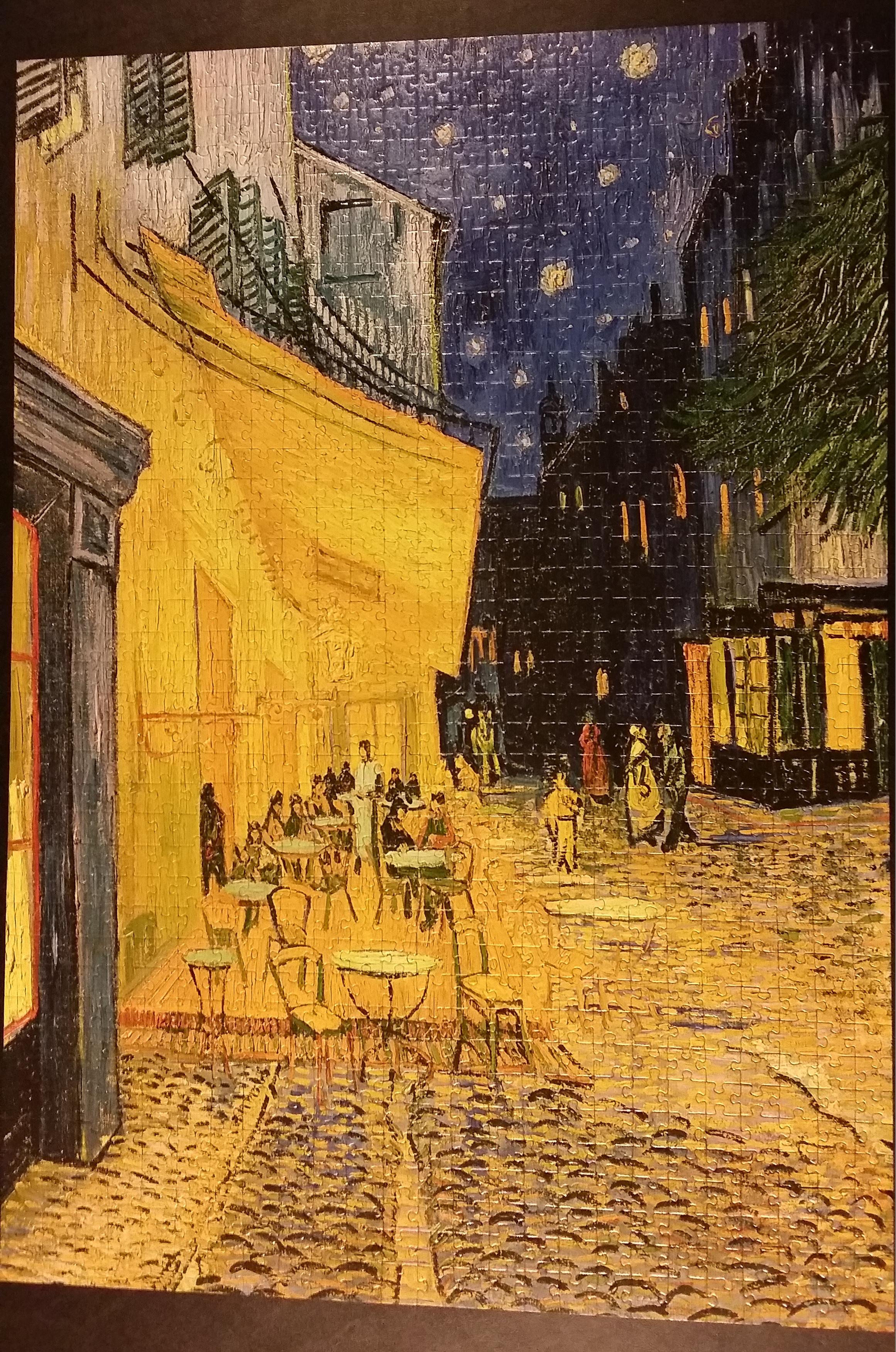
My wife and I finished this 1000 piece jigsaw of Vincent Van Gogh’s “Cafe Terrace at Night,” providing an excuse to revisit this essay from 2011.

210 years as slaves in Egypt. 40 years wandering in the desert. 70 years of suffering in Babylon. 1,931 years scattered to the far ends of the earth… and counting.

Exile has defined most of the history of Jewish people, always as a response to our failure to value our relationship with the Almighty. When we turn our backs on Him (or on one another), He responds by allowing us to experience the consequences of separation through the loneliness of exile.

How remarkable, then, that at times extraordinarily pious have undertaken journeys of self-imposed exile, wandering anonymously from place to place, begging for bread and lodging, concealing their true character and brilliance, and never knowing what awaited them around the next corner. There was nothing remotely romantic about these adventures. They were intended to inure budding Torah leaders against attachment to material comforts, and also to teach them humility as a safeguard against the reverence and adulation showered upon the learned. During the days of the Chassidic masters of the 18th and 19th centuries, stories of the tribulations of exile abounded.

I knew nothing of this when I embarked upon the most foolhardy undertaking of my life and set off to hitchhike across the United States after I finished college. What I did know was that my existence had become too comfortable and too easy. I had never had to overcome serious obstacles or grapple with substantial challenges. I had spent five years acquiring a degree that prepared me for nothing, and I lacked even the faintest outline of a plan for the future.

As I had approached the culmination of my college career, I found myself disconcerted — not because I had no idea what I would do next, but because my lack of prospects didn’t seem to bother me at all. I had been carried by the current along the River of Least Resistance, without ever learning to navigate or deciding upon a destination. Now the river was about to empty into the Sea of Countless Possibilities, and my boat was not seaworthy.

hitchhiker_thinkstock630_1a3p7rp-1a3p7snSo I slung a pack over my back and hit the road. I didn’t think of it as exile, but as escape. Escape from too much comfort and too much security; escape from too little responsibility and too little accountability. And as much as I tried to make it sound romantic, all such illusions were swept away my first night on the road clambering out into the cold to stake out my tent as it buckled before the November wind that swept out of a still evening sky.

I wasn’t Jack Kerouac — indeed, I was already old enough to see through Kerouac, whose revelations had lost their drama by the early eighties and who, when he ran out of money the first time out, caught a bus back home to his mother.

I wasn’t Christopher McCandless, who walked away from his prospects and possessions to go off into the wild. After all, I had $500 in traveler’s checks, carried two credit cards, and I was never far from a phone in case of emergency. On the other hand, I didn’t die of exposure after eating poison berries.

And I certainly wasn’t Rabbi Zusia of Annipoli, whose secret acts of piety in the face of astonishing adversity have become legend.

But I did learn to look at myself and at the world around me through different eyes. And one of the most powerful lessons came, albeit inadvertently, from a most unlikely teacher.

I met Steve at a youth hostel in Santa Fe, New Mexico, from where he agreed to drive me as far as Fort Worth, Texas. I remember the blue desert sky and dazzling sun that morning, and I remember going out in shirt sleeves as I would have in California, only to be driven back inside by an air temperature ten degrees below freezing. I was already starting to learn.

Steve was in no hurry. He was taking the two weeks before starting a new job to see the country, but he was on a budget and insisted upon driving 50 miles per hour to save on gas. Having begged my ride I was in no position to argue. I certainly wasn’t in a hurry myself, except to keep pace with the advancing cold front as I headed south.

Nevertheless, I gritted my teeth in frustration as we crawled along the highway. Cars, trucks, and trailers sped past us, each a blur of motion, as did birds and tumbleweeds — or so I imagined. But it was going to be a long trip, and as I forced myself to make peace with the inevitable, I began to notice something completely unexpected:

Detail.

oil-paintings-art-gallery-paintings-by-claude-monet-1840-1926-1345044100_bBy slowing down a mere fifteen miles per hour, the world beyond the roadside changed from a blur into a sharply defined landscape; trees and shrubs transformed from shapeless, green masses into a nuanced tapestries of leaves reflecting sunlight in infinite combinations as they rippled softly in the breeze; every lonely farmhouse acquired a unique character, whether from weathered paint or strewn tractor parts or kitschy statuary or slung hammocks and yard swings. Even the gray asphalt of the highway and the painted white lines took on texture and depth.

Stripped completely of any control over our rate of progress, I relaxed enough to recognize the view beyond my window not as a continuously rolling panorama but as a carefully fashioned composition of myriad parts and variegated pieces. Like an impressionist masterpiece, the apparent randomness of details up close belied the order of design revealed by distance, and the holism achieved at a distance belied the attention to detail that only became recognizable up close.

The wise man’s eyes are in his head, says King Solomon. Well, where else would they be? As the wisest of all men, Solomon never wasted time stating the obvious. Rather, he was commenting on the Creator’s placement of the eyes, upon which we rely most for sensory input, adjacent to the brain, which enables us to process and interpret the information we acquire.

A wise may does not merely look, nor does he merely see. He perceives. And he understands that perception requires looking at the world in many different ways, from different directions, and in different environments. As the great impressionists demonstrated through an innovative style that was originally derided by traditionalists, the appearance of any object or phenomenon can change dramatically depending on how we view them. Things do not look the same at morning as they do in the afternoon, or in the afternoon as they do at evening. Light, shadow, angle, context — these are the elements that create perspective, which is the key to genuine understanding.

It might seem logical to race through the exile of this world in order to more quickly escape its travails and come out on the other side. But only by paying attention to where we are can we chart a course toward where we need to go. As we race through our lives, too busy to notice the subtleties that make our world a place of limitless fascination, too preoccupied to take revel in the development of our own children and the maturing of our own relationships, too distracted by the blur of ephemeral attractions to contemplate the eternal complexion of our souls, we cheat ourselves of the opportunity to learn the lessons of exile. And it is only by learning those lessons that we can truly shorten the road that leads us home.

Originally published by Jewish World Review.

Spitting Image 5:3 — Visions of Martyrdom

israel museum

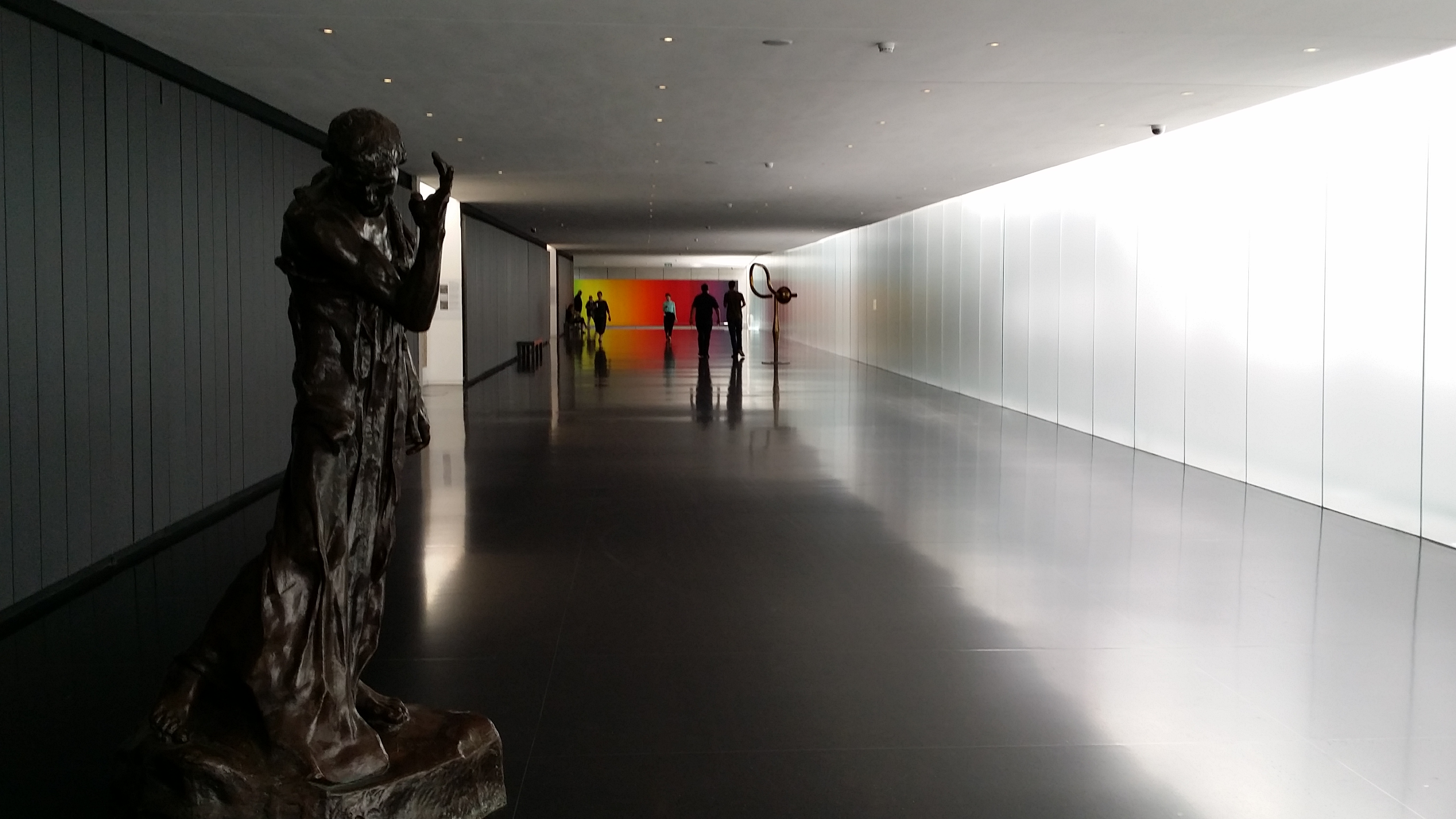
In the vast, austere entry hall to the Israel Museum, with its ultramodern monochrome walls, prismatic focal point, and symbiotic theme of shadow and luminescence, you happen upon a discordant figure:  one of the Burghers of Calais, sculpted by the French master Auguste Rodin.

The original sextet of figures represents the city fathers of Calais who surrendered themselves to save their besieged city during the Hundred Years’ War.  With heads and feet bare, ropes around their necks, and the keys of the town in their hands, the burghers were brought before the English king Edward III who ordered them beheaded.

Although their lives were eventually spared, Rodin has rendered their images as they prepare to meet what they believe will be their end, their respective expressions spanning the gamut from stoicism to despair.

As jarring as the image may appear in this contemporary setting, the story resonates deeply with ancient Jewish tradition.  In the Yom Kippur liturgy, there figures prominently the narrative of the 10 Martyrs, the talmudic sages who received the Heavenly decree that their deaths would atone for the sins of their generation and deflect Divine wrath from their people.  They too went to meet their end stoically, but without despair.

Martyrdom is not something we seek, but there are times that call for self-sacrifice of one kind or another.  In this generation of selfish individualism, entitlement, and personal autonomy, we can look to the past to remind us that tribalism, senseless violence, and identity politics are all symptoms of a society that has forgotten how to commit itself to a higher sense of purpose, and that only by setting aside our superficial differences can we survive as one people.

Near-death experience

1You’re ten years old and a sound sleeper, so it’s already unusual that something has woken you up in the middle of the night.  You go out into the hall to investigate.  There are strangers in the house and flashing lights out the window.  Your father tells you to go back to bed.


When you wake up the next morning, your mother has disappeared from your life.

It’s 1970, before school counselors or lettered conditions like PTSD.  Your father means well, but he’s not the communicative type, not one for expressing his feelings to others or eliciting others to share their feelings with him.  He’s from the Depression Era, and he barely saw his own father growing up during those desperate years.  He’s a veteran of the Second World War; difficulties are part of life.

He’s also dealing with his own trauma, as his wife lingers between life and death.

You get shipped off to stay with friends, or with your grandmother.  Very little is explained to you, and you understand even less.  Years later, there won’t be much that you remember, aside from the indelible images of that first night.

You won’t remember waking up the next morning to find your grandmother home with you instead of you parents.  You won’t remember when they took you to visit your mother one last time because no one thought she had much time left.  You won’t remember shouting at her for having abandoned you.  You won’t remember the outgoing, cheerful little boy you were before that cold, winter’s night.

You only remember how hard it was for you to talk to people from that moment forward.  You remember how easily you cried during the years that followed, and how much you hated yourself for crying so easily without understanding what made you that way.  You remember how you considered taking your own life, but always managed to convince yourself that you could do it tomorrow.

A decade passes before you really recover.  In some ways, you never recover at all.

Click here to read the whole essay.

Spitting Image 4:1 — Face the East, Love the West

The sages of the Talmud teach us that the center of spirituality is in the east, but the Divine Presence resides in the West.  The essence of divinity cannot be perceived directly, but is reflected in the wonders of nature, the magnificence of the universe, and the acts of moral dignity that elevate Man from an animal to above the highest angels, illuminating the world with the glory of the Creator.

lambert 4

lambert 2

lambert 1

One step closer to Eden

Awake from the north and come from the south!  Blow upon My garden and let its spices flow.  Let My beloved come to his garden and partake of its precious fruit.
— Song of Songs 4:16

Would the world be better off without mankind?

Many environmentalists think so.  It’s hard to deny that, from a purely ecological point of view, life on earth would do much better without human beings around to interfere with the natural order.

But without mankind, there would be no point and, ultimately, no reason for the world to exist at all.  Only Man seeks to create; only Man strives to become more than he is; and only Man directs his efforts toward ideals that transcend mere survival and procreation.

If we are to act as responsible custodians of the world, however, we have to stop from time to time and let the world remind us what those ideals are.

In the late 1800s, the great Rabbi Samson Raphael Hirsch announced his plan to travel from Germany to see the storied mountain ranges of Switzerland.  This was entirely in keeping with Rabbi Hirsch’s philosophy of integrating worldly knowledge and experience into his religious outlook.  That being said, the incomparable leader of Orthodox Jewry was well into his seventies, seemingly much too old to undertake such an adventure.

Some of the rabbi’s closets acolytes questioned the wisdom of embarking on such a strenuous journey at his advanced age.  The rabbi replied that it was precisely because of his age that he felt it necessary to go.

“I may not have much longer to live,” explained Rabbi Hirsch.  “And when I stand in judgment upon my arrival in the World to Come, what will I say when the Almighty asks me, “Samson, why did you not see My Alps?”

Rabbi Hirsch understood what we too easily forget:  That the wonder and beauty of the world are here for us to experience, for us to enjoy, and for us to find inspiration in the masterful Hand that fashioned all of Creation.

But North Americans need not travel to Switzerland to find their inspiration.  Within our own borders we have the “American Alps.”  That’s what Louis Hill, president of the Great Northern Railway, called the mountains of Glacier National Park.  It was Hill who found the region so extraordinary that he lobbied congress to designate Glacier as a national park in 1910.  And it was Hill who influenced the Alpine design of the park’s hotels and facilities to echo the mountains’ namesake across the sea.

Even from the same continent, getting to the park in northern Montana is no simple matter.  My wife and I flew into Spokane, Washington, then rented a car and began to drive, first across the Washington border, then through Idaho, and ultimately into Montana.  The roads were mostly straight and flat as the miles sped by; it took us six hours just to reach the outskirts of 1,583 square-mile wilderness.  But as my own rabbi likes to say, the best things in life are rarely found on the beaten path.

Click here to read the whole article from this month’s Wagon Magazine.

Don’t count down — count up

The phrase Reinvent Yourself on a cork notice boardBetween Passover and the festival of Shavuos (Pentacost, celebrating the Almighty’s revelation at Sinai), tradition calls for every Jew to count the days and the weeks connecting the freedom of the exodus from Egypt with the responsible application of that freedom.

These seven weeks are a time filled with opportunity for personal growth, beginning with the awareness that little changes can add up to extraordinary transformation.

Read about it here.

Passover, Freedom, and the War on Culture

nulogo4bThe responsibilities of freedom, the history of freedom, and the culture wars that threaten the values and the foundations of civilization.

Listen to my interview on the Bill Martinez show (interview begins at 33:00).