Home » Science and Nature (Page 5)
Category Archives: Science and Nature

The War on Women Continues
From the Huffington Post:
 British chess grandmaster Nigel Short is responding to criticism after recently arguing that inherent differences in men’s and women’s brains may explain why there are fewer female chess champions than males ones.
“Men and women’s brains are hard-wired very differently, so why should they function in the same way? I don’t have the slightest problem in acknowledging that my wife possesses a much higher degree of emotional intelligence than I do,” he wrote in the February issue of New In Chess magazine. “One is not better than the other, we just have different skills.”
“It would be wonderful to see more girls playing chess, and at a higher level, but rather than fretting about inequality, perhaps we should just gracefully accept it as a fact,” he added.
So why would Huff Post run such a blatantly chauvinistic report? Well, obviously, for the counter-offensive that makes up the last 60% of the article. Then, of course, you have the comments, which fluctuate wildly between the apoplectic, the apologetic, the politically correct, and the well-reasoned.
Anyone who has raised children or taught school knows that males and females are more different than some species. We have different strengths and weaknesses, which is why it makes sense that we form partnerships called “the family.”
It’s both fascinating and disturbing that so many people are offended by those who say so.
Bad Hair Day at CSI
 Since 2012, the FBI has been reviewing some 2600 convictions from the ’80s and ’90s that depended on hair analysis. With 268 cases reviewed so far, more than 95% have been called into question, according to NewScientist.
This doesn’t mean that science is unreliable. Rather, it reinforces the well-known computer adage of GIGO — garbage in, garbage out. In other words, technology is only as good as the people using it.
So when it comes to understanding the origins of the universe, the evolution of man, the nature of human psychology, or the changing climate patterns of our planet, perhaps a bit more humility is in order before we jump to conclusions that new discoveries might force us to reverse tomorrow or the next day.
Our world is a complicated place. Instead of insisting that we have everything figured out, let’s watch the sun rise and listen to the rain fall while we enjoy the mystery of it all.
Settled Science?
 Last March, scientists believed they had discovered evidence of the Big Bang. Early this year, analysis raised new doubts about the soundness of the Big Bang Theory altogether, according to an article in Quanta Magazine.
The issue here is not whether to believe in Big Bang. I have no skin in the game, since Creationism can work with or without it. The real issue is the unshakable certainty of so many in the scientific community despite a history of mistaken hypotheses that goes back at least as far as Aristotle.
Whether it’s Big Bang, evolution, or climate change, it is disingenuous for ideologues to quash open debate by proclaiming any of these as “settled science.” They are not. Each faces serious logical and scientific challenges that may not refute them but certainly demand acknowledgment and honest investigation. To claim “case closed” when so many legitimate objections remain unanswered is hardly a responsible application of scientific method.
Which begs the question: why are so many in the scientific community afraid of the truth?
Read the whole article here. Here are a few excerpts:
No one has devised an alternative to inflation [the exponential expansion of the universe following the initial “big bang”] that explains so many observations with so much economy. For a decade, Paul Steinhardt of Princeton University, an early pioneer of inflation who has since become one of its most vocal critics, has championed the “ekpyrotic model,” a cyclical picture in which the universe executes an eternal series of expansions and contractions. In this scenario, any unevenness that develops in the cosmos as it expands gets compressed as it contracts. The slate is wiped clean for each cosmic rebirth, accounting in this way for the exceptional uniformity observed early on in this latest iteration.
But the ekpyrotic model has few subscribers. It hinges on the idea that the universe will bounce, rather than bang, each time it shrinks to a point. The theoretical arguments for why it should bounce strike most experts as highly speculative. And the non-bounciness of black holes suggests it would not do so.
At present, inflation has cornered the market on Big Bang theories, and yet there is still room for doubt. “The fact that we don’t have an alternative doesn’t mean we know the truth,” said Avi Loeb, a theoretical astrophysicist at Harvard University.
The theory’s triumphs are undercut by a strange detail: If inflation works the way it’s supposed to, it seems that it should never have happened at all.
Inflation now seems less likely than ever, the critics say.
The Grateful Whale
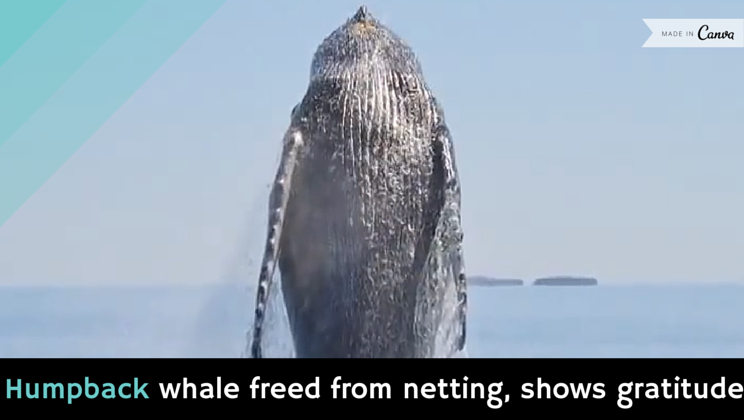 Swimmers worked an hour to free this humpback whale tangled in fishing net. To see the whale’s reaction, skip to 6:40 on the video. Perhaps the display was one of sheer elation at being freed, or perhaps an unbridled expression of gratitude.
This whale knows something too many of us have forgotten. Our society has embraced the culture of convenience, entitlement, and victimization to the point where we barely feel appreciation anymore. In a world where everything is supposed to be available and instantaneous, we’ve responded with the attitude that everything takes too long, takes too much thought, takes too much effort. Our expectations are so high that we are forever frustrated and disgruntled.
In biblical Hebrew, the term for gratitude is hakoras hatov — literally, “recognizing the good.” Before we can appreciate, we have to look for the good in our lives, see it as good, recognize how we have benefited from it as good; once we have that recognition, not only can we experience true appreciation but we inevitably will feel appreciative. How can we not, with that which has benefited us so clear before our eyes?
“The wise man’s eyes are in his head,” says King Solomon in Proverbs. Only if we see through the lens of our minds’ eye can we truly perceive, truly understand, and truly achieve the lofty human reactions that should be uniquely ours, but which sometimes we have to learn from the creatures with which we share our world.
How sad for us if they get it and we don’t.
It’s not always wise to look to the skies
 Just ask the bar-headed goose, famous for traversing the Himalayan Mountains on its annual migration from the Indian subcontinent to central Asia. According to NPR, researchers have now determined that the migrant birds, although once believed to soar at heights near the peak of Everest, keep much lower to the ground, rising over obstacles and then settling back into a tighter, more earth-bound trajectory.
It’s worth considering the lesson for those of us who aspire to lives of spiritual elevation. Man is a creature of contradictions, a divinely inspired being whose ethereal soul is nevertheless trapped in a body of flesh and blood and sentenced to live his life amidst the material attractions of the physical world. We long for the heavens but, like Icarus, we risk losing our bearings and plummeting into the abyss if we neglect the needs of our earthly selves.
And so, like the goose, we rise up, we drop down, we endure the peaks and valleys of personal challenge as we try to chart our course through the uncertain terrain that is life in this world.
The Aroma of Ideology
 A NYT op-ed cites a study by social scientists at Brown, Harvard, and Penn State that people we agree with smell better to us.
For a theological critique, see my article, The Scent of Spirit.
 Yonason Goldson