Blog: The Ethical Echo Chamber

How Little Ripples of Kindness Create Big Waves of Happiness
 Of all the Jewish holidays, none is anticipated by little children more than the festival of Purim.
The theme of reversal figures prominently in the traditional observance of Purim, which is seen as a kind of alter-ego to the solemn holiday of Yom Kippur, the Jewish Day of Atonement. In place of fasting there is feasting. In place of prayerful reflection there is revelry. In place of the simple white garments of purity there are costumes and spectacle.
Children especially look forward to dressing up on Purim. But Purim is in no way a Jewish Halloween. Just the opposite: children dress up and go door-to-door not to ask for treats and threaten tricks, but to give away gifts of food to others.
Which brings me to the point of this narrative, with only one more small digression.
Grump on Trump
 I will not vote for Donald Trump,
I do not like him on the stump;
I will not make myself a chump
I will not vote for Donald Trump.
I do not like him in debate
I do not like his words of hate;
I do not like this fake Machiavelli
I’d sooner vote for Megyn Kelly.
I will not vote for one so crude
No matter whom he can delude;
I will not vote for one so crass
To deepen our country’s moral morass.
I don’t care if he’s tough and rich
He’ll drive the country into a ditch;
I don’t care if he’ll build a wall
Since mayhem will engulf us all.
I won’t support him against Bernie,
Not against Bert, not against Ernie;
Not even if you pillory me
Not even against Hillary, see?
 There must be someone to prevent us
From choosing this sorcerer’s apprentice;
I’ll give my vote to some third party
Even if it’s led by Moriarty.
I don’t care how his groupies swoon
Even as each day he changes tune;
I don’t care what he’ll promise to do
Since not a word he says is true.
I will not vote for Donald Trump
To make America a toxic dump;
Not even with a stomach pump
Will I give my vote to Donald Trump.
St. Patrick’s Day — Searching for the way out of exile
Every year on St. Patrick’s Day I revisit these thoughts from 1999. Things have gotten better in Ireland, where both sides have finally recognized that peace requires sacrifice and compromise. Not much has improved in Israel, where leaders on one side continue to hold their people hostage as political pawns so they can keep their own hold on power.

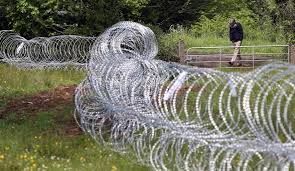 At first glance, the soggy, green downs of Ulster bear little resemblance to the parched and craggy hills of Israel. But a gentle tugging at the cultural fabric of either place unravels an unmistakable common thread: two peoples, impossibly close geographically, impossibly distant ideologically, with more than enough fuel for hatred between them to burn until the coming of the Messiah. Tromping over hills and through city streets, however, first in one place and then in the other, I discovered a more compelling similarity: the bitter struggle of humanity in exile.
“Which are the bad parts of town, the ones I should avoid?” I asked the owner of the bed-and-breakfast where I passed my first night in Belfast.
She dutifully pointed out the Shankhill neighborhood on my map, cautioning me to steer clear of it. I thanked her and, with sophomoric self-confidence, proceeded there directly.
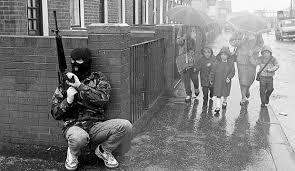 It was the summer of…
View original post 576 more words

2016: The Last Year of the Weimar Republic
 In this new era of surrealism, it’s ironic that we can find prophetic wisdom in as unlikely a source as Hollywood scriptwriter Aaron Sorkin. In his 1995 masterpiece The American President, we find this exchange between President Andrew Shepherd and his domestic policy advisor, Lewis Rothschild:
Lewis Rothschild: People want leadership, Mr. President. And in the absence of genuine leadership they’ll listen to anyone who steps up to the microphone. They want leadership; they’re so thirsty for it they’ll crawl through the desert toward a mirage, and when they discover there’s no water they’ll drink the sand.
President Shepherd: Lewis, people don’t drink the sand because they’re thirsty; they drink the sand because they don’t know the difference.
The truth is that both are right. Deprive people of authentic leadership for long enough and they will certainly lose the ability to tell the difference between reality and illusion.
When we reflect upon the contrast between the elegant ideals set forth by revolutionary leaders two and a half centuries ago and the cartoonish ranting of the avenger seeking coronation today, there is ample reason for anxiety that has nothing to do with Nazi genocide.

Frank Reagan for President
It’s election day in Missouri, and I don’t care what the polls say… I’m not giving up hope. #VoteForFrank
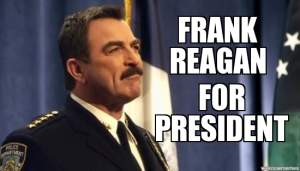
Highly principled, hard as nails, even-keeled, dedicated to higher values, devoted to the welfare of the people he serves, and fiercely loyal to those who serve under his command.
If he’s not available, I’d settle for Tom Selleck. Like Ronald Reagan, at least he would know how to act like a president.

Spitting Image 2:3 — Unrandom Acts of Kindness
 My neighbor was standing at the front desk of a high-end fitness center one morning when a man came through the door and approached the counter.
“I’ve been jogging,” he said, panting, “and I forgot to bring my water bottle with me. Could I please have a glass of water?”
“I’m sorry,” said the young woman behind the desk, “but this is a private club. There’s a gas station down the street that might be able to help you.”
The jogger looked at the receptionist, shrugged his shoulders, and left.
My neighbor watched in disbelief. “Excuse me,” she said. “You have a coffee machine with paper cups right next to you. You have a sink with a faucet. You could have poured the man a cup of water.”
The young woman looked back at her and replied, with evident remorse. “You’re right. I wish I had thought of that.”
The response is staggering. Not “I was just following the rules” or “I’m not allowed to leave my desk.” Those would have be the predictable, if disappointing answers.
But how is it possible that the thought of offering a cup of water to an overheated stranger could have been so far off the receptionist’s radar that it would not even enter her mind?
Never mind that the woman behind the counter was white and the jogger was black. That only makes it worse, since the jogger might reasonably have suspected racism and the motive behind the refusal.
But this was not about race. It was about how we have retreated so far into our worlds of isolation that offering a cup of water — the easiest, simplest, cheapest, most fundamental act of kindness possible for one human being to perform for another — has become something “we wish we had thought of.”
Those stories of disconnectedness — of two friends in school passing each other without noticing while they talk to each other on the phone, of a child calling her parents in the living room from her bedroom, of a husband and wife texting one another from opposite sides of the couch — have gone from being amusing anecdotes to being darkly disturbing. We’re well on our way to forgetting that other people are real. Which means we’re forgetting what it is to be human.
Like anything else, kindness takes practice. It has become popular to talk about doing random acts of kindness, and that’s wonderful. But it might benefit us more if we did disciplined acts of kindness, to develop the habit of kindness so that we don’t have to think about it.
It really isn’t so hard to drop a coin in a jar for charity every morning, to give a smile and a greeting to the strangers we pass on the sidewalk or to our co-workers in the office, to hold the door open for another as we go through the door ourselves, to offer help to someone whose hands are full, to call a colleague who doesn’t show up at work to ask if everything is okay.
With a little practice, we won’t have to remember to act kind because we will have become kind.
The Three Laws of Hitchhiking
Lessons learned on the road for off the road.

What would your grandmother say, Mr. Cheeseburger?
 Does the benefit of pointing out outrageous behavior outweigh the cost of rewarding outrageous behavior by pointing it out? It’s hard to know anymore.
Nevertheless, the recent report of a man in Britain who changed his name to Bacon Double Cheeseburger demands brief mention — not only for its idiocy but for its insidious banality.
Oh, I know what you’re thinking: that this kind of no-news-news isn’t worth the time it takes to read about it. But trivial symptoms can offer an early warning to life-threatening conditions; and, with our culture already in dire need of life-support, the passive acceptance of every “new normal” may soon lead us into the category of DNR — Do Not Resuscitate.
So, yes, the obvious question is, “who cares”? People do all kinds of dopey things and, if they aren’t violating any laws or committing immoral acts, we might as well just shrug our collective shoulders and get on with our collective lives — especially when we can’t stop them in any case. Compared with multiple body piercings and blanket-tattoos, adopting a silly name seems downright pedestrian.
But it’s worth asking ourselves this: why did it never occur to our grandparents to alter their appearances or their appellations?

Caravan to Midnight with John B. Wells
 Listen to my recent interview with John B. Wells on Caravan to Midnight:
Ancient wisdom for modern times (interview starts at about 1:40:00).
Spitting Image 2:2 — When sacrifice is for the birds
 Would you sacrifice one of your children to save the other?
That was the unthinkable dilemma revealed at the climax of the Meryl Streep classic Sophie’s Choice, which left the heroine emotionally scarred for the rest of her life.
The poignancy of that final scene tears at the insides of anyone who’s ever seen it. Some things are too hideous even to contemplate, and we simultaneously rage against the evil of the Nazi tormentor and ache for the mother who had to choose and could never forgive herself for choosing.
But reality can be just as disturbing as fiction. A recent study by University of Florida scientists describes how herons, egrets, and storks living in the Everglades willingly sacrifice some of their young to alligators living below their nests so that the alligators will protect the remaining chicks from raccoon and possums.
The deal makes perfect sense for the alligators: they get a steady diet of baby birds falling from the sky almost straight into their mouths. And it makes perfect sense for the mothers as well: since birds typically have more young than they can care for, so giving up a few who wouldn’t survive anyway to protect the rest is practical, logical and, arguably, moral.
Except that it isn’t. What separates human beings from animals is conscience. When our moral compass is functioning as it should, simple pragmatism isn’t enough to govern our decision-making. And if the cost of cold, hard logic, no matter how sound, requires us to sacrifice our humanity, then it is our willingness to embrace the full measure of devotion to a higher moral standard that serves the greater good, even when no one else is watching and no one else will ever know.
Sacrifice of oneself for the benefit of others is the most noble quality of humankind. Sacrificing others for our own benefit shows us to be lower than the lowest animal. Because, unlike animals, we know better.
Or, at least, we should.


 Yonason Goldson