Home » Posts tagged 'Community' (Page 13)
Tag Archives: Community

Suffer the Children?
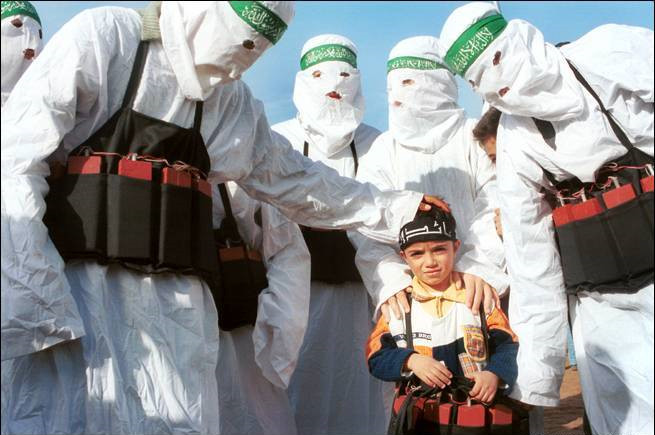 Twelve-year-olds don’t choose to become suicide bombers.
And true believers don’t send children as martyrs in place of themselves. The perpetrators of last week’s vicious attack on a Kurdish wedding in Turkey believe in nothing so much as violence as a means to their own power. It’s a sad sign of the times that we can almost admire the zealots of a few years ago who willingly gave their own lives for their ideals, no matter how convoluted those ideals may have been.
When fanatics eagerly give the last full measure of devotion — for which Abraham Lincoln praised the Union soldiers who sacrificed their lives at Gettysburg — we have to ask ourselves if we are prepared to sacrifice as much for our noble values as our enemies readily sacrifice in the name of terror.

Louisiana and the Waters of Life and Death
As residents across Louisiana struggle against catastrophic flooding, we should all take a few moments to contemplate how quickly nature can become our greatest adversary. Water is both the source of all life and the greatest destructive force on earth. I ponder the paradox in these reflections from after the Pacific Rim tsunami of 2005.
 Volcanoes. Hurricanes. Earthquakes. Fires. Tornadoes. Blizzards. Drought.
In a time when reports of terrorism have become all too common, it is sobering to consider the myriad ways nature possesses to inflict death and violence on a scale surpassing the most destructive instruments devised by man. Of all these, however, destruction by water, whether from the sea or from the sky, holds a unique terror in the scope and measure of its devastation.
Aside from the 150,000 lives already reported lost across nearly a dozen countries along the Indian Ocean, dehydration, disease and hunger threaten as many as 5 million more in the wake of the recent tsunami. And rare though tidal waves may be, the more familiar trial-by-water of floods has, with much greater frequency, left similar numbers homeless and in danger of starvation.
It seems ironic that water, the source and foundation of all life upon our planet, can become nature’s most malevolent instrument against the beings whose lives depend upon it.
Devastation by water occupies a prominent place in human history. Virtually every ancient culture records the tradition of a great flood that inundated the world, lending credence to the biblical account of Noah and the ark. Jewish tradition describes this not as a random event, but as a divine response to the corruption of mankind.
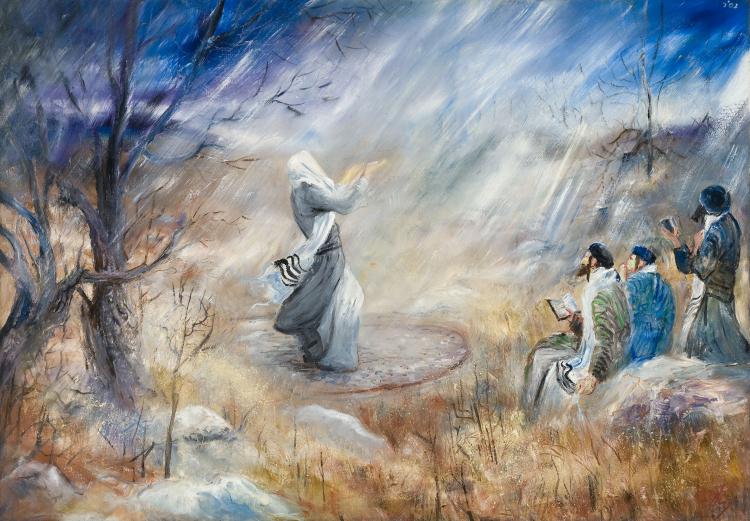
The Talmud, however, reports a much more enigmatic account of divine intervention through water. It was in a time of terrible drought that the Jewish people approached the sage Choni HaMagil and beseeched him to pray for rain on their behalf. When Choni’s supplications to the Almighty went unanswered, he drew a circle in the dust and stepped inside of it, vowing not to leave the circle until G-d bestowed rain upon His people.
Immediately, a fine mist settled upon the earth, too little to alleviate the drought but sufficient to free Choni from his vow.
Choni called out to heaven: “I asked not for this, but for a rain to fill all the wells and cisterns.” Immediately, raindrops larger than melons began to fall, wreaking destruction upon homes and fields.
 Again Choni called out to heaven: “Neither did I ask for this, but for a rain of blessing.” Immediately a normal rain began to fall, filling the wells and cisterns of the people as Choni had requested. But the rain did not stop, and soon the entire population of the land feared that they would drown in the rising waters.
One last time Choni called out heavenward: “Master of the World, Your people, Israel, whom You brought out from Egypt, can tolerate neither too much blessing nor too much misfortune.” Immediately the waters abated, and the people returned to their fields. From this time onward, people referred to Choni by the name HaMagil — the Circle-maker.
What was the point of G-d’s demonstration to the people of Israel? What did Choni mean that the people could not tolerate too much blessing? And why did Choni find it necessary to remind the Almighty, at this particular moment, that He had brought the Jewish people out from Egypt?
The Exodus from Egypt may be described, in commercial terms, as the largest loan ever extended in the history of man. During the generations of slavery in Egypt, the Jewish people had forgotten their Creator and lapsed into the same idolatries as their Egyptian masters. And although, to their credit, the Jews had guarded themselves against assimilation, this alone was insufficient to earn them the privilege of miraculous redemption. Nevertheless, G-d gave them an incalculable line of credit: Freedom from slavery, freedom from oppression, freedom to chart their own course into the future.
Moreover, He promised them immeasurable blessing and unbounded prosperity, on condition that they would repay their loan — repay it by living according to G-d’s law, repay it by rising above material pursuits and petty self-interest, repay it by using all the blessing that G-d would bestow upon them to aspire to moral, ethical, and spiritual perfection.
In this light, blessing may be understood as a double-edged sword. Wielded in one direction, it cuts down all enemies and obstacles that stand before us. Wielded in another, it obligates us to a standard of righteousness and moral behavior that we may find nearly impossible to meet.
This was the meaning behind the Almighty’s response to Choni the Circle-maker’s plea:
Two roads lie before My people, and it is their choice which to follow. One leads back to Egypt, back to the oppression of materialism and the slavery of self-indulgence, back to spiritual emptiness and the absence of all blessing. The other road leads forward, to spiritual fulfillment and spiritual greatness, if My people will only find within themselves the potential to seek greatness and discard all lesser goals. It is for this that I redeemed them, that they might cast off the chains of physicality and reach for the heavens.
 And this too was the meaning behind Choni’s appeal to the Almighty:
Master of the World, You brought your people out from slavery and oppression on condition that they would use their freedom and the blessings to strive for spiritual heights. Your people, however, have demonstrated from their beginnings that, whatever their potential may be, they still suffer from human failings and human shortcomings. They cannot tolerate too little material blessing, lest the struggle to survive overwhelms them and they abandon all higher aspirations. And they cannot tolerate too much blessing, lest they cower before the goal set for them and lose all hope of its attainment.
By all accounts, the world that we live in today enjoys a level of material affluence unattained and unimagined by previous generations. Such basic necessities as rapid transit, instantaneous communication, indoor plumbing, electrical lighting and refrigeration, which we take for granted, provide us with an ease of living simply unavailable to even the wealthiest, most powerful monarchs until the last century. The very existence of an “entertainment industry,” much less the staggering sums of money devoted to it, testifies to our abundance of resources — which is to say, our abundance of material blessing.
Nowhere does Jewish tradition teach the condemnation of wealth or of recreation.
Nowhere does Jewish law mandate the forcible redistribution of wealth from those blessed with good fortune to those less fortunate. But Jewish tradition does warn us of the responsibilities of prosperity. It warns us in the narrative of the flood, in the story of Choni HaMagil, and also in the Hebrew word for charity: tzedakah, derived from the word tzedek, or justice.
It is only just that those who are blessed share a portion of their blessing with their less fortunate neighbors. It is only just that, before overindulging in one’s own good fortune, he ponders why he deserves having received such blessing while his neighbor has not. And it is only just that he ask himself how, even in the absences of tax incentives or legal mandate, he might reach out with his blessing to ease his neighbor’s plight.
If the waters of the earth, the life-giving waters that are the source of our greatest blessing — life itself — have risen up to inflict enormous tragedy, swallowing human life and draining billions of dollars of aid to spare human suffering, we will all be remiss if we do not pause to consider whether we have used our blessings wisely, and what we must do to ensure that we will continue to deserve them.

My interview with Bill Martinez
 Listen to my recent interview about faith and politics on Bill Martinez live.

The Perils of Social Grade Inflation
 Here’s a no-brainer.
You want to improve your basketball game. Would you rather practice one-on-one with your older brother, who’s on the JV team, or with Kobe Bryant?
Unless you possess a serious streak of masochism, you did not choose Kobe Bryant — for reasons that should be obvious: while you will definitely improve playing with someone marginally better than yourself, you will accomplish nothing by playing with someone exponentially better than you are. Except, in all likelihood, the rapid deflation of your self-esteem.
Applying this principle more broadly, it’s easy to see how associating with peers slightly better than ourselves — whether academically, professionally, or morally — will push us to higher levels in our own conduct and performance. But the benefits of implied social pressure disappear when we perceive our peer group to be functioning on a higher level than it actually is.

The Seasons of our Discontent
 I received the following email in response to my article last week about Donald Trump and Tony Soprano. I think it’s well worth posting here:
Dear Rabbi,
His point was that Donald Trump’s crude, impulsive, petty, and narcissistic behavior has no bearing on his fitness for office.
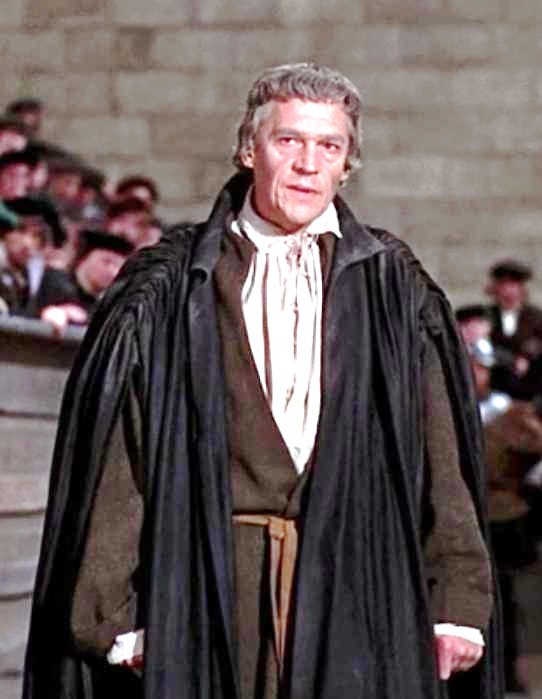
As I read these words in your email, a scene from the 1966 movie A Man for All Seasons came to my mind. The scene occurs at the beginning of the film between Cardinal Wolsey (Orson Welles) and Sir Thomas More (Paul Scofield). This whole scene, all of it worth quoting and so marvelously acted, is one of my favorite “duets” in all movies but I’ll limit myself to the quote below. .
WOLSEY:
Let the dynasty die with Henry Vlll
and we’ll have dynastic wars again.
Blood-witted barons ramping the country
from end to end.
Is that what you want? Very well.
England needs an heir.
Certain measures, perhaps regrettable…
…perhaps not, there’s much in the Church
which needs reformation, Thomas.
All right, regrettable.
But necessary to get us an heir.
Now, explain how you, as a councillor
of England, can obstruct these measures
for the sake of your own private conscience.
SIR THOMAS MORE:
I think that when statesmen forsake
their own private conscience
for the sake of their public duties
they lead their country
by a short route to chaos.
Your usually clear headed good friend is willing to jettison his own private conscience for the sake of political expediency. Millions of other Americans who are also willing to do so are leading our country by a short route to chaos.
 Your statement
The Hitlers, Stalins, and Ahmadinejads of the world may love their children and may have had troubled youths, but evil remains evil whether we choose to look it in the face or to bury our heads in the sand
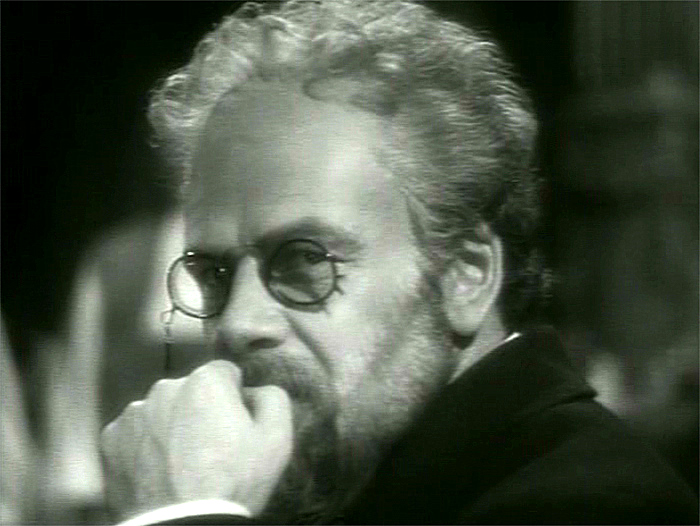
likewise brought to my mind an excerpt from the 1936 movie The Life of Emil Zola, delivered by Zola (played by the incomparable Paul Muni) during Zola’s trial which came about because of Zola’s accusations against the army with regard to the injustice of the Dreyfus affair:
The minister of war,
the chief of the general staff…
…and the assistant chief never doubted
that the famous bordereau…
…was written by Esterhazy…
…but the condemnation of Esterhazy
involved revision of the Dreyfus verdict…
…and that the general staff
wished to avoid at all cost.
For over a year, the minister of war
and the general staff have known…
…that Dreyfus is innocent…
…but they have kept this knowledge
to themselves.
And those men sleep…
…and they have wives
and children they love.
Evil, depravity and mediocrity come in all shapes and sizes. When we are willing to dispense with our own moral consciences and standards in support of that evil for whatever reason we have permitted ourselves to become one with that evil and become just as guilty.
Regards,
Bill Meisler

Before the Flood
 “Things will last my time,” said the Marquise de Pompadour, “But after me, le deluge.”
More prophetic words were never spoken. The mistress of Louis XV foresaw clearly the collapse of the French monarchy and the flood of violence and chaos that would engulf the next generation. But that was the future’s problem. Why should she care?
In some ways, her brutal disregard for future suffering is more palatable than the utopian fantasies and rhetorical flourishes of modern leaders. At least the Marquise knew what lay ahead, and at least she didn’t pretend that she had an easy fix to prevent the future from arriving on tomorrow’s doorstep.
But today we face an impending crisis no less ominous. Our expectations for national leadership have sunk so low that we are willing to overlook pathological, craven, and unapologetic dishonesty from one presidential candidate and volcanic, adolescent recklessness from the other. One can scour the nation’s capital without turning up even a smidgen of character and statesmanship, evidence of a political culture rife with cronyism, gridlock, and groupthink.

Take action against terror
Rabbi Mici Mark, the beloved Executive Director of the Torat Shraga talmudic academy in Israel, was murdered by terrorists last month while driving his car on his way to Jerusalem to celebrate his mother’s 80th birthday. He was 46 years old. His wife, Chavi and 2 of his 10 children were in the car with him and, with G-d’s help, are recovering from their injuries.
The community of Otniel has suffered greatly from terror attacks. Mici, was the 11th victim.
Please participate in the Go Fund Me campaign to sponsor a bullet proof van to prevent the Otniel community from further tragedy and trauma.
Details can be found by clicking here.


Between Heaven and Earth
Everyone I see should be smiling. A few of them are. Most of them aren’t, and I feel sorry for them, caught up in the distractions of earthly existence and overlooking the miracles that surround them.
Such is the human condition: the eyes betray the soul, and the heart grows deaf to its own inner voice, which vanishes into the rumble of routine that drums out the exhilaration of each new moment.
It should be easier here at the eye of the universe, and indeed it is. But easier is a relative term, and a hundred pounds might as well be a hundred tons when our muscles have atrophied from disuse. Just the same, in the absence of spiritual discipline, spirituality itself remains a cliché, a meaningless abstraction or, at best, a mere footnote in the narrative of life, an asterisk relegated to indices of the Sabbath, the Festivals, and the House of Worship.
Such an insidious lie. Such an insipid deception.

The Jewish liturgy begins each day with a series of 15 blessings acknowledging the gifts of fundamental existence and identity. How fortunate we are to have eyes that can behold the beauty of our world, limbs that can carry us to the corners of the earth, minds capable of discerning light from dark and good from evil; how reassured we are to commit ourselves to a higher purpose, to recognize that path we are meant to follow, and to trust the guiding Hand that gently steers us toward the fulfillment of our destiny; how much reason we have to rejoice that we are able to master our own passions, to summon the strength to meet failure with determination, and to discover new inspiration everyday amidst the monotony of life in the material world.
Yet still we forget. Even here in this place where heaven and earth kiss, even here at the focal point of human history, human nobility, and human aspiration. Too much light can blind even more effectively than too much darkness.
In the Old City of Jerusalem, the center of Creation, and in the ancient village of Tzefat, home of the greatest kabbalists of the last 500 years, the tension between the past and the present gives way to a supernal harmony that radiates from every rock and tree, that grows stronger as you turn every corner and pass through every archway. The voices of ages gone by whisper always in your ear, if you remember to listen for them.
Click here to read the whole essay from this month’s The Wagon Magazine.
In Memorium
 Yesterday, we held a memorial service for Rita Cholet White, one of Block Yeshiva High School’s most beloved teachers for over 20 years. After hearing the many stories and reflections, it’s hard to know whether she loved more or was loved more by her students. Perhaps the question contains its own answer. She was 85 years old.
Several years ago, when Madame White was honored by the school, I was asked to write her bio for the Scholarship Gala journal.
I present the text here as it appeared. She loved it then. I have no doubt that she will love it now.
Rita Cholet White has been involved in primary, secondary, and higher education for over half a century (an extraordinary achievement, especially for a woman who is only 49 years old). A Fulbright scholar, Madame White has appeared in Who’s Who in Education, Who’s Who in American Women, and Who’s Who International. Presumably, one of these organizations will eventually discover who Madame White truly is.
A stalwart member of Block Yeshiva’s distinguished faculty since 1992, Madame White demonstrates her pedagogical dexterity by wearing many hats – as French teacher, English teacher, college adviser, and yearbook adviser. Fortunately, the French like to wear hats.
More than just a faculty member, Madame White adds flare and panache to the halls of Block Yeshiva, dazzling students and staff alike with her sense of style and fashion, her stratified vocabulary in several languages, her pluck, her wit, her irrepressible good humor, and her remembrances of the McKinley administration.
Additional distinctions include a degree from the Sorbonne and the University of Nice, the HEW Certificate of Merit, the University of Richmond Certificate of Recognition as an outstanding teacher, and numerous honors that are beyond the capacity of our computer’s spell-check software.
Persistent rumors that Madame White posed as a model for the Mona Lisa and has BASE jumped from the Eiffel Tower remain unconfirmed.
Adieu, Madame. We will miss you with all our hearts.

A Tale of Too Many Egos
 This isn’t about the 2016 presidential campaign. It’s not about the candidates or the conventions; it’s not about about political ideology or the political process.
It’s all about We The People.
But that requires talking about — at least briefly — the candidates I’d rather not talk about.
Some of us had dared to hope that Donald Trump, after securing the Republican nomination, would disclose that it had all indeed been an act and that he was ready to start acting like an adult. After all, he’s a super-successful billionaire real estate mogul. And he has such great kids. Surely, he’s capable of acting presidential.
Ah, hope springs eternal.
Then the ghost of Ted Cruz reappeared. To be fair, Mr. Trump has a legitimate grievance against Mr. Cruz, who should have either endorsed his former rival or declined the invitation to speak from the convention pulpit. As a career politician, Senator Cruz must understand that the purpose of a national convention is to inspire party solidarity, not to posture for the next election cycle. Mustn’t he?
Of course, life isn’t any better in Philadelphia, where DNC head Debbie Wasserman-Schultz finally agreed to disappear into the night in exchange for one last grandstand, after she was caught exploiting her position to skew the supposedly even-handed primary process in favor of Hillary Clinton.
Not than anyone was surprised. Whatever your political bent, principles have largely become a thing of the past.
That may be because too many Americans have no notion of the values on which this country was founded: Equal opportunity, equal rights, and equal protection under the law. These do not ensure equal wealth or power. But they are part of a culture that once recognized a moral, as opposed to a legal, commitment to place the lowest rung of the ladder of fortune within reach of its most downtrodden citizens, to protect the minority from the tyranny of the majority, and to shape a society bound together by commitment to higher values and national destiny.
 Yonason Goldson