Home » Posts tagged 'Conflict Resolution' (Page 11)
Tag Archives: Conflict Resolution

The Virginia Shooting: Nihilism and the Culture of Anarchy
 “What has happened to us as a society that we now devalue life to such a level? What has happened in our society that people have become so violent? That’s the fundamental question we need to confront… We have a societal problem in our country. It reminds us of the most important job any of us will ever have … the job of a mother, a father or a parent.”
Senator Marco Rubio summed it up nicely… or tragically. But the deeper question is this: How do we stop the cultural inertia that is driving our society ever further into nihilism and moral anarchy?
Senator Rubio gets the answer perfect: If it doesn’t start in the home, then there really is no hope for the future. Without respect for traditional values, without recovering the lost ideals of civility, selflessness, modesty, and integrity, then the tide of history will sweep us away as it did the Roman Empire and leave behind a new Age of Darkness.
Bill O’Reilly makes the same point with his usual brass-knuckled pithiness here.
Speak Truth to Powers
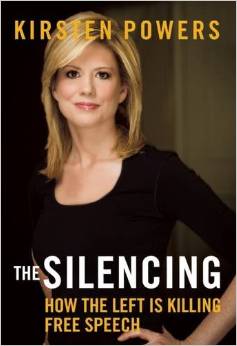 How refreshing that there are people like Kirsten Powers in the world.
In her new book, the outspoken, unapologetic liberal Democrat has taken aim at the militant search-and-destroy tactics employed by many liberals to shut down civil discourse and bully ideological opponents into submission.
Not surprisingly, many on the left have turned their attacks upon Ms. Powers and her book, proving her point by doing exactly what she accuses them of doing.
The intellectual laziness of groupthink lies at the heart of the deep divisions that are tearing this country apart. If more people would listen — listen to each other, and listen to Ms. Powers’s message — America might start turning back toward a culture of problem-solving and away from character assassination and political dogma.
How Ants Survive Rush Hour…
… and why putting your ego in check will change your life
 It’s everyone’s nightmare. Rush hour. Inching along interminably as too many cars navigate too few lanes, with too many merging in and too few turning off.
Who would have imagined that King Solomon already anticipated the chaos of our highways when he declared, Go, sluggard, and learn from the ant?
As it turns out, ants are better drivers than we are. And the lessons of their highway habits offer some valuable lessons that extend far beyond the way we drive.
According to NPR, Apoorva Nagar discovered the connection in a study by German and Indian researchers. Apparently, traveling ants are able to maintain a constant speed regardless of the number of ants on the path. In other words, even at rush hour, ant traffic carries on unimpeded.
Higher Education?
 On March 9, the Supreme Court refused to hear an appeal by the University of Iowa College of Law challenging Teresa Wagner’s successful lawsuit claiming political discrimination for her conservative views.
The decision comes a year after a more dramatic victory by Mike Adams, a conservative sociology professor who won a similar suit. Professor Adams was awarded a promotion, a raise, $50,000 in back pay and $710,000 in legal fees from the University of North Carolina-Wilmington.
Underlying both stories is the more serious concern that the culture of ideological narrow-mindedness and bullying has transformed college campuses around the nation from centers of higher thinking into indoctrination centers for political and philosophical uniformity.
 And it’s not just universities. My Google search for this story turned up only two headlines, one from the conservative Washington Times and the other from the local Iowa Press Citizen. The print media, it seems, has no more interest in open discussion and debate over opposing viewpoints than does academia. Better to man the battlements and defend the ivory towers from that most dangerous of all enemy attackers — rational thinking and reasoned argument.
The same principle holds true in business, in education, in religion, and in every arena of social discourse. If we can’t articulate the position of our ideological opponents, we can’t refute their arguments and, more important, we can’t fully understand our own.
For a more thorough discussion regarding the evils of groupthink, please see my article here.
Just who are “we”?
Tonto: What is wrong, Kimosabe?
Lone Ranger: We’re surrounded by bloodthirsty indians, Tonto. What are we going to do?
Tonto: What you mean, “we,” white man?
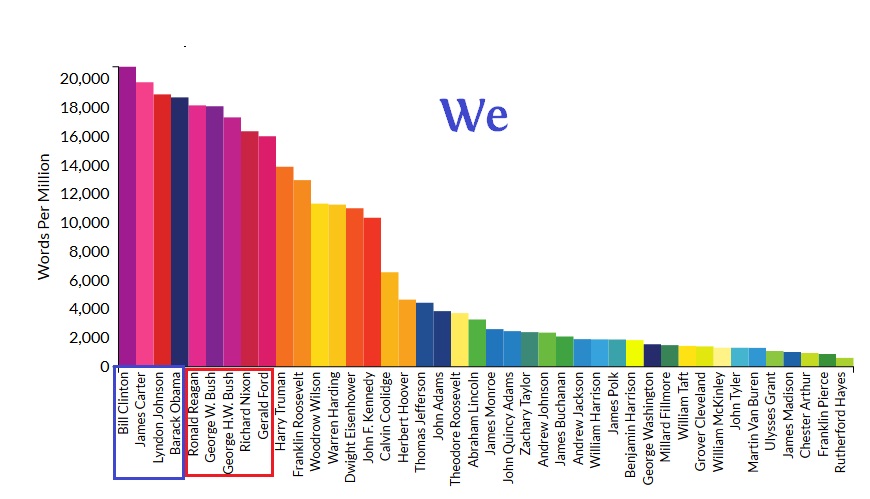 Thanks to Jay Livingston for this post on behalf of the Montclair State Sociology Department. He paints a compelling picture of how the collective language of “we” has been increasingly conscripted by modern politicians to create — or fabricate — an impression of common purpose and common allegiance.
With politics dividing us more deeply than ever, it might seem beneficial to employ rhetoric designed to bridge the ideology gap. In practice, however, disingenuous expressions of harmony and unified vision can do a lot more harm than good.
For one, when a demonstrably divisive leader — a U. S. president, for example — claims that he is the leading advocate of unity and cooperation, he makes himself a lightning rod for accusations of hypocrisy and manipulation that breed cynicism in place of optimism. For another, by claiming the high ground, he implicitly vilifies all who oppose him, even if they do so from positions of principle. Either way, the ideological rift grows wider, not narrower.
Perhaps worst of all, the collective “we” diffuses responsibility from the individual onto the collective: since all of us are responsible, none of us is responsible. This produces the effective equivalent of such politicalisms as “Mistakes were made.” Somewhere, someone did something wrong. There’s plenty of blame to go around, but nowhere for it to stick.
In short, fake unity achieves the opposite of unification.
But when there really is cohesion, whether within a team, a business, a community, or a society, the collective “we” becomes a priceless asset, including the lowly with the high, the rank and file with the leaders, the grunts with the visionaries. Like it or not, we’re all in it together. And the more we try to shoulder our collective burdens with one mind and one heart, the more we will succeed.
Symbiosis — Blueprint for Peace
 Here’s a beautiful spread from Cosmos Magazine on cooperation in nature. If natural enemies can make peace with one another for mutual advantage, shouldn’t human communities be able to recognize how much more we stand to gain by setting aside our petty differences… or even working through our substantive differences?
It’s largely a matter of will. We have to want to resolve our disagreements more than we want to be right. Some earlier thoughts on conflict resolution here.
Thanks to Rabbi Yaakov Feitman for his article in this week’s Mishpacha Magazine.
 Yonason Goldson