Home » Posts tagged 'Culture Wars' (Page 3)
Tag Archives: Culture Wars

Guest Post: Stop “Talking” During the National Anthem
 117 seconds. That is how long it takes, on average, for the playing of the National Anthem. So why are these 117 seconds becoming some of the most controversial in America?
Because people are “talking” during it. It’s not a time to talk. It’s a time to listen. And the voices that are supposed to speak at that time can’t be heard if others are talking during the playing of the Anthem.
Click to read the rest of a Gulf War veteran’s stirring call to action.


The Real Rainbow Coalition
 The story of a Great Flood can be found in virtually every human culture. However, the biblical record stands alone in its dramatic conclusion: as Noah emerges from the ark, the Almighty sets His rainbow in the heavens as a sign that never again will He visit the waters of devastation upon the earth.
Much has been made of the shape of the rainbow – an inverted bow to direct the arrows of divine wrath away from mankind. But is this a hopeful sign? Does it not imply that we are in fact deserving of destruction? Does it not contain a warning, that only because of God’s promise to Noah are we spared the natural consequences of our own moral corruption?
And what do the colors and beauty of the rainbow signify? Is it not incongruous to invoke something so beautiful as a reminder that a 4000 year-old covenant is all that stands between us and annihilation?
WANTING IT BOTH WAYS AND NO WAYS
In the old Peanuts comic strip, Linus once declared that, “I love humanity; it’s people I can’t stand.”
It’s no longer a joke. As human society grows ever more fractured, we see everyone else as either too traditional or too progressive, too dovish or too hawkish, too far left or too far right. Unity remains a dream we no longer believe in as we divide ourselves up into increasingly tribal enclaves.
Paradoxically, it is the strength of conviction that separates people from one another. Too many of us believe that our way is more “beautiful” than anyone else’s way, that only we are the chosen standard-bearers, and that we alone speak Truth while all others are heretics or infidels.
Why do we find it so difficult to celebrate our — dare I use the word — diversity? We give lip service to the value of multiculturalism, recognizing that our differences can make us greater than the sum of our parts. But then we use distinctiveness as a wedge to set ourselves apart from others.
In modern society, diversity often becomes a club to bludgeon into submission all whose sense of traditional values or personal integrity compels them to reject the moral anarchy that defines our times. Intolerance masquerades as forbearance, proclaiming an open-mindedness that is reserved only for those who conform to ideologically acceptable standards of cultural elites.
THE CHALLENGE OF MORAL EQUILIBRIUM
It was the same kind of violent division that brought the devastation of the Flood upon mankind. In that benighted generation, the law of the jungle drove human beings to an unthinkable level of bestial corruption. Had the Almighty not brought the waters of destruction upon the earth, human beings would surely have destroyed themselves.
Back then, it was selfishness and greed that tore society apart. Today, it is ego and ideology.
True, it’s not easy to achieve the delicate balance between acceptance on the one hand and conviction on the other. Tilting too far to one side catapults us toward moral dogmatism; tilting too far to the other sets our moral compass spinning in all directions.
So what is the solution?
The answer lies is seeing the rainbow as both beautiful and terrifying. It is a symbol of diversity and how much we can achieve by celebrating our differences; but simultaneously it is a reminder of how much destruction we can bring upon our world when differences become justification for divisiveness.
To truly love our fellow human beings we cannot retreat into ideological isolation. If we do, we will succeed only in marginalizing others in our own minds. Ultimately, we must take great care to chart a course between the extremes of ideology and accommodation.
So reach out to connect with someone outside your own close, closed, comfortable group. Engage people who think differently, not to debate but to exchange ideas and seek understanding. Remember as well that the most exquisite flowers, the most dramatic seascapes, and the most inspiring mountain peaks are those that reflect all the colors of the rainbow.

Honor Thy Fathers
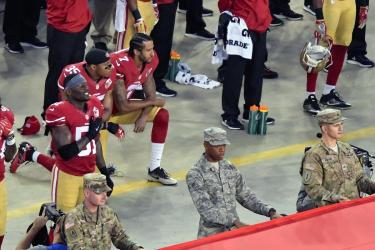 Meritocracy. Collaboration. Personal achievement.
These are the ideals upon which was the United States was founded, the ideals that have made and continue to make America great. They are also the ideals that have traditionally been associated with professional sports.
How ironic, therefore, that the NFL has been overtaken by a sentiment of rejectionism against the symbol of those very values. How tragic to witness players use the freedom represented by the flag to show contempt and disdain for the country that has afforded them an opportunity for success they might never have otherwise had.
No, our country is not perfect. But the flag represents that values that allow us to strive together toward a more perfect union.
That being said, it’s not the job of the president to call for the NFL to penalize those players. It’s his job to demonstrate the responsible use of free speech by conducting himself with principled determination and disciplined self-restraint.
Our Chief Executive is responsible for passing fair and effective legislation while creating a national tone of respect and personal responsibility. Implicit in that is knowing and showing where the division between the two must be drawn.

The Beauty of Misfortune

What would Gandhi say?
There’s not much question, really. The icon of civil disobedience disdained every form of violence. He most certainly would have condemned riotous demonstrations protesting any courtroom verdict, no matter how unpalatable. So would Martin Luther King.
It’s easy to understand why many St. Louis residents took to the streets over the acquittal of former police officer Jason Stockley in the shooting death of Anthony Lamar Smith. Officer Stockley’s comments and conduct raised serious questions about the credibility of his own testimony. And civil protest is one of the foundational principles of a free society.
But on the other hand, the shooting followed the high-speed pursuit of a suspected heroin dealer, and video footage failed to substantiate the claim that Officer Stockley planted a weapon. In the end, Judge Timothy Wilson concluded that there was insufficient evidence for conviction.
So did Jason Stockley get away with murder? We may never know. But that’s not the point.
TO ERR IS HUMAN
We all know that our justice system is imperfect, as any system designed and implemented by human beings must be. Sometimes honest people make mistakes. Sometimes authority is corrupt. Sometimes the truth hides its face, and sometimes we have to accept that justice can be painfully blind.
It’s what we do next that matters most.
Some respond to frustration by venting their anger on whatever target crosses their path – in this case, by smashing the windows of 23 storefronts in my hometown, the St. Louis suburb of University City.
But from these senseless acts of misdirected destruction emerged an exquisite silver lining, an example of how human beings can discover within themselves true nobility in the face of injustice.
 The morning after the carnage, volunteers appeared on the streets and began sweeping up the broken glass and boarding up the broken windows with plywood. But even at that, the kindness of strangers had only just begun.
Before long, local artists showed up to paint the plywood panels, transforming stark reminders of wanton violence into beautiful murals of friendship and neighborhood harmony.
FACING THE FUTURE
This week, the Jewish community stands between Rosh Hashanah and Yom Kippur, between the Day of Judgment and the Day of Atonement. On those awesome days, we gather together in prayer, one people with one heart, to recite the High Holiday prayers. And as the liturgy rises to a crescendo, it impels us to ponder the uncertain future that awaits us in the coming year:
Who will live and who will die; who by water and who by fire; who by the sword or wild beast, who by famine or thirst; who by storm or plague or violence. Who will rest and who will wander; who will have peace and who will suffer; who will be poor and who will have wealth; who will be cast down and who will be raised high.
We have no idea what the future holds. Ultimately, we have no control over where fortune will take us. What we do control, however, is how we respond to our own fortunes and the fortunes of our fellows.
When we see our neighbors in distress, will we drop everything and hurry to their aid? When we behold injustice, will we add to injustice by lashing out impulsively? Or will we stand shoulder to shoulder in a show of solidarity?
And when we witness senseless suffering, will we close our eyes and harbor vengeance in our hearts, or will we resolve inwardly to do better ourselves, to ensure that we never contribute to the problems of the world but apply our energies toward finding solutions?
There is so much good in the world from which to find inspiration. And while some may add to the darkness with misdirected violence, let us call upon ourselves to rise to every challenge, to shine bright so we can inspire others to shine themselves.

Ask the right questions
 How should we program driverless cars to respond to life-and-death situations? That’s the question posed by computational social scientist Iyad Rahwan in his recent Ted Talk.
His answer?
It’s a good question.

If all the seas were diamonds
 It’s not raining money, but it might be raining diamonds.
Not here on earth, of course. For that you’ll have to go to the planet Neptune. At least, that’s what scientists are now telling us.
I won’t pretend to understand the phenomenon of spontaneous diamond showers deep inside the ice giant that lurks at the outer reaches of our solar system. Nor will I attempt to explain how scientists here on earth are simulating the process.
Instead, let’s talk about the practical applications of mass diamond production.
It’s long been known that the diamond industry artificially inflates prices through market manipulation and manipulative advertising. Diamonds may be forever, but so are Cubic Zirconia — and most people can’t tell the difference. So why spend $5000 on a two karat diamond when you can buy a comparable CZ for 30 bucks?
To paraphrase Will Rogers, people will eagerly spend money they don’t have on things they don’t need to impress people they don’t like. The adage has been repeated by many, including Lev Leviev, the world renowned “King of Diamonds.”
Because of their hardness and heat conduction, diamonds do have genuine value: in the manufacture of cutting and drilling equipment, as well as for research and technology. But as far as jewelry, the cost is all about hype.
Which should make us pause to wonder: what if it really did start raining diamonds?
A famous parable tells the story of a poor man who travels to a far away island where the ground is littered with diamonds and precious stones. The moment he gets off his ship, he falls to the ground and begins stuffing his pockets with gems.
The people around begin to laugh. “Why are you picking up worthless pebbles?” they ask. In an instant, the man realizes that the stones, worth a fortune in his own country, have no value at all here. And since the obscure island is only visited by ship once a year, he will have to find a way to support himself until the next ship comes to carry him home.
After making some inquiries, the man learns that the most profitable source of income on the island is cooking-fat. He discovers that he has a particular talent in this area, and before long he is making an excellent living in the cooking-fat industry.
The year passes quickly, and when the ship finally arrives the man packs up all his valuable fats to bring home with him. He reaches the port just as the ship is getting ready to make sail. All at once he remembers the reason why he came in the first place. He hurriedly bends down to scoop up a few stones, then has no choice but to board the ship before it departs.
Upon returning home, the man’s family rejoices at the fortune with which he has returned. But the man is forlorn. “You don’t understand,” he says sadly. “If I hadn’t forgotten why I was there, we might have a thousand times what I brought back.”
If we bother to think about it, it’s be obvious that shiny stones are not the source of happiness. Objects have value because they are useful, because they are beautiful, or because they are rare. But when we allow others to convince us to make them rich by investing in things with no intrinsic value, is there anything more foolish?
King Solomon says: There is one who thinks himself rich and has nothing; there is one who thinks himself poor and has great wealth.
The blessing of family, of friends, of community; the joy of kind acts and charity; the inspiration that accompanies wisdom — these are the gems that are truly priceless. They cost far less than shiny stones, and they make our lives infinitely richer.
As long as we don’t forget.

No Safety in Numbers
 “While nobody knows what’s going on around here, everybody knows what’s going on around here.”
In his eerily prophetic 1975 novel, The Shockwave Rider, John Brunner describes the Delphi pool, a futuristic incarnation of the Las Vegas betting boards. It works this way:
Ask large numbers of people questions to which they can’t possibly know the answers. For example: How many victims died from influenza in the epidemic of 1918?
Even though few of the subjects know anything at all about the question, their guesses will cluster around the correct answer. In the novel, the principle held true even for things that hadn’t happened yet, creating a reasonably accurate window into the future.
As it turns out, Mr. Brunner wasn’t far from reality. Although his system doesn’t hold true for actual statistics, it’s right on target when applied to human psychology.
In a recent series of experiments, marketing professor Gita Johar of Columbia University and her team discovered that people in the company of others are more likely to accept unverified reports as true than people who are by themselves.
More compelling still is that the company we are in doesn’t have to be physical to impair our natural skepticism. Even in a social media setting – connected only virtually with other people – we are more likely to accept information at face value, especially if it fits in with our preconceived notions.
Professor Johar explains this as a manifestation of herd mentality, an unconscious response to the belief that there is safety in numbers. We don’t feel the need to question or fact-check because we rely on the group for authentication, even as everyone one else in the group simultaneously relies on everyone else in the group.
Welcome to the modern Delphi pool for the dissemination of fake news. The more people who hear a report, the more likely they are to believe it. In no time at all, news becomes accepted as fact regardless of accuracy, even when it is easily verifiable as false.
With groupthink becoming the standard of our times, we not only become less able to recognize the truth – we become less interested in doing so. We condemn reports as fake news not because they are factually incorrect but because they refuse to conform to our own vision of reality. As long as we keep company with others who are similarly disinterested in the difference between true and false, we have no reason to question the status quo.
In fact, probing for the truth can be positively dangerous. One word against the party line is guaranteed to bring down upon our heads the wrath of the ignorant majority among our own allies determined to hold fast to their fabulist misconceptions.
So as accusations of lying – real and imagined – fly back and forth across the aisle, we have to ask ourselves a question: do we want to do anything about it, or have we become too comfortable with our culture of falsehood to seek resurrection of the truth?
King Solomon says, A sophomoric person believes every word, but an insightful person minds his every step.
If we want to live in reality, we have to break away from the delusions of the herd and follow the path that leads back to the real world. If we want true answers, we have to be willing to ask hard questions – and then we have to be able to face up to the truth no matter how uncomfortable or how unpopular that might make us.


The Problem with Ethics
 “The hate and division must stop. And must stop now.”
~President Donald Trump
Is this the best we can hope for from the president who tells it like it is? Do we need yet another uninspired chapter lamenting the “cycle of violence” added to the tedious narrative of moral equivalence?
After eight years of an administration too feckless to acknowledge radical Islam as the leading force behind global terrorism and so vapid as to dismiss the Fort Hood massacre as “workplace violence,” we have a right to expect the new regime to condemn white supremacists and neo-Nazis for what they are.
To his credit, the president got there… eventually. But it took him way too long. If we want to stop these kinds of incidents before they start, we need to confront them with clarity and courage.
WHAT CAN BE DONE?
The sad reality is that we have to let bigots and racists hold rallies like the one last weekend in Charlottesville. And the sadder reality is that we have to encourage young idealists like Heather Heyer to put themselves on the line by speaking out against bigotry and racism, even though we know it sometimes ends in tragedy.
But passion has to be tempered with reason. Case in point: the outcry against Attorney General Jeff Sessions for not immediately launching a hate-crime investigation is all heart and little head.
The very term “hate-crime” is symptomatic of the ethical confusion of our times. With left and right more polarized than ever, each side brands the other side as evil and thereby legitimizes its own hateful rhetoric.
The result is that we criminalize the motives of people we don’t like and excuse the actions of people we do. And that just leads us deeper into the quagmire of moral anarchy.
WHAT GOES AROUND…
The day after the Charlottesville attack, a drunken American tourist got it into his head to give the Nazi salute in Dresden, Germany. A scandalized local physically attacked the man, then fled before police could arrest him for assault.
Are you nodding your head in approval? That’s only natural. But ignorance, loutishness, and racism are not illegal, nor should they be. If we want to live with freedom, we have to tolerate those who wield their freedom irresponsibly, if not criminally.
And when they do cross the line into criminality, we should let the law work the way it was meant to work. It’s a sure bet that the deranged extremist who rammed his car into the Charlottesville crowd had convinced himself he was acting on the side of the angels. But he should be prosecuted as a murderer, not as a zealot.
… COMES AROUND
What sparked this ugly episode was the removal of a statue of Robert E. Lee, a southern hero revered in his time for his honor and nobility. Should we ignore General Lee’s support of slavery because of his other virtues? Or should we discount his virtues because he fought for slavery?
No and no. People are complicated, and often contradictory. That’s why attributing motive is both tricky and risky.
It’s easy for us in our age of equality to condemn man’s oppression of man, as we should. But it’s also unjust to demand the same level of moral clarity from those who lived in different times with different values.
Indeed, when the values of future generations undergo another sea-change – as they will – who will defend us for our beliefs and actions before the indictment of our grandchildren?
IT’S NOT ALL BLACK AND WHITE
What are ethics but the slippery discipline of gleaning the spirit of the law from within the letter of the law? Even more slippery is the awareness that the morality of Man is subject to human bias and shifting cultural values. Sometimes the law is wrong; and sometimes so are we.
We dare not excuse every historical movement merely because it seemed right in its time; but neither should we condemn all those who lacked the moral clarity of our own times. 19th Century slavery and 20th Century Nazism were both evil. But they are not equivalent. And 21st Century white supremacism is much closer to the latter than to the former.
So how do we navigate these treacherous moral waters? We look to our leaders, who have the responsibility to help us set our collective moral compass as much as they have the obligation to steer the ship of state.
King Solomon says, A magic rests on the lips of the king; let his mouth not betray him in judgment.
You’ve got the helm, Mr. Trump. Be very careful what you do with it.
 Yonason Goldson