Home » Posts tagged 'Culture' (Page 3)
Tag Archives: Culture
Why Ethics Matter, Part 3: How I Survived Paris
You learn a lot when you travel. And the lessons you learn may include valuable tips on self-preservation.
My experience on the famous Champs-Elysee offers an entertaining look at our we can discover life-lessons in the most unlikely places.
Click here to enjoy another 2-minute video. Share your own account of some unexpected lesson learned in the comments section.


The One Best Way to Win
 Hindsight is 20/20, and Monday morning quarterbacks are never wrong. But back when democrats and republicans agreed that Hillary Clinton’s election was a foregone conclusion, the few voices predicting Trumpian triumph were drowned out in a chorus of Clintonian inevitability.
Of course everything looked different on the first Wednesday in November, and it came as no surprise that as soon as the shock wore off pundits began reverse engineering the former first lady’s defeat .
It’s a bit embarrassing how, a year after the election, Mrs. Clinton is still casting about to blame others for her cataclysmic upset. Perhaps she should read, “Shattered,” in which Jonathan Allen and Amie Parnes attribute Mrs. Clinton’s undoing primarily on what was obvious to everyone from beginning to end —

He Gave Peace a Chance
 After a 34-year run, Gerry Adams is stepping down as leader of the Irish nationalist party Sinn Fein. In a world ablaze with seemingly intractable political conflagrations, his story offers a whisper of hope that even the fiercest fires of discord can eventually be subdued by the waters of peace.
I witnessed a small part of the Irish conflict myself when I visited the emerald island in the summer of 1984. It was the midst of “the Troubles,” and central Belfast exuded all the charm of a city under martial law. Policemen on patrol wore flak jackets. An armored personnel carrier idled at a major intersection waiting for the signal to change. Blown out shells of buildings sprouted weeds, and street signs shouted, DO NOT LEAVE CAR UNATTENDED.
“Which are the bad parts of town, the ones I should avoid?” I asked the owner of the bed-and-breakfast where I passed my first night in the capital city.
She dutifully pointed out the Shankill neighborhood on my map and cautioned me to steer clear of it. I thanked her and, with sophomoric self-confidence, proceeded there directly. As I worked my way into the district, I discovered disturbing signs of contention: school yards surrounded by 20-foot fences topped by razor-wire, churches pocked with scars from automatic-rifle fire, and the uneasy quiet of a battlefield waiting for the next barrage.
From what I learned about the conflict, it seemed that each side had sufficient justification to ensure that the violence would continue on and on without end.
900 YEARS OF DARKNESS
As early as 1171, English barons began seizing Irish lands for themselves. In 1541, Henry VIII of England declared himself King of Ireland, adding a poisonous strain of religious acrimony between Irish Catholics and British Anglicans.
By 1703, 90% of Irish land was owned by English lords, who enriched themselves while Irish peasants endured bitter poverty and, during the potato famine of 1845, starvation. Only in 1948, after generations of unrest, did the birth of the Irish Republic restore most of Ireland to the Irish.
However, the six northernmost counties voted to remain part of Great Britain. The majority of residents were the descendants of English lords, but they saw no reason to be stripped of their national identity because of the sins of their fathers. Meanwhile, the long-suffering Catholic minority seethed at having been denied the liberation of their countrymen to the south.
In 1968, a series of protest marches led to riots and the first use of guerrilla tactics by the Irish Republican Army. If they could not win freedom for Ireland through elections and negotiation, they would win it through terror.
Over the next three decades, 3,600 people lost their lives in violent clashes and bloody attacks, many of them orchestrated by Sinn Fein, the political wing of the IRA. And from 1983 forward, the face of Sinn Fein was Gerry Adams.
A TIME TO HEAL
Reviled by British leaders as either a terrorist front man or enabler, Mr. Adams struggled to navigate the treacherous straits between hardliners and advocates of negotiation. Some accused him of collaboration in murder, others of selling out his own people.
 Whatever his faults or crimes, in 1998 Gerry Adams helped push through the Good Friday agreement, brokering the compromise that ended centuries of strife.
The greatest impediment to peace is often the will to make peace. Like it or not, we have to share our world with others who see the world differently, who have their own desires and dreams, who believe themselves justified in demands that contradict that strike us as anathema. As mutual hostility escalates, resolution seems increasingly impossible.
King Solomon warns: Do not say, “I will do to him as he has done to me and return upon others according to their own actions.”
When we demand what we believe we deserve, the frequent outcome is that we secure none of our demands. By giving up more than we want, we may end up with more than we ever believed we could get.
Once we recognize the advantage of peace over personal agenda, then the impossible becomes possible, and the ideal of peace has a chance to become reality.

Stop Squabbling, Start Succeeding
 In 1932, President Herbert Hoover appointed Benjamin Cardozo to the Supreme Court. The president was a conservative Republican. Justice Cardozo was seen as a liberal Democrat — but he was also recognized as the greatest legal mind in the country.
President Hoover certainly would have preferred a conservative, but he knew the country wouldn’t stand for him to choose a supreme court nominee based on politics. He nominated Benjamin Cardozo, who was approved by the Senate — unanimously .
As recently as 1986, the Senate confirmed Antonin Scalia without a single opposing vote, and in 1993 Ruth Bader Ginsburg sailed through confirmation with only 3 dissensions. It wasn’t so long ago that our politicians’ top priority was to keep the system working.
But times have changed.


Why Ethics Matter: Part 2 — Peruvian Beauties
Beauty contests aren’t PC anymore, but this year’s Miss Peru pageant was truly a thing of beauty.
Instead of headlines filled with accusations of sex scandals and kneejerk denials, as well as unfocused protests turning violent, contest contestants in Peru found a way to elevate an exercise in objectification into a show of civic responsibility, ethical accountability, and social conscience.
What does it say when beauty queens have more moral authority than politicians? Their initiative and resolution should be an inspiration to all of us.
Click to watch my 2-minute video. And please subscribe to my channel by clicking here. Thanks!

The Aftermath of Abuse
 Feeding frenzy might be the best caption for our scandal-ridden headlines. Paradoxically, the designation fasting frenzy would be equally suitable.
Let me explain.
In recent weeks and months, reports of sexual misconduct have propagated faster than entries on a nine-year-old’s birthday wish list. Roger Ailes, Bill O’Reilly, Steven Seagal and, of course, Harvey Weinstein are just a few of the 33 alleged predators listed in a recent L.A. Times article. Since then, accusations have been leveled Roy Moore, Richard Dreyfuss, George Takei, and Louis CK.
Perhaps the brightest silver lining is the extraordinary speed with which Kevin Spacey succeeded in destroying his own career. It’s reassuring to know that there are still forms of behavior sufficiently deviant to evoke universal condemnation.
In most cases, the alleged perpetrators have either fired back with furious rebuttals or dissembled with transparent evasions. Sadly but unsurprisingly, they remain unrepentant despite multitudinous plaintiffs or even their own court settlements.
Given the venal culture of both Washington and Hollywood, many of us are eager to believe every indictment and highly skeptical of the denials. But not all of us.
THE DARKER SIDE OF THE DARK SIDE
What effect do these scandals have on our culture? As with so many things, there’s good and there’s bad. The real question is: which outweighs the other?

On the positive side, when predators see that society will expose them and hold them accountable for their actions, the safer all potential victims become. On the other hand, the more such incidents are reported, the more degenerate behavior appears to become the norm. The result, perversely, could be to destigmatize and even enable similar behavior.
Then there is the sheer number of accusers. With so many plaintiffs, it’s hard not to wonder if some might be opportunists, simply piling on to genuine claims in hope of cashing in on the misfortunes of others. The frequency of such claims also increases the likelihood of defamation becoming a popular form of harassment itself, with baseless accusation converted into a weapon for character assassination.
Moreover, there’s the problem of exaggeration, of innocuous episodes unreasonably magnified. To wit, when former President George H. W. Bush – 93 years old and no longer fully in command of his faculties – pats a woman on her backside, this does not rise to level of abuses currently dominating the news cycles. We do real victims a disservice when lurid headlines paint every indiscretion with the same brush.
LESS THAN CHARMING
Depravity is bad enough. But the preponderance of charges, the kneejerk denials, and the moral equivalence of the petty and the abhorrent – these form a caustic trifecta of venality that sows cynicism all across the social landscape. With tragic irony, we can become so disgusted that we no longer care.
King Solomon says, If the snake bites because it was not charmed, there is no benefit to the charmer’s art.
How easily we convince ourselves that whatever we want is ours for the taking, that with craft and persuasion we can win anything we desire with no concern for risks and consequences. And when we overreach and fall victim to our own devices, the venomous destruction we let loose not only endangers us but all around us as well. In our arrogance we free the viper from its pit, and no one knows where it will strike.
Most of us will never come close to committing acts as horrific as those that fill the headlines. But without positive action, the persistence of such stories can erode our own commitment to ethics and set our own moral compass spinning in all directions.
 So how do we protect ourselves? First, by taking responsibility for even the smallest of our own actions. Second, by refusing to excuse the misdeeds of others – regardless of station or alliance – and, simultaneously, refusing to accept unsubstantiated accusations until all the evidence is in.
To see that all people are treated with the respect they deserve, to always rise to the defense of the defenseless, to hold ourselves and all others to a higher standard of personal conduct – this is the formula for a healthy, respectful, and civil society.
Published in Jewish World Review



Why Ethics Matter — Part 1: Evil Algorithms
Technology is supposed to serve us. But what happens when we create technology that takes control of us and leads us places we don’t want to go?
If you enjoy this video, please subscribe to my YouTube channel. Click here and then click the red SUBSCRIBE button.
Thank you!

Confronting the Credibility Crisis
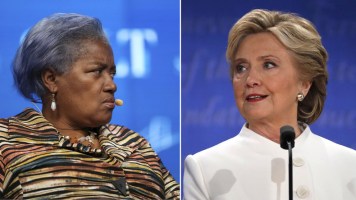 Hillary Clinton has been called a lot of things. But branding her the “cancer” of the Democratic Party ratchets the vitriol up to a new level.
More significant is who’s doing the name-calling. When Donna Brazile, Former Democratic National Committee Chair and longtime party stalwart, launches an internecine assault worthy of Donald Trump, it’s hard not to take notice.
Robby Mook certainly noticed. “Her claims are laughable,” the former Clinton campaign manager told Anderson Cooper. But Elizabeth Warren wasn’t laughing. Instead, the Massachusetts Senator invoked Ms. Brazile’s account of Clintonian malfeasance as evidence that the Democratic primary had been “rigged.”
So what are we to believe? Mrs. Clinton has been getting away with moral murder for years. Are the party faithful finally drawing a line? Or is Ms. Brazile merely trying to sell books while Senator Warren postures for the 2020 election?
Time may tell. But in the meantime, the undeniable victim is credibility.
TOO MANY CROOKS
There was a time when hustlers and lawbreakers would abandon their denials once evidence of wrongdoing grew overwhelming and indisputable. But today’s culture of fake news and fake outrage has spawned a limitless capacity for brazenness.
I am not a crook. I did not have sex with that woman. If you like your doctor, you can keep your doctor. I remember landing under sniper fire. The Art of the Deal is the number one selling business book of all time.
 Even the investigators of corruption fall under suspicion. Robert Mueller, the special counsel looking into Russian election tampering, has himself been implicated in the scandal he is charged with investigating. Mr. Mueller arrived on the scene with bipartisan plaudits for his character and integrity. Now we aren’t sure if we can believe that, either.
You would think in an age like ours, when every word and deed appears instantaneously as part of the public record, that public figures would be exercise more caution in what they do and say. Instead, they seem to care less than ever.
It’s not hard to understand why. Mainstream news outlets largely ignore stories inconsistent with their political ideologies. News consumers visit only those outlets that provide stories confirming their political biases. And the epidemic of inaccuracy leaves us so jaded that we feel justified believing whatever we want about anyone we choose.
The crisis of confidence in our political system is reason enough for dismay. But there’s an even more profound cause for alarm – the corrosive effect of cynicism on our collective conscience and moral clarity.
LEMMING MENTALITY SYNDROME
There may be no more malignant phrase in the English language than everyone does it. Our parents didn’t tolerate hearing it from us, and as responsible parents we refuse to tolerate it from our children. But anything that is repeated enough plants itself in our consciousness, where it insidiously takes root and refuses to let go.
 All the more so when the media bombard us with evidence that we can’t trust our leaders, can’t trust our icons, can’t trust the spokesmen for moral values to uphold the values they espouse. And if the people I’m supposed to look up to act without scruples, why should I worry about how I look in the eyes of others?
The solution, therefore, is relatively straightforward: start looking in a different direction.
In the first verse of his first psalm, King David writes: Fortunate is the one who does not walk in the counsel of the wicked, does not stand in the path of misguided people, and does not sit in the company of cynics.
The more we associate with those who reject ethical values, the more automatically we adopt their ways. The more we expose ourselves to the influence of those who embrace moral relativism, the more we disable our own moral compass. The more we keep company with those who view everything and everyone in a negative light, the more we grow convinced that there is no reason to hold ourselves to a higher standard.
But if we remove ourselves from corrupting influences by seeking out company and counsel from people of integrity, and by searching out the good instead of fixating on the bad – then we will find ourselves drawn steadily upward, and we will begin to draw those around us upward as well.
Published by Jewish World Review
If you enjoyed this article, please share with others. Thanks!
 Yonason Goldson