Home » Posts tagged 'Discipline' (Page 13)
Tag Archives: Discipline

Is there a difference between “opinion” and “bias”?
 On Tuesday 3 January — apparently in response to a hail of letters accusing the paper of editorial bias — the St. Louis Post-Dispatch ran a full-page editorial attempting to justify their approach to opinion pieces. I responded as follows:
Dear Editors,
In last Tuesday’s defense of your paper’s opinion pages, you claim that your reporting is free from editorial influence. Many would dispute this point, but I wish to address a more objectionable assertion in your argument.
You write: “Where you will absolutely find bias is on the opinion pages.” This remark is as astonishing as it is disconcerting.
Bias and opinion are not synonyms. Bias is by definition emotional, often to the point of irrational. Opinion expresses a principled position, ideally based on accurate information and sound reasoning.
Daniel Patrick Moynihan famously observed that you’re entitled to your own opinion but not your own facts. A responsible news organization, however, is duty bound to make sure that its opinion pieces are fact-based and logically developed. This requires an understanding of both sides of an issue and the commitment to intellectual integrity. Only then is an opinion deserving of publication.

Hail to the new chief
 Congratulations to Missouri’s new governor, Eric Greitens.
After serving as a Navy Seal, devoting his career to help returning veterans, and defining himself according to the value of character over ideology, Governor Greitens will enter his new role as public servant with today’s inauguration ceremony.
He offers the kind of hope that we all so desperately look for: modesty, civility, and a commitment to service above political agendas. He faces the challenges of anyone who seeks to confront a culture of entrenched partisanship and cronyism.
King Solomon says that the heart of kings is in the hands of God. May the Almighty guide him and all our leaders to recognize what is right, to retain purity of vision and purpose, and to rally support to lead us on the path of peace and prosperity.


It’s about time
 Are you feeling more rested this week? Do you notice your watch running a smidgen fast? Maybe it’s because of the leap-second added by the National Institute of Standards and Technology on New Year’s Eve.
A few of us may take comfort knowing that our clocks are back in sync with the earth’s relative positive to the sun, and find it reassuring that all the cosmic gears and cogs are once again in perfect alignment. The rest of us couldn’t care less.
Does it really matter?
Well, yes; it just might.
There are two ways to look at time. First, as a convenient touchstone for organizing our lives. Without some universal standard for tracking our days and our hours, imagine the trouble we would have arranging our affairs and interactions.
But you can also make the case that time really does mean something.

When bubbles burst
 Raise your glass of champagne to toast the new year. And then, before you take your first sip, ask yourself this question: where do the bubbles come from?
You see them, don’t you – those strings of tiny bubbles rising steadily from the bottom of your fluted goblet? They seem to appear out of nothing and come from nowhere. And yet they keep coming, like refugees from some parallel universe escaping through an inter-dimensional portal, yearning to be free.
The explanation is quite simple. What is more compelling is how the mystery of champagne bubbles can lead us to victory in the modern culture wars.
It can also provide a deeper insight into history’s first culture war, which culminated in the miracle of Chanukah.
TRAPPED IN THE DEPTHS
An average glass of champagne contains about 20 million microscopic bubbles, produced when fermentation under pressure forces carbon gas into wine. The relatively few bubbles that rise to the surface burst and release their CO2. As for the rest, the even distribution of internal pressure across the surface of each bubble keeps the gas trapped within.
Along the interior surface of the glass, however, are tiny imperfections. When bubbles come in contact with any such imperfection, the slightest change in pressure at the point of contact is enough to cause them to burst. Once released, the gas inside streams upward to the surface in a race for freedom.
Now think of champagne as an allegory for life.
A WORLD OF BUBBLE-DWELLERS
Never in history has a society been more comfortable than in this generation. Our homes are climate controlled within a two-degree range. Our cars have automatic entry, heated leather seats, and full entertainment centers. We buy our groceries and holiday gifts with the click of a mouse and wait for them to be delivered by bonded messenger or drone. We text people in the same room and find it too burdensome to open our email.
And what do we have to show for it? We have lost all ability to cope with inconvenience, delay, and change. A website refusing to load, a text not returned in 15 seconds, or our favorite TV show preempted by an amber alert — these are the crises of our times, the insufferable challenges of our era. It’s both laughable and tragic to imagine how we would manage had we to face the hardships of the crossing of the Mayflower, the Great Depression, or the Battle of the Bulge — let alone Auschwitz or the Soviet gulag. The plight of Syrian refugees right now across the sea is too horrific for us to even contemplate.
So we don’t. We’re too comfortable inside our bubbles, insulated from the cold, hard realities that most humans have had to endure through the ages. We hide away from the rest of the word, until something pricks the surface to burst our bubbles — leaving us in pieces and gasping for breath.
But really, we should be grateful for those pinpricks, both great and small. Like the gas that remains trapped beneath the surface, our own potential for greatness remains dormant within us until we are forced to confront the sharp edges of life. Instead of trying to hide from them, we need to prepare ourselves for when they inevitably arrive.
HIGHS AND LOWS
This was the state of affairs in Judea under the rule of the Seleucid Empire 2180 years ago. The prevailing culture of Greek philosophy worshipped aesthetic idealism. Graceful lines, elegant syllogisms, and harmonic symmetry represented the highest expression of human civilization.
But it also represented the lowest. Where the ancient Greeks revered physical and intellectual beauty, they abandoned children with physical deformities or mental impairments and left them to die. They valued the philosophic sophistication of their greatest thinkers less for its content and more for the polished sophistry of its expression. They ruthlessly stamped out all dissonance – as they did by sentencing Socrates, the greatest among them, to death for the crime of exposing the logical contradictions of their philosophy.
Enamored with the cultural idealism of Greece, Jewish Hellenists believed they could blend their practice of Judaism with the prettified ways of their masters. But Jewish philosophy demands that we challenge the external status quo, that we push our personal boundaries outward even as we strive to refine our commitment to the traditions on which our nation is founded. It is a prickly discipline, one in which bubbles cannot long survive.
And so the culture of Greece tried to swallow the soul of Judaism. But in the end, the weak rose up against the strong and the few prevailed over the many. Instead of capitulating to the apparent inevitability of their defeat, the Jews fought for their physical and spiritual lives. By doing so, they broke through the boundaries of what anyone imagined possible, and they set free the potential that would have remained forever hidden if the Greeks had not tried to crush it into non-existence.
And when the hidden spark of determination inside them caught fire, it light up the darkness of exile, just like the tiny container of oil that burned miraculously for eight days – a sign of divine favor because they refused to exchange spiritual identity for the comfort of cultural superficiality.
When we reject comfortable confinement and fight our way out of the bubbles we live in, there is no limit to the miracles we can expect to see in our daily lives.

Beyond the Stars — A tribute to John Glenn
 If I have seen further than others, it is by standing upon the shoulders of giants.
~Sir Isaac Newton
There are two kinds of visionaries.
The first type sees farther, like Sir Isaac Newton. They possess a special gift of brilliance, genius, or perception. They see what others cannot, recognize mysteries that hide in plain sight, uncover beauty and order where the rest of us see only chaos. For the most part, they are born, not made.
Then there are those who are blessed not so much with the ability to see, but with the ability to bestow vision, to illuminate the world not with new insights but by giving the gift of insight to others. It is not their acumen, but rather their irrepressible pursuit of transcendence that inspires us to do as much with our lives as they have done with theirs.
Thirty-six years after becoming the first man in orbit, John Glenn became the oldest man in space, not as an ego trip or publicity stunt but to observe the effects of weightlessness on his 77-year-old body. As with his first trip, he showed that the limits upon human beings are mostly self-imposed.
Most of all, he showed us not only what a person can do, but what a person should be.

Swearing makes you smarter. REALLY?
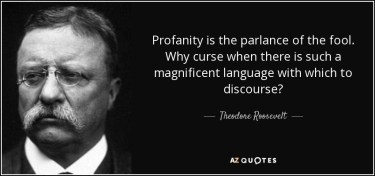 Experts have revealed [that] the use of profanity can in fact be a sign of a smart person.
This provocative assertion opened a recent article in the Daily Mail. The problem is, it’s not true.
Of course, that’s not the only problem. There’s also the problem of sloppy reporting, which comes from sloppy thinking, which comes from sloppy language. Which is what this story is really all about.
The alleged correlation between profanity and intelligence was inferred from a study concluding that people who know more curse words also know more words in general. Ipso facto, people who curse are smarter than people who don’t.
How much swearing do you suppose goes on at the Daily Mail?
Or you could ask a different question: Why should anyone take the Daily Mail seriously?
That’s a fair point. But the story also appeared in the Washington Post which, although avoiding the spurious equation between foul mouths and intelligence, still could not resist the lure of this equally misleading headline:
Why it’s a good sign if you curse. It isn’t. Which is clear from the Post article itself.

Peace in our Mind
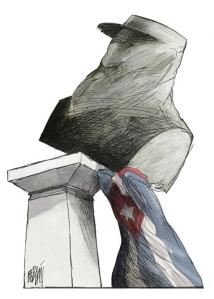 Two decades ago, Thomas Friedman suggested that someone should write a book called The Dictator Diet. Surely there must be some secret to the longevity of strongmen like Muammar Gaddafi, Yasser Arafat, and Fidel Castro. Like horror-movie mutations of the Eveready bunny, they just kept going and going and going.
Well, the last of them is gone at last. Adios, Mr. Castro. We wish we never knew ye.
But imagine if it had been different. What if Fidel had been a friend instead of a nuisance, if Cuba had been an ally instead of a thorn in America’s side?
It’s not such a wild notion.
 Yonason Goldson