Home » Posts tagged 'Ideology' (Page 12)
Tag Archives: Ideology
Dangerous Freedom
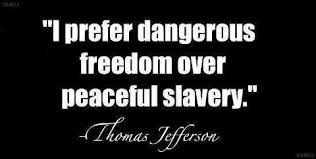 With the holiday of Passover behind us, the dangers of freedom become more threatening than ever.
Freedom is a privilege, not an inheritance. Freedom is an obligation, not a right. Freedom calls us to duty, not to indulgence.
And the illusion of freedom may be the cruelest tyrant of all, seducing us into accepting the slavery of ego, impulse, and comfort.
Every day we should ask ourselves: are we fighting to deserve and to preserve the freedom that our fathers fought so hard for us to have?
Higher Education?
 On March 9, the Supreme Court refused to hear an appeal by the University of Iowa College of Law challenging Teresa Wagner’s successful lawsuit claiming political discrimination for her conservative views.
The decision comes a year after a more dramatic victory by Mike Adams, a conservative sociology professor who won a similar suit. Professor Adams was awarded a promotion, a raise, $50,000 in back pay and $710,000 in legal fees from the University of North Carolina-Wilmington.
Underlying both stories is the more serious concern that the culture of ideological narrow-mindedness and bullying has transformed college campuses around the nation from centers of higher thinking into indoctrination centers for political and philosophical uniformity.
 And it’s not just universities. My Google search for this story turned up only two headlines, one from the conservative Washington Times and the other from the local Iowa Press Citizen. The print media, it seems, has no more interest in open discussion and debate over opposing viewpoints than does academia. Better to man the battlements and defend the ivory towers from that most dangerous of all enemy attackers — rational thinking and reasoned argument.
The same principle holds true in business, in education, in religion, and in every arena of social discourse. If we can’t articulate the position of our ideological opponents, we can’t refute their arguments and, more important, we can’t fully understand our own.
For a more thorough discussion regarding the evils of groupthink, please see my article here.
Visionaries and Ideology: a study in contrasts
 Who knew a trip to New York could be so emotional?
I didn’t want to go in the first place. As my 92-year-old student likes to quote: Travelling is for peasants.
But my wife convinced me with simple arithmetic. Four tickets to bring three kids and son-in-law home or two tickets to visit them. No-brainer.
So I went grudgingly, confirming in the end the truism that some of life’s most profound moments come not only unexpected but against our will.
Our first stop was the 9/11 museum. I marveled at the artistic vision that had conceived the memorial pools, the water channeling down in rivulets that mirrored the face of the fallen towers, the continuous downward rush balanced by the redemptive feeling of water — the source of life — returning to the heart of the world. Here there was solace, closure, and consolation.
But a very different feeling accosted me inside. Almost upon entering the doors a single word brandished itself across my mind’s eye: Holocaust.
Let me explain.
Read the whole article here.
Just who are “we”?
Tonto: What is wrong, Kimosabe?
Lone Ranger: We’re surrounded by bloodthirsty indians, Tonto. What are we going to do?
Tonto: What you mean, “we,” white man?
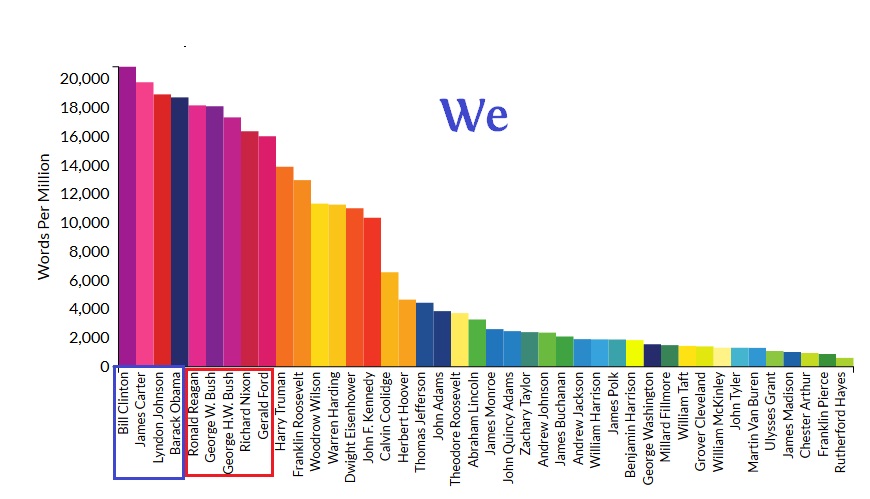 Thanks to Jay Livingston for this post on behalf of the Montclair State Sociology Department. He paints a compelling picture of how the collective language of “we” has been increasingly conscripted by modern politicians to create — or fabricate — an impression of common purpose and common allegiance.
With politics dividing us more deeply than ever, it might seem beneficial to employ rhetoric designed to bridge the ideology gap. In practice, however, disingenuous expressions of harmony and unified vision can do a lot more harm than good.
For one, when a demonstrably divisive leader — a U. S. president, for example — claims that he is the leading advocate of unity and cooperation, he makes himself a lightning rod for accusations of hypocrisy and manipulation that breed cynicism in place of optimism. For another, by claiming the high ground, he implicitly vilifies all who oppose him, even if they do so from positions of principle. Either way, the ideological rift grows wider, not narrower.
Perhaps worst of all, the collective “we” diffuses responsibility from the individual onto the collective: since all of us are responsible, none of us is responsible. This produces the effective equivalent of such politicalisms as “Mistakes were made.” Somewhere, someone did something wrong. There’s plenty of blame to go around, but nowhere for it to stick.
In short, fake unity achieves the opposite of unification.
But when there really is cohesion, whether within a team, a business, a community, or a society, the collective “we” becomes a priceless asset, including the lowly with the high, the rank and file with the leaders, the grunts with the visionaries. Like it or not, we’re all in it together. And the more we try to shoulder our collective burdens with one mind and one heart, the more we will succeed.
The Aroma of Ideology
 A NYT op-ed cites a study by social scientists at Brown, Harvard, and Penn State that people we agree with smell better to us.
For a theological critique, see my article, The Scent of Spirit.
 Yonason Goldson