Home » Posts tagged 'Israel' (Page 3)
Tag Archives: Israel

Napoleon’s Wisdom
 According to legend, Napoleon was riding through the streets of Paris one evening when he ordered his carriage driver to stop. Passing by a synagogue and glancing in the window, he had witnessed an entire congregation of Jews sitting on the floor by candlelight and raising their voices in cries of sorrow.
Napoleon sent his aide to investigate, and was informed that it was the ninth day of the month of Av, when the Jews were mourn the destruction of the Temple in Jerusalem.
“How long ago was it destroyed?” asked the Emperor.
“Over 1700 years ago,” he was told.
“1700 years and they’re still mourning!” exclaimed Napoleon. “Such a nation will endure forever and will rise to power again.”

The Road to Compromise
 After last week’s “historic” Obama-Kerry Compromise with Iran, it’s instructive to take a look back to see how little has changed. I published this op-ed in the St. Louis Post-Dispatch on 2 August 2002.
Henry Clay earned his reputation as “the great compromiser” when he forestalled the outbreak of the Civil War by ten years. Even so, one has to wonder whether even Mr. Clay’s genius for mediation could save the Mideast peace process from becoming a towering embarrassment to US foreign policy.
Compromise, according to Webster’s, is “a method of reaching agreement in a dispute, by which each side surrenders something that it wants.” This shouldn’t be hard to comprehend for anyone with a background in high school civics. What does remain incomprehensible is how otherwise reasonable people might seriously apply the term “compromise” to past peace proposals, and why anyone thinks it will be different the next time around.
Definitions notwithstanding, immediately after the Camp David negotiations in the summer of 2000 the New York Times observed that Yasir Arafat’s “willingness for more talks suggests room for compromise.”
The Times deserved credit for optimism and imagination, but won few points for objective editorial insight. Indeed, only a month earlier (on July 11 of that year), the Times reported that, “The Palestinians want a settlement based on United Nations Resolution 242,” implying that if not for Israeli intransigence, there would have been peace in the region long before.
Let’s see. Resolution 242 mandates 1) the “withdrawal of Israeli armed forces from territories occupied in the recent conflict,” and 2) the “termination of all claims or states of belligerency and respect for and acknowledgement of the sovereignty, territorial integrity and political independence of every State in the area and their right to live in peace within secure and recognized boundaries free from threats or acts of force.”
For its part, Israel returned more than 90% of the Sinai to Egypt in 1981, and offered to give more than 90% of Judea and Samaria to the Palestinians under former Prime Minister Ehud Barak. Pretty good, for a compromise.
From the Palestinian side, however, it’s been hard to detect even a whiff of compliance. Rather, these are the ways the Palestinian Authority has terminated its claims and belligerency: all government and schoolbook maps, as well as children’s television programs, identify the whole of Israel as “Palestine;” teenagers at Palestinian “summer camps” train with automatic weapons to fight Israelis; Arafat has named squares and streets after Hamas suicide bombers; Israeli security has caught PA officials smuggling numerous weapons, including anti-tank weapons, into Israel. The list could easily fill this column.
Ehud Barak had been prepared to overlook all that. But then the Camp David talks broke down anyway, largely because of Palestinian insistence of absolute sovereignty over East Jerusalem. Yet Jerusalem has been the heart and soul of Israel for over 3000 years, the holiest site on earth according to Jewish tradition and the Old Testament. The Arab’s spiritual capital is Mecca, whereas Jerusalem is merely a religious and historical footnote, not mentioned by name even once in the Quran. What’s more, from 1948 to 1967, when Jordan controlled East Jerusalem, not one Arab ruler visited the city, except Jordon’s own King Hussein. Electricity and water services were neglected, and no government offices or cultural centers were set up there.
So what does the Palestinian Authority want? What it has always wanted: everything. The very concept of compromise appears utterly foreign to the thinking of Palestinian leaders, and is entirely absent from their behavior. It’s hard to see what the PA has ever thought it’s bringing to the negotiating table, except for the vague promise of controlling terrorism and the hazy commitment of conceding Israel’s right to exist, a right already granted by the United Nations over half a century ago.
In hindsight, it’s also hard to see what Ehud Barak hoped to accomplish by bargaining away so much for so little. According to Mideast analyst David Makovsky, Mr. Barak’s objective was “peace without illusions.” Peace between governments, the former Prime Minister believed, is the only possible goal presently within grasp; peace between peoples is generations away.
Mr. Barak assumed that once a treaty is signed, all of Israel’s Arab neighbors will abide by its conditions, gradually leading to normalization and the eventual cessation of the hateful rhetoric that foments Arab violence.
The trouble is, there’s no evidence it would work. Whatever the terms, any deal that produces even the coldest peace must rest on the foundation of compromise, a foundation that doesn’t exist. The indoctrination of children with hatred of Israel continues, even in Egypt, nearly three decades after it grudgingly traded political recognition for the return of its land.
 Other Arab nations have refused to offer even this little olive branch; they have never demonstrated the slightest willingness to compromise. Neither Israel nor the United States should take another step forward until they do. Let us hope that the new U. S. president will learn from the errors of his failed namesake and not put his hope in false promises that have already led nowhere.

The Unfairness Doctrine
With the biggest FIFA scandal to date dominating the headlines, I’m revisiting this piece from a couple of years ago about the growing indifference to justice throughout the world community.
 There are certainly more important things than soccer to get worked up over — especially here in the United States, where we already have baseball, basketball, hockey, and (American) football.
Maybe that’s an argument in defense of referee Koman Coulibaly, who infuriated American soccer fans by disallowing a winning goal by team USA with no apparent justification. After all, it’s only a game. Wouldn’t all that passion be better directed against the gulf oil disaster or Iran’s nuclear weapons program?
In this case, at least, the Federation Internationale de Football Association (FIFA) might agree. According to the New York Times, FIFA president Sepp Blatter “does not want video replay or extra referees on the end line at the World Cup. He favors debate over decisiveness and human frailty over intrusive technology, thinking that subjectivity helps soccer more than it hurts.”
Now there’s an interesting philosophy: human error by judges, umpires, and referees enhances competitive sports. But don your body armor before making that suggestion to Detroit Tigers pitcher Armando Galarraga. Only two weeks earlier, you may remember, a blown call by umpire Jim Joyce on the last play of the game denied Mr. Galarraga baseball’s most coveted distinction — a perfect game.
In the aftermath, pundits have suggested that the baseball mishap did more for the sport than a perfect game ever could have. Mr. Galarraga was the model of graciousness, upset at being robbed but apparently harboring no resentment. For his part, Mr. Joyce appeared not only contrite but genuinely heartbroken. A week later, the league itself showed impressive quality of character when a hundred MLB players voted the repentant umpire the best in the game. All around, a sport that has been plagued with steroid and contract scandals produced extraordinary examples of dignity, restraint and — to revive an expression near to extinction — class.
In contrast, Mr. Coulibaly has yet to offer a single word of explanation, much less apology, for his inexplicable whistle-blowing. (However, mounting pressure may convince FIFA to reverse its own policy of refusing to comment on calls by the time this sees publication. Nothing challenges core values like bad press.)
But is it only a game? Every parent knows that the way children play reveals much about who they are deep down. It seems reasonable to assume the same about cultures: the way they play speaks volumes about their moral values.
MORE THAN A GAME
In American sports, everyone from fans to players to officials to high commissioners has weighed in on the use of instant replay to ensure the accuracy of calls at critical moments. Some argue that, in the interest of fairness, every available technology should be employed to ascertain the umpiric accuracy. Others are afraid that instant replay will slow down gamesalready mired in strategic interruptions and commercial breaks. But no one claims that accuracy doesn’t matter. And certainly no one has ever hinted that inaccuracy is good for the game.
What the Armando Galarraga incident so refreshingly demonstrates is that, to a large degree, Americans still care about facts and fairness. Umpire Jim Joyce acknowledged his mistake, expressed sincere remorse, and all was forgiven. What the Koman Coulibaly debacle indicates is that, to a large degree, the international community has lost all interest in truth and justice.
When such indifference to right and wrong confines itself to the playing field, we might pass it off as a sad but inconsequential character defect of sports celebrities. But this kind of skewed perception of reality long ago began seeping inexorably into the world of politics and social justice, most notably the assault by the community of nations against the State of Israel.
By all accounts, Israel should be the darling of the non-Arab world. Largely secular, the only democracy in the Mideast and the only Middle Eastern countryto have made concessions for peace, a socialist nation that has nevertheless become a burgeoning economic powerhouse, and a lone David surrounded by a hoard of Goliaths, Israel meets every criterion of European values. And yet, the European Economic Community and the European-dominated United Nations have, time and time again, cast Israel as aggressor and censured Israel for intransigence while ignoring facts and history that prove precisely the opposite.
Perhaps the United Nations should field its own soccer team. Perhaps Koman Coulibaly should seek nomination for the position of U.N. Secretary-General.
THE LAST EXILE
In his prophetic dream, the patriarch Jacob beheld celestial emissaries ascending and descending a ladder with its feet upon the earth and its top reaching the heavens. The sages of the Talmud teach that Jacob witnessed the guardian angel of Babylon go up seventy rungs and then descend, foreshadowing the Babylonian exile of 70 years. He then saw the guardian angels of Persia and Greece ascend 56 years and 180 years respectively, corresponding to the duration each would rule over the Jews. Finally, Jacob watched the guardian angel of Edom go up and up the ladder until he cried out to the Almighty, “Master of the World! Will this angel never come down?”
“Even if it reaches the gates of heaven,” replied G-d, “I will cast it down Myself,” implying that the nation of Edom would rule Israel until the arrival of the messianic era.
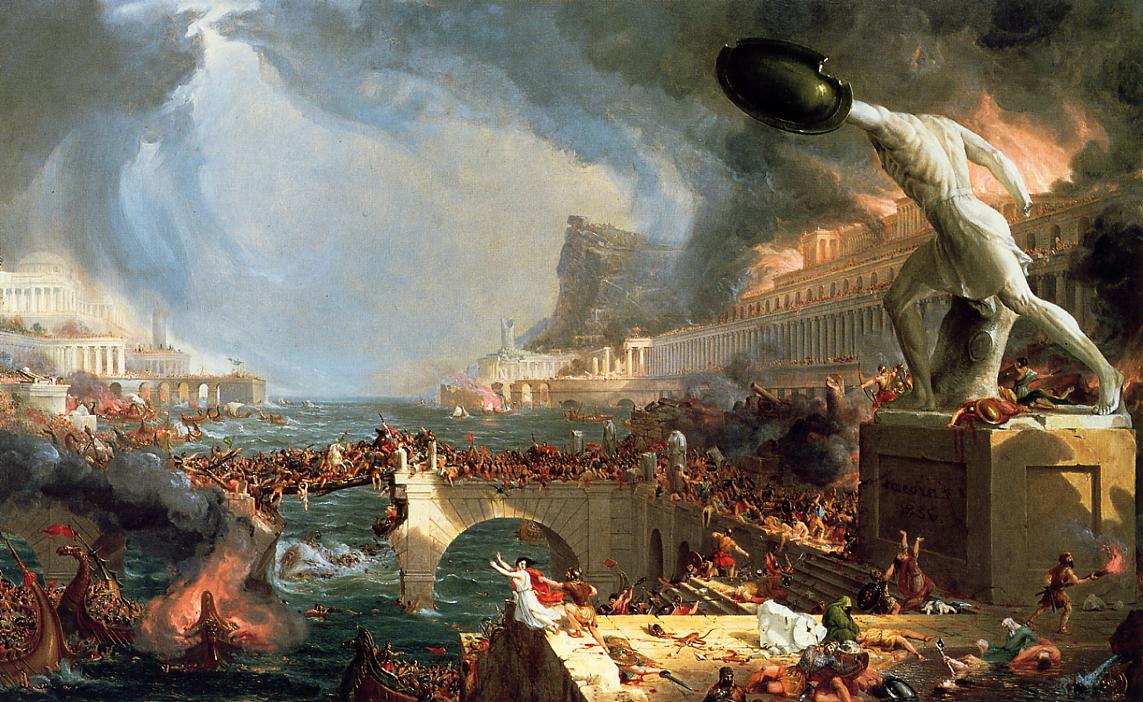 Nearly 2000 years ago, the sages identified the Roman Empire as the spiritual descendant of Edom, which was itself descended from Jacob’s wicked brother, Esau. But if the Roman Empire fell over 1500 years ago, how are we to understand the image of Rome’s guardian angel reaching the gates of heaven and surviving until the coming of the Messiah?
Esau was called Edom — meaning red — not because of his red complexion but because of his peculiar request that Jacob serve him “that red stuff,” by which he meant the bean stew he found his brother preparing when he came in hungry from the field. Color is the least intrinsic quality an object possesses, describing only the most external, cosmetic appearance without acknowledging function or purpose.
In this single moment, Esau revealed his defining quality as superficiality, the total lack of concern with anything other than outward appearances. And although the empires of Edom and Rome have long disappeared from the earth, the culture of superficiality that characterized them has become the salient characteristic of Western Civilization. In today’s culture wars, the final battleground between good and evil has become one in which evil claims to be good, conflating right and wrong with the empty sophistries of moral equivalence and political correctness, advancing arguments so thin and insubstantial that they fool no one who cares to look beneath the surface.
And yet, hardly anyone cares to look.
Soccer may be only a game, but it has become an international obsession. The contempt for truth articulated by its highest officials exposes a dangerous cultural bias and explains why the Europeans community would rather condemn the beleaguered nation of Israel than risk the consequences of antagonizing Israel’s belligerent and oil-rich enemies.
Jews around the world can take some comfort in the ability of America and Americans to still respond with passion in defense of truth. At the same time, the willingness of the current administration and so many in the media to rush to judgment against Israel offers unsettling evidence that we are approaching the fulfillment of the prophecy that, at the End of Days, Israel will stand against the world alone.
Originally published on Jewish World Review.

Jewish Billionaires put their Mouths where their Money is
Jewish billionaires Sheldon Adelson and Haim Saban have organized the first meeting of its kind, bringing together 50 Israeli and pro-Jewish corporations to push back against anti-Israel boycotts (BDS).
The real tragedy is that their efforts are necessary. The superficiality that typifies the Western World is self-evident with even the most feeble efforts to scratch the patina of political correctness that turns perpetrators into victims and victims into provocateurs.
 Shame on those who perpetuate the myth that Israel is the source of Arab suffering. Shame on those who provide the millions in aide that Gaza Arabs never see because their leaders spend it on high-tech tunnels for attacking Israeli civilians. Shame on those who caused hundreds of West Bank Arabs to lose their jobs by pressuring Soda Stream to move their production plant back across the “green line.” Shame on those who don’t hold the leaders of surrounding Arab nations accountable for ignoring the plight of Arab refugees for 60 years so they can vilify Israel for their own criminal negligence.
And shame on Jimmy Carter and his ilk who perpetuate the demonstrable lie that Israel is an apartheid state.
Would an apartheid state produce an Arab citizenry that has a higher standard of living, literacy, and longer life expectancy than that of the surrounding Arab nations? Would it have permitted a sitting Arab Supreme Court justice, Arab ministers, generals, ambassadors, and consulate-generals, an Arab Israeli national soccer team captain , and an Arab Miss Israel?
But ideologues never let facts get in the way of ideology. The successful western world must be held responsible for every evil in the world, even as radicals sacrifice their own lives to destroy the societies that allow well-meaning fools to enable the agents of their own self-destruction.

A Dybbuk in the White House?
 “What gives in the White House? If the genie is out the bottle what made, of all world leaders the most powerful, let it out? Who, or what, is the mischief maker behind the nuclear talks? What spirit runs amok in the corridors of power? The freak alignments lately fashioned point to some fiend on a depraved mission. American bombers now support Iranian troops to keep a chemical-weapon-dropping Syrian madman in power. Saudis and Israelis co-operate to stymie an American-made pact. An emissary from the White House supposedly told the Argentine government not to pursue Iranian murderers of eighty-odd Jews in Buenos Aries. Obama gives tacit blessing to the sale of a Russian ground-to-air missile system to Iran, which will make it more difficult for Israel to flatten those nuclear sites. A US President who sets all this, and more, in motion would have to be possessed.”
Read the rest of Steve Apfel’s inspired op-ed here.
Hat tip: Steve Glassman
St. Patrick’s Day — Searching for the way out of exile
 At first glance, the soggy, green downs of Ulster bear little resemblance to the parched and craggy hills of Israel. But a gentle tugging at the cultural fabric of either place unravels an unmistakable common thread: two peoples, impossibly close geographically, impossibly distant ideologically, with more than enough fuel for hatred between them to burn until the coming of the Messiah. Tromping over hills and through city streets, however, first in one place and then in the other, I discovered a more compelling similarity: the bitter struggle of humanity in exile.
“Which are the bad parts of town, the ones I should avoid?” I asked the owner of the bed-and-breakfast where I passed my first night in Belfast.
She dutifully pointed out the Shankhill neighborhood on my map, cautioning me to steer clear of it. I thanked her and, with sophomoric self-confidence, proceeded there directly.
 It was the summer of 1984, in the midst of “the Troubles,” and central Belfast exuded all the charm of a city under martial law. Policemen on patrol wore flack jackets. An armored personnel carrier idled at a major intersection waiting for the signal to change. Blown out shells of buildings sprouted weeds, and street signs warned, DO NOT LEAVE CAR UNATTENDED. But as I worked my way up Shankhill, I discovered even more disconcerting landmarks: elementary school yards swathed in barbed-wire and churches pocked with scars from automatic-rifle fire.
I stopped in at a corner pub and took a seat at the bar beside two locals. Each was nursing a pint of Guinness. Another glass, two-thirds full with boiled snails, rested between them. The men took turns using a bent eight-penny nail to dig each snail out of its shell before popping the meat into their mouths.
I was half-way through my own pint of ale when the nearest one began chatting me up. “Yootoorin?” he said.
“I beg your pardon?”
“Yootoorin?” he repeated.
“I’m sorry, I don’t understand.”
“You touring? You traveling around?”
I needed several minutes to adjust to his accent. I never did get used to his indifference to life in a war zone.
“It’s no big deal,” he said with a wave of his hand. “There’s not many bombs going off any more, except on the big anniversaries, and everyone expects it then.” He extracted another snail from its shell, tossed it into his mouth, and chased it down with a swig of Guinness.
“Nobody lets the fighting get in the way of their getting on with life,” my friend continued. “You get used to it, you know?”
 I was carried away to captivity in Ireland with so many thousands of persons, as we deserved, because we departed away from the Almighty … [and He] brought upon us the fury of His anger and scattered us among many nations as far as the end of the earth…
So writes St. Patrick, Ireland’s patron saint, echoing the prophecy in Deuteronomy 28 according to which, four centuries earlier, the Children of Israel had been exiled at the beginning of the great Diaspora. Yet Patrick applied it without hesitation to his own time and place, presuming that the right of a nation to reside peacefully in its land depends upon the character and integrity of its people.
My wanderings ultimately led me from Belfast to Jerusalem, where I also found people living amidst violence and without fear. And there, as St. Patrick had done in Ireland, I discovered the ancient lessons of my own people, who have found neither peace with their neighbors nor peace with one another.
Exile, I gradually came to understand, does not require banishment to the ends of the earth. It can happen right at home, and it can take many forms. Indeed, which is the more profound Diaspora: being scattered to distant lands, or living under siege in one’s own home? And if we do find ourselves exiles in our own land, to where can we escape?
Today, the residents of both Israel and Northern Ireland fight among themselves over definitions, over identity, and over direction. In this they are like so many other peoples in this uncertain world, laboring to learn that the only way any of us can find the path leading out of exile is by shouldering the responsibilities of freedom.
Originally published in the St. Louis Post-Dispatch, 1999.
 Yonason Goldson