Home » Posts tagged 'Jewish Philosophy' (Page 5)
Tag Archives: Jewish Philosophy

Passover and the price of freedom
 This Passover, let us all reflect upon the value of freedom, the price of freedom, the responsibilities of freedom, and the cost of taking freedom for granted. Only by standing strong against the forces within and without that never stop trying to enslave us will we remain free.
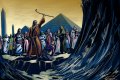
Passover and the First Holocaust
After yesterday’s terrorist bus bombing in Jerusalem, the first in years, Jews around the world felt the painful reminder of our precarious place among nations dedicated to our destruction. With the Passover festival approaching, these thoughts from 2005 remind us that Holocaust is not a phenomenon of the last century, or even the last millennium.

The extermination of six million Jews in the Nazi death camps represents but the most recent in a long history of Jewish holocausts. It was preceded by the Chmielnicki massacres in 17th century Poland, the Almohad massacres in 12th century Spain, the Inquisition and the Crusades and the relentless spilling of blood by the Roman legions — all these and similar chapters in the long, brutal history of attempted genocide against the Jewish people.
When did it all begin?
According to Jewish tradition, it began 3328 years ago, when nearly two and a half million Jews died in a single night.
It was the beginning of the plague of darkness, the penultimate blow in the systematic destruction of the Egyptians and their empire. Pharaoh had already released his Jewish slaves from their oppressive labor midway through the cycle of plagues, driven by the desperate hope that he could appease the G-d of the Jews. But he refused to grant them permission to leave.
For some Jews, the relaxation from their burdens offered an opportunity to reflect upon the responsibilities of freedom and the opportunity that had been promised them to build their own nation. For others, however, it gave time to grow comfortable in the paradise that was Egypt, to adopt an attitude of entitlement for their new-found prosperity, to forget that freedom is never free.
During their 210 years as slaves in Egypt, the Jews had gradually absorbed the corrupt values of that culture, its idolatry and its immorality, retaining only their names, their language, and their style of dress to set themselves apart from their Egyptian hosts. With no merit to deserve divine redemption, the Jewish people received their exodus on credit, credit to be repaid by accepting the Ten Commandments at Sinai and committing themselves to the higher moral and ethical standards of G-d’s chosen people.
600,000 Jews — 20% of their total number — accepted these terms, preparing themselves psychologically and physically to exchange the comfort and familiarity of Egypt for the uncertainty of the empty desert. Four times as many rejected the condition, refusing to make good, as it were, on the credit extended them from heaven, convincing themselves that, with the Egyptians humbled and the yoke of slavery removed from their necks, they could void their contract with the Almighty and remain unencumbered in the land of their former servitude.

David_Roberts-IsraelitesLeavingEgypt_1828
The human condition, however, is never static. One who stops growing immediately begins to die; one who stops moving forward instantly begins to slip backward. There is no standing still, no place to rest in this restless world, and the 2,400,000 Jews who thought to deny their destiny, who imagined they could stop the sands of time and were buried by them instead.
The fate of the 80% was not divine vengeance; it was spiritual inevitability. To survive for thirty three centuries, the Jewish nation would have to appreciate that it had no alternative other than survival. Assimilation, conversion, or abdication of Jewish identity may at times have seemed an attractive option to the burden of living as Jews, but the consequences of spiritual extinction are every bit as grave — indeed, much more so — than those of physical extinction.
Ask the Spanish Jews who converted to Christianity, only to be called marranos — pigs — by their Christian brothers and to be burned at the stake in the auto-de-fe of the Inquisition, if their abandonment of Jewish identity was worth the price. Ask the assimilated German Jews stripped of their property, forced to wear yellow stars, and incinerated in Nazi crematoria if they met a better end than those who refused to disavow their Judaism.
Indeed, the narrative of the exodus testifies that, as the Jews prepared to leave the ruins of Egypt after the plague upon the firstborn, “the Almighty gave the people favor in the eyes of the Egyptians.” As slaves forfeiting their identity within Egyptian society, the Egyptians regarded the Jews only with disdain. Once the Jews began to act with Jewish dignity, their former oppressors could not help but respect them.
And so it has been ever since. When we live as Jews, the rest of the world respects us for our values and our conviction. When we shirk our responsibility as upholders of morality to accommodated the ever-changing moral whims of the world around us, we bring upon ourselves nothing but suffering.
The freedom we celebrate at Passover is the freedom to remain true to who we are, who we always have been: The nation that introduced the world to the very concept of freedom, and the nation which has shown the world through the ages that the price of freedom is far less dear than the price of forsaking it.

Marriage of Convenience
 We are what we pretend to be, so we must be careful about what we pretend to be.
― Kurt Vonnegut
The orderly rolled my gurney to a stop before an imposing double doorway. “Okay,” he said, “This is where you get your kiss.” I couldn’t tell if he was speaking to me or to my wife. In any case, my wife kissed me and laughed and cried all at once. Then I was rolling again.
I arrived in surgery and scooted over onto the operating table. I joked with the anesthesiologist. He found my vein on the first try. I recited Psalms to myself and wondered distantly why I wasn’t scared out of my wits.
They sliced me open, broke my sternum, compressed my lungs like empty sugar bags, and stopped my heart to patch the hole between its upper chambers with a piece of my pericardium while redirecting the blood that flowed through an anomalous vein.
I don’t remember that part.
I also don’t remember my hands clawing the air, straining against nylon straps, struggling to tear the ventilator mask from my face and the dressing from my chest. My wife stifled a cry when she saw me in recovery. Apart from the convolutions of my fingers, the pallor of my face starkly mirrored the countenance of death.
“He looks so good,” the nurse told her.
When I did regain consciousness the next day, numbed by morphine and dazed by the residue of anesthesia, I asked my cardiologist if he could release me that afternoon. “I have to catch a flight to Jacksonville this evening,” I said.
I was trying to be funny. He thought I was delirious.
EXPECT THE UNEXPECTED
![[ File # csp3608269, License # 1131644 ] Licensed through http://www.canstockphoto.com in accordance with the End User License Agreement (http://www.canstockphoto.com/legal.php) (c) Can Stock Photo Inc. / Eraxion](https://proverbsandprovidence.com/wp-content/uploads/2016/04/anatomy-lungs.jpg)
Lacking prescience, however, I had no excuse for the cavalier attitude with which I approached this whole business. No matter how distinguished my surgeon’s credentials, and no matter how casually he explained away the operation as routine (with the probability of success better than 99%), cardiac surgery remains as heart-stopping as it sounds: they carve open your chest and, during an extended period of clinical death, cut and paste around your most vital organ before sewing you back together.
Call it what you like; it hardly ranks among the more attractive forms of elective surgery.
Yet “elective surgery” was how the doctor had described it. After all, I had virtually no symptoms, and my condition might not advance for twenty years. Then again, deterioration could begin within months, or even weeks. And so, at my cardiologist’s insistence, I opted to exchange the distant prospect of lingering death for the immediate promise of physical pain followed by months-long recovery.
That was what I expected. Instead, from beginning to end, while my wife and children and parents were dealing with their respective emotional traumas, the greatest discomfort I suffered throughout the entire episode came not from the incision, not from anesthesia withdrawal, not even from the mild pneumonia I contracted during recovery, but from a persistent hangnail that nagged me from the day after surgery until I returned home and exorcised it with my cuticle clippers.
THERE IS A LESSON
The great tennis player Arthur Ashe, after contracting AIDS via blood transfusion, was reported to have said, “If I ask why this has happened to me, then I must also ask concerning all the good that I have had in my life.”
Indeed, Mister Ashe, may you rest in peace — you should have asked both questions, as should we all.
If life is all One Great Accident, then there is no why. But the exquisitely textured fabric of our universe, the elegant design of our world, and the transcendent nobility of Man when he listens to the calling of his soul — all these testify to the genius of an invisible Conductor who guides the symphony of Creation.
And if there is a plan behind the apparent chaos, then whatever happens for good or for bad should prompt us to ask, “Why?”
Click here to read the whole essay, from my column in the inaugural issue of The Wagon Magazine

Dustin Hoffman and the Miracle of Purim
 The Festival of Purim may be the most misunderstood celebration in all Jewish tradition. Even the historical background seems to contradict the template of Jewish history and survival.
Confounded in the cultural and spiritual darkness of Persian exile 2372 years ago, the Jewish people faced a calculated plan for genocide beyond anything devised by Adolph Hitler. A conniving King Ahasuerus, inspired by his devious viceroy, Haman, laid out a scheme to exterminate the entire Jewish nation in a single day.
With the full force of the king and his empire turned against them, how could the Jews hold out any hope of salvation?
But in the wink of an eye, literally overnight, Haman fell out of favor and, through an improbable confluence of apparent coincidences, the Jews became the king’s most favored nation while the enemies who conspired to destroy them were themselves destroyed.
And how do Jews commemorate the divine intervention that saved them from annihilation? On this day that the sages equate with Yom Kippur, the Jewish Day of Atonement, we replace fasting with feasting, exchange prayerful reflection for revelry, and eschew the simple white garments of purity for masks and costumes.
Purim becomes a day of backwards and inside-out, of contradictions and reversals, of parties and paradoxes.
In keeping with the counterintuitive practices of Purim, allow me to conscript a pair of latter-day Jewish cognoscenti to dispel confusion with the light of clarity:
Dustin Hoffman and Sydney Pollack.

How Little Ripples of Kindness Create Big Waves of Happiness
 Of all the Jewish holidays, none is anticipated by little children more than the festival of Purim.
The theme of reversal figures prominently in the traditional observance of Purim, which is seen as a kind of alter-ego to the solemn holiday of Yom Kippur, the Jewish Day of Atonement. In place of fasting there is feasting. In place of prayerful reflection there is revelry. In place of the simple white garments of purity there are costumes and spectacle.
Children especially look forward to dressing up on Purim. But Purim is in no way a Jewish Halloween. Just the opposite: children dress up and go door-to-door not to ask for treats and threaten tricks, but to give away gifts of food to others.
Which brings me to the point of this narrative, with only one more small digression.

Behind the Hero on the Screen
 In the aftermath of this weekend’s Academy Awards Ceremony, I’m revisiting these thoughts from 2009. If you didn’t follow the link when I posted it a few weeks ago, now you have another chance.
Which of the following quotes does not belong with the others:
It is not what I am underneath, but what I do that defines me.
With great power comes great responsibility.
It is a far, far better thing that I do than I have ever done before.
Literary mavens will quickly identify the third quote as different from the first two for several reasons. First, it was written in the 19th century, where the others were written in the 21st. Second, it is a line from novel, where the others are lines from motion pictures. And third, it is the only one of the three not spoken by a Marvel Comic superhero.
On a more substantive level, however, all three have very much in common.
The first of the three is spoken by Bruce Wayne in his guise as Batman, explaining away his public playboy persona as a device to conceal his secret identity. The second is spoken by Peter Parker, aka Spiderman, explaining why he is walking away from the woman he loves in order to protect her from the enemies that would try to strike at him through the people closest to him.
The third quote is the closing line of Charles Dickens’s classic A Tale of Two Cities, in which the heretofore-undistinguished Sydney Carton expresses his love for Lucie Darnay by taking the place of her husband, Charles, and suffering death by guillotine so that Charles might live.
All three quotes issue from heroes who not only do great things at personal risk, but who sacrifice life, love, and reputation for a higher ideal. From a brooding moralizer like Dickens, we expect nothing less. From Hollywood scriptwriters and producers, however, we expect anything else.
FOLLOW THE MONEY
As the Oscar season descends upon us, its worth reflecting that Hollywood is known as Tinsel Town for good reason. Glitz, superficiality, and immediate gratification have become synonymous with the land responsible for most of today’s entertainment industry. Revolving door marriages and divorces, infidelity, and recreational drugs are only the most obvious symptoms of a culture that glorifies the pursuit of pleasure and the deification of personal autonomy.
Predictably, the film industry can be counted on to turn out major motion pictures that are thinly veiled propaganda pieces. Such unmemorable productions as Brokeback Mountain, Lions for Lambs, and The Good Shepherd may have curried favor with Hollywood politicos eager to promote alternative lifestyles or government conspiracy theories, but the movie-going public has shown considerably more enthusiasm for traditional good versus-evil-stories in which good triumphs in the end. (For the record, haven’t seen either Brokeback Mountain or Lions for Lambs.)
 If box office receipts are any indication, there can be no doubt that audiences will choose classic heroism every time. The musings of a couple of culturally conflicted cowboys on the open plain can hardly compete with such memorable moments as the President of the United States (played by Harrison Ford) throwing an international terrorist out the cargo hold of his plane in Air Force One or Kevin Kline’s presidential impersonator cutting government pork at a cabinet meeting to save funding for an orphanage in Dave.
That Hollywood did in fact release such movies as Batman Begins, Spiderman, and Air Force One, however, reveals an insight into Left Coast Culture that is at once obvious and surprising.
What is obvious is that money trumps ideology. When all is said and done, filmmakers would rather see increased revenues than the spread of counter-culture ideology. Fair enough. But what is truly remarkable is how well they understand the nobility, the selflessness, and the heroism of personal sacrifice that are so often at the heart of successful moviemaking.
MANKIND’S INNER HERO
Once upon a time, heroism in Hollywood was the norm. But we don’t have to go all the way back to Humphrey Bogart’s “the problems of three little people don’t add up to hill of beans” speech in Casablanca when he gives up Ingrid Bergman. When Helen Hunt refused to abandon her family for Tom Hanks in Cast Away, when Kelly McGillis refused to abandon her Amish community for Harrison Ford in Witness, when Robert Redford emptied out of his life’s savings to rescue Brad Pitt in Spy Games, the positive resolution of their inner conflicts provided some of the most powerful emotional climaxes in modern cinema. And let’s not forget this year’s biggest hit, The Dark Knight, in which Batman takes the blame for murder to allow Gotham City to keep its illusion of hope.
Perhaps the culture of make-believe that turns out movies of heroism is incapable of believing in either real heroism or the values that turn ordinary people into heroes. Why else would they persist in churning out so many ideological flops in between traditionalist blockbusters? One almost feels sorry for the creative geniuses that can portray such compelling drama on the screen but seem incapable of applying it to the reality of their lives.
The classical philosopher Rabbi Moshe Chaim Luzzato describes the human condition thus:
And so [man] finds himself truly in the midst of a raging battle, in which all the matters of the material world, whether good or evil, serve as trials for man. Poverty confronts him on the one side and wealth on the other… comfort on the one side, and suffering on the other, until he faces a battlefront before him and behind. But if he will be valiant and prevail against his adversaries on every side, then he will become a Complete Man.
Movies can remind us of the moral battles we face constantly in our own lives between what we know and what we feel, between what is right and what is pleasing, between rising to each new challenge or abdicating struggle for the line of least resistance. We rejoice when silver screen heroes emerge triumphant from their inner struggles, for they remind us that we too can emerge triumphant. But we despair when they fail, for they remind us how easily we too can fall prey to our inner demons.
It’s ironic that Hollywood filmmakers can describe the human condition so vividly with so little understanding of it. Perhaps they should watch their own movies – the ones that audiences go to see.

Spitting Image 1:2 — The Soldier and the Soul
 My son told me this morning that, as he was just beginning his training in the IDF special forces, he met a soldier who was just finishing his service in the same unit, the Gadsar Reconnaissance Division of the Nahal Brigade.
“I envy you, ” said the retiring warrior. “And I feel sorry for you. I envy you for the incredible experience you’re about to have. And I feel sorry for you because it will be harder than you can imagine.”
I immediately imagined two souls passing as one descends from on high to take its place inside a newborn child and the other departs this world on its way to receive its eternal reward.
“I envy you,” says the ascending soul to the one about to enter the material world. “And I feel sorry for you. I envy you for the joy you will find serving the Master of the Universe, a joy that I will never know again now that my time on earth is over. And I feel sorry for you, for you have no idea how difficult it will be for you to remember who you are and what your purpose is amidst so much pain and confusion.”
The more we seek to avoid pain, the more we deprive ourselves of the inner pleasure that is the source of true happiness. The more we rise to meet the obstacles and challenges that confront us, the more we find joy in this world and make ourselves deserving of the pleasure that awaits us once our time here has passed.

The Midpoint of the World
As we finally enter the voting season with the Iowa caucuses, I’m drawn back to these thoughts from 2013 on who we are and where we are headed. If hindsight is 20/20, why do we keep making the same mistakes over and over again?
 What would you ask of a time traveler from a hundred years ago? And if you traveled a hundred years into the future, what would you want to tell the people you found there? Perhaps it would sound something like this:
What did you do to handle the overpopulations we predicted? How did you protect the seashores? What did you do to keep the ozone layer intact, the energy supplies, the trees? Have you eliminated ignorance, brutality, greed?
There might be no better way to discover unexamined truths about ourselves then by composing a letter to our grandchildren’s grandchildren. This was certainly on the mind of award-winning essayist Roger Rosenblatt a quarter century ago when he penned his deeplythoughtful Letter to 2086:
This letter will be propped up in a capsule at the Statue of Liberty, to be opened on the statue’s bicentennial. Go ahead. Undo the lock. I see your sharp, bright faces as you hoist us into your life, superior as cats to your primitive elders. Quaint, are we not? Beware of superior feelings. The message is in this bottle.
As a student of Jewish philosophy, I don’t believe in coincidences. So when my neighbor — out of the blue — handed me a long forgotten back issue of Time Magazine, the cover article by Mr. Rosenblatt resonated with the faint echo of providence. And although the intended audience still reside three generations in the future, this letter offers a tantalizing window into the past, as well as an illuminating perspective on how much has changed and how much has remained the same.
Click here to read the whole essay.

My interview on Solomon Success
Great minds think alike, and Jason Hartman has a website and podcast exclusively devoted to the practical lessons of King Solomon’s wisdom.
Listen to my interview with him here.

The Failure of Freedom
 For those who care enough to learn the lessons of history, the echoes of the ancient past can be heard clearly amidst the discord of the chaotic present. If we want to understand the crisis of political leadership that plagues our country and our world, we have only to look back to earliest records of national governance, nearly 3000 years ago.
It was the 9th Century Before the Common Era. 391 years had passed since the Children of Israel first entered their land. For nearly four centuries, Jewish society had been plagued by divisiveness, political instability, and spiritual ambivalence. But at last, after the prophet Samuel spent his entire career teaching the Jews to more deeply respect the law and inspiring them to more profoundly appreciate their national mission, the people united in response to his invocations and dispatched emissaries to ask:
“Appoint a king to rule over us like all the other nations” (1 Samuel 8:5).
Seemingly, the Jews had finally come to their collective senses, recognizing that all their political and social strife stemmed from a pervasive national attitude in which “every man did what seemed right in his own eyes” (Judges 21:25). Without a strong executive office to pilot the ship of state, without a single voice of authority to bind many into one, the tribes of Israel remained a disconnected confederation of individuals who joined forces only when necessary and turned against one another whenever self-interest clashed with national purpose and identity.
240 years ago, another attempt was made to create a new nation, conceived in liberty, and built upon guiding principles of equality and justice.
Today, that same nation, blessed with more power, prosperity, freedom, and opportunity than any in the history of the modern world, confronts a political system crippled by bloat, inefficiency, and corruption. At a moment in time when we desperately need inspired leadership, we face a contest between a socialist and a sociopath in one party, a narcissist and a curmudgeon in the other. And while the frontrunners serenade us with siren-songs of high-sounding dreams and visions — all deeply divorced from reality — the few aspirants who attempt to set forth concrete policy proposals and plans of action wallow in low single digits.
Why is the electorate so eager to embrace the illusion of leadership and so unwilling to recognize the real hope of positive change?
 Yonason Goldson