

Home » Posts tagged 'Leadership' (Page 18)

Tag Archives: Leadership

How to Choose a Candidate

Brujula_1We complain about our leaders.  But are we doing all we can and should do to put responsible leaders in positions of authority, or do we deserve what we’ve been getting?

Here are some insights into political leadership and decision making in my radio interview with James Lowe.

The interview begins at 18:30 here.


Email of the Week — The Haircut

politicianBlessed are those that can give without remembering,  and take without forgetting.

One day a florist went to the barber for a haircut. When the barber finished he said to the florist,  “I can’t take your money:  I’m doing community service this week.”  The florist was pleased and left the shop.

When the barber went to open his shop the next morning, there was a Thank You card and a dozen roses waiting for him at his door.

Later, a policeman came in for a haircut.  When he tried to pay his bill, the barber again explained, “I can’t take your money:  I’m doing community service this week.” The officer was happy and left the shop.

The next morning when the barber went to open up, there was a Thank You card and a dozen donuts waiting for him at his door.

Then a Congressman came in for a haircut.  “I can’t take your money,” said the barber once again.  “I’m doing community service this week.”  The Congressman was very happy and left the shop.

The next morning, when the barber went to open up, there were a dozen Congressmen lined up waiting for a free haircut.

And that, my friends, illustrates the fundamental difference between the citizens of our country and the politicians who run it.

As Mark Twain said:

Both politicians and diapers need to be changed often, and for the same reason.


Hat tip:  Mom and Ginny Harrigan

The Language of Confusion

2015-005-La-tirannide-non-tirannicaPolitical Correctness has reached a new high — or low — at the University of New Hampshire, where administrators have issued a Bias-Free Language Guide.  Forbidden words include the following: “mothering, fathering, healthy, homosexual, rich, poor, senior citizen, and American.”  

Perhaps we should find it comforting that a taxpayer-funded school is prepared to go so far to protect its students from hurt feelings.  Presumably, educators believe that this measure will improve student’s self-esteem and thereby lead to greater success in the workplace.

Once again, life imitates art, as I discussed in this essay from 2009, written to honor the 60th anniversary of George Orwell’s 1984.

If only they would teach it in New Hampshire.

It never takes more than a day or two into the new school year before I hear the chant of my students’ favorite refrain: That makes no sense!

“What you mean,” I answer the first student who utters that unutterable phrase, “is that you don’t understand.”

“That’s what I said,” the student responds, predictably. “It makes no sense.”

“It makes perfect sense,” I insist, “as you will see once you understand it.”

The student doesn’t give up without a fight. “You know what I mean,” he says. “What difference does it make how I say it?”

It makes no sense implies that, if the material we are learning does not conform to your way of thinking, then it must be wrong. I don’t understand acknowledges the possibility that the flaw in reasoning may reside in you, rather than in the material.”

He stares back at me, trying to digest this new idea. Over the course of the year, through constant repetition, most of my students will learn never to saythat makes no sense. At least not in my class.

I’ve been challenged on this many times. Is it really my job to belabor this point, to demand that my students express ideas concisely, even when the intent is clear? After all, I’m not a speech or language instructor. Why not just teach the material I’m being paid to teach?

WE THINK WHAT WE SPEAK

In his essay “The Principles of Newspeak,” the appendix to his classic novel, 1984 (published 60 years ago this month), George Orwell describes how the leaders of his totalitarian future have contrived to assure their hold on power by replacing English with Newspeak, a language containing no vocabulary for concepts contrary to the platform of the state-run Party. By controlling language, the Party controls its people’s very thoughts.

quotes-1984-george-orwell-HD-WallpapersIntuition suggests that language is a product of thought: if we think clearly, automatically we will speak clearly. Orwell demonstrates the opposite, that thought is a product of language. Because we formulate our thoughts in words and sentences, incompetent use of language guarantees muddled thinking. If there are no words for rebellion, uprising, or discontent people will find it difficult to formulate and articulate the concept of overthrowing even the most corrupt and oppressive government.

Students of Orwell will shudder when applying this simple axiom to the corruption of modern language. Advertisers and politicians have known for years that the best way to manipulate public perception is by arranging words in unconventional combinations. Car dealers know that potential customers will feel better buying cars that are “pre-owned” rather than “used.” A certain former president knew that the American people would not respond to the gravity of his presidential peccadilloes if distracted by pondering what the meaning of “is” is.

But linguistic confusion became institutionalized with the rise of political correctness. By dodging frantically out of the rain of potentially offensive terms, we soak ourselves in a torrent of euphemisms for simple words the thought-police deem pejorative. When illegal aliens become “undocumented workers,” we lose all sense of the danger posed by the porous condition of our borders. When terrorists become “insurgents,” we more readily accommodate the moral equivalence that blurs the line between aggressors and defenders. When abortion becomes “reproductive freedom,” the horror over the indiscriminate murder of innocents vanishes altogether.

Similarly, when marriage is bereft by judicial fiat of the definition that has served for thousands of years, the foundations of the family structure erode like sand castles before the approaching tide. And as it becomes taboo to make any direct reference to race, class, ability or performance without fear of hurting one group’s collective feelings or another group’s collective self-esteem, the words that form our thoughts and understanding end up so fully shorn of their dictionary definitions that they cease to mean much of anything at all. In short, nothing makes sense.

CONFUSION BY DESIGN

In truth, for advertisers, politicians, special interest groups, and the politically correct, the real purpose of language is no longer to convey meaning – it is to obscure meaning, to appeal to emotions while bypassing the intellect. Their motive is obvious: it is far easier to evoke a strong emotional response than it is to present a logically developed argument. But by allowing meaning to be drained from our language and our words, we have not only denuded them of their clarity, but also of their depth.

Even worse, we are no longer allowing confusion to reign free but legislating it into the public square. Earlier this year, London decided to remove apostrophes from its street signs. King’s Heath will now become Kings Heath. What’s the reason? Apostrophes are too confusing.

According to Councilor Martin Mullaney, who heads the city’s transport scrutiny committee, “Apostrophes denote possessions that are no longer accurate, and are not needed,” he said. “More importantly, they confuse people. If I want to go to a restaurant, I don’t want to have an A-level (high school diploma) in English to find it.”

Linguistic laziness in both syntax and vocabulary has worn smooth the sharpness of our minds. When I say that I love my wife, and I love my car, and I love ice cream, am I not indulging a subtle self-hypnosis that affirms an equation between all three, that suggests that my feelings for my wife is no more profound than my taste for Baskin Robbins and BMW? By impoverishing our words, we impoverish our thoughts as well.

6a00d8341bfb1653ef01b7c6f82d6e970b-400wiWhat is love? And what is honor? and loyalty? and commitment? As we strip our language of both its clarity and its nobility, these concepts become caricatures of what they once were, defined by the mass media who, like the Orwellian Party, have as their only concern the selling of their own values and their own agenda. And as much as we the people are willing to buy, they will continue to sell.

“Teachers, be careful with your words,” warns the Talmud, “lest the disciples who follow you will drink of evil waters and die.” When the waters of wisdom become polluted with confusion and contradiction, it is society’s youth who will pay the price through the erosion of moral clarity and moral principles.

Back in the classroom, my student continues to stare at me, contemplating my rebuke for a few more seconds before he responds. “What I meant to say,” he finally answers, “is that it makes no sense to me.”

I shake my head. “Don’t make it sound like what you want it to mean,” I tell him. “Just say it the way it is.”

Originally published by Jewish World Review

Mike Huckabee’s the Bomb Thrower?

Former Arkansas Governor and former Republican presidential candidate Mike Huckabee speaks during the third session of the Republican National Convention in Tampa, Florida August 29, 2012. REUTERS/Jason Reed (UNITED STATES  - Tags: POLITICS ELECTIONS)   - RTR379BK

“This President’s foreign policy is the most feckless in American history.  It is so naive that he would trust the Iranians. By doing so, he will take the Israelis and march them to the door of the oven. This is the most idiotic thing, this Iran deal.”

These are the incendiary words of Mike Huckabee in an interview with the Breitbart News Network.  Woe upon us.

It’s hardly surprising that Barack Obama found the governor’s words offensive; for six years the president has taken offense at every utterance that isn’t laudatory, obeisant, or downright reverential.

It’s also no surprise that John Kerry found the governor’s comments offensive. The Iran deal is Mr. Kerry’s only shot at a Nobel Peace Prize, and the unwelcome reality check of fear-mongers like Prime Minister Netanyahu and Governor Huckabee might, if they find traction (which they won’t), jeopardize his chance to join the ranks of such great historic peacemakers as Jimmy Carter, Al Gore, and Yasir Arafat.

Read the whole essay here.

Is Anyone Still Wild About Harry?

53985-oAs a boy in junior high school, I bought the soundtrack of “Give ’em Hell, Harry” at a school book and record sale.  I have no idea what prompted me to spend a dollar on that particular piece of vinyl — I wasn’t living in Missouri then, but in Los Angeles, California.

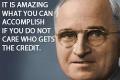
Whatever the reason, it proved one of the best investments of my life.  By the time I reached high school, I had practically committed James Whitmore’s entire 90-minute monologue to memory, and Harry Truman had become my hero.

I found the video on YouTube recently and, just last week, returned to the beloved performance.  With my recent essay on honesty and integrity so freshly pressed, the following words jumped out and seized hold of me:

“Dictatorship?  No, it’ll never happen.  The Constitution will stop ‘em every time.

“I’ll tell you, there’s only one way that could happen, and that’s if we had a liar in public office.  There’s nothing more dangerous on this earth than a liar in public office, because the people might believe him.

“But if the people every found a fellow like that they ought to show him the same amount of compassion that he showed the constitution.  No more, no less.”

What would Harry Truman say about a president like Barack Obama who, according to the Washington Post, claims three of the twelve most egregious lies of 2014 and three of the ten biggest lies of 2013?  What would Harry say about a candidate like Hillary Clinton, the “congenital liar” who seems emboldened to tell ever-inflating whoppers without a shred of shame or contrition?

And what would Mr. Truman have to say about an American electorate willing to overlook the brazen dishonesty of politicians willing to say and do anything to get into office and push through their self-serving agendas?

As the song says:  Harry, where are you, now that we need you?

The Road to Compromise

us-iran-rapprochementAfter last week’s “historic” Obama-Kerry Compromise with Iran, it’s instructive to take a look back to see how little has changed.  I published this op-ed in the St. Louis Post-Dispatch on 2 August 2002.


Henry Clay earned his reputation as “the great compromiser” when he forestalled the outbreak of the Civil War by ten years. Even so, one has to wonder whether even Mr. Clay’s genius for mediation could save the Mideast peace process from becoming a towering embarrassment to US foreign policy.

Compromise, according to Webster’s, is “a method of reaching agreement in a dispute, by which each side surrenders something that it wants.” This shouldn’t be hard to comprehend for anyone with a background in high school civics. What does remain incomprehensible is how otherwise reasonable people might seriously apply the term “compromise” to past peace proposals, and why anyone thinks it will be different the next time around.

Definitions notwithstanding, immediately after the Camp David negotiations in the summer of 2000 the New York Times observed that Yasir Arafat’s “willingness for more talks suggests room for compromise.”

The Times deserved credit for optimism and imagination, but won few points for objective editorial insight. Indeed, only a month earlier (on July 11 of that year), the Times reported that, “The Palestinians want a settlement based on United Nations Resolution 242,” implying that if not for Israeli intransigence, there would have been peace in the region long before.

Let’s see. Resolution 242 mandates 1) the “withdrawal of Israeli armed forces from territories occupied in the recent conflict,” and 2) the “termination of all claims or states of belligerency and respect for and acknowledgement of the sovereignty, territorial integrity and political independence of every State in the area and their right to live in peace within secure and recognized boundaries free from threats or acts of force.”

For its part, Israel returned more than 90% of the Sinai to Egypt in 1981, and offered to give more than 90% of Judea and Samaria to the Palestinians under former Prime Minister Ehud Barak. Pretty good, for a compromise.

From the Palestinian side, however, it’s been hard to detect even a whiff of compliance. Rather, these are the ways the Palestinian Authority has terminated its claims and belligerency: all government and schoolbook maps, as well as children’s television programs, identify the whole of Israel as “Palestine;” teenagers at Palestinian “summer camps” train with automatic weapons to fight Israelis; Arafat has named squares and streets after Hamas suicide bombers; Israeli security has caught PA officials smuggling numerous weapons, including anti-tank weapons, into Israel. The list could easily fill this column.

Ehud Barak had been prepared to overlook all that. But then the Camp David talks broke down anyway, largely because of Palestinian insistence of absolute sovereignty over East Jerusalem. Yet Jerusalem has been the heart and soul of Israel for over 3000 years, the holiest site on earth according to Jewish tradition and the Old Testament. The Arab’s spiritual capital is Mecca, whereas Jerusalem is merely a religious and historical footnote, not mentioned by name even once in the Quran. What’s more, from 1948 to 1967, when Jordan controlled East Jerusalem, not one Arab ruler visited the city, except Jordon’s own King Hussein. Electricity and water services were neglected, and no government offices or cultural centers were set up there.

So what does the Palestinian Authority want? What it has always wanted: everything. The very concept of compromise appears utterly foreign to the thinking of Palestinian leaders, and is entirely absent from their behavior. It’s hard to see what the PA has ever thought it’s bringing to the negotiating table, except for the vague promise of controlling terrorism and the hazy commitment of conceding Israel’s right to exist, a right already granted by the United Nations over half a century ago.

In hindsight, it’s also hard to see what Ehud Barak hoped to accomplish by bargaining away so much for so little. According to Mideast analyst David Makovsky, Mr. Barak’s objective was “peace without illusions.” Peace between governments, the former Prime Minister believed, is the only possible goal presently within grasp; peace between peoples is generations away.

Mr. Barak assumed that once a treaty is signed, all of Israel’s Arab neighbors will abide by its conditions, gradually leading to normalization and the eventual cessation of the hateful rhetoric that foments Arab violence.

The trouble is, there’s no evidence it would work. Whatever the terms, any deal that produces even the coldest peace must rest on the foundation of compromise, a foundation that doesn’t exist. The indoctrination of children with hatred of Israel continues, even in Egypt, nearly three decades after it grudgingly traded political recognition for the return of its land.

529198-israelOther Arab nations have refused to offer even this little olive branch; they have never demonstrated the slightest willingness to compromise. Neither Israel nor the United States should take another step forward until they do. Let us hope that the new U. S. president will learn from the errors of his failed namesake and not put his hope in false promises that have already led nowhere.

If you still think the Iranian compromise was a good deal, read what Charles Krauthammer has to say.

The Power to Change the World

With so much senseless violence dominating the headlines, from Charleston, South Carolina, to Syria and beyond, it’s worth revisiting this story of heroism and the power of the individual to change the world.

On the afternoon of September 18th, 2014, a teenage driver lost control of his SUV as he sped down Salt Lake City’s Indiana Avenue. The GMC Yukon tore through the safety barrier, went airborne into a ravine, and landed upside down in three feet of water and the bottom of the gully. Dazed or unconscious, strapped in by their seat belts, the driver and his two passengers had minutes before they would drown.

article-0-21869C9000000578-789_634x608What happened next offers a welcome relief from the relentless litany of strife and suffering that fills the headlines. Moments after the crash, nearly a dozen bystanders waded into the waist-high water and, working in unison, flipped the massive vehicle over onto its wheels, lifting the crash victims out from under the water and saving their lives.

But it might never have happened. As horrified onlookers stood frozen and stared at the capsized SUV, Leo Montoya, Jr., an out-of-work locksmith, overcame the Bystander Effect, plunged into the current and dove under the water in an effort to save the occupants. Unable to free them from their seat belts, only one option presented itself.

Turning toward the crowd, Mr. Montoya shouted, “We have to get this vehicle back on its wheels. Now, now, now!” Prompted by his commands, some of the men standing on the roadside began following him into the water. With so many pairs of hands and shoulders at work together, the Yukon rolled up and over until it was back on all four wheels and the passengers were clear of the water. When firefighters arrived, they freed the occupants and rushed them to the hospital.

The collective effort of bystanders saved three lives. But only because one person showed them the way and convinced them to follow.

The incident calls to mind another scene that happened 3,326 years ago after the exodus from Egypt at the splitting of the Sea. Faced with Pharaoh’s chariots bearing down on them from behind and the imposing expanse of water ahead, the Jewish people’s faith in God wavered. “Were there not enough graves in Egypt that you had to bring us out here to die?” they railed against Moses. The situation was impossible; there was no hope.

Until one man spoke up. Nachshon ben Aminadav, the prince of the tribe of Yehudah, cried out to the people: “If the only way to escape the Egyptian army is to go forward, then forward we must go. Let us do what we can and trust God to do the rest.” And with that, he waded out into the sea.

Inspired by his words, the people followed him. Deeper and deeper they advanced into the waters until, as the water reached Nachshon’s chin, the sea split before and around them, offering both the means of the Jews’ escape and the method of the Egyptians’ destruction.

What kind of person marches into the sea assuming that a path will open up to make way for a desperate nation? The same type of person who would charge forth and rally a dozen men to overturn a ton of steel, the type of person who understands that no matter how daunting the odds, there is no way to know the limit of human potential until we have pushed human potential to the limit.

What’s more, the potential of the many may remain unrealized until a singular individual shows that he has no interest in probabilities and, through sheer determination, awakens the collective spirit through which the impossible becomes reality.

We all want to be good and do good, and change the world for the better. But we lack confidence in ourselves, we lack the conviction to act, we lack the courage to risk failure. So we miss opportunities for greatness – not just by failing to charge into the breach, but by not expecting more from ourselves, by not setting the bar of human achievement and human integrity a little higher.

In one heroic moment, one man can inspire a world of others to change themselves. And the more we change ourselves, the more we change the world.

Just ask Leo Montoya. “As far as I know, a couple of kids get to live because of my actions,” Mr. Montoya told reporters. “I feel like I’m somebody.”

Originally published at Aish.com.


Jewish Billionaires put their Mouths where their Money is

Jewish billionaires Sheldon Adelson and Haim Saban have organized the first meeting of its kind, bringing together 50 Israeli and pro-Jewish corporations to push back against anti-Israel boycotts (BDS).

The real tragedy is that their efforts are necessary.  The superficiality that typifies the Western World is self-evident with even the most feeble efforts to scratch the patina of political correctness that turns perpetrators into victims and victims into provocateurs.

pal-child-abuse-74Shame on those who perpetuate the myth that Israel is the source of Arab suffering.  Shame on those who provide the millions in aide that Gaza Arabs never see because their leaders spend it on high-tech tunnels for attacking Israeli civilians.  Shame on those who caused hundreds of West Bank Arabs to lose their jobs by pressuring Soda Stream to move their production plant back across the “green line.”  Shame on those who don’t hold the leaders of surrounding Arab nations accountable for ignoring the plight of Arab refugees for 60 years so they can vilify Israel for their own criminal negligence.

And shame on Jimmy Carter and his ilk who perpetuate the demonstrable lie that Israel is an apartheid state.

Would an apartheid state produce an Arab citizenry that has a higher standard of living, literacy, and longer life expectancy than that of the surrounding Arab nations?  Would it have permitted a sitting Arab Supreme Court justice, Arab ministers, generals, ambassadors, and consulate-generals, an Arab Israeli national soccer team captain , and an Arab Miss Israel?

But ideologues never let facts get in the way of ideology.  The successful western world must be held responsible for every evil in the world, even as radicals sacrifice their own lives to destroy the societies that allow well-meaning fools to enable the agents of their own self-destruction.


A Dybbuk in the White House?

images“What gives in the White House? If the genie is out the bottle what made, of all world leaders the most powerful, let it out? Who, or what, is the mischief maker behind the nuclear talks? What spirit runs amok in the corridors of power? The freak alignments lately fashioned point to some fiend on a depraved mission. American bombers now support Iranian troops to keep a chemical-weapon-dropping Syrian madman in power. Saudis and Israelis co-operate to stymie an American-made pact. An emissary from the White House supposedly told the Argentine government not to pursue Iranian murderers of eighty-odd Jews in Buenos Aries. Obama gives tacit blessing to the sale of a Russian ground-to-air missile system to Iran, which will make it more difficult for Israel to flatten those nuclear sites. A US President who sets all this, and more, in motion would have to be possessed.”

Read the rest of Steve Apfel’s inspired op-ed here.

Hat tip:  Steve Glassman

Just who are “we”?

Tonto:  What is wrong, Kimosabe?
Lone Ranger:  We’re surrounded by bloodthirsty indians, Tonto.  What are we going to do?
Tonto:  What you mean, “we,” white man?

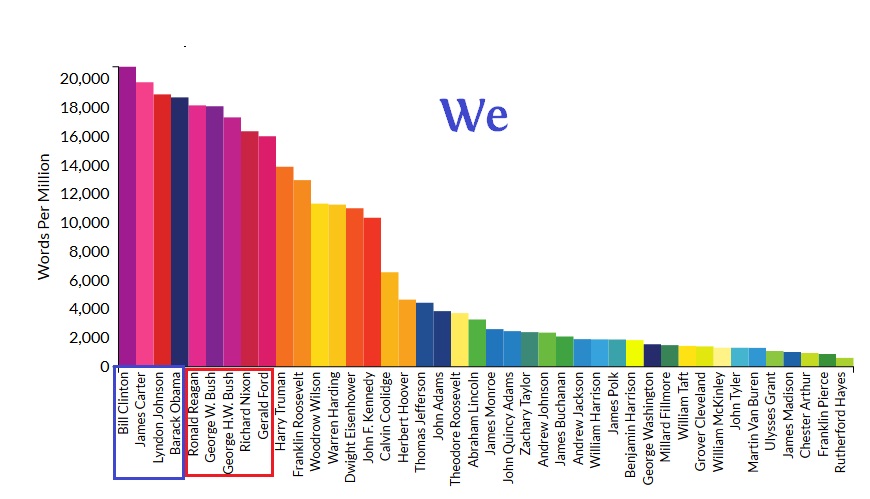
SOTU We 2Thanks to Jay Livingston for this post on behalf of the Montclair State Sociology Department.  He paints a compelling picture of how the collective language of “we” has been increasingly conscripted by modern politicians to create — or fabricate — an impression of common purpose and common allegiance.

With politics dividing us more deeply than ever, it might seem beneficial to employ rhetoric designed to bridge the ideology gap.  In practice, however, disingenuous expressions of harmony and unified vision can do a lot more harm than good.

For one, when a demonstrably divisive leader — a U. S. president, for example — claims that he is the leading advocate of unity and cooperation, he makes himself a lightning rod for accusations of hypocrisy and manipulation that breed cynicism in place of optimism.  For another, by claiming the high ground, he implicitly vilifies all who oppose him, even if they do so from positions of principle.  Either way, the ideological rift grows wider, not narrower.

Perhaps worst of all, the collective “we” diffuses responsibility from the individual onto the collective:  since all of us are responsible, none of us is responsible.  This produces the effective equivalent of such politicalisms as “Mistakes were made.”  Somewhere, someone did something wrong.  There’s plenty of blame to go around, but nowhere for it to stick.

In short, fake unity achieves the opposite of unification.

But when there really is cohesion, whether within a team, a business, a community, or a society, the collective “we” becomes a priceless asset, including the lowly with the high, the rank and file with the leaders, the grunts with the visionaries.  Like it or not, we’re all in it together.  And the more we try to shoulder our collective burdens with one mind and one heart, the more we will succeed.