Home » Posts tagged 'Moral Compass' (Page 16)
Tag Archives: Moral Compass
Excuses
 If I were a tadpole, and you were a fish,
If the South China sea were a licorice dish,
If the King of Siam staged an off-Broadway play,
If the Man in the Moon weren’t afraid of the day,
If phones were not busy and lines never long,
If Fay Wray were a dozen times tall as King Kong,
If gators wore shirts with men stitched on the breast,
If the head of the pack could escape from the rest,
If the dark could be pierced by a single white flame,
If Professor Bob Knoll could remember my name,
If the sea didn’t swell and the ship didn’t rock,
If naive good intentions could turn back the clock,
If each moment could stretch to the end of our lives,
If bees came in gaggles and geese lived in hives,
If the hare beat the tortoise by less than a mile,
If the face in the mirror would give me a smile,
If the northern lights migrated south with the birds,
If my fluttering heart could be calmed by your words,
If I’d show you my heart, and you’d show me yours, too,
We’d have no more excuses.
Then what would we do?



Behind the hero on the screen
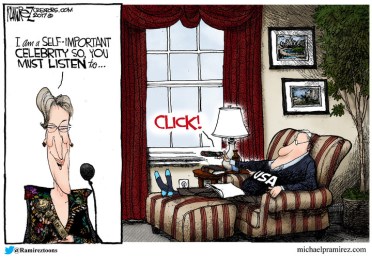
In the wake of Meryl Streep’s finely crafted but sanctimonious speech at the Golden Globe awards, I’m revisiting these thoughts from 2009.
 Which of the following quotes does not belong with the others:
It is not what I am underneath, but what I do that defines me.
With great power comes great responsibility.
It is a far, far better thing that I do than I have ever done before.
Literary mavens will quickly identify the third quote as different from the first two for several reasons. First, it was written in the 19th century, where the others were written in the 21st. Second, it is a line from novel, where the others are lines from motion pictures. And third, it is the only one of the three not spoken by a Marvel Comic superhero.
On a more substantive level, however, all three have very much in common.
The first of the three is spoken by Bruce Wayne in his guise as Batman, explaining away his public playboy persona as a device to conceal his secret identity. The second is spoken by Peter Parker, aka Spiderman, explaining why he is walking away from the woman he loves in order to protect her from the enemies that would try to strike at him through the people closest to him.
The third quote is the closing line of Charles Dickens’s classic A Tale of Two Cities, in which the heretofore-undistinguished Sydney Carton expresses his love for Lucie Darnay by taking the place of her husband, Charles, and suffering death by guillotine so that Charles might live.
All three quotes issue from heroes who not only do great things at personal risk, but who sacrifice life, love, and reputation for a higher ideal. From a brooding moralizer like Dickens, we expect nothing less. From Hollywood scriptwriters and producers, however, we expect anything else.
FOLLOW THE MONEY
As the Oscar season descends upon us, its worth reflecting that Hollywood is known as Tinsel Town for good reason. Glitz, superficiality, and immediate gratification have become synonymous with the land responsible for most of today’s entertainment industry. Revolving door marriages and divorces, infidelity, and recreational drugs are only the most obvious symptoms of a culture that glorifies the pursuit of pleasure and the deification of personal autonomy.
Predictably, the film industry can be counted on to turn out major motion pictures that are thinly veiled propaganda pieces. Such unmemorable productions as Brokeback Mountain, Lions for Lambs, and The Good Shepherd may have curried favor with Hollywood politicos eager to promote alternative lifestyles or government conspiracy theories, but the movie-going public has shown considerably more enthusiasm for traditional good versus-evil-stories in which good triumphs in the end. (For the record, haven’t seen either Brokeback Mountain or Lions for Lambs.)
 If box office receipts are any indication, there can be no doubt that audiences will choose classic heroism every time. The musings of a couple of culturally conflicted cowboys on the open plain can hardly compete with such memorable moments as the President of the United States (played by Harrison Ford) throwing an international terrorist out the cargo hold of his plane in Air Force One or Kevin Kline’s presidential impersonator cutting government pork at a cabinet meeting to save funding for an orphanage in Dave.
That Hollywood did in fact release such movies as Batman Begins, Spiderman, and Air Force One, however, reveals an insight into Left Coast Culture that is at once obvious and surprising.
What is obvious is that money trumps ideology. When all is said and done, filmmakers would rather see increased revenues than the spread of counter-culture ideology. Fair enough. But what is truly remarkable is how well they understand the nobility, the selflessness, and the heroism of personal sacrifice that are so often at the heart of successful moviemaking.
MANKIND’S INNER HERO
Once upon a time, heroism in Hollywood was the norm. But we don’t have to go all the way back to Humphrey Bogart’s “the problems of three little people don’t add up to hill of beans” speech in Casablanca when he gives up Ingrid Bergman. When Helen Hunt refused to abandon her family for Tom Hanks in Cast Away, when Kelly McGillis refused to abandon her Amish community for Harrison Ford in Witness, when Robert Redford emptied out of his life’s savings to rescue Brad Pitt in Spy Games, the positive resolution of their inner conflicts provided some of the most powerful emotional climaxes in modern cinema. And let’s not forget this year’s biggest hit, The Dark Knight, in which Batman takes the blame for murder to allow Gotham City to keep its illusion of hope.
Perhaps the culture of make-believe that turns out movies of heroism is incapable of believing in either real heroism or the values that turn ordinary people into heroes. Why else would they persist in churning out so many ideological flops in between traditionalist blockbusters? One almost feels sorry for the creative geniuses that can portray such compelling drama on the screen but seem incapable of applying it to the reality of their lives.
The classical philosopher Rabbi Moshe Chaim Luzzato describes the human condition thus:
And so [man] finds himself truly in the midst of a raging battle, in which all the matters of the material world, whether good or evil, serve as trials for man. Poverty confronts him on the one side and wealth on the other… comfort on the one side, and suffering on the other, until he faces a battlefront before him and behind. But if he will be valiant and prevail against his adversaries on every side, then he will become a Complete Man.
Movies can remind us of the moral battles we face constantly in our own lives between what we know and what we feel, between what is right and what is pleasing, between rising to each new challenge or abdicating struggle for the line of least resistance. We rejoice when silver screen heroes emerge triumphant from their inner struggles, for they remind us that we too can emerge triumphant. But we despair when they fail, for they remind us how easily we too can fall prey to our inner demons.
It’s ironic that Hollywood filmmakers can describe the human condition so vividly with so little understanding of it. Perhaps they should watch their own movies – the ones that audiences go to see.

Radio Interview with Steve Curtis — Ethics of the Day
Listen to my interview this Monday on Wake Up with Steve Curtis on KLZ Denver.

Click here for The Ethics of our Day.


In Search of Journalistic Integrity
 What are the hottest news topics of the New Year?
I turned to Google News to find out. By adding “2017” in my computer’s search bar, I created my own (small and unscientific) database profiling some of the most reported current events topics.
One might expect – naively, to be sure – that the most pressing issues of the day would populate the brightest constellations of reportage across the firmament of internet news. So let’s take a look at which topics got the most hits:
- Vladimir Putin: 15.6 million
- Terrorism: 24.7 million
- Climate change: 29 million
- Gay: 41.5 million
- Israel: 74.4 million
Now what can we make of all this?

Is there a difference between “opinion” and “bias”?
 On Tuesday 3 January — apparently in response to a hail of letters accusing the paper of editorial bias — the St. Louis Post-Dispatch ran a full-page editorial attempting to justify their approach to opinion pieces. I responded as follows:
Dear Editors,
In last Tuesday’s defense of your paper’s opinion pages, you claim that your reporting is free from editorial influence. Many would dispute this point, but I wish to address a more objectionable assertion in your argument.
You write: “Where you will absolutely find bias is on the opinion pages.” This remark is as astonishing as it is disconcerting.
Bias and opinion are not synonyms. Bias is by definition emotional, often to the point of irrational. Opinion expresses a principled position, ideally based on accurate information and sound reasoning.
Daniel Patrick Moynihan famously observed that you’re entitled to your own opinion but not your own facts. A responsible news organization, however, is duty bound to make sure that its opinion pieces are fact-based and logically developed. This requires an understanding of both sides of an issue and the commitment to intellectual integrity. Only then is an opinion deserving of publication.

Hail to the new chief
 Congratulations to Missouri’s new governor, Eric Greitens.
After serving as a Navy Seal, devoting his career to help returning veterans, and defining himself according to the value of character over ideology, Governor Greitens will enter his new role as public servant with today’s inauguration ceremony.
He offers the kind of hope that we all so desperately look for: modesty, civility, and a commitment to service above political agendas. He faces the challenges of anyone who seeks to confront a culture of entrenched partisanship and cronyism.
King Solomon says that the heart of kings is in the hands of God. May the Almighty guide him and all our leaders to recognize what is right, to retain purity of vision and purpose, and to rally support to lead us on the path of peace and prosperity.
 Yonason Goldson