Home » Posts tagged 'Personal Development' (Page 10)

Tag Archives: Personal Development

Four Ways to Make Attention Deficit Less Disorderly

attend-girlMany years ago, when my eldest son was about six years old, I introduced him to Chutes and Ladders, the next board game up from Candyland on the sophistication scale.  Nothing but luck, the game nevertheless contains an engaging element of the unpredictable, as any roll of the die can rocket you up a ladder to the top or send you plummeting down a slide to the bottom.

My son took to the game immediately, and we bonded as we moved our respective pieces up and down the board.  And then, with fatherly foresight, I waited for the moment of supreme joy and excitement as my son counted his piece onto the 100 mark at the top of the playing grid.

“You won!” I cried out, expecting him to respond with elation.

Instead, my son looked at the board, looked at me, and burst into tears.

“What’s wrong?” I exclaimed, genuinely flummoxed.

“I don’t want the game to be over!” he bawled.

Oh, if only they could stay six years old forever.

It’s worth examining what happens as we grow older that makes us lose the joy of the game in our headlong pursuit of victory.  Maybe it’s that we’re not paying attention.  Maybe it’s that we’re paying too much attention.

Or maybe it’s both.

Click here to read the whole article.

The next new thing all over again

Why didn’t I think of that?

41fPdiV51BL._AC_UL320_SR284,320_Can you remember the world before Post-It notes?  Have you ever paused to appreciate the brilliant simplicity of the Phillips-head screw and screwdriver?

How many times have you cursed yourself for sloshing tea onto the table or dropping your keys between the car seat and console?  But you never thought of the Tea-Pot Frame of the Drop-Stop Car Seat Gap Filler, did you?

Don’t feel too bad; you have plenty of company.  That’s why we might all benefit from reading Adam Grant’s new book, The Originals:  How Non-Conformists Move the World.

slide_8501_113144_freeBut here’s the problem:  For years, Dr. Pepper challenged the cola establishment with it’s tag-line, Be Original.  Promoters knew that we all like to think of ourselves as one-of-a-kind, to imagine that we are masters of our own destiny, a breed apart from the herd.  The sad truth is, however, that we only want to imagine it; in reality, nothing scares us more than the fear that we don’t belong.

Even the Dr. Pepper ads reflected our ambivalence toward non-conformity:  a whole room full of people line-dancing, in perfect sync with one another, singing “Be original.”

Anti-conformity is easy.  Just say no to the party line, and you can always find a cadre of nay-sayers willing to accept you into the ranks of their new conformity.  Just look at some of the most unlikely front-runners in our political primary race.

la-me-pc-safety-warning-labels-proposed-for-so-001True non-conformity is much more difficult.  It requires thought, courage, integrity, perseverance, conviction, and the willingness to be able to join when it’s right to join and stand alone when popular opinion will crucify you for breaking ranks.

It’s just too hard for most of us most of the time.  But then, nothing good comes easy, does it?

My interview on Solomon Success

Great minds think alike, and Jason Hartman has a website and podcast exclusively devoted to the practical lessons of King Solomon’s wisdom.

Listen to my interview with him here.

Affluenza: Nothing new but the name

why-do-you-think-that-juxtaposing-an-image-and-some-words-is-sufficent-authority-for-you-to-act-like-a-spoiled-insensitive-bratSome verbal atrocities are either too offensive or too absurd to ever be forgotten. Like Jonathan Gruber’s candid admission that “the stupidity of the American voter … was really, really critical for [Obamacare] to pass.” Or Brian Williams misremembering that he had been shot down in a helicopter. Or Al Gore’s claim that he invented the internet (although, in all fairness, that was not quite what he said).

But few violations of common sense and common decency compare to that of Jean Boyd, the judge who concluded that probation and rehab were sufficient punishment for Ethan Crouch — after he pled guilty to taking the lives of four people while driving drunk — because he was a victim of affluenza.

Now, two years later, after Ethan Crouch has violated his parole, fled to Mexico with his mother, and finally ended up back in custody, the Washington Post would like us to reconsider whether the diagnosis is really so ridiculous after all. Rallying experts to support his case, Post editor Fred Barbash suggests that affluenza may indeed be an authentic malady, citing ASU professor of psychology Suniya S. Luthar and Barry Schwartz of Swarthmore College:

“High-risk behavior, including extreme substance abuse and promiscuous sex, is growing fast among young people from communities dominated by white-collar, well-educated parents. These kids … show serious levels of maladjustment as teens, displaying … marijuana and alcohol abuse, including binge drinking [and] abuse of illegal or prescription drugs.”[What also stands out] is the type of rule-breaking – widespread cheating and random acts of delinquency such as stealing from parents or peers among the affluent, as opposed to behavior related to self-defense, such as carrying a weapon, among the inner-city teens.”

“[What also stands out] is the type of rule-breaking – widespread cheating and random acts of delinquency such as stealing from parents or peers among the affluent, as opposed to behavior related to self-defense, such as carrying a weapon, among the inner-city teens.”

And finally: Serious depression or anxiety among affluent kids is “is two to three times national rates.”

No arguments from this quarter. But what does not appear in Mr. Barbash’s lengthy commentary is even the most meager attempt to identify why affluence produces teenage miscreants. What is it about growing up with every possible advantage that predisposes so many children to criminally irresponsible behavior?

The answer is quite simple.

Click here to find out why.

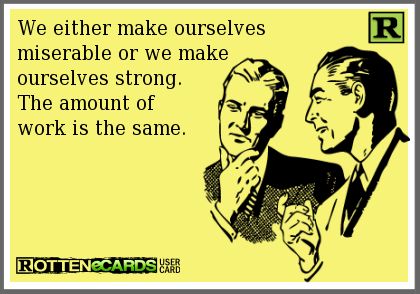
Worst Day Ever?

RottenEcardsWorst Day Ever?
by Chanie Gorkin

Today was the absolute worst day ever
And don’t try to convince me that
There’s something good in every day
Because, when you take a closer look,
The world is a pretty evil place.
Even if
Some goodness does shine through once in a while
Satisfaction and happiness don’t last.
And it’s not true that
It’s all in the mind and heart
Because
True happiness can be attained
Only if one’s surroundings are good
It’s not true that good exists
I’m sure that you can agree that
The reality
Creates
My attitude
It’s all beyond my control
And you’ll never in a million years hear me say
Today was a very good day

Now read it from bottom to top, the other way,
And see what I really feel about my day.

From Aish.com.


Making the Ordinary Extraordinary

08b419073f601987ce81e919e41a021d-300x300You’ve just ordered a top sirloin at a five star restaurant and the waiter brings you prime rib.  Or you arrive on time for your reservation and still have to wait 20 minutes to get a table.  Or you ask for a beer with your dinner and, after you’ve reminded the waiter twice, he informs you as you’re finishing off your entree that the restaurant is out of your selection.

Do you complain to the manager, or do you wax philosophic and chalk up the experience to the vagaries of life?

It may depend on whether you are dining cross-country or dining across town.

That’s what researchers from Temple University, Arizona State University, and the University of Minnesota concluded when they studied a cross-section of restaurant reviews: we’re more likely to be critical of establishments when we’re closer to home than we are when we’re on the road.

The question, of course, is why?

Read the whole article here.

Who is Wise? Who is Righteous? One who reads Harry Potter

RADCLIFF...TO GO WITH STORY TITLED POTTER COUNTDOWN--FILE--Actor Daniel Radcliffe writes with a quill in a scene from Warner Bros. "Harry Potter and the Philosopher's Stone," in this undated promotional photo. The film has its world premiere in London this weekend and hits theaters Nov. 16. Based on the first of author J.K. Rowling's best-selling series, the movie follows the adventures of Harry, an orphan boy who is invited to become a student at the Hogwart's School of Witchcraft and Wizardry. The movie faces huge expectations not only among fans, but at the box office, too. (AP Photo/Warners Bros. Pictures, Peter Mountain/FILE)

Do you want to put an end to bigotry, ultra-nationalism, and racism? It might be easier than you think. Try reading Harry Potter.

No, it’s not magic. According to the Journal of Applied Social Psychology, there’s more to the wildly successful series than just a good story. The tale of a mistreated orphan boy who discovers extraordinary magical abilities is essentially an epic metaphor for the battle between merit and privilege, between status and stature, as pure-blooded wizards contend with half-bloods and “mudbloods” for supremacy over the magical world.

By identifying with the heroes of the story who grapple with the conflict between ancestral identity and the content of character, readers will likely emerge a little more heroic themselves.

That’s what Professor Loris Vezzali and his team of researchers from Italy’s University of Modena and Reggio Emilia concluded after a series of studies which demonstrated how children exposed to the passages dealing with prejudice displayed improved attitudes toward minorities and other social classes. According to Scientific American, this research supports an earlier study in Science, which “found that reading literary fiction, as opposed to popular fiction or nonfiction, results in keener social perception and increased empathy.”

This really should come as no surprise. Literary fiction seeks to educate as well as entertain. The combination of relaxing the mind, the willing suspension of disbelief, and the integration of moral themes, allows for the better internalization of values. Of course, the benefits are dependent upon the soundness of those values.

But Harry Potter hits the mark with almost unwavering accuracy.

Read the whole article at: http://www.learning-mind.com/reading-harry-potter/

Compartmentalize Your Free Will

do-not-cross-the-line-crossing-a-shopping-cart-prohibition-of-shopping-cart-1201651Throw out the diet books and stop starving yourself.  Here’s the next big thing in healthy living:

Duct tape.  Yellow duct tape.

That’s what researchers found when they partitioned grocery store shopping carts into sections, one side for fruits and vegetables, one side for other items.  Just a little nudge to make shoppers more conscious of their purchases led them to buy more healthy food and less junk.

The researchers, Brian Wansink, Dilip Soman, Kenneth Herbst, and Collin Payne, didn’t stop there.  By varying the size of the compartments, they discovered that shoppers bought even more fruits and vegetables in proportion to the size of the designated compartment.  With a little manipulation, customers could be prodded into choosing a healthier diet.

Ah, but there’s the rub.  How dare they manipulate us!  Who are they to play with our minds, to force us to conform to their values, and to interfere with our free will?

To which there is only one obvious response:  nonsense!

Read the whole article at http://www.pickthebrain.com/blog/compartmentalizing-free-will/#kyxx1wXQ1Ae41ZFJ.99

If You Could Be Supergirl

The new CBS drama “Supergirl” premiered last night to surprisingly positive reviews.  (No, I didn’t watch it.)  Critics liked the return to an all-American, disarmingly optimistic protagonist after the recent rash of moody, brooding, self-doubting superheroes who spend one moment saving the world and the next wallowing in their own personal angst.

Perhaps “Supergirl” is a step back toward lost innocence, and maybe a step forward toward a future when traditionalists don’t have to apologize for their commitment to traditional values.

We can only hope, and contemplate these thoughts on heroism, originally published in 2008 by Aish.com.

If You Could Be Superman

The-Avengers-Movie-Roster-Concept-ArtThe question caught me off guard, which doesn’t happen often after 15 years in the classroom. “If you could have any superpower,” asked Aliza, the ‘reporter’ for the school newspaper, “which would you choose?”

I pondered my choices. Super strength? Invisibility? Mind control? X-ray vision? I wouldn’t like becoming a green mutant like the Incredible Hulk, but swinging on webbed ropes like Spiderman might be cool.

The question is more than a variation on the genie-in-the-bottle scenario. Three wishes make narrowing the field of possibilities much easier, and focus on what you want to have, as opposed to who you want to be.

Ironically, it was two Jews who brought the whole genre of superheroes into the collective consciousness of popular culture. In 1933 Jerry Siegel and Joe Shuster, two Jewish teenagers from Cleveland, responded to Hitler’s rise to power in Germany by reinventing their comic character, Superman, as a defender of truth, justice, and the American way. The only time they couldn’t work on their project was Thursday nights, when their “drawing board” was confiscated by Joe’s mother, who used it to knead the dough for her Shabbos challah.

Batman, Spiderman, Captain America, and the Green Lantern were all created by Jews as well. For the not-yet assimilated Jew trying to find his place in gentile society, the invincible alter ego of the mild-mannered misfit was the perfect symbol of cultural ambivalence.

Jewish tradition has its share of larger than life heroes. Samson defeated the Philistines with superhuman strength. Jacob’s son Naftali possessed supernatural speed. The biblical prophets predicted the future and performed countless miracles, including at least two incidents of resurrecting the dead. The kabbalistic literature includes credible accounts of sages possessing knowledge of other’s secret thoughts or personal histories.

A proper understanding of these narratives requires an appreciation that the personalities in the Bible are not cartoon characters. Moses was infinitely greater than Charlton Heston could ever make him out to be, and the memory of Samson is poorly served by his common portrayal as a World Wrestling Federation caricature. The biblical heroes of Judaism were real people who, through extraordinary dedication and self-sacrifice, achieved extraordinary things.

THE RESPONSIBILITIES OF POWER

Nevertheless, there is a critical point in common between the heroes of Jewish tradition and the heroes of comic book fantasy: all recognized that their unique talents and abilities obligated them in service beyond individual self-interest. As Cliff Robertson says to Tobey Maguire in Spiderman: “With great power comes great responsibility”.
crossing-the-red-seaThe heroes of the Bible did not seek greatness. Moses tried to argue his way out of the yoke of national leadership. The prophet Jeremiah protested that he was too young and inexperienced to rebuke his fellow Jews. Samson’s divine mission was prophesied before his birth. Yet each of them rose to the responsibility imposed upon him by the power with which he was endowed by his Creator.

Consider the structure of the Jew’s daily prayer, composed by the sages to include every possible category of request. We ask for knowledge, so that we can know the difference between right and wrong. We ask for forgiveness, repentance, redemption from our problems, health, guidance, and for the arrival of the messianic era. In short, we ask for the Almighty to bestow upon us the resources we need to help bring His plan for creation closer to its fulfillment.

None of which requires superpower.

THE REAL HEROES

So what should one ask of his Creator? It is with this request that the devout Jew begins his day: Bring us not into the hands of careless sin or wanton transgression, nor into the hands of trials or disgrace; let us not fall under the dominion of the inclination to do evil, and distance us from wicked men and every wicked companion. We do not ask for super power to defeat our enemies, but for the inner strength and the divine protection to rule over ourselves.

The attraction of superhuman power and the mystique of superheroes springs forth from a romantic adventurism that renders ordinary life unsatisfying by comparison. We find our lives mundane and therefore long for the excitement of fantasy. We discard the value of the everyday and seek to live vicariously through the imagined and the unattainable.

It is noteworthy, therefore, that Biblical Hebrew contains no word for either romance or adventure. These are concepts of the modern world, both of them betraying the modern world’s dissatisfaction with reality.

So what superpower would I ask for? I still can’t say. And when I asked a group of my students, not one would commit to an answer. Perhaps our reticence comes from our innate appreciation that we are already supermen by virtue of the soul that resides within us. How else to explain the courage that compels human beings to battle daily against ignorance, prejudice, laziness, impatience, dishonesty, and deceit. To conquer those enemies, day after day and year after year, and to return to the fight when they have conquered us — this is the measure of true heroism.

We don’t need super powers to become extraordinary. Striving to fulfill the potential with which we were endowed by our Creator makes us the greatest heroes of all.

Yom Kippur: Playoff Season for the Soul

Guest post by Mendel Horowitz

81+-f2+wGkL._UX385_From the Washington Post

Like a field of dreams Yom Kippur counts on ghosts to inspire. In Kevin Costner’s sentimental role, his character Ray Kinsella carves a baseball diamond from a cornfield after hearing a mysterious whisper “if you build it he will come.” Encouraged by the prophecy and by the spirits of departed ballplayers, Ray in the end discovers his estranged father behind the plate and engages him in a seraphic game of catch. The High Holidays too can be stirred by fantastic voices – inexplicable motivators of contrition, correction, change. On Yom Kippur, standing solemn before my Maker with ghosts of past defeats and not-yet triumphs at hand, I too will aspire to engage Him. I too will hew a future from the past.

This year, the portentous Day of Atonement falls on the eve of September 23, while Sir David Wright hosts the Braves and the Mets delight in their amazing dream. For believers in Flushing, on that weekend baseball might seem delightfully temporal, repentance as distant a notion as spring. For me, our pastime is irresistibly spiritual, her diamond silhouette an invocation, her metaphors as vibrant as her checkered outfield grass. In my synagogue, that holy day will be celebrated as an occasion of longing, an extra-inning playoff of abstinence and prayer. I may not be rooting for the home team that afternoon but I will be encouraged by baseball’s oddities.

Our national pastime is peculiar indeed. When Yogi Berra quipped “it ain’t over till it’s over” during the summer of 1973, the Mets were in last place, finishing July a dismal 44-57. By August 30 the team was 61-71, 6.5 games back with 29 to play. Before the season closed the Mets would claim the NL East, victorious in 21 of their last 29 contests. The Mets infiltrated the postseason with a record of 82-79, to date the worst percentage by a division champion. After raising the NL pennant and battling to a World Series Game Seven, it was finally over when the Mets fell to the Mustache Gang and their swaggering MVP.

Yogi was only half right. In all professional team sports – baseball included – a playoff berth is routinely clinched before the season officially ends. It can be over before it’s over. Baseball is, however, unique in disallowing any single game to be over before its final out.  Only on a diamond can a team come back from any deficit with no buzzer, whistle, or horn interrupting its rally. No game is over till it’s over. Just ask Mookie Wilson, who in 1986 delegitimized Billy Buckner on the tenth pitch of his heroic at-bat after the Red Sox were at three times one strike from deliverance. Baseball is a game of second chances.

For diehards, Yom Kippur is a final opportunity in a season of do-overs. When the Israelites forged a golden calf at Sinai Moses was compelled to smash the original tablets, tossing the first pitch in an epic struggle for God’s favor. Throughout a heated summer Moses labored valiantly atop the hill, earning the right to carve new tablets by offering himself for his team. On Yom Kippur, his efforts rewarded, the prophet descended triumphant, with God’s unassuming pardon and trophy slabs in hand. From the assurance of spring through the worry of summer, Moses carried his team to a fall salvation. Not bad for a rookie.

Relived annually, the Jewish season of second chances gets underway with the advent of Elul, the final month before the New Year. From then, each morning after services a shofar sounds and a special psalm is recited, calling to mind the far-reaching potential of the ensuing homestand. For a meritorious few and their less fortunate opposites, Rosh Hashanah, thirty days later, is the conclusive day of judgement, when the righteous and the wicked are inscribed in their respective tomes. Yom Kippur occurs ten days after that, allowing unremarkable journeymen extra innings to settle their score. Before the season’s final strike everyone will have their say at the plate.

A forty day homestand of penitence offers adequate occasions for transcendance. The process of repentance can invigorate, awakening dormant courage from slumber. But introspection is notoriously difficult to maintain, the stretch from Elul to Yom Kippur wearisome, draining. Like an ordinary baseball season (which spans three of four climatic seasons) the Days of Awe rely more on storylines than thrills, more on drama than excitement. Baseball is neither raucous nor bold. When “90% of the game is half mental” its energy is bound to be subtle.

IAB_logoBy some estimates 90% of the game is also spent standing around. According to the WSJ baseball’s fleeting moments of action account for but 17 minutes and 58 seconds of a typical three hour game. From on-deck circle to bullpen, from pathological glove adjustments to obsessive shaking off signs, baseball is an exhibition of exaggerated preparedness. Everything important in baseball happens in the heartbeats between anticipation. Apprehension is baseball’s charm; waiting, her mystique.

What made the pennant race endearing in ‘73 and the rally against Boston amazing in ‘86, were the unhurried ways they unfolded. Few things happen suddenly in baseball, it’s magic evolves leisurely in plain sight. No need for rapid eye movement or instant replay; baseball’s feats are taken in with a pencil and a stomach for suspense. In baseball, time is not something to play against but to toy with, the moments between activity more moving than the action itself.

The Day of Atonement is itself drawn out, prone to rushes of emotion and spans of boredom too. Between its haunting first inning and expectant last are 25 self-denying hours, an ascetic journey of supplication, ceremony, and song. Like baseball, Yom Kippur is a slow game, one that rewards patience with equal measures of elation. The enchantment of the day lingers in its tensions, its allure apparent in its yearning. A classic Yom Kippur unfolds without hurry, its promise swelling cautiously, its hesitancy bursting my heart.

As a religious orientation, baseball imbues the virtue of readiness, the modesty of reacting to something thrown at you really fast. At the plate and on Yom Kippur I can never be sure what may be tossed my way. All I can do is to prepare. Before the ghosts arrived, Ray Kinsella sculpted sacred space from profane, building it so “he will come.” Before knowing who he was, Ray was prepared for his arrival.

Absolution is never assured. To encounter Him on September 23 I will rely on ritual and superstition to get myself ready. My personal playoff will be lengthy, and if all goes well, improbable. I envision a nail-biter until late innings when, like Kirk Gibson, I will limp to the plate and achieve the impossible. Preferably with a longball. Preferably on a full count.