Home » Posts tagged 'Politics' (Page 19)
Tag Archives: Politics
The New Polarization
 A college student who rarely attended classes and turned in assignments poorly done or not at all, emailed his professor after receiving his final grade to ask if there was any way he could raise his grade — an F earned with a 25% average — to a C. Even grade inflation couldn’t help this hapless soul.
But hope springs eternal, and wishful thinking has become so pervasive that it has a new name: magical thinking, as if wishing just isn’t enough anymore.
It’s everywhere. Government programs with no revenue to pay for them. Students acquiring massive debt from loans to procure degrees in art history, classical philosophy or — no joke — viking studies. State sponsored alternative energy schemes built on nothing but high-minded intentions. School boards hiring puppet administrators and then firing them when student performance crashes.
On the one hand, we indulge in the most irrational flights of fancy with no concern for the consequences. On the other, we resist thinking out of the box by denying ourselves the opportunity to engage people with opposing viewpoints in civil discourse.
Is this the new face of polarization? Not just between groups, but within our own minds?
Instead, let’s turn it around: challenge yourself to seek out new viewpoints and strategies, not to escape from reality but to deal with it and succeed.
Holocaust Day — Visionaries and Ideology
 Who knew a trip to New York could be so emotional?
I didn’t want to go in the first place. As my 92-year-old student likes to quote: Travelling is for peasants.
But my wife convinced me with simple arithmetic. Four tickets to bring three kids and son-in-law home or two tickets to visit them. No-brainer.
So I went grudgingly, confirming in the end the truism that some of life’s most profound moments come not only unexpected but against our will.
Our first stop was the 9/11 museum. I marveled at the artistic vision that had conceived the memorial pools, the water channeling down in rivulets that mirrored the face of the fallen towers, the continuous downward rush balanced by the redemptive feeling of water — the source of life — returning to the heart of the world. Here there was solace, closure, and consolation.
But a very different feeling accosted me inside. Almost upon entering the doors a single word brandished itself across my mind’s eye: Holocaust.
Let me explain.
Read the whole article here.
Higher Education?
 On March 9, the Supreme Court refused to hear an appeal by the University of Iowa College of Law challenging Teresa Wagner’s successful lawsuit claiming political discrimination for her conservative views.
The decision comes a year after a more dramatic victory by Mike Adams, a conservative sociology professor who won a similar suit. Professor Adams was awarded a promotion, a raise, $50,000 in back pay and $710,000 in legal fees from the University of North Carolina-Wilmington.
Underlying both stories is the more serious concern that the culture of ideological narrow-mindedness and bullying has transformed college campuses around the nation from centers of higher thinking into indoctrination centers for political and philosophical uniformity.
 And it’s not just universities. My Google search for this story turned up only two headlines, one from the conservative Washington Times and the other from the local Iowa Press Citizen. The print media, it seems, has no more interest in open discussion and debate over opposing viewpoints than does academia. Better to man the battlements and defend the ivory towers from that most dangerous of all enemy attackers — rational thinking and reasoned argument.
The same principle holds true in business, in education, in religion, and in every arena of social discourse. If we can’t articulate the position of our ideological opponents, we can’t refute their arguments and, more important, we can’t fully understand our own.
For a more thorough discussion regarding the evils of groupthink, please see my article here.
St. Patrick’s Day — Searching for the way out of exile
 At first glance, the soggy, green downs of Ulster bear little resemblance to the parched and craggy hills of Israel. But a gentle tugging at the cultural fabric of either place unravels an unmistakable common thread: two peoples, impossibly close geographically, impossibly distant ideologically, with more than enough fuel for hatred between them to burn until the coming of the Messiah. Tromping over hills and through city streets, however, first in one place and then in the other, I discovered a more compelling similarity: the bitter struggle of humanity in exile.
“Which are the bad parts of town, the ones I should avoid?” I asked the owner of the bed-and-breakfast where I passed my first night in Belfast.
She dutifully pointed out the Shankhill neighborhood on my map, cautioning me to steer clear of it. I thanked her and, with sophomoric self-confidence, proceeded there directly.
 It was the summer of 1984, in the midst of “the Troubles,” and central Belfast exuded all the charm of a city under martial law. Policemen on patrol wore flack jackets. An armored personnel carrier idled at a major intersection waiting for the signal to change. Blown out shells of buildings sprouted weeds, and street signs warned, DO NOT LEAVE CAR UNATTENDED. But as I worked my way up Shankhill, I discovered even more disconcerting landmarks: elementary school yards swathed in barbed-wire and churches pocked with scars from automatic-rifle fire.
I stopped in at a corner pub and took a seat at the bar beside two locals. Each was nursing a pint of Guinness. Another glass, two-thirds full with boiled snails, rested between them. The men took turns using a bent eight-penny nail to dig each snail out of its shell before popping the meat into their mouths.
I was half-way through my own pint of ale when the nearest one began chatting me up. “Yootoorin?” he said.
“I beg your pardon?”
“Yootoorin?” he repeated.
“I’m sorry, I don’t understand.”
“You touring? You traveling around?”
I needed several minutes to adjust to his accent. I never did get used to his indifference to life in a war zone.
“It’s no big deal,” he said with a wave of his hand. “There’s not many bombs going off any more, except on the big anniversaries, and everyone expects it then.” He extracted another snail from its shell, tossed it into his mouth, and chased it down with a swig of Guinness.
“Nobody lets the fighting get in the way of their getting on with life,” my friend continued. “You get used to it, you know?”
 I was carried away to captivity in Ireland with so many thousands of persons, as we deserved, because we departed away from the Almighty … [and He] brought upon us the fury of His anger and scattered us among many nations as far as the end of the earth…
So writes St. Patrick, Ireland’s patron saint, echoing the prophecy in Deuteronomy 28 according to which, four centuries earlier, the Children of Israel had been exiled at the beginning of the great Diaspora. Yet Patrick applied it without hesitation to his own time and place, presuming that the right of a nation to reside peacefully in its land depends upon the character and integrity of its people.
My wanderings ultimately led me from Belfast to Jerusalem, where I also found people living amidst violence and without fear. And there, as St. Patrick had done in Ireland, I discovered the ancient lessons of my own people, who have found neither peace with their neighbors nor peace with one another.
Exile, I gradually came to understand, does not require banishment to the ends of the earth. It can happen right at home, and it can take many forms. Indeed, which is the more profound Diaspora: being scattered to distant lands, or living under siege in one’s own home? And if we do find ourselves exiles in our own land, to where can we escape?
Today, the residents of both Israel and Northern Ireland fight among themselves over definitions, over identity, and over direction. In this they are like so many other peoples in this uncertain world, laboring to learn that the only way any of us can find the path leading out of exile is by shouldering the responsibilities of freedom.
Originally published in the St. Louis Post-Dispatch, 1999.
Just who are “we”?
Tonto: What is wrong, Kimosabe?
Lone Ranger: We’re surrounded by bloodthirsty indians, Tonto. What are we going to do?
Tonto: What you mean, “we,” white man?
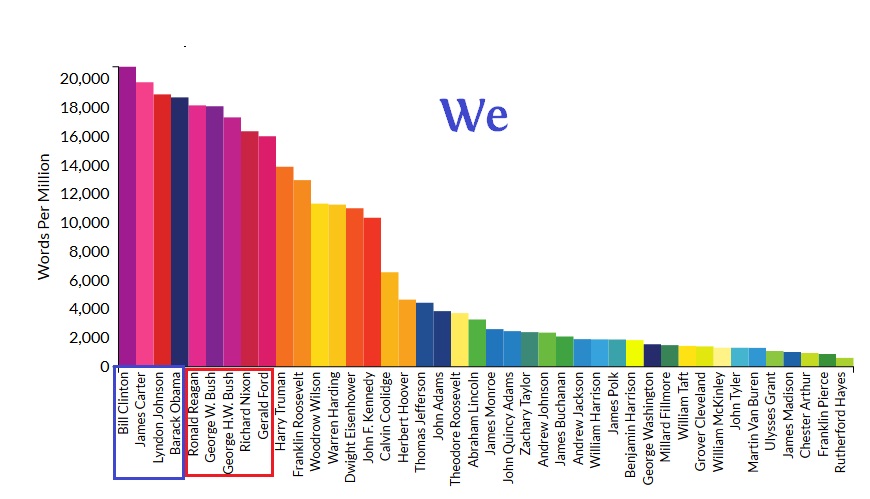 Thanks to Jay Livingston for this post on behalf of the Montclair State Sociology Department. He paints a compelling picture of how the collective language of “we” has been increasingly conscripted by modern politicians to create — or fabricate — an impression of common purpose and common allegiance.
With politics dividing us more deeply than ever, it might seem beneficial to employ rhetoric designed to bridge the ideology gap. In practice, however, disingenuous expressions of harmony and unified vision can do a lot more harm than good.
For one, when a demonstrably divisive leader — a U. S. president, for example — claims that he is the leading advocate of unity and cooperation, he makes himself a lightning rod for accusations of hypocrisy and manipulation that breed cynicism in place of optimism. For another, by claiming the high ground, he implicitly vilifies all who oppose him, even if they do so from positions of principle. Either way, the ideological rift grows wider, not narrower.
Perhaps worst of all, the collective “we” diffuses responsibility from the individual onto the collective: since all of us are responsible, none of us is responsible. This produces the effective equivalent of such politicalisms as “Mistakes were made.” Somewhere, someone did something wrong. There’s plenty of blame to go around, but nowhere for it to stick.
In short, fake unity achieves the opposite of unification.
But when there really is cohesion, whether within a team, a business, a community, or a society, the collective “we” becomes a priceless asset, including the lowly with the high, the rank and file with the leaders, the grunts with the visionaries. Like it or not, we’re all in it together. And the more we try to shoulder our collective burdens with one mind and one heart, the more we will succeed.
Church vs. State
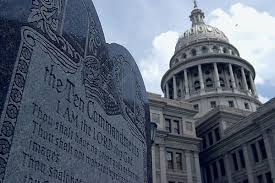 Here’s a quiz question: When was the phrase “separation of church and state” first introduced into American jurisprudence?
a) 1789; b) 1800;
c) 1840; d) 1947
Most of us would answer 1789, with the ratification of the United States Constitution and the First Amendment, guaranteeing religious freedom.
Guess again.
According to Columbia law professor Philip Hamburger (cited by Eytan Kobre in Mishpacha Magazine), the first use of the phrase was during the presidential election of 1800, when defenders of Thomas Jefferson responded to attacks that their candidate was anti-religious by invoking the “need to separate religion from politics.” Jefferson himself used the phrase in a letter in support of Connecticut Baptists who feared political oppression. Jefferson’s overture was ignored by religionists who could not imagine the absence of religion from public life, even in their own defense.
Around 1840, when Catholics in New York City began claiming access to funding for religious schooling, Protestants responded by asserting church and state separation, eventually seeking a new constitutional amendment to that effect in the 1870s. When that effort failed, reinterpretation of the First Amendment became their next strategy.
But it was only in 1947 in Everson vs. Board of Education that, despite a 5-4 split in the Supreme court ruling, the justices agreed unanimously that a “wall of separation between church and state” was implicit in the First Amendment. The majority opinion was authored by Justice Hugo Black, a former leader of the Ku Klux Klan in Alabama.
Thus, the origins of a tradition that everyone thinks believes goes back to the framers — most of whom would be horrified by the popular outlook that has come to define the First Amendment, in the words of Joseph Lieberman, as protecting not freedom of religion but freedom from religion. The “wall of separation” has been critiqued by Justice Clarence Thomas as “born in bigotry,” by Justice Potter Stewart as “nowhere to be found in the Constitution,” and by former Chief Justice William Rehnquist as “a metaphor based on bad history, a metaphor which has proved useless as a guide to judging. It should be frankly and explicitly abandoned.”
Writes American University law professor Daniel Dreisbach: “Indeed, this wall has done what walls frequently do — it has obstructed the view. It has obfuscated our understanding of constitutional principles…”
Groupthink: Blinded by “I’m Right”
 Crossword puzzles. Sudoku. Word games. Logic problems. These are common recipes from the diet books for the mind. Go traveling. Take up knitting or gardening. Learn Italian. Drive a different way to work. Get an advanced degree. Anything and everything that piques cognitive activity belongs in our catalogue of mental health activities.
“That’s all good,” says Barbara Strauch, author of The Secret Life of the Grown-Up Brain: The Surprising Talents of the Middle-Aged Mind and New York Times health and medical science editor. But the most intriguing advice Ms. Strauch has heard is this: “Deliberately challenge your view of the world. Talk to people you totally disagree with.”
It makes sense. Nothing kicks the brain into overdrive like having to defend your point of view against attack, or the desire to dismantle an argument you find unsound or wrongheaded. What’s more, Ms. Strauch asserts that the brain is actually primed for questioning assumptions, since reexamining our beliefs provides the opportunity to revisit, or more deeply contemplate, why we believe the way we do.
“Confronting things you disagree with may not make you change your mind,” she says, “but it will perhaps give you a view that is more satisfying to the middle-aged brain.”
And who knows? Sometimes we may even discover that we’ve been wrong.
 Yonason Goldson