Home » Posts tagged 'Sociology' (Page 7)
Tag Archives: Sociology

The War on Women Continues
From the Huffington Post:
 British chess grandmaster Nigel Short is responding to criticism after recently arguing that inherent differences in men’s and women’s brains may explain why there are fewer female chess champions than males ones.
“Men and women’s brains are hard-wired very differently, so why should they function in the same way? I don’t have the slightest problem in acknowledging that my wife possesses a much higher degree of emotional intelligence than I do,” he wrote in the February issue of New In Chess magazine. “One is not better than the other, we just have different skills.”
“It would be wonderful to see more girls playing chess, and at a higher level, but rather than fretting about inequality, perhaps we should just gracefully accept it as a fact,” he added.
So why would Huff Post run such a blatantly chauvinistic report? Well, obviously, for the counter-offensive that makes up the last 60% of the article. Then, of course, you have the comments, which fluctuate wildly between the apoplectic, the apologetic, the politically correct, and the well-reasoned.
Anyone who has raised children or taught school knows that males and females are more different than some species. We have different strengths and weaknesses, which is why it makes sense that we form partnerships called “the family.”
It’s both fascinating and disturbing that so many people are offended by those who say so.
How Ants Survive Rush Hour…
… and why putting your ego in check will change your life
 It’s everyone’s nightmare. Rush hour. Inching along interminably as too many cars navigate too few lanes, with too many merging in and too few turning off.
Who would have imagined that King Solomon already anticipated the chaos of our highways when he declared, Go, sluggard, and learn from the ant?
As it turns out, ants are better drivers than we are. And the lessons of their highway habits offer some valuable lessons that extend far beyond the way we drive.
According to NPR, Apoorva Nagar discovered the connection in a study by German and Indian researchers. Apparently, traveling ants are able to maintain a constant speed regardless of the number of ants on the path. In other words, even at rush hour, ant traffic carries on unimpeded.
Sanity vs. Compassion — how to choose?
 Would you accept an invitation to the Mind and Life Institute’s International Symposium for Contemplative Studies? Or does it all sound too flaky?
It’s hard not to sound pretentious when trying to be substantive in a superficial world. I might easily have dismissed the headline — Creating a Caring Society — as so much new-age twaddle… but if I had I’d have been guilty of the same superficiality that I frequently decry.
Citing Tania Singer, a social neuroscientist from The Max Planck Institute, the article offers an intriguing distinction between empathy and compassion. The first is a mere sharing of feelings; the second is an impulse to turn feelings into action. Sure, empathy is a good start. But feeling another’s pain doesn’t help feed the poor, shelter the homeless, enlighten the ignorant, or comfort the bereaved.
In fact, failure to take action may actually cause distress and suffering to the empathizer, who feels frustrated and inadequate for having provided no relief to the one in need.
The more pervasive problem, however, is our increased detachment from the plight of others so that we don’t feel at all. No surprise there… if we responded as we should to every news story of poverty, illness, and violence, we’d all be on a perpetual Valium drip. So instead we plug into our electronic kaleidoscopes and tune out the real world.
We can only preserve our sanity by deadening ourselves to the flood of human suffering that washes over us day and night. But to ignore the call of compassion leaves us less than human.
As with so many things, the answer lies somewhere in the middle. Feel pain, but not too much pain. Respond to the pain of others with concrete action. No, it’s not easy. But it’s the only avenue we have for restoring an emotionally and morally healthy society.
The New Polarization
 A college student who rarely attended classes and turned in assignments poorly done or not at all, emailed his professor after receiving his final grade to ask if there was any way he could raise his grade — an F earned with a 25% average — to a C. Even grade inflation couldn’t help this hapless soul.
But hope springs eternal, and wishful thinking has become so pervasive that it has a new name: magical thinking, as if wishing just isn’t enough anymore.
It’s everywhere. Government programs with no revenue to pay for them. Students acquiring massive debt from loans to procure degrees in art history, classical philosophy or — no joke — viking studies. State sponsored alternative energy schemes built on nothing but high-minded intentions. School boards hiring puppet administrators and then firing them when student performance crashes.
On the one hand, we indulge in the most irrational flights of fancy with no concern for the consequences. On the other, we resist thinking out of the box by denying ourselves the opportunity to engage people with opposing viewpoints in civil discourse.
Is this the new face of polarization? Not just between groups, but within our own minds?
Instead, let’s turn it around: challenge yourself to seek out new viewpoints and strategies, not to escape from reality but to deal with it and succeed.
Visionaries and Ideology: a study in contrasts
 Who knew a trip to New York could be so emotional?
I didn’t want to go in the first place. As my 92-year-old student likes to quote: Travelling is for peasants.
But my wife convinced me with simple arithmetic. Four tickets to bring three kids and son-in-law home or two tickets to visit them. No-brainer.
So I went grudgingly, confirming in the end the truism that some of life’s most profound moments come not only unexpected but against our will.
Our first stop was the 9/11 museum. I marveled at the artistic vision that had conceived the memorial pools, the water channeling down in rivulets that mirrored the face of the fallen towers, the continuous downward rush balanced by the redemptive feeling of water — the source of life — returning to the heart of the world. Here there was solace, closure, and consolation.
But a very different feeling accosted me inside. Almost upon entering the doors a single word brandished itself across my mind’s eye: Holocaust.
Let me explain.
Read the whole article here.
Just who are “we”?
Tonto: What is wrong, Kimosabe?
Lone Ranger: We’re surrounded by bloodthirsty indians, Tonto. What are we going to do?
Tonto: What you mean, “we,” white man?
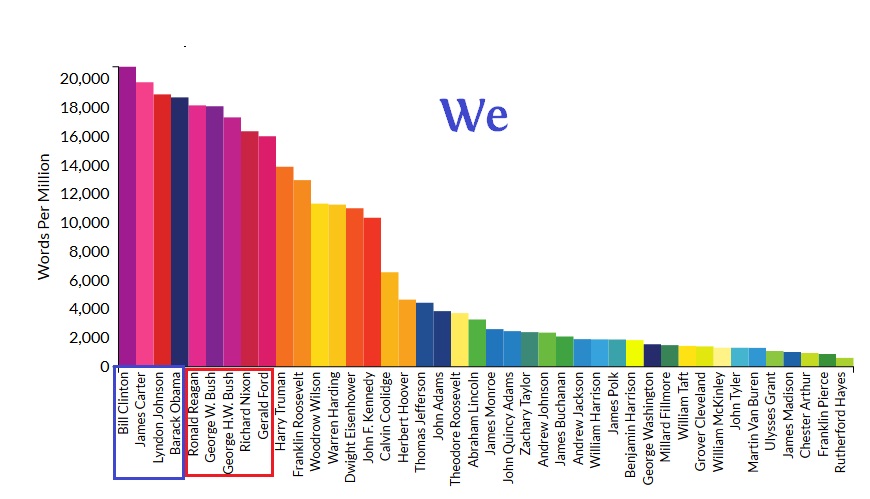 Thanks to Jay Livingston for this post on behalf of the Montclair State Sociology Department. He paints a compelling picture of how the collective language of “we” has been increasingly conscripted by modern politicians to create — or fabricate — an impression of common purpose and common allegiance.
With politics dividing us more deeply than ever, it might seem beneficial to employ rhetoric designed to bridge the ideology gap. In practice, however, disingenuous expressions of harmony and unified vision can do a lot more harm than good.
For one, when a demonstrably divisive leader — a U. S. president, for example — claims that he is the leading advocate of unity and cooperation, he makes himself a lightning rod for accusations of hypocrisy and manipulation that breed cynicism in place of optimism. For another, by claiming the high ground, he implicitly vilifies all who oppose him, even if they do so from positions of principle. Either way, the ideological rift grows wider, not narrower.
Perhaps worst of all, the collective “we” diffuses responsibility from the individual onto the collective: since all of us are responsible, none of us is responsible. This produces the effective equivalent of such politicalisms as “Mistakes were made.” Somewhere, someone did something wrong. There’s plenty of blame to go around, but nowhere for it to stick.
In short, fake unity achieves the opposite of unification.
But when there really is cohesion, whether within a team, a business, a community, or a society, the collective “we” becomes a priceless asset, including the lowly with the high, the rank and file with the leaders, the grunts with the visionaries. Like it or not, we’re all in it together. And the more we try to shoulder our collective burdens with one mind and one heart, the more we will succeed.
Kung Fu Sociology
 I often say sociology is a martial art, a means of self-defense. Basically, you use it to defend yourself, without having the right to use it for unfair attacks.
As with all data, facts, information, or intellectual discipline, social science can be used honestly to reveals truths about the human condition or applied selectively to support preconceptions and bolster entrenched ideology. In this blog post, the writer who cites Professor Bourdieu correctly identifies examples of disingenuous conclusions reached through misapplication of facts and logic. At the same time, however, the writer indulges his own personal biases by making sweeping assumptions about headline events without regard for established facts.
In the same way we have no right to misapply data to fit our preexisting notions, neither are we justified imposing our world view on specific situations that objectively refuse to fit our own personal narrative.
Civil society depends upon debate that is both civil and intellectually honest. When we manipulate conclusions, we fail in the art of social kung fu. I imagine that Professor Bourdieu would agree.
 Yonason Goldson