Home » Posts tagged 'Virtue' (Page 25)
Tag Archives: Virtue

The Virginia Shooting: Nihilism and the Culture of Anarchy
 “What has happened to us as a society that we now devalue life to such a level? What has happened in our society that people have become so violent? That’s the fundamental question we need to confront… We have a societal problem in our country. It reminds us of the most important job any of us will ever have … the job of a mother, a father or a parent.”
Senator Marco Rubio summed it up nicely… or tragically. But the deeper question is this: How do we stop the cultural inertia that is driving our society ever further into nihilism and moral anarchy?
Senator Rubio gets the answer perfect: If it doesn’t start in the home, then there really is no hope for the future. Without respect for traditional values, without recovering the lost ideals of civility, selflessness, modesty, and integrity, then the tide of history will sweep us away as it did the Roman Empire and leave behind a new Age of Darkness.
Bill O’Reilly makes the same point with his usual brass-knuckled pithiness here.

Someone is Always Watching
 “Someone is always watching.” Movie fans will recognize this as the punchline from “Ocean’s Eleven,” a glib repartee that ultimately recoiled on Andy Garcia and drove Julia Roberts back into the arms of George Clooney. Political observers might remember it, now that former Illinois Governor Rod Blagojevich is back (briefly) in the news, as a line the convicted politico should have uttered when he found himself the subject of state and federal investigators.
But just the opposite was true. The AP reported:
“You would think he would see his life collapsing around him,” said Chicago defense lawyer John Beal, who was in the courtroom with Blagojevich this week and noted how carefree he seemed. “But he was the center of attention and seemed to love it.”
One almost envies Mr. Blagojevich the comfort of his delusions.
At the beginning of the last century, the invention of electric lighting,telecommunication, and cinematography began to change the complexion of modern society. At the time, the leader of European Jewry, the venerable Chofetz Chaim, observed that the introduction of technologies scarcely imagined a generation before provided a lesson for any spiritually sensitive person to recognize that the Universe is not indifferent to our moral conduct.
Previously, the natural cycle of night and day imposed strict order upon human activity. Because most people in those times could not afford the limitless supplies of candles necessary to transform night into day, all activity was cut short early by the long nights of winter, and only in summer could the workday stretch late into the evening. Now, inexpensively and with the flick of a switch, the night could be expelled and the secrets of the darkness instantly revealed.
Can you say AshleyMadison?

What is happiness, and how do we get it?

Order on Amazon today.
Proverbial Beauty, a new book on how to achieve happiness and success, offers a practical guide to changing our outlooks and our fortunes. Here’s an excerpt:
In a single, ringing phrase, Thomas Jefferson captured the essence of the American dream when he declared that all men have the right to “life, liberty, and the pursuit of happiness.” And yet, despite Mr. Jefferson’s noble sentiments and laudable achievements, the enduring lyricism of his words spawned an epidemic of confusion and despondency that continues to spread like pestilence through western society.
How precisely does one pursue happiness? We may pursue wealth, pursue fame, pursue gratification of one form or another. But the fiction of pursuing happiness has become a collective obsession that consumes our lives, either by goading us into chasing impossible dreams or by tarnishing the quality of our existence with unwarranted regrets.
Before we set off in pursuit of anything, we ought to know what it is and how to get it. Like many other words and expressions, we toss about the word “happiness” without really knowing what we mean. The definition seems obvious, but the inconvenient truth is that we really have no idea what we’re talking about.
So what is happiness, and how does one get it?
Read the whole excerpt here:
http://www.jewishworldreview.com/0815/Goldson_pursuit_of_happiness.php3

Email of the Week — The Haircut
 Blessed are those that can give without remembering, and take without forgetting.
One day a florist went to the barber for a haircut. When the barber finished he said to the florist, “I can’t take your money: I’m doing community service this week.” The florist was pleased and left the shop.
When the barber went to open his shop the next morning, there was a Thank You card and a dozen roses waiting for him at his door.
Later, a policeman came in for a haircut. When he tried to pay his bill, the barber again explained, “I can’t take your money: I’m doing community service this week.” The officer was happy and left the shop.
The next morning when the barber went to open up, there was a Thank You card and a dozen donuts waiting for him at his door.
Then a Congressman came in for a haircut. “I can’t take your money,” said the barber once again. “I’m doing community service this week.” The Congressman was very happy and left the shop.
The next morning, when the barber went to open up, there were a dozen Congressmen lined up waiting for a free haircut.
And that, my friends, illustrates the fundamental difference between the citizens of our country and the politicians who run it.
As Mark Twain said:
Both politicians and diapers need to be changed often, and for the same reason.
Hat tip: Mom and Ginny Harrigan

Acquire the Gift of Giving
When she was 8 years old, Lara Aknin convinced her little brother to trade his dimes for her nickels. It was an easy sell… after all, nickels are bigger and must therefore be worth more.
 Now a psychologist at Canada’s Simon Fraser University, Dr. Aknin has discovered a mistake more profound than youthful embezzlement: in truth, her motivation itself was built on a misunderstanding of human nature.
In an interview with NPR’s Shankar Vendatam, Dr. Aknin describes the experiment in which her team asked toddlers to feed candies to hand-puppets which, they were told, would really enjoy the treats. Considering that these children were still too young to have absorbed any cultural awareness of giving as a value, the results produced two surprises. Explains Dr. Aknin:
“Children smiled significantly more when they were giving treats away than when they received the treats themselves. But what we thought was particularly exciting was that children actually smiled significantly more when they gave away one of their own treats than an identical treat provided by the experimenter.”
In other words, the greatest feelings of joy may come from giving up that which we treasure the most.
But does the impulse remain as we grow into adulthood?

The Orchestra of Mankind

Find tranquility in the midst of conflict. Develop attitudes that deepen relationships. Gain clarity through times of darkness and confusion. Decrease cynicism and find joy in the daily miracles that fill our lives.

Clean up your act and become a better person
 Counting your change as you exit the local supermarket, you discover that the cashier accidentally handed you back a ten dollar bill instead of a five. You pause, debating whether to go back and correct the error or pocket your modest windfall.
What you do next may depend on how fresh the fruit smelled in the produce section. If the tomatoes were over-ripe enough to emit an unpleasant odor, that might be all it takes to set your moral compass spinning.
In a series of social science experiments, researchers observed how exposure to disgusting smells or images can influence our attitudes and behavior: the same self-protective reflex that makes us back away from an assault upon our senses can also make us recoil from offensive behavior. Needless to say, rotten tomatoes have nothing to do with personal character; but once our feelings of disgust have been activated toward repugnant pictures or noxious odors we are more likely to feel aversion toward objectionable conduct and become increasingly repelled by unethical behavior.
That’s the good news. What’s really ironic, however, is that the same stimuli that make us less tolerant of improper actions by others make us more likely to engage in those same kinds of actions ourselves.

Can we Stay Honest in a Dishonest World?

The biggest tragedy of the Supreme Court decisions on Obamacare and gay marriage was not the decisions themselves. It was the perception, by both winners and losers, that these decisions were not reached based on legal principle but upon political ideology and personal bias.
Which means that, regardless of which side won, the country as a whole lost.
Honesty has seen its market value tumble over the years with countless reports of plagiarism, factual carelessness, and blatant fabrication. It’s bad enough when such prevarication comes from the media. But what’s really cause for alarm when it becomes the norm among our political leaders.
The sad truth is that truth from our politicians has become far more the exception than the rule. But the brazenness with which they conjure up easily verifiable falsehoods grows ever more astonishing.
Once integrity disappears, the only motive not to lie is fear of not getting away with it — and get away with they have, in a society that has grown indifferent to lying.
We may not be able to stop the lying in politics. But here are ten ways we can prevent the erosion of our own integrity.
Expanded and updated from an article published earlier this year. Click here to read the whole article.

In Memoriam: Nicholas Winton, 1909-2015
 Nicholas Winton, a Briton who said nothing for a half-century about his role in organizing the escape of 669 mostly Jewish children from Czechoslovakia on the eve of World War II, a righteous deed like those of Oskar Schindler and Raoul Wallenberg, died on Wednesday in Maidenhead, England. He was 106.
It was only after Mr. Winton’s wife found a scrapbook in the attic of their home at Maidenhead, in 1988 — a dusty record of names, pictures and documents detailing a story of redemption from the Holocaust — that he spoke of his all-but-forgotten work in the deliverance of children who, like the parents who gave them up to save their lives, were destined for Nazi concentration camps and extermination.
For all his ensuing honors and accolades in books and films, Mr. Winton was a reluctant hero, often compared to Schindler, the ethnic German who saved 1,200 Jews by employing them in his enamelware and munitions factories in Poland and Czechoslovakia, and to Wallenberg, the Swedish businessman and diplomat who used illegal passports and legation hideaways to save tens of thousands of Jews in Nazi-occupied Hungary.
May we all be inspired by a life of extraordinary heroism and modesty. Click here to read the New York Times retrospective.
Success in Failure
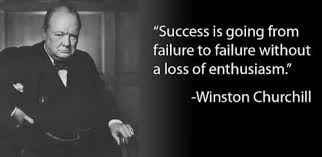 A righteous man falls seven times.
~Proverbs
But failure only leads to success if we learn the lessons it tries to teach us. Otherwise we prove the wisdom not of Solomon or Churchill but of Einstein and Hegel:
Insanity is doing the same thing over and over and expecting different results.
What experience and history teach is this — that people and governments never have learned anything from history, or acted on principles deduced from it.
 Yonason Goldson