







Home » Articles posted by Yonason Goldson (Page 50)

Author Archives: Yonason Goldson

The Unfairness Doctrine

With the biggest FIFA scandal to date dominating the headlines, I’m revisiting this piece from a couple of years ago about the growing indifference to justice throughout the world community.

cdn-media.nationaljournalThere are certainly more important things than soccer to get worked up over — especially here in the United States, where we already have baseball, basketball, hockey, and (American) football.

Maybe that’s an argument in defense of referee Koman Coulibaly, who infuriated American soccer fans by disallowing a winning goal by team USA with no apparent justification. After all, it’s only a game. Wouldn’t all that passion be better directed against the gulf oil disaster or Iran’s nuclear weapons program?

In this case, at least, the Federation Internationale de Football Association (FIFA) might agree. According to the New York Times, FIFA president Sepp Blatter “does not want video replay or extra referees on the end line at the World Cup. He favors debate over decisiveness and human frailty over intrusive technology, thinking that subjectivity helps soccer more than it hurts.”

Now there’s an interesting philosophy: human error by judges, umpires, and referees enhances competitive sports. But don your body armor before making that suggestion to Detroit Tigers pitcher Armando Galarraga. Only two weeks earlier, you may remember, a blown call by umpire Jim Joyce on the last play of the game denied Mr. Galarraga baseball’s most coveted distinction — a perfect game.

In the aftermath, pundits have suggested that the baseball mishap did more for the sport than a perfect game ever could have. Mr. Galarraga was the model of graciousness, upset at being robbed but apparently harboring no resentment. For his part, Mr. Joyce appeared not only contrite but genuinely heartbroken. A week later, the league itself showed impressive quality of character when a hundred MLB players voted the repentant umpire the best in the game. All around, a sport that has been plagued with steroid and contract scandals produced extraordinary examples of dignity, restraint and — to revive an expression near to extinction — class.

In contrast, Mr. Coulibaly has yet to offer a single word of explanation, much less apology, for his inexplicable whistle-blowing. (However, mounting pressure may convince FIFA to reverse its own policy of refusing to comment on calls by the time this sees publication. Nothing challenges core values like bad press.)

But is it only a game? Every parent knows that the way children play reveals much about who they are deep down. It seems reasonable to assume the same about cultures: the way they play speaks volumes about their moral values.

MORE THAN A GAME
In American sports, everyone from fans to players to officials to high commissioners has weighed in on the use of instant replay to ensure the accuracy of calls at critical moments. Some argue that, in the interest of fairness, every available technology should be employed to ascertain the umpiric accuracy. Others are afraid that instant replay will slow down gamesalready mired in strategic interruptions and commercial breaks. But no one claims that accuracy doesn’t matter. And certainly no one has ever hinted that inaccuracy is good for the game.

What the Armando Galarraga incident so refreshingly demonstrates is that, to a large degree, Americans still care about facts and fairness. Umpire Jim Joyce acknowledged his mistake, expressed sincere remorse, and all was forgiven. What the Koman Coulibaly debacle indicates is that, to a large degree, the international community has lost all interest in truth and justice.

When such indifference to right and wrong confines itself to the playing field, we might pass it off as a sad but inconsequential character defect of sports celebrities. But this kind of skewed perception of reality long ago began seeping inexorably into the world of politics and social justice, most notably the assault by the community of nations against the State of Israel.

By all accounts, Israel should be the darling of the non-Arab world. Largely secular, the only democracy in the Mideast and the only Middle Eastern countryto have made concessions for peace, a socialist nation that has nevertheless become a burgeoning economic powerhouse, and a lone David surrounded by a hoard of Goliaths, Israel meets every criterion of European values. And yet, the European Economic Community and the European-dominated United Nations have, time and time again, cast Israel as aggressor and censured Israel for intransigence while ignoring facts and history that prove precisely the opposite.

Perhaps the United Nations should field its own soccer team. Perhaps Koman Coulibaly should seek nomination for the position of U.N. Secretary-General.

THE LAST EXILE
In his prophetic dream, the patriarch Jacob beheld celestial emissaries ascending and descending a ladder with its feet upon the earth and its top reaching the heavens. The sages of the Talmud teach that Jacob witnessed the guardian angel of Babylon go up seventy rungs and then descend, foreshadowing the Babylonian exile of 70 years. He then saw the guardian angels of Persia and Greece ascend 56 years and 180 years respectively, corresponding to the duration each would rule over the Jews. Finally, Jacob watched the guardian angel of Edom go up and up the ladder until he cried out to the Almighty, “Master of the World! Will this angel never come down?”

“Even if it reaches the gates of heaven,” replied G-d, “I will cast it down Myself,” implying that the nation of Edom would rule Israel until the arrival of the messianic era.

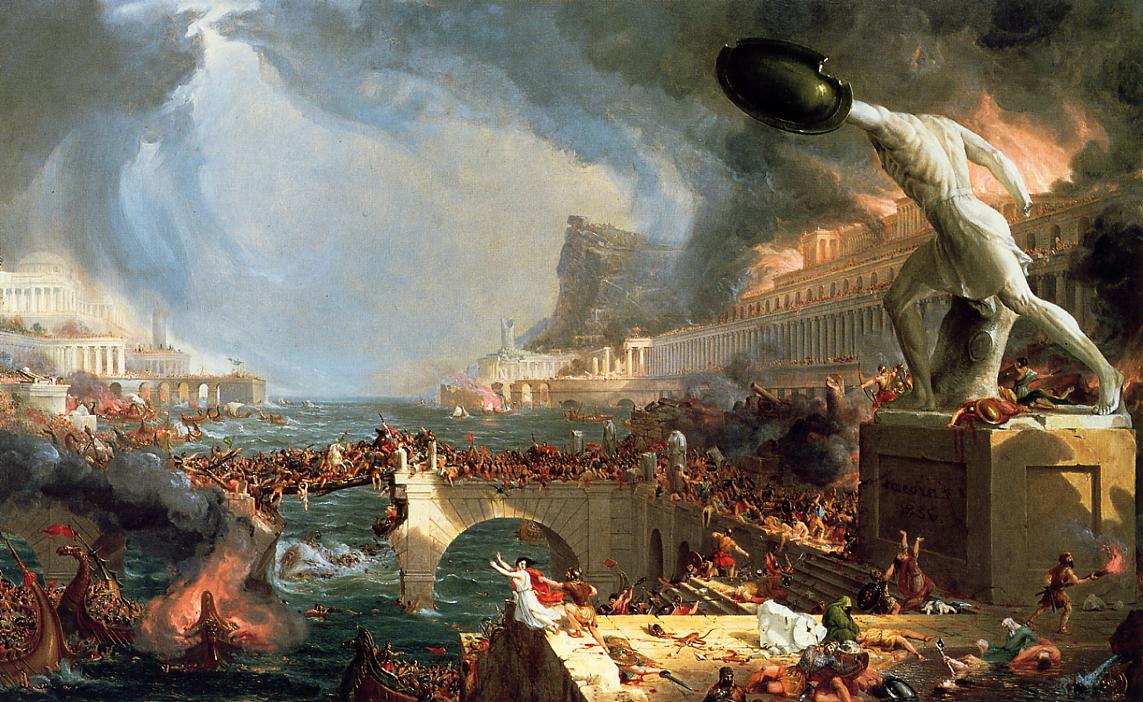
the-fall-of-the-roman-empire-romes-destruction-paintingNearly 2000 years ago, the sages identified the Roman Empire as the spiritual descendant of Edom, which was itself descended from Jacob’s wicked brother, Esau. But if the Roman Empire fell over 1500 years ago, how are we to understand the image of Rome’s guardian angel reaching the gates of heaven and surviving until the coming of the Messiah?

Esau was called Edom — meaning red — not because of his red complexion but because of his peculiar request that Jacob serve him “that red stuff,” by which he meant the bean stew he found his brother preparing when he came in hungry from the field. Color is the least intrinsic quality an object possesses, describing only the most external, cosmetic appearance without acknowledging function or purpose.

In this single moment, Esau revealed his defining quality as superficiality, the total lack of concern with anything other than outward appearances. And although the empires of Edom and Rome have long disappeared from the earth, the culture of superficiality that characterized them has become the salient characteristic of Western Civilization. In today’s culture wars, the final battleground between good and evil has become one in which evil claims to be good, conflating right and wrong with the empty sophistries of moral equivalence and political correctness, advancing arguments so thin and insubstantial that they fool no one who cares to look beneath the surface.

And yet, hardly anyone cares to look.

Soccer may be only a game, but it has become an international obsession. The contempt for truth articulated by its highest officials exposes a dangerous cultural bias and explains why the Europeans community would rather condemn the beleaguered nation of Israel than risk the consequences of antagonizing Israel’s belligerent and oil-rich enemies.

Jews around the world can take some comfort in the ability of America and Americans to still respond with passion in defense of truth. At the same time, the willingness of the current administration and so many in the media to rush to judgment against Israel offers unsettling evidence that we are approaching the fulfillment of the prophecy that, at the End of Days, Israel will stand against the world alone.

Originally published on Jewish World Review.


Dispel Uncertainty

Wisdom, Proverbs, Proverbial Beauty, Success, Happiness

9 Ways to Keep your Integrity

proverbial beauty wisdom proverbsEveryone likes a good story.

I have my share to tell, having spent my prodigal youth hitchhiking cross country and circling the globe, living abroad for a decade, and teaching high school for over 20 years.

But it still happens that friends and neighbors occasionally respond to my recollections by asking: “Did that really happen?”

Read the intro to Proverbial Beauty at Amazon.

Are my tales so truly unbelievable? After all, I never claim to have flown to the sun with Icarus, to have crossed the Rubicon with Julius Caesar, or to have followed Teddy Roosevelt’s charge up San Juan Hill.

No, I’ve merely sought to pluck insights from slightly quirky encounters and offer a bit wisdom from my observations on the human condition.

“I loved your article,” someone will say. And then, almost predictably: “Did that really happen?”

I even get it from my mother.

The new normal?

To be honest, it comes as no surprise. After all, honesty has seen its market value tumble over the years with countless reports of plagiarism, factual carelessness, and blatant fabrication.

But as troubling as such prevarication may be from the media, it’s far more disheartening when it becomes the norm among our political leaders.

The sad truth is that we expect our politicians to lie. But the brazenness with which they conjure up easily verifiable falsehoods grows ever more astonishing.

Once integrity disappears, the only motive not to lie is fear of not getting away with it — and get away with politicians have, in a society that has grown indifferent to lying.

But there is something we can do.  Here are 9 ways we can prevent the erosion of our own integrity:

Read the full article here.

Have you changed the world?

Candle proverbial beauty wisdom proverbsIf you’re walking into the sun, you can’t see the shadow you cast, no matter how long it might be.

If you’re looking for your shadow, you’re looking away from the light.

When the sun is at it’s highest and brightest, the shadow you cast is hiding under your feet.

Only when the source of light is about to disappear does your shadow stretch out toward infinity.

We don’t always get to see how we change the world.

Read the intro to Proverbial Beauty on Amazon.

Who’s Number One?

“The  fragile beauty of narcissism.”

That’s the title of a blog post I came across.  The author tries to make the case — in engagingly poetic prose — that arrogance is a virtue.  Having just published a book illustrating how to turn negatives into positives, I was intrigued by his efforts, but fear the gentleman doth protest too much.  We have enough blights upon society without turning more vices into virtues.

The author posits that,

Arrogance is “claiming ownership without justification”, in other words, more commonly, an inflated sense of self-worth. Why is it inflated? Because it assumes that that which is the source of pride endures, when the truth is it does not.

David-OrtizWell, he’s half-right.  “Inflated sense of self-worth” is definitely accurate.  But the real root of arrogance is the assumption the one is the source of one’s own power.

Why is the arrogance of starlets, sports “heroes,” and members of Mensa so irksome?  Because to be born with brains or beauty has more to do with genetics and fate than with innate worth.  And although most successful athletes work and train hard to succeed, a certain amount of inborn talent is requisite to anything they may achieve through practice.

The laudable custom among many (mostly Hispanic) baseballers to point toward Heaven after getting a hit shows the humble acknowledgement that athletic prowess is not one’s own.  With a single, small gesture they remind themselves — and countless spectators — Who is really Number One.

When our innate abilities lead us to believe in our own superiority, we think we have the right to devalue  not only the contributions but the very existence of others.  The Torah describes Moses as both “the most humble man who ever lived” and “the greatest prophet who ever would live.”  Moses’ knowledge of his own greatness did not impair his humility.  Just the opposite — he recognized that whatever ability he possessed came from outside himself, and also how much more he was obligated because of his natural abilities.

To paraphrase a certain president (who meant something else entirely), “You didn’t create that!”

“My point is that arrogance, narcissism, pride, all forms of hubris, are not without aesthetic value. The arrogant man believes, or at least attempts to believe, that he is or has something of unique and special value.”

The author errs by conflating arrogance with self-confidence.  To believe in my own value, to seek to fulfill my potential, and to strive to push myself beyond my comfort zone toward new horizons — all that has nothing to do with arrogance.  Just the opposite:  an arrogant person believes he is already great and therefore has nothing to prove.  In fact, studies have shown that people who overvalue their own worth are less likely to take up challenges lest they expose themselves as frauds.

Humility and modesty have largely gone out of style in our society, which is a loss for us all.  Let’s try to hang on a bit longer to our contempt for arrogance.

Jewish Billionaires put their Mouths where their Money is

Jewish billionaires Sheldon Adelson and Haim Saban have organized the first meeting of its kind, bringing together 50 Israeli and pro-Jewish corporations to push back against anti-Israel boycotts (BDS).

The real tragedy is that their efforts are necessary.  The superficiality that typifies the Western World is self-evident with even the most feeble efforts to scratch the patina of political correctness that turns perpetrators into victims and victims into provocateurs.

pal-child-abuse-74Shame on those who perpetuate the myth that Israel is the source of Arab suffering.  Shame on those who provide the millions in aide that Gaza Arabs never see because their leaders spend it on high-tech tunnels for attacking Israeli civilians.  Shame on those who caused hundreds of West Bank Arabs to lose their jobs by pressuring Soda Stream to move their production plant back across the “green line.”  Shame on those who don’t hold the leaders of surrounding Arab nations accountable for ignoring the plight of Arab refugees for 60 years so they can vilify Israel for their own criminal negligence.

And shame on Jimmy Carter and his ilk who perpetuate the demonstrable lie that Israel is an apartheid state.

Would an apartheid state produce an Arab citizenry that has a higher standard of living, literacy, and longer life expectancy than that of the surrounding Arab nations?  Would it have permitted a sitting Arab Supreme Court justice, Arab ministers, generals, ambassadors, and consulate-generals, an Arab Israeli national soccer team captain , and an Arab Miss Israel?

But ideologues never let facts get in the way of ideology.  The successful western world must be held responsible for every evil in the world, even as radicals sacrifice their own lives to destroy the societies that allow well-meaning fools to enable the agents of their own self-destruction.


Are you too sure for your own good?

“Understanding the distinctions between probability and certainty is one of the keys to developing a sociological imagination (and becoming an educated citizen, for that matter). One of the fascinating aspects of social science is using research tools to test assumptions through collected data—typically through multiple studies in a variety of settings.”

odds-in-your-favor.jpg.423x318_q100_crop-centerThis insightful post by Karen Sternheimer raises two critical points.

First, aside from death and taxes, there’s no such thing as a sure thing.  Everything we do is based in probable outcomes.  In the game of life, we are all gamblers.

But that’s as it should be.  The difference between a gambler and an investor is largely semantic.  We take a chance every time we cross the street, and success in any enterprise depends on weighing risk against reward, assessing the odds of winning against the odds of losing, calculating how much might be won and how much might be lost.

“Thinking about probabilities, rather than certainties, leads us to ask questions that help us understand sociological phenomena in much more depth than assumptions do.”

The problem is that most of us don’t want to do the hard work of making sure our facts are in order and our reasoning is sound.  We’d rather listen to our gut, which is notoriously unreliable; after all, it’s a lot easier to take confidence in feelings and assumptions, than to deal with uncertainty.

The second point is the likelihood of children learning from their parents’ examples.  If we gamble, chances are our children will, too.  If we gamble recklessly, we are setting them up for disaster.  But if we never take risks, our children may grow up timid and unaccomplished.

However, if we play the odds wisely, not waiting for the sure thing that will never come but neither betting the farm on long-shots… if we do our due diligence to make cautious bets when the probabilities are in our favor and the potential losses are manageable, then odds are our children will learn to be responsible gamblers themselves and will have the best chance for success in life that we can pass on to them.


Are your kids ready? They’ll let you know.

On a summer afternoon many years ago, I stood in my front yard and watched my neighbor teaching his four-year-old son how to pedal a new bicycle. The father hovered nervously as the boy tried to balance himself between his bike’s rear training wheels. Just then a blurred figure whisked by – my own four-year-old son, riding confidently on his own two-wheeler, sans training wheels.

“That’s amazing,” my neighbor gasped.

Was it? I hadn’t thought so, even though I couldn’t ride a bike with confidence until I was nearly 12.

Father teaching son how to ride a bike

I’m not one of those parents who push their children to become hyper-achievers. Rather, it was my son’s relentless petitions to remove his training wheels that had prompted me to reach into the tool box and retire that extraneous hardware to the back of the garage with so much other junk. I never consulted books or articles or experts about the age at which a boy is developmentally ready to ride a bicycle.

My son wanted to learn. Who was I to stand in his way?

It took some time on my part, and a good bit of huffing and puffing, gripping the back of the seat with white knuckles and running along beside him, first in the back yard and later in the street. But who ever said being a parent was easy?

In less than a week my son was tooling around on his own, a bit shaky at first, but more boldly and self-assured with each circuit around the neighborhood. By the end of the school year, he was still in only boy in his class who had learned to ride. It was hard not to be proud. Maybe my son really was amazing. Maybe he would excel in basketball or football as well as bicycling. Maybe he would win an athletic scholarship to UCLA or Ohio State, become a college all-star and a first-draft pick, break every professional record, and land a $50 million endorsement contract with Nike.

Or maybe not. Was I already turning into one of those over-zealous parents who live vicariously through their children and make them neurotic in the process? What if I pushed my son too hard and made him hate sports forever, or convinced him to set his heart on an unachievable goal? Wasn’t it safer to take it slow and err on the side of caution rather than encourage him to reach for the sky and risk setting him up for anxiety or disappointment?

THE ROOT OF ALL FAILURE

For decades now, psychology and education gurus have been telling us that all our problems stem from a single root: low self-esteem. When we don’t feel good about ourselves, we lack confidence in our own ability to achieve; without confidence, we can’t motivate ourselves to try; unmotivated, we never do achieve, reinforcing our feelings of inadequacy and perpetuating a vicious circle of substandard performance.

By lowering expectations, by diluting standards, by broadening the definition of success to include effort and attitude and environment, we make it possible for our children to succeed and enable their self-esteem to flourish. That’s the theory. The problem is that it doesn’t work, mostly because kids are neither as shallow nor as fragile as its advocates would have us believe.

If I have learned anything in my years standing in front of a class room, it is that kids can spot a phony a mile off – and certainly when it’s standing only a few feet away at the front of the class. Students know whether they have had to work for their grades. And every student, no matter how grade-conscious or grade-indifferent, feels better about himself for having earned a B than he does for having been given an A. Even the student who fails because of laziness learns the consequences of inaction and, with a little guidance, learns that he can climb out of the hole he has dug for himself.

THE ULTIMATE GIFT

True, low self-esteem will produce a vicious circle of low achievement. But high yet realistic standards will create a virtuous circle wherein genuine achievement begets sincere aspirations to attain ever-higher goals. By sheltering our children from expectations that challenge their abilities, we steal from them the opportunity to experience the joy of meaningful accomplishment and condemn them to a life of complacency and mediocrity… as well as that bugaboo, low self-esteem.

King Solomon warned us, parents and educators alike: teach every youth according to his own way. Each child is a unique combination of talents, abilities, emotions, and desires. To help our children channel those qualities in the pursuit of excellence, to awaken in them the passion to reach for the stars – this is the greatest gift we can give them.

7604866396_d2182f8058_bMy son hasn’t grown up to become an Olympic athlete. I’ll probably never find his name in a sports almanac or see his picture on a box of Wheaties. But I’ll always remember the expression on his face that summer’s day as he zipped up and down the street, standing up on his pedals, shooting me a grin as he watched me watching him and recognized the pride I felt.

No one ever told him that four-year-olds can’t ride bicycles.

On his next pass, he locked down his coaster breaks and skidded to a stop. “Will you teach me to ride with no hands?” he asked, eager to conquer his next mountain.

“Not today,” I said with a smile. Understanding limits also builds self-esteem.

“Okay,” he said. And, still grinning, he was on his way again.

Originally published in the St. Louis Post-Dispatch


Remembering Forgetfulness

positivethinkingToo many people become members of the ‘Bad Memory Club’ and focus on the 5% of the time that their memory fails them. If you think you have a bad memory, it means you have a good one because you can remember where your memory has gone wrong. Think about how much data you already have stored in your memory… Your memory does a lot right, so ask yourself, “How does my memory serve me – how did it serve me today?

Kevin Horsley

We all have the power to radically improve the quality of our lives by turning negatives into positives.  With modest but consistent effort, we can train ourselves to focus on the good, initiating a virtuous circle of positive thinking that leads to increasingly positive actions and results.

Sometimes all it takes is remembering to try.

Life is no different

god-doesnt-change-to-change-your-heartCan I possibly count how many things I desperately wanted that I later rejoiced not having gotten?

Can I possibly remember how many things I thought I needed that I would have been better off without?

Can I possibly imagine how different my life would be if all my wishes had come true?

In medicine, the cures are often more painful than the afflictions.  Life is no different.