Home » Communication (Page 11)
Category Archives: Communication



St. Patrick’s Day — Searching for the way out of exile
Every year on St. Patrick’s Day I revisit these thoughts from 1999. Things have gotten better in Ireland, where both sides have finally recognized that peace requires sacrifice and compromise. Not much has improved in Israel, where leaders on one side continue to oppress their people, holding them hostage as political pawns so they can keep their own hold on power.
 At first glance, the soggy, green downs of Ulster bear little resemblance to the parched and craggy hills of Israel. But a gentle tugging at the cultural fabric of either place unravels an unmistakable common thread: two peoples, impossibly close geographically, impossibly distant ideologically, with more than enough fuel for hatred between them to burn until the coming of the Messiah. Tromping over hills and through city streets, however, first in one place and then in the other, I discovered a more compelling similarity: the bitter struggle of humanity in exile.
“Which are the bad parts of town, the ones I should avoid?” I asked the owner of the bed-and-breakfast where I passed my first night in Belfast.
She dutifully pointed out the Shankhill neighborhood on my map, cautioning me to steer clear of it. I thanked her and, with sophomoric self-confidence, proceeded there directly.
It was the summer of 1984, in the midst of “the Troubles,” and central Belfast exuded all the charm of a city under martial law.

Incivility: the new gold standard
 “Are you still beating your wife, Mr. Secretary?”
That was about the only question not leveled at White House Press Secretary Sean Spicer by the ill-mannered woman who accosted him in an Apple store over the weekend.
“I wanted to speak truth to power,” Mr. Spicer’s assailant explained, after her Periscope video went viral and made international headlines.
Indeed, here was a rare moment of opportunity, a chance to catch a high-ranking official in an unguarded moment and engage him free from the filters of the national press corps and the censors of the nightly news.
So how did our heroic citizen capitalize on her unexpected access to Mr. Trump’s confidant as she streamed it live from her cellphone? What were the penetrating questions she posed to solicit a candid discussion with a representative the president’s inner circle? Here they are:


World Peace through Shared Servings
 We’ve all heard that you are what you eat. Now we learn that you may be what others eat.
A University of Chicago study found that people are more inclined to trust one another and more likely to come to agreement when eating the same kind of food. Although researchers can’t explain why, a series of experiments demonstrates a dramatic increase in cooperation and collegiality when people are talking not just over lunch, but over the same lunch.
Experts have been telling us for years that children flourish in proportion to the frequency of family dinners. The more time parents and children spend together at the table, the more likely children are to succeed in school, to develop positive self-image, and to enjoy better physical and emotional health.
The natural assumption has been that family interaction increases children’s feelings of love and security, which leads to a deeper appreciation of family values. That’s almost certainly true.
But there may be an additional factor. At most family dinners, whatever is on the menu is what everyone eats. And that, apparently, makes a big difference.

Both sides now, and then
In the beginning, the questions came with surprising consistency:
What do you mean, you’re not Australian? I thought you were from England. You sound like a Scot.
 It’s noteworthy that I didn’t fool anyone into thinking I was one of them. The Aussies knew I wasn’t Australian and the Brits knew I wasn’t English. Oddly enough, the Americans believed I wasn’t American. But few were able to successfully place me or my accent.
I hadn’t planned it that way, although my newfound cultural ambiguity did give me a certain amount of pleasure. There was something romantic, adventurous, and egalitarian about being a Citizen of the World. There was also something reassuring about being an anonymous everyman, without the baggage of preconception and the insult of stereotype.
The explanation wasn’t complicated.


Telling evil from evil
 My home town of St. Louis made headlines across the country last week. Some of it was bad news; some of it was good news.
And some of it might have been fake news.
The bad news was the travesty of desecration: vandals toppled of 154 headstones in a Jewish cemetery during the night of 21 February. The Jewish community has far too much history of indignity and intimidation over decades and centuries to not react with horror, anger, and fear.
The good news was the community response. Citizens of St. Louis from across the religious and political divide came together in an inspiring show of support. Hundreds showed up last Wednesday to participate in a collective cleanup effort, including Missouri Governor Eric Greitens and Vice President Mike Pence. A crowd-funding campaign initiated by the Muslim community raised $75,000. People responded to a profane act of hate with solidarity, compassion, and brotherhood.
But what if they were missing the point?

In Memorium
Originally published by the St. Louis Post-Dispatch on Father’s Day, 2001.
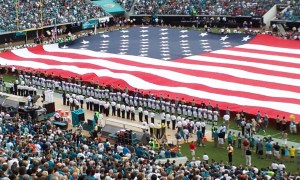 I was ten or twelve years old. My father and I had arrived at the stadium early, and I felt a thrill of excitement as we stood up for the Star Spangled Banner. Down on the field, our home team, the Los Angeles Rams, stood in a line holding their helmets under their arms. And in the row in front of us, a middle aged man stood with his hat perched casually upon his head.
“Hey, Buddy,” my father said. “Take off your hat.”
The man didn’t respond. “Hey you,” my father said, louder, “take off your hat.”
The man grunted an unintelligible, though clearly dismissive remark.
“You unpatriotic SOB,” growled my father; he didn’t abbreviate, either.
“Dad!” I whispered, mortified and afraid, but also faintly confused. My father had never before demonstrated any dramatic displays of patriotism.
The national anthem ended, the game began, and I guess I forgot about the incident because I never discussed it with my father, never asked him to explain an indignation that seemed entirely out of character.
But now I’m a father myself, and I don’t find my father’s action thirty years ago perplexing at all.
Why should we take off our hats for the national anthem? Why should we stand up for the flag? Why should we address strangers as “Sir” or “Madam,” wear coats and ties to church or synagogue, and give up our seats to the elderly?
It’s a matter of respect. Respect for people. Respect for institutions. Respect for wisdom and values and human dignity.
 Unfortunately, respect has been going out of fashion for a long time. Sex scandals and no-fault divorce have eroded respect for marriage and commitment. Partisan politics has eroded respect for leadership. Inflated grades and deflated standards have eroded respect for teaching. Abortion-on-demand and doctor-assisted suicide have eroded respect for life. “Reality television” has eroded respect for ourselves.
Which was our first step onto this slippery slope? Maybe it was the noble ideal of social equality, set spinning so wildly out of control that we began to equate respect with elitism. Maybe the information glut convinced us that we know as much about medicine as our doctors, as much about cars as our mechanics, and as much about education as our children’s teachers. Maybe our relentless pursuit of leisure time has made us too selfish to value age and experience, too lazy to act civilly toward our neighbors.
When respect is not earned, it disintegrates; when respect is exploited, it implodes. Indeed, after his desperate quest for legacy, Bill Clinton was best remembered at the time of his departure as the American president who made his underwear preferences a matter of public policy, who pilfered the White House china, and for whom a large percentage of once-self-respecting Americans so casually excused perjury in federal court. Barack Obama will leave behind the first video of an American president making faces in the mirror in preparation for an historic selfie.
But we should never rely on respect to percolate down from the top; it is our responsibility to grow it up from the grass roots. It is the job of parents to teach their children to say “please” and “thank you,” to not interrupt and not talk with their mouths full, to speak civilly and give up their seats to the elderly, to pick up their own litter and maybe even someone else’s. By doing so, parents instill in their children an intuitive sense of respect for others, even if their children may not understand why all these social minutiae are indispensable.

???????
But too many parents have abdicated that job, either because they’re not around enough or because they never learned to be respectful themselves.
The Talmud says that where there are no leaders, strive to be a leader yourself. In today’s increasingly fatherless society, teachers, scout leaders, and little league coaches have a greater obligation than ever to teach respect by showing respect for others — and so do we all every time we walk down the street or through the supermarket aisle.
A journey of a thousand miles begins with a single step. And a journey through life begins with a step in the right direction. Help a child take that step and, many steps later, his success will speak his thanks louder than words.
Every Father’s Day offers a reminder to say every day: Thanks, Dad.

 Yonason Goldson