Home » Culture (Page 41)
Category Archives: Culture
The New Polarization
 A college student who rarely attended classes and turned in assignments poorly done or not at all, emailed his professor after receiving his final grade to ask if there was any way he could raise his grade — an F earned with a 25% average — to a C. Even grade inflation couldn’t help this hapless soul.
But hope springs eternal, and wishful thinking has become so pervasive that it has a new name: magical thinking, as if wishing just isn’t enough anymore.
It’s everywhere. Government programs with no revenue to pay for them. Students acquiring massive debt from loans to procure degrees in art history, classical philosophy or — no joke — viking studies. State sponsored alternative energy schemes built on nothing but high-minded intentions. School boards hiring puppet administrators and then firing them when student performance crashes.
On the one hand, we indulge in the most irrational flights of fancy with no concern for the consequences. On the other, we resist thinking out of the box by denying ourselves the opportunity to engage people with opposing viewpoints in civil discourse.
Is this the new face of polarization? Not just between groups, but within our own minds?
Instead, let’s turn it around: challenge yourself to seek out new viewpoints and strategies, not to escape from reality but to deal with it and succeed.
Just Plain Ugly
 Here’s another lovely headline:
Top 15 Celebrities who are Just Plain Ugly
And no, I’m not including the link.
Why would anyone write an article like this? Why would anyone read it?
Sadly, the answers are obvious. Someone wrote it because he knew people would read it. And people read it either out of pure voyeurism or, even worse, because they need to tear down others to feel good about themselves.
Maybe we should revisit some old cliches:
- Don’t judge a book by its cover
- Beauty is only skin deep
- All that glitters is not gold
Sure, they’re cliches. But remember: cliches become cliches because people recognize their truth enough to repeat them over and over and over.
When we make the effort to see the best in others, that makes our world brighter. With practice, recognizing what’s good in others can motivate us to be like them, which will make us feel better about ourselves.
After all, the grass isn’t really greener on the other side of the fence.
Holocaust Day — Visionaries and Ideology
 Who knew a trip to New York could be so emotional?
I didn’t want to go in the first place. As my 92-year-old student likes to quote: Travelling is for peasants.
But my wife convinced me with simple arithmetic. Four tickets to bring three kids and son-in-law home or two tickets to visit them. No-brainer.
So I went grudgingly, confirming in the end the truism that some of life’s most profound moments come not only unexpected but against our will.
Our first stop was the 9/11 museum. I marveled at the artistic vision that had conceived the memorial pools, the water channeling down in rivulets that mirrored the face of the fallen towers, the continuous downward rush balanced by the redemptive feeling of water — the source of life — returning to the heart of the world. Here there was solace, closure, and consolation.
But a very different feeling accosted me inside. Almost upon entering the doors a single word brandished itself across my mind’s eye: Holocaust.
Let me explain.
Read the whole article here.
The Hazards of Headline News
 Here’s an insidious little headline: Money, Not Marriage, Makes Parents Better
Family structure, family meals, limiting television, extracurriculars. No worries. None of it makes much of a difference. Your child’s success or failure in life will have more to do with how much money you have. If it’s in LiveScience, it must be true. No?
Thanks to the U.S. Census Bureau for using our tax dollars to produce such a sinister study. Maybe their next project will offer similarly insightful results. How about something like this: Wings, Not Landing Gear, Make Air Travel Safer.
Well, sure, up to a point. But what does one really have to do with the other?
Read the whole post here.
Higher Education?
 On March 9, the Supreme Court refused to hear an appeal by the University of Iowa College of Law challenging Teresa Wagner’s successful lawsuit claiming political discrimination for her conservative views.
The decision comes a year after a more dramatic victory by Mike Adams, a conservative sociology professor who won a similar suit. Professor Adams was awarded a promotion, a raise, $50,000 in back pay and $710,000 in legal fees from the University of North Carolina-Wilmington.
Underlying both stories is the more serious concern that the culture of ideological narrow-mindedness and bullying has transformed college campuses around the nation from centers of higher thinking into indoctrination centers for political and philosophical uniformity.
 And it’s not just universities. My Google search for this story turned up only two headlines, one from the conservative Washington Times and the other from the local Iowa Press Citizen. The print media, it seems, has no more interest in open discussion and debate over opposing viewpoints than does academia. Better to man the battlements and defend the ivory towers from that most dangerous of all enemy attackers — rational thinking and reasoned argument.
The same principle holds true in business, in education, in religion, and in every arena of social discourse. If we can’t articulate the position of our ideological opponents, we can’t refute their arguments and, more important, we can’t fully understand our own.
For a more thorough discussion regarding the evils of groupthink, please see my article here.
No Direction
 “You just could not make this up,” tweeted Alan Price of the British employment law firm Peninsula.
Of course, I couldn’t have made it up at all, since I’d never heard of Zayn Malik or the boyband One Direction until this morning. That’s when I learned about the aftermath of Mr. Malik’s change of direction in headline news.
According to the Telegraph, Peninsula received 480 calls from employers asking how to respond to workers requesting compassionate leave so they can grieve over the music idol’s decision to go rogue — and that was just between Wednesday and Friday morning.
One shudders to think how these workers will react when real tragedy enters their lives. Or maybe they’re so removed from reality that the foibles of the entertainment industry are the only events in which they can find any relevance at all.
But that’s what happens in a world without direction.
The Illusion of Knowledge
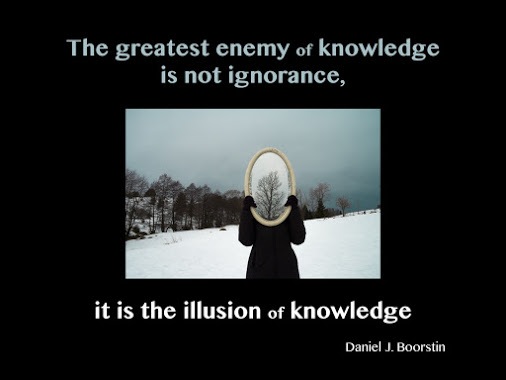
Nothing could be more true in the age of unlimited access and information overload. King Solomon wrote in Ecclesiastes, “One who tears a hole in a fence invites in a snake.” In other words, no fence is better than a broken fence, since the former demands constant vigilance while the latter allows a false sense of security. The more we think we know, the more ignorant we actually are.
Please take a look at how modern research backs this up here.
St. Patrick’s Day — Searching for the way out of exile
 At first glance, the soggy, green downs of Ulster bear little resemblance to the parched and craggy hills of Israel. But a gentle tugging at the cultural fabric of either place unravels an unmistakable common thread: two peoples, impossibly close geographically, impossibly distant ideologically, with more than enough fuel for hatred between them to burn until the coming of the Messiah. Tromping over hills and through city streets, however, first in one place and then in the other, I discovered a more compelling similarity: the bitter struggle of humanity in exile.
“Which are the bad parts of town, the ones I should avoid?” I asked the owner of the bed-and-breakfast where I passed my first night in Belfast.
She dutifully pointed out the Shankhill neighborhood on my map, cautioning me to steer clear of it. I thanked her and, with sophomoric self-confidence, proceeded there directly.
 It was the summer of 1984, in the midst of “the Troubles,” and central Belfast exuded all the charm of a city under martial law. Policemen on patrol wore flack jackets. An armored personnel carrier idled at a major intersection waiting for the signal to change. Blown out shells of buildings sprouted weeds, and street signs warned, DO NOT LEAVE CAR UNATTENDED. But as I worked my way up Shankhill, I discovered even more disconcerting landmarks: elementary school yards swathed in barbed-wire and churches pocked with scars from automatic-rifle fire.
I stopped in at a corner pub and took a seat at the bar beside two locals. Each was nursing a pint of Guinness. Another glass, two-thirds full with boiled snails, rested between them. The men took turns using a bent eight-penny nail to dig each snail out of its shell before popping the meat into their mouths.
I was half-way through my own pint of ale when the nearest one began chatting me up. “Yootoorin?” he said.
“I beg your pardon?”
“Yootoorin?” he repeated.
“I’m sorry, I don’t understand.”
“You touring? You traveling around?”
I needed several minutes to adjust to his accent. I never did get used to his indifference to life in a war zone.
“It’s no big deal,” he said with a wave of his hand. “There’s not many bombs going off any more, except on the big anniversaries, and everyone expects it then.” He extracted another snail from its shell, tossed it into his mouth, and chased it down with a swig of Guinness.
“Nobody lets the fighting get in the way of their getting on with life,” my friend continued. “You get used to it, you know?”
 I was carried away to captivity in Ireland with so many thousands of persons, as we deserved, because we departed away from the Almighty … [and He] brought upon us the fury of His anger and scattered us among many nations as far as the end of the earth…
So writes St. Patrick, Ireland’s patron saint, echoing the prophecy in Deuteronomy 28 according to which, four centuries earlier, the Children of Israel had been exiled at the beginning of the great Diaspora. Yet Patrick applied it without hesitation to his own time and place, presuming that the right of a nation to reside peacefully in its land depends upon the character and integrity of its people.
My wanderings ultimately led me from Belfast to Jerusalem, where I also found people living amidst violence and without fear. And there, as St. Patrick had done in Ireland, I discovered the ancient lessons of my own people, who have found neither peace with their neighbors nor peace with one another.
Exile, I gradually came to understand, does not require banishment to the ends of the earth. It can happen right at home, and it can take many forms. Indeed, which is the more profound Diaspora: being scattered to distant lands, or living under siege in one’s own home? And if we do find ourselves exiles in our own land, to where can we escape?
Today, the residents of both Israel and Northern Ireland fight among themselves over definitions, over identity, and over direction. In this they are like so many other peoples in this uncertain world, laboring to learn that the only way any of us can find the path leading out of exile is by shouldering the responsibilities of freedom.
Originally published in the St. Louis Post-Dispatch, 1999.
Settled Science?
 Last March, scientists believed they had discovered evidence of the Big Bang. Early this year, analysis raised new doubts about the soundness of the Big Bang Theory altogether, according to an article in Quanta Magazine.
The issue here is not whether to believe in Big Bang. I have no skin in the game, since Creationism can work with or without it. The real issue is the unshakable certainty of so many in the scientific community despite a history of mistaken hypotheses that goes back at least as far as Aristotle.
Whether it’s Big Bang, evolution, or climate change, it is disingenuous for ideologues to quash open debate by proclaiming any of these as “settled science.” They are not. Each faces serious logical and scientific challenges that may not refute them but certainly demand acknowledgment and honest investigation. To claim “case closed” when so many legitimate objections remain unanswered is hardly a responsible application of scientific method.
Which begs the question: why are so many in the scientific community afraid of the truth?
Read the whole article here. Here are a few excerpts:
No one has devised an alternative to inflation [the exponential expansion of the universe following the initial “big bang”] that explains so many observations with so much economy. For a decade, Paul Steinhardt of Princeton University, an early pioneer of inflation who has since become one of its most vocal critics, has championed the “ekpyrotic model,” a cyclical picture in which the universe executes an eternal series of expansions and contractions. In this scenario, any unevenness that develops in the cosmos as it expands gets compressed as it contracts. The slate is wiped clean for each cosmic rebirth, accounting in this way for the exceptional uniformity observed early on in this latest iteration.
But the ekpyrotic model has few subscribers. It hinges on the idea that the universe will bounce, rather than bang, each time it shrinks to a point. The theoretical arguments for why it should bounce strike most experts as highly speculative. And the non-bounciness of black holes suggests it would not do so.
At present, inflation has cornered the market on Big Bang theories, and yet there is still room for doubt. “The fact that we don’t have an alternative doesn’t mean we know the truth,” said Avi Loeb, a theoretical astrophysicist at Harvard University.
The theory’s triumphs are undercut by a strange detail: If inflation works the way it’s supposed to, it seems that it should never have happened at all.
Inflation now seems less likely than ever, the critics say.
Why we love conspiracy theories
 In short, we want the world to make sense, so ideological cabals and aliens offer a more attractive solution to the appearance of randomness than does randomness itself. On the one hand, we have to temper our impulse to impose order on chaos by reining in our imaginations with common sense, logic, and civil discussion.On the other hand, this reveals our deeply rooted conviction that there is a purpose to our existence and that there is true meaning in our lives and in our world.
 Yonason Goldson