Home » Ethics (Page 5)
Category Archives: Ethics

Guest Post: Stop “Talking” During the National Anthem
 117 seconds. That is how long it takes, on average, for the playing of the National Anthem. So why are these 117 seconds becoming some of the most controversial in America?
Because people are “talking” during it. It’s not a time to talk. It’s a time to listen. And the voices that are supposed to speak at that time can’t be heard if others are talking during the playing of the Anthem.
Click to read the rest of a Gulf War veteran’s stirring call to action.




The Real Rainbow Coalition
 The story of a Great Flood can be found in virtually every human culture. However, the biblical record stands alone in its dramatic conclusion: as Noah emerges from the ark, the Almighty sets His rainbow in the heavens as a sign that never again will He visit the waters of devastation upon the earth.
Much has been made of the shape of the rainbow – an inverted bow to direct the arrows of divine wrath away from mankind. But is this a hopeful sign? Does it not imply that we are in fact deserving of destruction? Does it not contain a warning, that only because of God’s promise to Noah are we spared the natural consequences of our own moral corruption?
And what do the colors and beauty of the rainbow signify? Is it not incongruous to invoke something so beautiful as a reminder that a 4000 year-old covenant is all that stands between us and annihilation?
WANTING IT BOTH WAYS AND NO WAYS
In the old Peanuts comic strip, Linus once declared that, “I love humanity; it’s people I can’t stand.”
It’s no longer a joke. As human society grows ever more fractured, we see everyone else as either too traditional or too progressive, too dovish or too hawkish, too far left or too far right. Unity remains a dream we no longer believe in as we divide ourselves up into increasingly tribal enclaves.
Paradoxically, it is the strength of conviction that separates people from one another. Too many of us believe that our way is more “beautiful” than anyone else’s way, that only we are the chosen standard-bearers, and that we alone speak Truth while all others are heretics or infidels.
Why do we find it so difficult to celebrate our — dare I use the word — diversity? We give lip service to the value of multiculturalism, recognizing that our differences can make us greater than the sum of our parts. But then we use distinctiveness as a wedge to set ourselves apart from others.
In modern society, diversity often becomes a club to bludgeon into submission all whose sense of traditional values or personal integrity compels them to reject the moral anarchy that defines our times. Intolerance masquerades as forbearance, proclaiming an open-mindedness that is reserved only for those who conform to ideologically acceptable standards of cultural elites.
THE CHALLENGE OF MORAL EQUILIBRIUM
It was the same kind of violent division that brought the devastation of the Flood upon mankind. In that benighted generation, the law of the jungle drove human beings to an unthinkable level of bestial corruption. Had the Almighty not brought the waters of destruction upon the earth, human beings would surely have destroyed themselves.
Back then, it was selfishness and greed that tore society apart. Today, it is ego and ideology.
True, it’s not easy to achieve the delicate balance between acceptance on the one hand and conviction on the other. Tilting too far to one side catapults us toward moral dogmatism; tilting too far to the other sets our moral compass spinning in all directions.
So what is the solution?
The answer lies is seeing the rainbow as both beautiful and terrifying. It is a symbol of diversity and how much we can achieve by celebrating our differences; but simultaneously it is a reminder of how much destruction we can bring upon our world when differences become justification for divisiveness.
To truly love our fellow human beings we cannot retreat into ideological isolation. If we do, we will succeed only in marginalizing others in our own minds. Ultimately, we must take great care to chart a course between the extremes of ideology and accommodation.
So reach out to connect with someone outside your own close, closed, comfortable group. Engage people who think differently, not to debate but to exchange ideas and seek understanding. Remember as well that the most exquisite flowers, the most dramatic seascapes, and the most inspiring mountain peaks are those that reflect all the colors of the rainbow.


Honor Thy Fathers
 Meritocracy. Collaboration. Personal achievement.
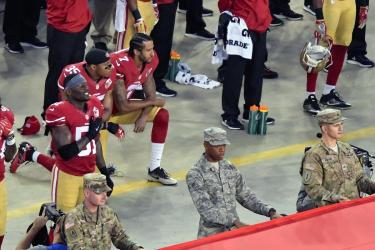
These are the ideals upon which was the United States was founded, the ideals that have made and continue to make America great. They are also the ideals that have traditionally been associated with professional sports.
How ironic, therefore, that the NFL has been overtaken by a sentiment of rejectionism against the symbol of those very values. How tragic to witness players use the freedom represented by the flag to show contempt and disdain for the country that has afforded them an opportunity for success they might never have otherwise had.
No, our country is not perfect. But the flag represents that values that allow us to strive together toward a more perfect union.
That being said, it’s not the job of the president to call for the NFL to penalize those players. It’s his job to demonstrate the responsible use of free speech by conducting himself with principled determination and disciplined self-restraint.
Our Chief Executive is responsible for passing fair and effective legislation while creating a national tone of respect and personal responsibility. Implicit in that is knowing and showing where the division between the two must be drawn.

The Beauty of Misfortune

What would Gandhi say?
There’s not much question, really. The icon of civil disobedience disdained every form of violence. He most certainly would have condemned riotous demonstrations protesting any courtroom verdict, no matter how unpalatable. So would Martin Luther King.
It’s easy to understand why many St. Louis residents took to the streets over the acquittal of former police officer Jason Stockley in the shooting death of Anthony Lamar Smith. Officer Stockley’s comments and conduct raised serious questions about the credibility of his own testimony. And civil protest is one of the foundational principles of a free society.
But on the other hand, the shooting followed the high-speed pursuit of a suspected heroin dealer, and video footage failed to substantiate the claim that Officer Stockley planted a weapon. In the end, Judge Timothy Wilson concluded that there was insufficient evidence for conviction.
So did Jason Stockley get away with murder? We may never know. But that’s not the point.
TO ERR IS HUMAN
We all know that our justice system is imperfect, as any system designed and implemented by human beings must be. Sometimes honest people make mistakes. Sometimes authority is corrupt. Sometimes the truth hides its face, and sometimes we have to accept that justice can be painfully blind.
It’s what we do next that matters most.
Some respond to frustration by venting their anger on whatever target crosses their path – in this case, by smashing the windows of 23 storefronts in my hometown, the St. Louis suburb of University City.
But from these senseless acts of misdirected destruction emerged an exquisite silver lining, an example of how human beings can discover within themselves true nobility in the face of injustice.
 The morning after the carnage, volunteers appeared on the streets and began sweeping up the broken glass and boarding up the broken windows with plywood. But even at that, the kindness of strangers had only just begun.
Before long, local artists showed up to paint the plywood panels, transforming stark reminders of wanton violence into beautiful murals of friendship and neighborhood harmony.
FACING THE FUTURE
This week, the Jewish community stands between Rosh Hashanah and Yom Kippur, between the Day of Judgment and the Day of Atonement. On those awesome days, we gather together in prayer, one people with one heart, to recite the High Holiday prayers. And as the liturgy rises to a crescendo, it impels us to ponder the uncertain future that awaits us in the coming year:
Who will live and who will die; who by water and who by fire; who by the sword or wild beast, who by famine or thirst; who by storm or plague or violence. Who will rest and who will wander; who will have peace and who will suffer; who will be poor and who will have wealth; who will be cast down and who will be raised high.
We have no idea what the future holds. Ultimately, we have no control over where fortune will take us. What we do control, however, is how we respond to our own fortunes and the fortunes of our fellows.
When we see our neighbors in distress, will we drop everything and hurry to their aid? When we behold injustice, will we add to injustice by lashing out impulsively? Or will we stand shoulder to shoulder in a show of solidarity?
And when we witness senseless suffering, will we close our eyes and harbor vengeance in our hearts, or will we resolve inwardly to do better ourselves, to ensure that we never contribute to the problems of the world but apply our energies toward finding solutions?
There is so much good in the world from which to find inspiration. And while some may add to the darkness with misdirected violence, let us call upon ourselves to rise to every challenge, to shine bright so we can inspire others to shine themselves.



Rosh Hashanah, Tailor-Made
Nobody likes fundraising dinners. The speeches are dry, the menu is dull, and the seating arrangements seem to have been drawn up by the Marquis de Sade. No one looks forward to these affairs, and we attend them only out of a sense of obligation.
Since one dinner I attended last year, however, I have become more wary than ever of this kind of event.
The evening began unremarkably and proceeded unremarkably — up to a point. The food was better than usual, the speeches ran longer than usual, the company was as good as could be hoped for, and I never saw the dinner plate that slipped from the tray of the passing waiter and struck me squarely on the forehead.
 “I didn’t hit you, did I?” asked the waiter in response to the alarmed gasps and cries from the people who shared my table, several of whom assured him that he had, indeed, scored a direct hit.
“Are you all right?” he asked, inevitably. A silly question, really.
A pound-and-a-half of glazed ceramic packs quite a wallop after accelerating at thirty-two feet-per-second-squared from a height of six feet in the air.
At least I was still conscious, still sitting upright, and I didn’t think I was bleeding.
“Get a doctor,” someone said.
“He doesn’t need a doctor,” said someone else. “Get him a lawyer.”
The manager arrived with an ice pack. “Here, take this.”
“I was hoping for scotch with my ice,” I said.
He laughed, but didn’t bring me any scotch. “I’ll need your name and address, sir,” he said, handing me a pen and paper.
“Don’t sign anything,” yelled someone from the next table.
I scribbled my vital statistics. “I’m really very sorry, sir,” he said.
“Is there anything else I can do for you?”
“Just the scotch.” He laughed again and went away. I had figured the manager would offer me vouchers for a complimentary night’s stay. He hadn’t. (I never even got a letter of apology.) I hadn’t gotten my whisky, either.
I began regaining my bearings to a medley of more lawsuit jokes. From across the table, however, my next door neighbor offered the only profound comment of the evening: “What were you thinking about before you got hit?”
I knew exactly what he meant. According to Talmudic philosophy, there are no accidents, no coincidences, no random events. Everything comes about through the guiding hand of Divine Providence, the spiritual imperative that governs how the external world acts upon each and every one of us. In other words, if I got smacked on the head, I must have had it coming to me.
This is a far cry from the popular notion that whatever I want, I have coming to me. As much as contemporary culture may insist that privileges and entitlements are birthrights, the Talmud recognizes only our responsibilities, both to other individuals and to society. When we live up to our obligations, we may expect certain rewards to come our way. But if we do receive an apparently undeserved blow, great or small, we should assume that the equilibrium of the cosmic scales of justice somehow needed to be set back in balance, and we should reflect upon the message that has just been sent us from on high.
Sometimes we can easily identify a concrete lesson to glean from such mishaps. Other times not. But the principle holds, even when we can’t perceive any clear cause and effect: this was necessary; now we need to brush ourselves off and get on with life.
The traditional Yom Kippur liturgy provides a poignant example in its narrative concerning Rabbi Ishmael, the High Priest, who was cruelly tortured to death at the whim of the Roman governor’s daughter.
The heavenly court protested in outrage before the throne of G-d: “Is this the reward for living a life committed to holiness?” they demanded.
“Be silent!” commanded the Almighty, “or I will return the world to void and nothingness.”
 The incomparable 18th century genius, Rabbi Elijah of Vilna, explains G-d’s reply with this allegory:
A king once received a gift of fine Turkish wool, the most luxurious fabric in the world. It was so beautiful, in fact, that the king could not bear to think that even a tiny piece of it should end up as scrap on the cutting floor. He went to every tailor in his kingdom and asked each to make him a suit without letting even one thread of the wool go to waste. But every tailor claimed that such a feat was beyond his ability.
Finally, the king found a tailor who agreed to do the job. When the king returned to the tailor’s shop on the appointed date, he discovered that the tailor had indeed produced an exceptional suit of clothes. The king was elated.
“But have you fulfilled your promise?” asked the king. “Did you use every thread?”
“You really don’t know,” answered the tailor. “And the only way you will ever will find out is if you tear your beautiful suit apart and lay out all the pieces in the original shape of the fabric.”
Similarly, we often think that life is full of unfair knocks or is missing essential pieces. But to know for sure, we would have to see all of human history undone before our eyes. Only then would we have the right to assert that there were flaws in the slow sculpture of creation.
The days from Rosh HaShonnah to Yom Kippur — the traditional season of judgment — afford us the opportunity to strengthen our trust that the Master Tailor has done His job well, that He has stitched together the fabric of eternity according to a plan He understands far better than we do — even when bricks, or china plates, fall out of the sky upon our heads.
Should I have sued the hotel? the waiter? the school holding the event? the principal, who was speaking when I got hit? No doubt, I could have found any number of lawyers eager to take the case. If a woman could receive 4 million dollars for spilling a cup of coffee in her own lap, this should be worth at least as much.
But life is full of honest accidents resulting in superficial scrapes and bruises. It’s better for us (and better instruction for our children) to look for what we can learn from life’s bumps and knocks, not to look for whom we can blame and how much we can squeeze out of them.
 The waiter returned, contrite and apologetic, perhaps more shaken than I was. “In twelve years this has never happened to me,” he said. Evidently, he also had a date with Providence. “Is there anything else I can do for you, sir?”
“I wouldn’t mind a scotch on the rocks.”
“I’ll see what I can do.”
He did. It wasn’t four million dollars, but it was better than a knock on the head.
 Yonason Goldson