Home » Headlines (Page 3)
Category Archives: Headlines

The Rights of Women and Robots
 Have you heard what the Saudis are up to lately?
If you haven’t heard the story, you may not believe it. But there’s a lesson in it for all of us.

Beware of the Ultras
 Where did all these fanatics come from?
History traces the origins of some, but others remain a mystery. My own personal theory is that one of the most fanatical sects of modern times was invented in the early 1980s by Time Magazine.
I’m talking about the group commonly identified as Ultra-Orthodox.
In truth, there is no such label. Nevertheless, ultra is a favorite adjective of the media: it implies radicalization and imposes a stigma of extremism on otherwise respectable individuals and institutions.
Ironically, the same tactic gave rise to the term Orthodox itself. In the early 19th Century, a movement coalesced among the Jews of Germany to bring “reform” to the 3100-year-old practices of Judaism. To augment their own legitimacy, these self-styled reformers branded Jews adhering to traditional practice as “orthodox,” a pejorative intended to marginalize mainstream adherents as out of date and out of touch.
HIGHWAY TO HEAVEN?
Every driver on the road believes that he alone is travelling at the correct speed – anyone going faster is a maniac, and anyone going slower is a plodder. And it’s no different with ideology, whether political or religious.
We all believe ourselves to be balanced in our worldviews. Anyone to this side is a zealot; anyone to the other side is a heretic. And there are always just enough true zealots and true heretics associated with any group so that detractors can point and declare, “See! They’re all like that.”
The sign of true leadership, therefore, is not to denounce opponents on the other side of the aisle or the divide; rather, it is to call out those on one’s own side whose irresponsible speech or behavior threatens to discredit one’s own affiliation.
Former President George W. Bush drew fire from the right last week for doing just that, when he denounced the incendiary rhetoric and tribalism that have become too common within his own party.
Should Mr. Bush have called out those across the aisle as well? Possibly. But perhaps he hoped that leaders on the other side might follow his example and demand proper conduct from their own. And indeed, only days later former President Jimmy Carter chastised the media for its open hostility toward Donald Trump, Colin Kaepernick and his cohorts for their disrespect of the national anthem, and Barak Obama for his “disappointing” presidency.
Meanwhile, two oceans away, a similar story of leadership unfolded.
A VOICE OF ULTRA-MODERATION
For decades, a large contingency among the community of Torah observant Jews in Israel has felt itself under attack by a secular government and secular society. Recent legislation to eliminate army service exemptions for seminary students sent sparks into the tinder, igniting last week into unruly protests that blocked traffic, intimidated bystanders, and cast a pall of chaos over the city of Jerusalem.
 In response, Rabbi Chaim Kanievsky, one of the Torah community’s most revered leaders, broke his characteristic silence by denouncing the protesters as “empty” and “reckless,” an “inflamed mob,” and “public desecrators.”
Yes, there is justifiable cause for anger and protest. But for those who choose to identify themselves as observant Jews, as children of Torah, and as students of the sages, it is inexcusably perverse to embrace the tactics of the street in order to defend a lifestyle of spiritual and moral refinement.
But the dark display brought forth a beacon of light, as Rabbi Kanievsky imparted the wisdom of true leadership upon the confused and misguided souls whose hearts may have been well-intentioned but whose reason clearly abandoned them. Whether they aspire to be truly Torah observant or Orthodox Jews, their “day of rage” exposed them as deserving of only one label:
Ultra.
May we soon witness leaders on every side and from every corner who demonstrate the courage and conviction to denounce not only opponents but allies whose extremism endangers the essence of civilization and civil society.

Guest Post: Stop “Talking” During the National Anthem
 117 seconds. That is how long it takes, on average, for the playing of the National Anthem. So why are these 117 seconds becoming some of the most controversial in America?
Because people are “talking” during it. It’s not a time to talk. It’s a time to listen. And the voices that are supposed to speak at that time can’t be heard if others are talking during the playing of the Anthem.
Click to read the rest of a Gulf War veteran’s stirring call to action.

Honor Thy Fathers
 Meritocracy. Collaboration. Personal achievement.
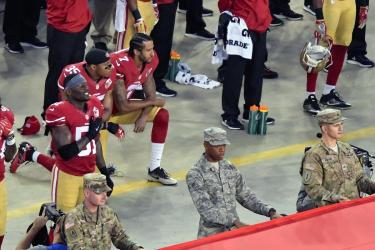
These are the ideals upon which was the United States was founded, the ideals that have made and continue to make America great. They are also the ideals that have traditionally been associated with professional sports.
How ironic, therefore, that the NFL has been overtaken by a sentiment of rejectionism against the symbol of those very values. How tragic to witness players use the freedom represented by the flag to show contempt and disdain for the country that has afforded them an opportunity for success they might never have otherwise had.
No, our country is not perfect. But the flag represents that values that allow us to strive together toward a more perfect union.
That being said, it’s not the job of the president to call for the NFL to penalize those players. It’s his job to demonstrate the responsible use of free speech by conducting himself with principled determination and disciplined self-restraint.
Our Chief Executive is responsible for passing fair and effective legislation while creating a national tone of respect and personal responsibility. Implicit in that is knowing and showing where the division between the two must be drawn.

The Beauty of Misfortune

What would Gandhi say?
There’s not much question, really. The icon of civil disobedience disdained every form of violence. He most certainly would have condemned riotous demonstrations protesting any courtroom verdict, no matter how unpalatable. So would Martin Luther King.
It’s easy to understand why many St. Louis residents took to the streets over the acquittal of former police officer Jason Stockley in the shooting death of Anthony Lamar Smith. Officer Stockley’s comments and conduct raised serious questions about the credibility of his own testimony. And civil protest is one of the foundational principles of a free society.
But on the other hand, the shooting followed the high-speed pursuit of a suspected heroin dealer, and video footage failed to substantiate the claim that Officer Stockley planted a weapon. In the end, Judge Timothy Wilson concluded that there was insufficient evidence for conviction.
So did Jason Stockley get away with murder? We may never know. But that’s not the point.
TO ERR IS HUMAN
We all know that our justice system is imperfect, as any system designed and implemented by human beings must be. Sometimes honest people make mistakes. Sometimes authority is corrupt. Sometimes the truth hides its face, and sometimes we have to accept that justice can be painfully blind.
It’s what we do next that matters most.
Some respond to frustration by venting their anger on whatever target crosses their path – in this case, by smashing the windows of 23 storefronts in my hometown, the St. Louis suburb of University City.
But from these senseless acts of misdirected destruction emerged an exquisite silver lining, an example of how human beings can discover within themselves true nobility in the face of injustice.
 The morning after the carnage, volunteers appeared on the streets and began sweeping up the broken glass and boarding up the broken windows with plywood. But even at that, the kindness of strangers had only just begun.
Before long, local artists showed up to paint the plywood panels, transforming stark reminders of wanton violence into beautiful murals of friendship and neighborhood harmony.
FACING THE FUTURE
This week, the Jewish community stands between Rosh Hashanah and Yom Kippur, between the Day of Judgment and the Day of Atonement. On those awesome days, we gather together in prayer, one people with one heart, to recite the High Holiday prayers. And as the liturgy rises to a crescendo, it impels us to ponder the uncertain future that awaits us in the coming year:
Who will live and who will die; who by water and who by fire; who by the sword or wild beast, who by famine or thirst; who by storm or plague or violence. Who will rest and who will wander; who will have peace and who will suffer; who will be poor and who will have wealth; who will be cast down and who will be raised high.
We have no idea what the future holds. Ultimately, we have no control over where fortune will take us. What we do control, however, is how we respond to our own fortunes and the fortunes of our fellows.
When we see our neighbors in distress, will we drop everything and hurry to their aid? When we behold injustice, will we add to injustice by lashing out impulsively? Or will we stand shoulder to shoulder in a show of solidarity?
And when we witness senseless suffering, will we close our eyes and harbor vengeance in our hearts, or will we resolve inwardly to do better ourselves, to ensure that we never contribute to the problems of the world but apply our energies toward finding solutions?
There is so much good in the world from which to find inspiration. And while some may add to the darkness with misdirected violence, let us call upon ourselves to rise to every challenge, to shine bright so we can inspire others to shine themselves.



Irma and Harvey: a love story
 If the stars should appear one night in a thousand years, how would men believe and adore.
~Ralph Waldo Emerson
It’s a sad reality of human nature: we miss out enjoying the blessings that fill our lives because we take them for granted. Until we don’t have them any more.
How many hours do we fritter away on texts and tweets and Facebook updates? Are these more satisfying than friends and family, more enlivening than smelling the roses and gazing at the stars? Not in a thousand years.
We think we can have it both ways. After all, the roses will be there tomorrow; and the stars will be there forever.
Until they aren’t. Having been bred for beauty, many of our roses have no fragrance whatsoever. And most of us have never beheld the wonder of the Milky Way. It disappeared decades ago behind the veil of urban pall.
AWAKE, MY GLORY!
Nature has its own way of reminding us to pay attention. Sometimes it’s through extraordinary beauty. And sometimes it’s through awesome power. Last month, the light of the sun disappeared at midday as the eclipse moved across the country. This month, the fury of life-giving water uprooted the lives of millions.

Photo Credit: Washington Post
The misery inflicted by Hurricanes Harvey and Irma was horrific to watch, and exponentially more horrific to endure. From thousands of miles away, Americans shook their heads at scenes of devastated communities, shattered homes, and displaced families. We wrote relief checks, offered prayers, gave thanks for our own safety, and carried on with our lives.
We wished we could do more. But what more we could do?
Consider this: Maimonides writes that anyone who hears of human suffering and does not respond with repentance and good deed is a cruel person.
The most effective way to make the world a better place is by making ourselves better people. Yes, I can work to save the rainforests and save the whales. I can raise money for refugees and volunteer my time to Habitat for Humanity. I can do these things, and I should.
Ultimately, however, the only thing I can be certain of changing is myself.
If I give charity out of guilt, I’m really just bribing my conscience to leave me alone. If I write a check because I think I’m going to relieve human suffering, I’m merely indulging my ego. It’s true, of course, that the recipients will benefit from any act of giving regardless of motivation. But am I benefitting myself as well?
LEARNING TO LOVE
Acts of kindness and charity should be expressions of sharing another’s pain – a natural, reflexive response to human suffering. When I give what I can, whether a lot or a little, I join with others to raise our collective voice and proclaim that we will not stand idly by and abandon others to their fate, even if we have no real control over how fate will deal with them.
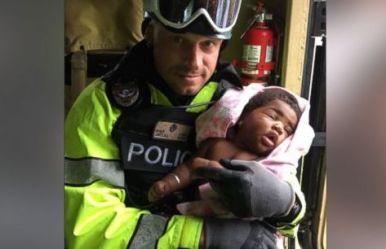 Purely motivated giving transforms us into giving people. By taking action when others are in need we learn to love our fellows as we love ourselves. And when we do, we become more appreciative of the relationships that are the source of true happiness.
The Jewish prayer book contains a series of blessings we recite each morning to acknowledge who we are and why we exist. Among those blessings we find the following:
Blessed are You, L-rd, our G-d, King of the universe, who stretches out the earth above the waters.
Our place in this world is precarious. The laws of nature operate with both granite consistency and fickle unpredictability. If we want to weather the storms of life, we need the support of others, which means we have to be there when others need support from us.
As individuals, we are exposed and vulnerable to the vagaries of happenstance. As a community, we find that the winds of fortune will not overturn our lives, and the waters of uncertainty will never extinguish our spirit. Out of the darkness of misfortune, the light of fellowship will shine down on us like the brightest of stars.
 Yonason Goldson