
Home » Headlines (Page 8)

Category Archives: Headlines

Adios, Amigos!

I’ve never made secret my disaffection for Donald Trump.  But within the dark clouds of his campaign and presidency, one bright ray of sunshine may be getting ready to pierce through the gloom:

Even before our new president began settling into the White House, a grassroots movement was already underway, gradually building momentum toward the singular goal of California seceding from the union.

According to the Washington Post, the activist group Yes California has responded to the Trump presidency by mobilizing its minions, which now constitute 53 chapters statewide, determined to gather the half-million votes necessary for getting the measure on the state ballot in 2018.  I encourage readers to donate generously.

And here I offer these sage words of advice to the secessionists:  look south.

Click here to read the whole article.

California and the Waters of Life and Death

Whenever headlines carry the painful images of human being caught in the path of catastrophic flooding, we should all take a few moments to contemplate how quickly nature can become our greatest adversary.  Water is both the source of all life and the greatest destructive force on earth.  I ponder the paradox in these reflections from after the Pacific Rim tsunami of 2005.


The Tsunami and the Circle-Maker

california-flood-bicyclist-jpg_5902745_ver1-0_640_360Volcanoes. Hurricanes. Earthquakes. Fires. Tornadoes. Blizzards. Drought.

In a time when reports of terrorism have become all too common, it is sobering to consider the myriad ways nature possesses to inflict death and violence on a scale surpassing the most destructive instruments devised by man. Of all these, however, destruction by water, whether from the sea or from the sky, holds a unique terror in the scope and measure of its devastation.

Aside from the 150,000 lives already reported lost across nearly a dozen countries along the Indian Ocean, dehydration, disease and hunger threaten as many as 5 million more in the wake of the recent tsunami. And rare though tidal waves may be, the more familiar trial-by-water of floods has, with much greater frequency, left similar numbers homeless and in danger of starvation.

It seems ironic that water, the source and foundation of all life upon our planet, can become nature’s most malevolent instrument against the beings whose lives depend upon it.

Devastation by water occupies a prominent place in human history. Virtually every ancient culture records the tradition of a great flood that inundated the world, lending credence to the biblical account of Noah and the ark. Jewish tradition describes this not as a random event, but as a divine response to the corruption of mankind.

The Talmud, however, reports a much more enigmatic account of divine intervention through water. It was in a time of terrible drought that the Jewish people approached the sage Choni HaMagil and beseeched him to pray for rain on their behalf. When Choni’s supplications to the Almighty went unanswered, he drew a circle in the dust and stepped inside of it, vowing not to leave the circle until G-d bestowed rain upon His people.

Immediately, a fine mist settled upon the earth, too little to alleviate the drought but sufficient to free Choni from his vow.

Choni called out to heaven: “I asked not for this, but for a rain to fill all the wells and cisterns.” Immediately, raindrops larger than melons began to fall, wreaking destruction upon homes and fields.

Again Choni called out to heaven: “Neither did I ask for this, but for a rain of blessing.” Immediately a normal rain began to fall, filling the wells and cisterns of the people as Choni had requested. But the rain did not stop, and soon the entire population of the land feared that they would drown in the rising waters.

One last time Choni called out heavenward: “Master of the World, Your people, Israel, whom You brought out from Egypt, can tolerate neither too much blessing nor too much misfortune.” Immediately the waters abated, and the people returned to their fields. From this time onward, people referred to Choni by the name HaMagil   —   the Circle-maker.

What was the point of G-d’s demonstration to the people of Israel? What did Choni mean that the people could not tolerate too much blessing? And why did Choni find it necessary to remind the Almighty, at this particular moment, that He had brought the Jewish people out from Egypt?

The Exodus from Egypt may be described, in commercial terms, as the largest loan ever extended in the history of man. During the generations of slavery in Egypt, the Jewish people had forgotten their Creator and lapsed into the same idolatries as their Egyptian masters. And although, to their credit, the Jews had guarded themselves against assimilation, this alone was insufficient to earn them the privilege of miraculous redemption. Nevertheless, G-d gave them an incalculable line of credit: Freedom from slavery, freedom from oppression, freedom to chart their own course into the future.

Moreover, He promised them immeasurable blessing and unbounded prosperity, on condition that they would repay their loan   —   repay it by living according to G-d’s law, repay it by rising above material pursuits and petty self-interest, repay it by using all the blessing that G-d would bestow upon them to aspire to moral, ethical, and spiritual perfection.

In this light, blessing may be understood as a double-edged sword. Wielded in one direction, it cuts down all enemies and obstacles that stand before us. Wielded in another, it obligates us to a standard of righteousness and moral behavior that we may find nearly impossible to meet.

This was the meaning behind the Almighty’s response to Choni the Circle-maker’s plea:

Two roads lie before My people, and it is their choice which to follow. One leads back to Egypt, back to the oppression of materialism and the slavery of self-indulgence, back to spiritual emptiness and the absence of all blessing. The other road leads forward, to spiritual fulfillment and spiritual greatness, if My people will only find within themselves the potential to seek greatness and discard all lesser goals. It is for this that I redeemed them, that they might cast off the chains of physicality and reach for the heavens.

H19060-L75167491And this too was the meaning behind Choni’s appeal to the Almighty:

Master of the World, You brought your people out from slavery and oppression on condition that they would use their freedom and the blessings to strive for spiritual heights. Your people, however, have demonstrated from their beginnings that, whatever their potential may be, they still suffer from human failings and human shortcomings. They cannot tolerate too little material blessing, lest the struggle to survive overwhelms them and they abandon all higher aspirations. And they cannot tolerate too much blessing, lest they cower before the goal set for them and lose all hope of its attainment.

By all accounts, the world that we live in today enjoys a level of material affluence unattained and unimagined by previous generations. Such basic necessities as rapid transit, instantaneous communication, indoor plumbing, electrical lighting and refrigeration, which we take for granted, provide us with an ease of living simply unavailable to even the wealthiest, most powerful monarchs until the last century. The very existence of an “entertainment industry,” much less the staggering sums of money devoted to it, testifies to our abundance of resources   —   which is to say, our abundance of material blessing.

Nowhere does Jewish tradition teach the condemnation of wealth or of recreation.

Nowhere does Jewish law mandate the forcible redistribution of wealth from those blessed with good fortune to those less fortunate. But Jewish tradition does warn us of the responsibilities of prosperity. It warns us in the narrative of the flood, in the story of Choni HaMagil, and also in the Hebrew word for charity: tzedakah, derived from the word tzedek, or justice.

It is only just that those who are blessed share a portion of their blessing with their less fortunate neighbors. It is only just that, before overindulging in one’s own good fortune, he ponders why he deserves having received such blessing while his neighbor has not. And it is only just that he ask himself how, even in the absences of tax incentives or legal mandate, he might reach out with his blessing to ease his neighbor’s plight.

If the waters of the earth, the life-giving waters that are the source of our greatest blessing   —   life itself   —   have risen up to inflict enormous tragedy, swallowing human life and draining billions of dollars of aid to spare human suffering, we will all be remiss if we do not pause to consider whether we have used our blessings wisely, and what we must do to ensure that we will continue to deserve them.


Originally published by Jewish World Review.

What are Ethics? Part 8: Collateral Damage

A View from the Frontlines

fairness-wordleReporter Hunter Stuart describes how a strong dose of reality forced him to reconsider his biases and preconceptions.

In the summer of 2015, just three days after I moved to Israel for a one-and-a-half year stint freelance reporting in the region, I wrote down my feelings about the Israeli-Palestinian conflict. A friend of mine in New York had mentioned that it would be interesting to see if living in Israel would change the way I felt about it. My friend probably suspected that things would look differently from the front-row seat, so to speak.

Boy was he right.

Read the whole article here.

Profit is not enough

“Cybercrime is out of control.”

So says Caleb Barlow, Vice President at IBM Security.  And if you’re already worried about credit card fraud and Russian hacking, you may not want to read any further.

On the other hand, there’s a lesson for all of us from the world of virtual villainy.

Most of us have come to accept internet espionage, phishing emails, and scam artists as part of life, the virtual equivalent of political kickbacks, muggings, and drive-by shootings.  We don’t like them; but the real world is not a perfect world, so we learn to take the bad with the good.

In a recent Ted Talk, Caleb Barlow offered a terrifying and surreal account of criminal organizations operating like professional, legitimate businesses, with English-speaking help desks and fake banking websites.  They operate anonymously on the Dark Web, which most of us relate to as something from a Kiefer Sutherland thriller.

But it’s real.  So real, in fact, that if you stumbled across a dark website you’d think you were shopping on Amazon or checking reviews on Angie’s List.

Read the whole article here.

Walking the Talk

diogIf Diogenes couldn’t find an honest man 24 centuries ago in ancient Greece, it’s hard to imagine his search would prove more fruitful in modern-day Washington, D.C. or, lamentably, in modern-day America.
It’s not hard to understand why.  In our age of personal gratification, truth has become more than merely inconvenient.  It has become an utter nuisance.

Conservatives have been eager – and correctly so – to shine the light of hypocrisy on Sally Yates, the acting Attorney General fired by Donald Trump last week for refusing to enforce his recent executive order on refugees.  Ms. Yates might have argued against the order’s constitutionality; instead, she based her decision primarily on personal bias.

Celebrated by the left for her stand on principle, what Ms. Yates really did was to violate her oath of office by failing to fulfill her duties.  It’s her job to uphold the law, not her individual values. If conscience prevented her from performing her duties, she would have resigned in protest.  But that would have required true principle.  So much easier to merely participate in another round of partisan gamesmanship.

This brings us back to Kim Davis, the Kentucky clerk who refused to grant marriage licenses to same-sex couples back in 2015.  She too claimed to stand on principle by refusing to honor her oath of office.

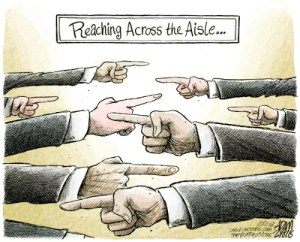
partisanshipSo why are the same voices that castigated Ms. Davis hailing Sally Yates as a hero?  And where were the critics of Ms. Yates when Kim Davis was making herself a martyr in name only?

Jedediah Bila posed that very question on The View, prompting Whoopi Goldberg to go ballistic and invoke the popular refrain, it’s not the same thing.

Nowadays, principle is just a synonym for equivocation.

Click here to read the rest in Jewish World Review.

The morning after

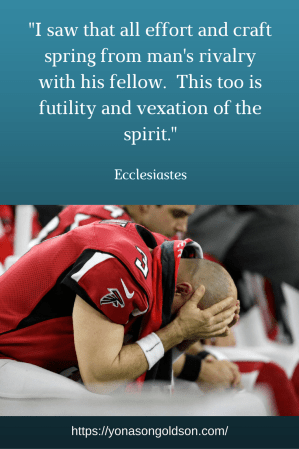
i-saw-that-all-effort-and-craft

What are Ethics? Part 6: Success through consensus

Behind the hero on the screen

In the wake of Meryl Streep’s finely crafted but sanctimonious speech at the Golden Globe awards, I’m revisiting these thoughts from 2009. 

195257_imageWhich of the following quotes does not belong with the others:

It is not what I am underneath, but what I do that defines me.

With great power comes great responsibility.

It is a far, far better thing that I do than I have ever done before.

Literary mavens will quickly identify the third quote as different from the first two for several reasons. First, it was written in the 19th century, where the others were written in the 21st. Second, it is a line from novel, where the others are lines from motion pictures. And third, it is the only one of the three not spoken by a Marvel Comic superhero.

On a more substantive level, however, all three have very much in common.

The first of the three is spoken by Bruce Wayne in his guise as Batman, explaining away his public playboy persona as a device to conceal his secret identity. The second is spoken by Peter Parker, aka Spiderman, explaining why he is walking away from the woman he loves in order to protect her from the enemies that would try to strike at him through the people closest to him.

The third quote is the closing line of Charles Dickens’s classic A Tale of Two Cities, in which the heretofore-undistinguished Sydney Carton expresses his love for Lucie Darnay by taking the place of her husband, Charles, and suffering death by guillotine so that Charles might live.

All three quotes issue from heroes who not only do great things at personal risk, but who sacrifice life, love, and reputation for a higher ideal. From a brooding moralizer like Dickens, we expect nothing less. From Hollywood scriptwriters and producers, however, we expect anything else.

FOLLOW THE MONEY

As the Oscar season descends upon us, its worth reflecting that Hollywood is known as Tinsel Town for good reason. Glitz, superficiality, and immediate gratification have become synonymous with the land responsible for most of today’s entertainment industry. Revolving door marriages and divorces, infidelity, and recreational drugs are only the most obvious symptoms of a culture that glorifies the pursuit of pleasure and the deification of personal autonomy.

Predictably, the film industry can be counted on to turn out major motion pictures that are thinly veiled propaganda pieces. Such unmemorable productions as Brokeback Mountain, Lions for Lambs, and The Good Shepherd may have curried favor with Hollywood politicos eager to promote alternative lifestyles or government conspiracy theories, but the movie-going public has shown considerably more enthusiasm for traditional good versus-evil-stories in which good triumphs in the end. (For the record, haven’t seen either Brokeback Mountain or Lions for Lambs.)

Top-10-heroesIf box office receipts are any indication, there can be no doubt that audiences will choose classic heroism every time. The musings of a couple of culturally conflicted cowboys on the open plain can hardly compete with such memorable moments as the President of the United States (played by Harrison Ford) throwing an international terrorist out the cargo hold of his plane in Air Force One or Kevin Kline’s presidential impersonator cutting government pork at a cabinet meeting to save funding for an orphanage in Dave.

That Hollywood did in fact release such movies as Batman Begins, Spiderman, and Air Force One, however, reveals an insight into Left Coast Culture that is at once obvious and surprising.

What is obvious is that money trumps ideology. When all is said and done, filmmakers would rather see increased revenues than the spread of counter-culture ideology. Fair enough. But what is truly remarkable is how well they understand the nobility, the selflessness, and the heroism of personal sacrifice that are so often at the heart of successful moviemaking.

MANKIND’S INNER HERO

Once upon a time, heroism in Hollywood was the norm. But we don’t have to go all the way back to Humphrey Bogart’s “the problems of three little people don’t add up to hill of beans” speech in Casablanca when he gives up Ingrid Bergman. When Helen Hunt refused to abandon her family for Tom Hanks in Cast Away, when Kelly McGillis refused to abandon her Amish community for Harrison Ford in Witness, when Robert Redford emptied out of his life’s savings to rescue Brad Pitt in Spy Games, the positive resolution of their inner conflicts provided some of the most powerful emotional climaxes in modern cinema. And let’s not forget this year’s biggest hit, The Dark Knight, in which Batman takes the blame for murder to allow Gotham City to keep its illusion of hope.

Perhaps the culture of make-believe that turns out movies of heroism is incapable of believing in either real heroism or the values that turn ordinary people into heroes. Why else would they persist in churning out so many ideological flops in between traditionalist blockbusters? One almost feels sorry for the creative geniuses that can portray such compelling drama on the screen but seem incapable of applying it to the reality of their lives.

The classical philosopher Rabbi Moshe Chaim Luzzato describes the human condition thus:

And so [man] finds himself truly in the midst of a raging battle, in which all the matters of the material world, whether good or evil, serve as trials for man. Poverty confronts him on the one side and wealth on the other… comfort on the one side, and suffering on the other, until he faces a battlefront before him and behind. But if he will be valiant and prevail against his adversaries on every side, then he will become a Complete Man.

Movies can remind us of the moral battles we face constantly in our own lives between what we know and what we feel, between what is right and what is pleasing, between rising to each new challenge or abdicating struggle for the line of least resistance. We rejoice when silver screen heroes emerge triumphant from their inner struggles, for they remind us that we too can emerge triumphant. But we despair when they fail, for they remind us how easily we too can fall prey to our inner demons.

It’s ironic that Hollywood filmmakers can describe the human condition so vividly with so little understanding of it. Perhaps they should watch their own movies – the ones that audiences go to see.

Originally published on Jewish World Review

Radio Interview with Steve Curtis — Ethics of the Day

Listen to my interview this Monday on Wake Up with Steve Curtis on KLZ Denver.

wakeupsteve6-7a640x250-300x117

Click here for The Ethics of our Day.