

Home » Philosophy (Page 11)

Category Archives: Philosophy

Rosh Hashanah: Letting our spirits soar

shutterstock_145625101When my youngest daughter was three years old, she discovered the helium balloons in the flower section of our local supermarket, handed out free to every child who asks. I tied the string around her wrist so the precious balloon wouldn’t escape up to the rafters. She bounced it on its string as I pulled it this way and that to avoid bumping other shoppers. She hugged it as we climbed into the car for the ride home.

As I pulled into the driveway, my daughter flew out of the car, her balloon bobbing along behind her, raced in through the front door and out again to our back yard, slipped the string off her wrist and gazed upward as the balloon rose into the sky and slowly drifted away.

“Why did you let go of your balloon?” I asked, slightly miffed that she had so casually cast away the new toy she had been fussing over for the last half hour.

My daughter just shrugged, giggled, and watched the balloon disappear from sight.

After our next trip to the market she did it again. Then again, over and over for months. Every time I asked the same question. “Why did you let go of your balloon?”

Finally I got an answer. My daughter looked me in the eye and replied, “It’s a present for God.”

* * *

She doesn’t do it anymore. And part of me mourns for the pure, innocent faith that prompted a little girl to give up her toy as an offering to the Almighty.

For all our experience and the sophistication, for all our indulgent smiles at the simplicity of our children’s beliefs, is it not likely that our children know something we don’t, something they themselves soon won’t know or even remember they once knew? And perhaps it is precisely their power of belief that sets them apart from the adults they will become.

Children believe in God, believe in their parents, believe in their country and their school and their friends and that good will always win out over evil. Their trust and faith haven’t yet been sullied by the lies of politicians, the corruption of law and justice, the avarice of sports heroes, the superficiality of Hollywood or, most importantly, the cynicism of their parents, who may try for a time to put on an act to spare their children from their own disillusionment.

But what if it worked the other way, that we could learn an old lesson from our children instead of imposing yet another new lesson upon them? What if we could turn the clock back and recapture even a whiff of the innocence of youth? Would we reach out to grasp it, or have we grown too jaded even to try?

erin-lange-renewal-iThis Rosh Hashana, Jews around the world will fill synagogues to inaugurate the first day of the Jewish new year. But Rosh Hashana celebrates much more than the beginning of another calendrical cycle. It celebrates birth and rebirth; it celebrates beginning and renewal, for it commemorates nothing less than the Creation of the world and Mankind.

As we approach the New Year, let us ask ourselves how we can turn back the clock, exchanging bad habits for new challenges, routine for renewal, and cynicism for enthusiasm. Instead of smiling with adult condescension at the innocence of children, let us consider instead that the difference between childhood and maturity is not whether we give presents to our Creator, but what kind of presents we choose to give. A child serves God by sending a balloon up into the sky. An adult serves God by releasing his spirit to soar to the heights of Godliness.

Have we given charity in proportion with our means? Have we visited the sick and comforted the distressed? Have we consistently spoken with kindness to our neighbors, with respect to our superiors, and with patience to our children? Have we honored the Sabbath and studied the ancient wisdom of our people?

It’s not enough to make resolutions; we need to inspire ourselves to see them through. We need to awaken in ourselves an awe of the Almighty by reflecting upon the vastness of creation, the unfathomability of the stars in their courses, the mysteries of life, and the limitless potential of the soul — to behold for a lingering moment the immeasurable beauty and majesty of our universe.

And if we can follow through, if we can make the moment last without slipping back into our well-traveled rut of discounting every noble and beautiful thought and deed, then perhaps we can retain our faith in those things truly worthy of faith throughout the coming year.

Originally published by the St. Louis Post-Dispatch and Aish.com

Why Souls Come Back: A Study of Reincarnation

study-of-reincarnationWhat is déjà vu? Some believe it’s an echo of recognition resonating through the curtain that separates one incarnation from another. For one brief moment, two separate but interconnected lives make contact through a flicker of metaphysical commonality. Maybe that’s true; maybe it isn’t. But a recent study of reincarnation by Dr. Ian Stevenson supports the belief that our souls do in fact return to this world after we die.

One of the most persistent dilemmas in spiritual philosophy is why bad things happen to good people, followed closely by its sister conundrum, why good things happen to bad people. If we believe in Divine justice, why does our world operate according to a system in which justice seems to be the exception rather than the rule?

Read more at: http://www.learning-mind.com/why-souls-come-back-a-study-of-reincarnation/

Days of Fear, Days of Love

fdb6bf41ace6004aef23b7c67553d766You must know that there is fear, and there is fear:  there is warranted fear and senseless fear.  Then there is trust and there is naiveté.

Rabbi Moshe Chaim Luzzato, 18th Century kabbalist

We have nothing to fear but fear itself.

Franklin Delano Roosevelt

As we approach Rosh Hashanah and Yom Kippur, the days of fear and the days of love, we should remind ourselves that the real dangers we face are not from the Ayatollah, not from Vladimir Putin, not from Donald Trump, and not from Hillary Clinton.

The greatest dangers that we face are from our own bitterness, our own complacency, our own pettiness, and our own resistance to challenging ourselves to learn, to grow, and to bring the spirit of God into our world.

The Gift of Dissatisfaction

PB Meme -- Lack of satisfaction

Order your copy at Amazon.com now.

The Greatest Moment in the History of the Universe

trumpWell, no.  It wasn’t.

But to hear Ann Coulter tell it, it was awfully close.

Just to be clear, this has nothing to do with politics.  Hardly anyone thinks that Donald Trump’s immigration plan is viable, no matter how much it may appeal to hardliners.  It probably would require a constitutional amendment, it would certainly take half a century and over 100 billion dollars to implement, and it would effectively make Mr. Trump unelectable — if he isn’t already.

But none of that is the point.

What is absolutely clear, beyond any doubt or debate is this:  Donald Trump’s plan is not the greatest political document since the Magna Carta.

No matter what Ms. Coulter says.

This is the same kind of irresponsible hyperbole that turns every ideological opponent into a Nazi, a terrorist, a rapist, or a child molester.  It shows the same kind of disregard for history that led Ms. Coulter to attempt to resurrect Joseph McCarthy as a fallen hero in place of the paranoid pit-viper that he was.  And it’s the same kind of disregard for language and reality that allowed Al Sharpton to laud Bill Clinton as “the first black president,” that enabled Bill Clinton to redefine the word “is,”  and that lies at the heart of the political correctness that Ms. Coulter herself (correctly) abhors.

To brand every antagonist a Nazi is to devalue the horror of the Holocaust and to insult its millions of victims.  To call newspaper columnists and television hosts terrorists shows a vile lack of empathy for the victims of 9/11 and Oklahoma City.  And to suggest any comparison between the Magna Carta and a political platform that is 90% grandstanding and 10% policy is to muddy the waters of logic and reason whey both are clouded enough already.

What an insult to the Summa Theologica, the Declaration of Independence, the Articles of Confederation, the Constitution, the Federalist Papers, Thomas Paine’s Rights of Man, and the Emancipation Proclamation.  What a mockery of political history.

“Words, words, words,” wrote William Shakespeare.  When we don’t respect them, when we twist them to gain cheap rhetoric advantage without regard for accuracy or authenticity, we become complicit in accelerating the Orwellian doublethink that is already eating away at the civil discourse that is the foundation of a functioning democracy.

The Orchestra of Mankind

Order your copy of Proverbial Beauty now

Find tranquility in the midst of conflict. Develop attitudes that deepen relationships. Gain clarity through times of darkness and confusion. Decrease cynicism and find joy in the daily miracles that fill our lives.

Order your copy of Proverbial Beauty now.

The Depth of the Human Soul

Now Available at Amazon

Now Available on Amazon

[Available to preview & purchase on Amazon.com]

The Scent of Spirit

images“A rose by any other name would smell as sweet,” wrote William Shakespeare, arrange ten simple words into possibly the most famous aphorism in the English language.

[Proverbial Beauty – preview at Amazon.com]

And yet, for all the mystique and romance associated with the beauty of the rose, the greatest of all poets recognized fragrance, not visage, as the defining quality of the most admired flower.

Bonnie Blodgett would almost certainly agree. In Remembering Smell: A Memoir of Losing and Discovering the Primal Sense, Ms. Blodgett describes the emptiness and depression that took over her life when a zinc-based nasal spray disrupted the operation of her olfactory nerve and disfigured her sense of smell.

Gone were the familiar, reassuring fragrances of her garden, replaced by ceaseless aromas of rotting flesh and excrement, which Ms. Blodgett describes as nothing less than torture. But even when these “phantom smells” abated, the odorless existence that replaced them was only a marginal improvement.

“I had no way of knowing before what it would be like to not smell anything,” she told NPR. “When I woke up and sniffed and there was nothing there — I don’t know how to explain it — I felt completely disconnected. I truly felt as if colors were more flat. The voices in conversation felt like a TV soundtrack to me.”

Adding insult to injury was the lack of sympathy received from friends. Unlike blindness, deafness, illness, or injury, most of us cannot relate to an impaired sense of smell as especially debilitating. Of all our senses, it is the one we are most likely to take for granted.

Of course, not everyone fails to recognize the power of fragrance. From Cleopatra to Oprah Winfrey, the rich and powerful have scented themselves to augment their personas and project an image of potency, charisma, or sensuality. Today, the research, development, and production of perfume and cologne have created a $25 billion industry that markets, in the words of star perfumer Sophia Grojsman, “a promise in a bottle.”

imagesNational Geographic explains it this way:  “Memory and fragrance are intertwined, some biologists insist, because the sense of smell plugs smack into the limbic system, the seat of emotion in the brain. No other sense has such immediate access.”

The unique power of fragrance takes little time to assert itself in the chronicles of mankind. Immediately upon exiting the ark, Noah gave thanks for his salvation by building an altar and bringing offerings of thanksgiving. “And the Almighty smelled the pleasing fragrance, and said to Himself, Never again will I curse the earth on account of man” (Genesis 8:21).  Obviously, G-d does not “smell” the way human beings do.  But according to the linguistic nuances of biblical Hebrew, “aroma” implies direct contact over a great distance in the finest detail and in the most subtle ways.*

The Hebrew words rayach (scent) and ruach (spirituality) derive from a common grammatical root, and the implied connection between them appears as early as the narrative of man’s formation, when the Almighty “breathed a living soul into his nostrils” (Ibid. 2:7).  The common derivation of the Hebrew words neshimah –“breath” – and neshomah – “soul” – suggests that our spiritual life force comes, literally and metaphorically, by way of air and respiration.

Just as smell is the most difficult sense to measure, quantify, and define, so too is our spiritual essence the least palpable and discernible facet of our existence.  Similarly, the interplay between one soul and another is the most elusive of human pleasures, but it is also the most rewarding.  As King Solomon says, “Scented oil and incense gladden the heart, sweet as the sincere counsel of a kindred soul” (Proverbs 27:9).  Indeed, the smoky fragrance of incense wafting into the corners of our minds and rippling across the strings of our hearts is anything but smoke and mirrors; it stirs our memories and hopes and dreams the same way that true friendship and camaraderie arouse our spirit.  Truly, the faculty of smell provides the spice of life by adding texture and dimension to all our other senses.

[Proverbial Beauty – preview at Amazon.com]

Ask Bonnie Blodgett.  As suddenly as her sense of smell disappeared, just as suddenly it returned, and she will never take it for granted again. “I was going around smelling everything,” she says. “Being able to smell lilacs again was just — I don’t think I’ll ever get over it.”

imagesBut it goes beyond mere olfactory pleasure. There is truth to common expressions like he has a good nose for business and something doesn’t smell right. Like our sense of smell, human intuition is our intangible moral compass, guiding us when we encounter something for the first time to quickly assess its value and authenticity.  In the biblical narrative, Jacob disguises himself as his brother, Esau, then enters the tent of his father, Isaac, who exclaims, “The fragrance of my son is like the fragrance of a field blessed by G-d” (Genesis 27:27).  The sages elaborate, explaining that the fragrance of the Garden of Eden entered with Jacob, convincing Isaac to bestow his blessing.**

What was this “fragrance of Eden”?  It was nothing less than the soul’s eternal connection to the ultimate Plan of Creation, which began with the placement of Man into a perfect world and will culminate in the restoration of that perfect world at the End of Days.***  And throughout the long generations of chaos in between, the spiritual nature of our world can be scarcely perceived through sight, sound, touch, or taste.  But it can be smelled, if we pay attention to the subtle pleasures of life that are expressions of the human soul and contemplate the mysterious allegory of fragrance.

And so the ancient sources describe the advent of the messianic era as a time when the divinely appointed redeemer will “smell and judge,” – determining complex truths through spiritual discernment (Babylonian Talmud, Sanhedrin 93b).  Thus we find, according to Chassidic tradition, the story of Rabbi Menachem Mendel of Vitebsk, the 18th Century leader of European Jewry whose wife ran through the door one afternoon shouting, “Mendel, Mendel, there’s a man outside shouting that the Messiah has arrived!”

Immediately, Rabbi Menachem Mendel jumped up and ran to the window, took a long sniff of air, then shook his head and muttered, “Nonsense!” before returning to his studies.  Like Isaac, the rabbi knew that a world with the Messiah smells different from a world without Messiah, and that if he could not detect the fragrance of Eden then certainly the messianic era had not yet arrived.

Two generations later, Rabbi Israel of Rizhin asked why the illustrious rabbi had to run to the window – why could he not simply sniff the air in his own home?

Rabbi Israel answered his own question.  So involved was Rabbi Menachem Mendel with his own personal service of the Almighty, so intent was he upon hastening the arrival of messianic era, so profoundly had he had already connected with the spiritual source of the universe that his own house had already acquired the fragrance of Eden.  Consequently, he had to run to the window to discover what the rest of the world smelt like.

The more we focus on what we should be doing to create a perfect world through the perfection of our own character and conduct, the more our lives will acquire the fragrance of spiritual purpose.  And the more eagerly we anticipate the glorious fulfillment of the Almighty’s Master Plan, the sooner we will enjoy a world in which we draw in the aroma of the Divine with every breath.

[Proverbial Beauty – preview at Amazon.com]

*Rabbi Samson Rafael Hirsch

**Rabbi Shlomo Yitzchaki, ad. loc

***Based on the Malbim, loc. cit.

Adapted from an essay originally published in Inyan Magazine, 2 July 2014.  With thanks to Rabbi Shraga Simmons and Aish.com.
Have you changed the world?

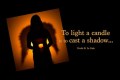
Candle proverbial beauty wisdom proverbsIf you’re walking into the sun, you can’t see the shadow you cast, no matter how long it might be.

If you’re looking for your shadow, you’re looking away from the light.

When the sun is at it’s highest and brightest, the shadow you cast is hiding under your feet.

Only when the source of light is about to disappear does your shadow stretch out toward infinity.

We don’t always get to see how we change the world.

Read the intro to Proverbial Beauty on Amazon.

What’s in a Name? Everything!

A name is not merely a label; it is an expression of the thing itself.

For instance, in Hebrew a donkey is a chamor.  A variant form of the same word, chomer, means “mortar,” the cement used in laying bricks.  And so the animal most characterized by its stubbornness is called by a name that also connotes “thickness.”  The dog, known for its loyalty, is called a kelev, which can also be read as k’lev, which means “of the heart.”  Names can provide insights into the nature of the world, if we know how to interpret them…

The meaning of a name can offer an insight into one’s intrinsic character.  The name David means “beloved,” suggesting the capacity to form deep emotional bonds.  The name Deborah means “bee,” suggesting an industrious nature as well as a personality that can both sting and sweeten.  The name Abigail means, “source of joy,” suggesting a talent for providing happiness to others.  Awareness of our innate, individual abilities can motivate us to develop potential that would otherwise remain dormant deep within us.

Read the whole article here.