Home » Psychology (Page 19)

Category Archives: Psychology

Willful Ignorance: the new normal

google-isnt-a-social-network--its-the-matrix

Maybe we really are living in the Matrix.

Day by day, even hour hour by, the headlines become more surreal and the actions of our leaders become more incomprehensible.  Who could have imagined that all the conspiracy theories of extraterrestrial mind-control and computer-generated mass-delusion would start to seem like the most reasonable explanations for where we are and how we got here.

The most recent administration scandal over the United States Central Command (CentCom) deleting military intelligence brings to a crescendo the chorus of claims of the White House stifling inconvenient truths about the Islamic State to avoid dealing with the real threat of terrorism.  Last year, the Pentagon’s inspector general began investigating after CentCom analysts protested that their findings had been manipulated to whitewash their conclusions.  Now it appears that files and emails were not only misrepresented but actually erased.

As we pass the 30th anniversary of the Challenger Space Shuttle disaster, it’s beyond mind-boggling that the culture of denial has grown worse than ever.  Back then, NASA administrators ignored warnings that O rings lose resilience at low temperatures and might fail on takeoff — which is exactly what happened.

But as irresponsible as it seems to disregard objections as insubstantial or unfounded, by what conceivable logic does one erase information because it supports an undesirable conclusion?  Can we make pneumonia vanish from a patient’s lungs by shredding x-ray images?  Can we make a brain tumor disappear by dragging the MRI results across the desktop and into the trash file?

Come to think of it, maybe this was the original strategy intended to make Obamacare viable:  destroying evidence of disease would certainly keep medical costs to a minimum.

WE HAVE SEEN THE ENEMY…

It’s not just the government.  As a society, we have become increasingly disinterested in a pesky little problem once known as reality.  Perhaps this is the inevitable result of fantasy movies and fantasy football, of virtual images and virtual messaging, of games that have become more compelling than reality, and of reality that has become more mind-bending than science fiction.  All this aided and abetted by the undo and reset buttons that instantaneously restore our make-believe worlds to perfection when things go wrong.

The rejection of reality cuts across every major issue of our times and infects every corner of political and social ideology.  Climate change advocates and skeptics alike exaggerate their claims and malign objectors.  Pro-choice zealots dismiss the horrors of late-term abortions, while pro-life zealots often refuse to even consider the complex issues of rape and incest, and sometimes even the life of the mother.  Supply-side Republicans continue to trumpet the effectiveness of a trickle-down tax structure despite the widening gap between rich and poor, while tax-and-spend Democrats cry out for fairness despite empirical and historical evidence that everyone loses.

In our information age, we are less concerned with facts than ever.  With a single click of the mouse, anyone can find legions of pundits asserting preconceived half-truths and countless articles defending outright falsehoods.  We are all adrift on a sea of misinformation, carried along by the winds of self-validation.  Had Samuel Coleridge imagined this, he might have written, experts, experts, everywhere, nor anyone to think.

Unsurprisingly, in the field of politics it’s even worse.  The most brazenly untruthful political figure in the history of the country calls for her opponents to take a lie-detector test, and a master of reality-television who has reversed himself on almost every substantive issue is winning hearts (if not minds) by branding himself as the candidate who “tells it like it is.”

If Laurence Fishburne appeared to offer us a choice between the red pill and the blue pill, which would we choose?  Have we so lost our interest in reality that we would happily opt for a world of illusion, or are we still capable of recognizing that a life of illusion is no life at all?

And again, it’s even worse in the world of politics, where neither red nor blue is likely to offer us any escape from our waking nightmare.

THE CHOICE

But we really don’t need a pill at all.

King Solomon said, “The wise man’s eyes are in his head.”  Closer to the brain than to the heart.  Looking outward, seeing inward.

What we really need to do is ask ourselves a few hard questions, then follow them up with a few honest answers.

We need to ask ourselves why we no longer value our word the way our parents and our grandparents did.  We need to ask why they felt more connected to one another corresponding through written letters than we do through face time.  We need to ask why they were willing to sacrifice for higher values when we have forgotten what higher values are.

First we have to be willing to ask ourselves these questions.  Then we might be ready to face the universal truths that are self-evident from the answers:  that trusting others and being trustworthy go hand in hand; that relationships are only worth as much as the effort that we put into maintaining them; that commitment to something greater than ourselves is the only thing that makes life worth living.

True, the world seems to be spinning toward its own destruction.  But even if we can’t save the world, we can stand strong and not allow the world to pull us down with it.  Keeping our word, showing respect to those we disagree with, offering a kind word to a stranger or a smile to a passerby — these few faint beatings of a butterfly’s wings might be enough to stir the winds of change, blowing away the clouds of chaos to let the light of reason shine once again.

Published in Jewish World Review.

Sage Advice from Eeyore

I came across this on Candid Market Networking.  Definitely worth the time.

0d2a42fdc29ae1dea16172839023a32f“Eeyore is a very misunderstood character.  Everyone thinks he is just the sad, depressed character.  We can learn a lot from him though.  He goes out of his way to help his friends.  When Owl loses his house, he searches high and low for a new house.  He really thinks about all living things around him, and treats them how he would want to be treated.  He loves unconditionally, and finds beauty in everything, including weeds.

“The reason he appears so depressed to all of us, is that he expects the same attitude from everyone around him, and is consistently let down.  He would do anything for his friends, yet they can’t even seem to remember when his birthday is.  Owl didn’t even recognize his tail when he found it.  It became an accessory for his new door bell.  Eeyore, like all of us, wants to be noticed.  He wants to be loved.  When Pooh and Christopher Robin think of him, and then help him, he is so happy, he frolics around the forest, waving his tail as he goes.”

In other words, we should moderate our expectations of others while expecting everything from ourselves, focus on our responsibilities to those around us instead of fixating on what we think others should do for us, and try persistently to bring joy to others, which will make us far happier than indulging in the pursuit of our own happiness.

Read the whole post here.

The Devil can’t make you do it

shutterstock_85142173Hey, mom. Post-partum depression got you down? Thinking of leaving your husband? Don’t fight it; just let him go. After all, it’s not your fault.

It’s your hormones. That’s the latest from the world of science. According to psychologist Jennifer Bartz of McGill University, researchers have identified a link between new parents divorcing and low levels of oxytocin.

Whatever the explanation, there seems to be a familiar eagerness by researchers to impose a chemical, as opposed to a psychological, explanation upon human behavior. Scientists often appear to prefer a model that links our choices to biological and evolutionary causes, further disassociating human decision-making from that most obvious explanation — free will.

Click here to read the whole article.

Article of Faith: Victims and Survivors in Kalamazoo

Last Saturday evening, according to CNN, the Michigan shooter drove through the streets of Kalamazoo for seven hours, firing at eight people in different neighborhoods and killing six of them.  In between attacks, he picked up and dropped of Uber passengers without incident.

confusion“There isn’t a connection that we’ve been able to establish between any of the three victim groups with each other, any of the three victim groups with the defendant,” said Michigan prosecutor Jeffrey Getting.

What could these victims have done to protect themselves?  Why were the survivors chosen for life and not for death? The natural conclusion is that the world is a place of randomness, where we are left to the hands of fate without rhyme or reason.

Amidst all the pain and confusion, is there any way for us to confront the presence of evil in our world and the persistent appearance of disorder without retreating into bitterness and despair?  

As we mourn and look for answers, I’d like to offer these thoughts from 2009.

Every night, most of us go to bed without questioning whether we’ll wake up the next morning or whether the sun will rise in the east. Every morning, most of us go to our front doors confident that our cars will start, that the trains will run, that our coworkers and customers will be respectively friendly, or sour, or aloof, each according to our expectation based upon experience.

Is this faith? Or is it rather the reasoned projection of logical extrapolation? Or is there a difference?

Over the past two decades, 50% more tornadoes have swept through the state of Illinois than the state of Alabama. Nevertheless, Alabama has suffered many more fatalities. An article in the journal Science has suggested the following explanation: Because people in Alabama tend to share the religious conviction that their destiny is in the hands of G-d, they resign themselves to the inevitability of Divine Providence. In contrast, people in Illinois more commonly believe that they are in control of their own destiny and masters of their own fate; consequently, they are more inclined to take action toward ensuring their own safety and welfare.

If correct, this analysis might imply that faith is vastly over-rated. If dependence upon the Almighty increases the likelihood of an early demise, perhaps we should all reject the notion of faith and conclude that God really does help those who help themselves.

Alternatively, we might re-evaluate our understanding of faith.

physics_confusion_by_kasurabellThe Hebrew word emunah — commonly translated as faith — is more accurately translated at faithfulness. It is less descriptive of our internal beliefs and more descriptive of our external behaviors. It describes not our feelings but the degree to which our commitment translates into concrete actions. Most significantly, it expresses our conviction that the Almighty keeps faith with us, even when we may fail to keep faith with Him.

Consider the husband on a business trip a thousand miles from home who resists the overtures of an attractive young woman in the hotel lounge, the teenager away at college who leaves a party when hard drugs start passing around, the lowly private who doggedly advances according to orders even when he is cut off from the rest of his company — all these are examples of faithfulness that endures even when human logic and fear of consequences offer no objection, even when peer-pressure urges us to abandon duty and loyalty. These are the truly unsung heroes, who set aside the relentless calling of self-interest and immediate gratification for nothing but the commitment to another person, to a code of honor, or to an ideal.

According to Jewish philosophy, our trust in the Almighty is not the “leap of faith” that comes from believing without logic or reason, but the confidence that comes from knowing that the Almighty has proven His faithfulness again and again over 3,300 years of uniquely supernatural history. It derives not from our faith that everything will turn out the way we want all of the time, but our certainty that everything is guided by Providence, and that the logic behind every divine edict is true and just — even when it is unfathomable to human understanding.

Finally, faithfulness does not require us, nor even advise us, to sit by passively and await the Divine Will to reveal itself before us. Rather, it requires us to act in our own best interest while adhering to the moral laws of God and man.

Almost everyone has heard the story of the clergyman forced to seek refuge on his rooftop by the rising waters of a flood. One boat comes and offers to save him, but he replies, “I have faith in God.” Another boat comes,and then another, but he refuses to accept help.  Finally, a helicopter drops down a ladder and warns that they are the last of the rescuers. But the man of the cloth declares, “I have faith in God.”

The floodwaters continue to rise, and the clergyman drowns.

Upon arriving in the next world, he asks why, in spite of his devout faith, the Almighty did not save him. And God replies: “What did you want from Me? I sent you three boats and a helicopter.”

G-d does indeed help those who help themselves. But He ultimately rewards those who remain faithful, who recognize that there is both a time for taking matters into our own hands and a way to do so without compromising our faithfulness to the Master of the Universe. There is a time to live — through determined effort, with honor and dignity and self-respect. There is also a time to die — either when the cost of personal integrity becomes too great, or when one’s time is simply up, no matter how random the events that end a life may appear.

Learning to strike the perfect balance between determined effort and principled resignation is the work of a lifetime. It is also the key to achieving true faithfulness to God while taking comfort in the promise that, despite the illusion of chaos and the very real pain of loss, everything happens for a reason.

Originally published in Jewish World Review

Christopher Hitchens: Almost a Hero

book-quotable-splshIt’s remarkable how we can develop a deep fascination, sometimes to the point of fixation, toward people we despise.

This is not particularly healthy: we gain much more by studying those who are worthy of our admiration and reverence, both as models for the refinement of our own behavior and as sources of inspiration that demonstrate the heights to which human nobility can soar.

But human nature produces an incessant magnetism toward the negative, no matter how much we may know better.  So I couldn’t resist clicking on Daniel Oppenheimer’s recent retrospective* on Christopher Hitchens, one of my least favorite intellectuals.

I’m glad I did.

Click here to read the whole essay.

Four Ways to Make Attention Deficit Less Disorderly

attend-girlMany years ago, when my eldest son was about six years old, I introduced him to Chutes and Ladders, the next board game up from Candyland on the sophistication scale.  Nothing but luck, the game nevertheless contains an engaging element of the unpredictable, as any roll of the die can rocket you up a ladder to the top or send you plummeting down a slide to the bottom.

My son took to the game immediately, and we bonded as we moved our respective pieces up and down the board.  And then, with fatherly foresight, I waited for the moment of supreme joy and excitement as my son counted his piece onto the 100 mark at the top of the playing grid.

“You won!” I cried out, expecting him to respond with elation.

Instead, my son looked at the board, looked at me, and burst into tears.

“What’s wrong?” I exclaimed, genuinely flummoxed.

“I don’t want the game to be over!” he bawled.

Oh, if only they could stay six years old forever.

It’s worth examining what happens as we grow older that makes us lose the joy of the game in our headlong pursuit of victory.  Maybe it’s that we’re not paying attention.  Maybe it’s that we’re paying too much attention.

Or maybe it’s both.

Click here to read the whole article.

8 Choices for Making a Happier Life

I’m a big fan of Malcolm Gladwell.  His particular genius for collecting data and weaving together fresh insights has produced a wealth of practical wisdom to help us improve the quality of our lives.

Grocery shopping

But nobody’s perfect.

I recently came across Mr. Gladwell’s 2004 Ted Talk, in which he recounted the career of one Howard Moskowitz, a psychophysicist whose market research for Pepsi Cola, Vlasic Pickles, and Prego Spaghetti Sauce — beginning back in the early 70s — changed the food industry forever. It might seem obvious to us with the wisdom of hindsight but, to make a long story short, Howard Moskowitz discovered that there is no perfect pickle, no ideal type of cola, and no universal favorite recipe for spaghetti sauce.

How big a deal was this?  I’ll let Mr. Gladwell explain:

Everyone else in the industry looked at what Howard had done, and they said, “Oh my God! We’ve been thinking all wrong!” And that’s when you started to get seven different kinds of vinegar, and 14 different kinds of mustard, and 71 different kinds of olive oil. And then eventually even Ragù hired Howard, and Howard did the exact same thing for Ragù that he did for Prego. And today, if you go to a really good supermarket, do you know how many Ragùs there are? 36! In six varieties: Cheese, Light, Robusto, Rich & Hearty, Old World Traditional — Extra-Chunky Garden.

All well and good.  Now we can all have exactly what we like all the time, without sacrifice, without compromise, without effort.

But then Mr. Gladwell continues, moving on from tomato sauce to mustard.  And it is here that Malcolm Gladwell exits the highway of reason and turns onto the backstreets of phantasmagoria.

Click here to read the whole article.

Why do we Cry? The Psychology of Tears

0610-why-we-cry-1154My dog died.  I just got engaged. An earthquake leaves thousands homeless. “Time in a Bottle” comes on the radio. I passed my college physics exam. My best friend has leukemia. My daughter just gave birth to twins. Another senseless terror attack takes innocent lives. Jimmy Stewart’s friends and neighbors all rally to his defense at the end of “It’s a Wonderful Life.”

It would be hard to compose a more random grouping, would it not? Taken individually, the items on this list seem so far removed from one another that anyone having the same emotional response to every one of them might reasonably be diagnosed as schizophrenic.

Well, maybe schizophrenic is what we are, since any of them could send any of us into a spell of sniffles, if not outright sobbing.

Which has to make us wonder:  why do we cry? We all know when we cry.

We cry when we’re sad, and we cry when we’re happy. We cry when we’re lonely, when we’re in pain, when we hear bad news, and when we hear good news. We cry when we’re so overwhelmed with work or debt or family or life in general that we can no longer cope, and we cry when we’re so filled with joy that we want hug the world.

But what do all these highs and lows have in common? And why is crying our natural, involuntary reaction to emotional intensity?

Read more at: http://www.learning-mind.com/why-do-we-cry/

Mistaking Identity

08.18.15-IntersexDennis Prager is at it again, this time with the simultaneously radical and reactionary, bigoted, sociopathic, and really-not-very-nice assertion that transgender people should take names and employ pronouns appropriate to their chosen identity.

Quick!  Inside the nearest shelter… the sky is falling.  Civil society may never recover.

Okay, yes, I am being sarcastic.  Guilty as charged.  But sometimes the logical and moral convolutions the politically-correct allow for no outlet other than simple mockery.

But I apologize if I hurt anyone’s feelings.  I know it’s terribly bad form these days to speak the truth.

However, it should come as no surprise that the moral boundaries of civil society grow ever blurrier, in this case by design.  These winds were already blowing with gale force when I published the following essay back in 2011:

When their third child, Storm, was born, Kathy Witterick and David Stocker announced the birth of their new baby with the following email:

“We’ve decided not to share Storm’s sex for now — a tribute to freedom and choice in place of limitation, a stand up to what the world could become in Storm’s lifetime (a more progressive place? …).”

Needless to say, friends and family alike have trouble understanding Witterick and Stocker’s unconventional approach to child-raising. With stereotyping, bullying, and social stigma inevitable parts of growing up, it’s easy to argue that manufacturing an additional obstacle to healthy social development is hardly in the child’s own best interest.

“Everyone keeps asking us, ‘When will this end?'” says Witterick. “And we always turn the question back. Yeah, when will this end? When will we live in a world where people can make choices to be whoever they are?”

FREEDOM WITHOUT LIMITS

A single family hardly constitutes a trend. But consider the Egalia preschool in Stockholm, Sweden, where staff avoid such culturally loaded words as “him” and “her,” addressing the children as “friends” rather than “boys and girls.” According to the AP, “breaking down gender roles is a core mission in [Sweden’s] national curriculum,” and many preschools have hired “gender pedagogues” to devisestrategies for eliminating “stereotypes.”

germanyCould they be right? Is sexual identity nothing more than arbitrary social programming? By eliminating every vestige of guidance from a child’s environment might parents actually help him learn to make better choices? Will indoctrinating a child with the conviction that every imaginable alternative is equally viable produce a canny, confident, and even-keeled adult?

Well, would it make travel easier if we uprooted every street sign and tore down every traffic signal? Would it make navigation easier if we burned every map and disabled every GPS?

The hazards of unrestricted freedom often go overlooked in a society that values personal autonomy above all else. But the formula for resolving the tension between individual expression and social boundaries was articulated by King Solomon, the wisest of all men, nearly three thousand years ago.

Hear, my son, the moral guidance of your father,
and do not forsake the teaching of your mother
(Proverbs 1:8).

Giving voice to the self-evident truth that men are men and women are women, Solomon alludes to the distinct manner in which a father and a mother each makes a unique contribution to the psychological and ethical development of their child. From the father comes instruction— formal guidance in the ways of moral values and discipline. How to know right from wrong, and how to choose good over evil — this is the kind of wisdom most effectively communicated through fatherly counsel and direction.

Complementing the father’s instruction are the lessons absorbed from the mother, who plays the primary role in creating the atmosphere of personal responsibility and spiritual commitment that should permeate a home. It is mainly through the intangible, unquantifiable influence of the mother that a child develops moral sensitivity. Neither father nor mother can successfully assume the role of the other, for our distinct psycho-spiritual complexions are part of the design according to which the universe was formed.

Parents who refuse to assert moral principles, albeit in the name of tolerance and progressivism, succeed only in making their home an environment of intellectual anarchy that will inevitably lead to confusion and dysfunction later in life.

CHILD-RAISING, TAILOR-MADE

Train a youth according to his way;
even when he grows old he will not depart from it
(Ibid. 22:6).

Often cited, correctly, as the source for individualizing education based upon the singular needs of every child, this proverb contains another element often overlooked: the word “youth” — na’ar, in Hebrew — implies immaturity. Truth be told, the majority of us suffer from a sophomoric certitude in the infallibility of our own wisdom. And children are the most susceptible of all to such delusions.

Wanting desperately to believe in their own independence, children seize hold of any excuse, no matter how irrational, to invalidate the wisdom of their parents. Left to his own devices, a youth will steer confidently into the heart of the nearest storm, delighted to be free from the steady guidance of the parent who could have saved him from catastrophe.

Like old wine and fine cuisine, genuine wisdom is an acquired taste, and the immature mind will reject its lessons as surely as the untrained palate will disdain the delicacies of a Cordon Bleu in favor of peasant’s fare smothered in salt and ketchup. But we do our children no favor by making it easier for them to marching confidently over the edge of the nearest precipice. Gentle instruction administered with care and consistency will lay the foundations of moral discernment as a child grows into adulthood.

A WORLD WITHOUT BORDERS

In his famous legal discourse regarding character development, Maimonides writes that “people are influenced by the society in which they live” (Hilchos Dayos 6:1). Among the many dangers of the modern world, none may be as insidious as the attack upon all natural and moral boundaries. Electric lighting pushes away the darkness of night, central air conditioning and heating insulate us from the changing of the seasons, cars and planes shrink the distance between faraway places, and electronic communication eliminates all delay in correspondence and information.

No one is suggesting that we live like the Amish and eschew modern technology. But these inventions are not as innocuous as we wish to believe: in the same way that physical boundaries have been breached, so too have moral boundaries become increasingly blurred and the path of moral conduct ever more difficult to find.

Maze-2-1024x717Respect for traditional family structure continues to erode. The personal conduct of political leaders raises less concern than the carelessness that leads to getting caught. Violent criminals are cast as victims while defenders of life and limb are vilified as exploiters and oppressors. And the role of human sexuality in mental health and social stability is ever more profoundly misunderstood. Political correctness and moral equivalence have so muddied conventional wisdom that young and old alike often fear censure from their peers for daring to judge even the most abhorrent behaviors.

Yes, children need to learn to make their own choices, and today’s helicopter parents who micromanage every aspect of their children’s lives are more likely to produce crippled than capable adults. Nevertheless, we dare not overcompensate by throwing our children into the stormy waters of amorality and expecting them to swim. As Solomon has said, it is only through the guidance and teaching of moral values that we will keep our children afloat, as well as enabling them to navigate their way to safe harbor.

Originally published by Jewish World Review

Worst Day Ever?

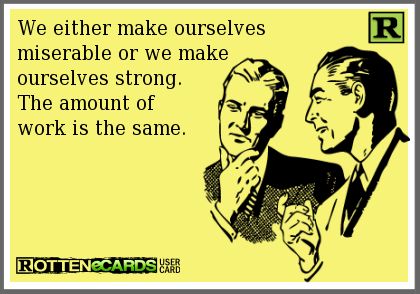
RottenEcardsWorst Day Ever?
by Chanie Gorkin

Today was the absolute worst day ever
And don’t try to convince me that
There’s something good in every day
Because, when you take a closer look,
The world is a pretty evil place.
Even if
Some goodness does shine through once in a while
Satisfaction and happiness don’t last.
And it’s not true that
It’s all in the mind and heart
Because
True happiness can be attained
Only if one’s surroundings are good
It’s not true that good exists
I’m sure that you can agree that
The reality
Creates
My attitude
It’s all beyond my control
And you’ll never in a million years hear me say
Today was a very good day

Now read it from bottom to top, the other way,
And see what I really feel about my day.

From Aish.com.