








Home » Posts tagged 'Community' (Page 17)

Tag Archives: Community

Creating a Culture of Violence

San-Bernardino-vigil-Mark-J.-Terrill-Associated-PressI wish there was no reason to repost this essay.  But with “random” violence becoming a cultural norm, we can’t run away from the root causes of radicalization, whether Muslim or otherwise.  President Obama may not be totally off the mark in his belief that the West created this problem — but our contribution is not what he thinks, and his policies are only adding fuel to the fire.

Zebadiah Carter describes himself living in “an era when homicide kills more people than cancer and the favorite form of suicide is to take a rifle up some tower and keep shooting until the riot squad settles it.” In 1980, this remark by the main character in a Robert Heinlein novel sounded like the science fiction that it was. Now it echoes like a prophecy.

Read the whole article here:
http://yonasongoldson.com/2015/05/18/remembering-the-boston-bombing/

Spiritual Gridlock

Trânsito em São Paulo

With congress increasing paralyzed by gridlock and our president usurping monarchic power by executive fiat, it seems appropriate to revisit this essay from 2008, originally published by Jewish World Review and adapted in my book Proverbial Beauty.

New York Mayor Michael Bloomberg wants to end traffic congestion in Manhattan. However, as sympathetic as New Yorkers may be to Mr. Bloomberg’s vision, his proposed method is most likely to produce madness.

To curb the number of vehicles entering downtown (which has grown annually by an average of 8000 per day since the 1920s, according to U. S. News and World Report), the proposed law would encourage (or coerce) commuters to rely on public transportation by imposing a daytime tax of $8 per car and $21 per truck traveling onto the island. City officials believe that this “congestion pricing” would reduce traffic by as much as 12 ½ percent.

Whether or not commuters can be persuaded to practice even occasional abstinence in their love affairs with their cars makes for interesting speculation. However, the concept itself is sound. In fact, it has been used for some time on a much larger scale, implemented throughout every borough of the world by the Mayor of the Universe.

EXPRESS LANES TO FREEDOM

The most the dramatic experiment in mass transit came over 3300 years ago when the Almighty split the Sea of Reeds, allowing the Jews to pass through and escape their Egyptian pursuers. In contrast to Cecil B. DeMille’s famous recreation, the sages teach that the sea opened up into twelve distinct passageways, one for each of the Tribes of Israel. As they passed through, the water separating the passages turned clear like glass, so that each tribe could see its fellow tribesmen traveling alongside them.

The design of this miracle teaches three lessons. First, the division of the sea into separate passageways demonstrates that there is more than one way to have a relationship with G-d. The Almighty does not want us to be automatons or clones, sheepishly following whoever is in front of us. Each individual is unique, and his divine service should be tailored to the nature of his singular soul.

Second, the water turning clear like glass reveals the lengths to which we must go to master the human ego. Had the walls of each passageway remained opaque, each tribe would have thought that it alone had discovered the correct avenue to reach the other side, and that it alone was traveling in the right direction to serve G-d. When they saw the other tribes traveling along side them, the Jews of each tribe recognized that they were not the only ones who had discerned the proper path.

splitting_the_red_sea2The final lesson can be learned from recognizing that there were a limited number of paths. Anyone who did not follow one of the twelve passageways was, literally and figuratively, under water. Every spiritual movement does not become legitimate simply because it declares itself so, no matter how sincere its leaders or followers may be. Every self-proclaimed “holy man” is not genuine simply because he hangs out his shingle or attracts parishioners. Natural laws govern the operation of the spiritual universe just as they govern the workings of the physical world. One cannot render those rules null and void simply by wishing them out of existence or declaring them defunct, any more than congress can annul the force of gravity.

THE PRICE OF PRIDE

There is yet one more insight to be gained from the illustration of the Jews’ passage through the sea, one that is echoed by the New York mayor’s effort to cure his city’s traffic woes.

Consider the car as an allegory for personal autonomy. In a very real sense, we are all control freaks. We want to control our destiny, to chart our own heading, to have our hands on the wheel. Often the greatest demonstration of inner strength comes through humbling ourselves, giving up control and placing our fate in the hands of another. Often this is a concession we are either unwilling or unable to make.

But do we consider the cost? For car owners, the cost is rolled up in the price of the vehicle itself, of gas, insurance, repairs, parking fees, tolls and, perhaps, congestion tax. Public transportation is far cheaper and often more efficient. But still we refuse to relinquish control.

In business, the most efficient workers are those who work as part of a team, who coordinate their efforts with the efforts of others and trust their coworkers to get their own jobs done. Those who try to do everything themselves, or to micromanage others at their work, create confusion, inefficiency, and frustration.

Our relationships, marriages, and families function best when the individuals within them tend to their own responsibilities and allow others to look after theirs. Hovering, ordering, or criticizing before a spouse or child has even had a chance to complete an assigned task breeds resentment and destroys trust.

Spirituality is much the same. We like to think that we are in control of defining our own relationship with the Almighty. We strike out in whatever direction seems right to us, often without any roadmap or compass to guide us in distinguishing good from bad, right from wrong, moral from immoral. We believe that intuition alone will get us to our goal, when we have only the faintest notion of where we are trying to get.

Worst of all, there is available transportation ready to take us to our final destination in the most efficient way. By keeping G-d’s laws and following in His ways, we guarantee ourselves the smoothest possible journey through this world until we arrive at the World to Come.

THE FAST TRACK

escher-glass-ball1But still many of us won’t give up control. So the Almighty levies His “taxes,” creating obstacles that make the paths of personal autonomy increasingly difficult. We feel stifled in our jobs, unhappy with our families, and discontented with the direction of our lives. So we seek out “detours,” looking for fulfillment in the least likely places: alcohol, drugs, gambling, or extramarital affairs. We think change will make us feel better, but we usually find ourselves worse off than before.

Rabbi Elyahu Dessler explains that we find ourselves in emotional or spiritual darkness at those times when we have cut ourselves off from the source of spirituality in the world. But when we “look into the darkness,” when we recognize that we have created the darkness for ourselves by distancing ourselves from the ways of the Creator, then and only then will we begin to find our way back to the light. By giving up control over our destiny, we regain mastery over our soul.

Whether taxing drivers will solve New York’s traffic problems remains a mystery. But it is in our hands to solve the mysteries of the spirit by following the well-trodden path of the generations that have gone before us. By retracing their steps, we can have confidence that we are not solely dependent upon our own devices to chart our way out of the darkness of confusion, but that we have a clearly marked path to follow toward the light of true meaning.

A Message to my Son

Mountaineer reaches the top of a snowy mountain in a sunny winter day. Western Alps, Biella, Italy.

My oldest son enters the Israeli army this week, motivated by nothing other than a sense of commitment to the security of his people.

It seems fitting to revisit these thoughts, written on the occasion of his bar mitzvah ten years ago.

It’s not difficult to sympathize with the skeptics who questioned the ability of Avrohom Mordechai Altar, then still a teenager, to succeed his father as leader of the Gerrer Chassidim, possibly the most influential Torah community in Poland at the end of the 19th century. But the young scholar, who would grow up to become a great rabbi and author of the Imrei Emes, answered his critics with the following parable.

A small town in an isolated land rested at the foot of a great mountain, a peak so high and steep that all reasonable people considered it unconquerable. From time to time, however, some impetuous youth would set out to climb the mountain. Some of these returned admitting defeat. The rest were never heard from again.

Despite the warnings and prophesies of doom, a certain young man decided to challenge the mountain. Many times he nearly turned back, and many times he nearly met his end, but through sheer persistence he finally reached the mountain top. But he was utterly unprepared for what he found there.

A thriving city of people lived upon a great plateau at the mountain¹s summit. There were houses and farms — an entire community living where everyone believed that no one had ever set foot.

The inhabitants of the mountain top laughed at him when he expressed his astonishment. “Do you think you¹re the first one to climb the mountain?” they chided. “We also reached the top and, having done so, chose to build this town and make our lives here.”

Not yet recovered from his dismay, the young man noticed a small boy, only six or seven years old. This was more than he could believe. “Did you climb all the way up here, too?!” the young man exclaimed.

“No,” replied the boy. “I was born here.”

The youthful rabbi explained to his followers that indeed he was young. But he had been born into a dynasty of great Torah leaders, raised by and taught by the greatest sages of his generation who had in turn been taught and raised by the greatest sages of their generation. True, he was young; but he had been born on a mountain, and from his place atop the shoulders of the spiritual giants who preceded him he would build upon their greatness. In this way would he succeed as a leader of his people.

And so he did.

NHUV7363816Every year, on the sixth day of the Jewish month of Sivan, Jews around the world celebrate the revelation at Sinai, over 3300 years ago, when the Almighty gave us the Torah. It was the Torah that provided the moral and legal foundation that has enabled the Jewish people to build a nation devoted to spiritual ideals, a nation that endured for nearly 1,500 years in its land and nearly 2,000 years scattered across the globe. It was the Torah that introduced the concepts of peace, of charity, of justice, and of collective responsibility to a world that knew no value other than “might makes right.” It was the Torah that formed the basis of Christianity and Islam, spreading monotheism throughout the world and fashioning the attitudes of modern progressivism.

It all began on that mountain called Sinai, and from that point on the Jewish people have labored to climb the mountain of morality and virtue, sometimes succeeding, sometimes failing, sometimes wondering whether our efforts are worthwhile, but always persevering in our mission to attain the summit of spiritual and moral perfection.

Had our mission demanded completion within a single generation, we would never have held out hope of success. But every generation climbs a little higher, building on the accomplishments of their parents and grandparents, fighting for every handhold, struggling for every foothold, occasionally slipping back but never surrendering.

The mission that defines us as a people began 33 centuries ago; it continues today as we recommit ourselves to the study and observance of Torah, and celebrate it on the holiday of Shavuos.

And it was two weeks after Shavuos that I celebrated what happens only once in a lifetime — the bar mitzvah of my eldest son. In his first 13 years of life I did my utmost to teach him that he was born on the mountain, that he has the accomplishments of generations beneath his feet to support him, and that future generations will depend upon him for their support just as he depends on those who went before.

And so it is with every Jewish child. Each has his own contribution to make in the eternal mission of our eternal people. It is the Torah that defines us, the Torah that guides us, the Torah that sustains us, and the Torah that will ultimately bring us to the fulfillment of the spiritual goals for which the Almighty created us.

Climb, my son. Climb and keep climbing toward the top of the mountain.

Originally published by Aish.com.

The Legacy of Woodrow Wilson

564f3cc7c10e0.imageOnce Iowa Democrats decided to rename the venerated event known as the Jefferson-Jackson dinner, it was only a matter of time before PC zealots would start demanding the purge of historical icons all across America.  After all, how in good conscience can a country continue to commemorate its most influential leaders if they failed to anticipate that the legal and universally-accepted institutions of their times would eventually be regarded as immoral by their great-grandchildren?

Now it’s Woodrow Wilson’s turn, as students at Princeton demand that the memory of their university’s former president be expunged from under the heavens because he supported segregation, a policy viewed by many as progressive a century ago, no matter what we may think of it now.

There is a deeper irony in their campaign, however.  In terms of political acumen, Woodrow Wilson has quite a bit in common with a much more contemporary figure, one who is revered by the very people who are protesting President Wilson’s racism and misogyny:  Barack Obama.

Read the whole article here.


The Great Divide: Ignorance and Insecurity

Conor Friedersdorf writes in the Atlantic:

temper-tantrum[At Yale University, one] resident declared in a campus publication, “I have had to watch my friends defend their right to this institution. This email and the subsequent reaction to it have interrupted their lives. I have friends who are not going to class, who are not doing their homework, who are losing sleep, who are skipping meals, and who are having breakdowns.” One feels for these students. But if an email about Halloween costumes has them skipping class and suffering breakdowns, either they need help from mental-health professionals or they’ve been grievously ill-served by debilitating ideological notions they’ve acquired about what ought to cause them pain.

This is the reaction of Ivy League students, the best and the brightest, the cream of the crop, the hope for the future, the movers and shakers of the next generation, the political, social, and economic leaders of tomorrow.  Their entire world collapses because someone, somewhere disagrees with them.

The depressing irony of the episode is that Erika Christakis’ noble attempt to accord students a greater measure of personal and moral responsibility resulted in the students themselves protesting for — and thereby demonstrating — their own incapacity to take responsibility for their actions on any level at all.  Without a trace of embarrassment, academe’s most elite sons and daughters dissolved into a collective hissy-fit because one of their instructors suggested they should be treated as adults.

Read the whole article here.


Did That Really Happen?

ben-carsonWell, it was probably inevitable.  Dr. Ben Carson, quintessential political outsider and man of integrity, has been caught in a … well, let’s call it a modest inaccuracy for the time being.  The inspirational narrative of his turning down a full scholarship to West Point proved somewhat less dramatic:  at best, he was encouraged to attend West Point and chose otherwise.

This may have been an honest misstatement or trick of memory decades after the fact.  It certainly can’t be compared to claims of having been shot down in a helicopter or having had to duck under sniper fire, and if it doesn’t emerge as part of a pattern of prevarication then the doctor can be forgiven.

It does demonstrate, however, how careful we should be with our words, especially in this day and age when everything is recorded and almost everything can be verified or disproven.

It’s a topic I address in this essay, published by Jewish World Review back in 2010.

Having circled the globe one and a half times before finding my way to Torah observance, having lived for nine years in Israel and one year in Hungary, having taught adolescents for nigh on two decades, it’s only natural that I have more than a few stories to tell. Consequently, it never fails to discomfit me when friends or neighbors respond to my essays by asking:

“Did that really happen?”

Are my anecdotes so truly unbelievable? After all, I never claimed to have flown to the moon on gossamer wings, to have crossed the Alps with Hannibal and his elephants, or to have led the attack against Custer’s army at Little Big Horn. No, I’ve merely looked to pluck useful insights from slightly quirky encounters and bring to light the Torah wisdom that resides within myriad aspects of the human condition.

12d8aa967e8ef907e5f1f4932db629feAnd so I’ve penned essays about my white fedora, which fellow travelers reported noticing as our paths crisscrossed throughout Europe; about the Israeli gentlemen who rebuked me in an elevator for wearing an earring while sporting tzitzis, the fringed tassels worn over the belt line according to Torah law; and about the ragged man who stopped in his tracks on the streets of Budapest, apparently overwhelmed and overjoyed to discover a religious Jew having survived the travails of the Holocaust and assimilation; these, together with assorted episodes from my high school class room.

“I loved your article,” an acquaintance will say. And then, with alarming frequency: “Did that really happen?”

I even get it from my mother.

To be honest, I can’t say that I’m surprised. After all, narrative accuracy has seen its market value tumble over the years. As candidate for president, John Kerry described how Christmas in Cambodia was “seared in his memory.” A stirring narrative, aside from the fact that he wasn’t actually there. In the Democratic primary four years later, Hillary Clinton reported that her parents had named her in honor of Sir Edmund Hillary — an impressive feat of prescience, since Sir Edmund had not conquered Mount Everest until five years after Ms. Clinton was born and named. Even Ronald Reagan, although never caught embellishing his own history, nevertheless brought tears to the eyes of his audiences with poignant war stories that turned out to be scenes from old movies.

Popular motion pictures that are “based on” or “inspired by” true stories often undergo such embellishment that they emerge bearing little resemblance to the events they claim to portray. Tonight Show host Jay Leno, in his autobiography, reportedly included anecdotes that actually happened to other people, but explained that he had permission to use one story, and that he had paid for the right to use the other.

As in so many cases, the Torah prohibition against speaking untruths extends far beyond the simple meaning of the words. MiDavar sheker tirchak translates, simultaneously, as “Distance yourself from a false word” and as “Distance yourself from a false thing.” From the perspective of Jewish philosophy, words are not mere symbols or labels; they possess a substance and a reality all their own. Consider how a cruel word can inflict more pain than a sharp blow between the eyes, or how a well-placed compliment can produce more pleasure than the sweetest dessert.

When does a word or a thing become false? In principle, the slightest embellishment or exaggeration constitutes a violation of Torah values, if not Torah law. If one is uncertain about the details of a story, it is easy enough to add “I think” or “something like” to one’s narrative. That small concession to veracity helps us preserve our respect for the lines between truth and falsehood — lines that grow increasingly blurred amidst the moral confusion of our generation.

the-truth-shall-set-you-freeThe Hebrew word emes, commonly translated as truth, is formed by the three letters that come, in sequence, at the very beginning, the precise middle, and the very end of the Hebrew alphabet. Before we can be certain that anything is true, we must have a sufficiently broad perspective; we must have all the information, accurately and in context; and we must have a clear understanding of the propriety of revealing that information and the consequences of doing so. Only then is it emes.

Consequently, sometimes even absolute truth may be considered false. In the case of malicious gossip, the accuracy of the information may result in harm even worse than slander by damaging relationships that would have been secure against rumor or innuendo. Similarly, details taken out of context, although factual, often imply conclusions that have no bearing on reality. They may be true, but they are not emes.

The distinction between words that are true and words that are emes easily leads us onto thin moral ice. What about “white lies” intended to spare the feelings of others, or “harmless” untruths meant to warm another person’s heart?

At first glance, Torah tradition seems to endorse such ideas. The sages teach that Aaron, the High Priest, upon discovering that two friends had come to quarrel, ran back and forth reporting to each how sorry the other was and how desperately he longed for reconciliation, until the two friends resolved their dispute and became friends once again. The same sages tell us to always call a bride beautiful, no matter what she actually looks like.

On deeper reflection, however, is it not true that true friends, divided by conflict, miss the relationship they once had and deeply long to restore their friendship? And is it not similarly true that every bride glows with an inner beauty projected at the moment of her greatest joy, and that she is truly beautiful in the eyes of her bridegroom? If so, is it not also true that the sages were offering us a profound lesson in how to interpret human nature?

Indeed, even if there may be cases that require us to speak some literal untruth to protect another person’s physical, mental, or spiritual welfare, such cases are few and far between. If we are honest with ourselves, we will concede that most of us will have rare occasion to bend or break the truth.

Perhaps, if we all exert more effort to ensure that all our words are words of emes, we will not find ourselves suspicious of those stories of little miracles and inspirational irony that can make our eyes sparkle and our hearts swell. And if a more profound commitment to honesty helps us become less cynical and more easily inspired, then what do we really have to lose?

James Zogby is Right: Israel is Like Ferguson

Ferguson-Palestine-Protest-APRandom acts of violence.  Daily stabbings.  Bystanders run down on the sidewalks.  A religious couple shot dead in front of their four children.

So says James Zogby, president of the Arab-American Institute.  But Mr. Zogby offered an additional insight in a recent interview with Andrea Mitchell on MSNBC.

“Palestinian lives matter,” declared Mr. Zogby.

“Look, there’s a bit of Ferguson going on here. Maybe a little bit more than a bit of Ferguson…  Unless we find a way for those who control the occupation — it’s not the Palestinians, it’s the Israelis — to give these kids a ray of hope, to say that there is a future for you that’s different than what you’re seeing right now, this isn’t going to end… The violence is the result of a situation of despair that is eating away at the lives and souls of both peoples.

“Palestinians are at the end of the day the ultimate victims.”

Mr. Zogby’s comparison is absolutely right.  But he’s right for all the wrong reasons.

Read the whole article here.

Who is Wise? Who is Righteous? One who reads Harry Potter

RADCLIFF...TO GO WITH STORY TITLED POTTER COUNTDOWN--FILE--Actor Daniel Radcliffe writes with a quill in a scene from Warner Bros. "Harry Potter and the Philosopher's Stone," in this undated promotional photo. The film has its world premiere in London this weekend and hits theaters Nov. 16. Based on the first of author J.K. Rowling's best-selling series, the movie follows the adventures of Harry, an orphan boy who is invited to become a student at the Hogwart's School of Witchcraft and Wizardry. The movie faces huge expectations not only among fans, but at the box office, too. (AP Photo/Warners Bros. Pictures, Peter Mountain/FILE)

Do you want to put an end to bigotry, ultra-nationalism, and racism? It might be easier than you think. Try reading Harry Potter.

No, it’s not magic. According to the Journal of Applied Social Psychology, there’s more to the wildly successful series than just a good story. The tale of a mistreated orphan boy who discovers extraordinary magical abilities is essentially an epic metaphor for the battle between merit and privilege, between status and stature, as pure-blooded wizards contend with half-bloods and “mudbloods” for supremacy over the magical world.

By identifying with the heroes of the story who grapple with the conflict between ancestral identity and the content of character, readers will likely emerge a little more heroic themselves.

That’s what Professor Loris Vezzali and his team of researchers from Italy’s University of Modena and Reggio Emilia concluded after a series of studies which demonstrated how children exposed to the passages dealing with prejudice displayed improved attitudes toward minorities and other social classes. According to Scientific American, this research supports an earlier study in Science, which “found that reading literary fiction, as opposed to popular fiction or nonfiction, results in keener social perception and increased empathy.”

This really should come as no surprise. Literary fiction seeks to educate as well as entertain. The combination of relaxing the mind, the willing suspension of disbelief, and the integration of moral themes, allows for the better internalization of values. Of course, the benefits are dependent upon the soundness of those values.

But Harry Potter hits the mark with almost unwavering accuracy.

Read the whole article at: http://www.learning-mind.com/reading-harry-potter/

When Monsters Lurk in Every Shadow

Originally published by the St. Louis Post-Dispatch and Aish.com.

classic-monsters1Every year at Halloween, my wife and I lay in a supply of candy for the trick-or-treaters who come knocking at our door, even though neither we nor our children observe the rituals of the day. Only once did we fail in our preparations: that was the year we forgot to brief our four-year-old son on the creepy customs of this curious festival.

Shortly after dark, I watched from the window as the first of our nocturnal visitors arrived, alighting from a minivan that idled beside the curb and swiftly approaching our front door. The doorbell rang, and my son raced to answer it, excited only by the prospect of an unexpected visitor.

Imagine his surprise, upon throwing open the door, to find himself face to face with a 4-foot-high Frankenstein’s monster complete with rubbery green skin, oozing stitches, and bolts protruding from its neck. Imagine further the surprise of our gruesome little guest when he stepped forward with his bag held open, only to receive a two handed shove in the chest and have the door slammed in his face by a ferocious four-year-old shrieking, “Monsters!”

Young Frankenstein took off toward his car at full flight, also screaming, “Monsters!”

We sorted the matter out and little Frankenstein got his Milk Duds, but it was a long time before my son was willing to answer the door again. That’s a normal response, for a four-year-old. I have to wonder, however, if we aren’t all spending far too much time peering out from behind our curtains and seeing monsters lurking in every shadow.

The simple minds of children sort out the dichotomy of their worlds in the most rudimentary fashion: us and them, superheroes and monsters, good guys and bad guys. And the good guys always wear white.

As we grow up, however, we should come to appreciate that the world is considerably more complex, that the good guys don’t always look like us and the bad guys sometimes do. Unfortunately, by longing for the simplicity of childhood, many adults cling to an either/or view of the world as unsophisticated as a child’s. And although childishness in children may be cute, in adults it is not only embarrassing, but dangerous.

The desire for a return to simplicity is easily understood. As technology and social evolution spin our world around faster and faster, people are seeking common belief, common culture, and common interest to steady them against the storm. Indeed, cultural continuity and a sense of community are among the most stabilizing factors within families and society. But when we begin to feel threatened in our own beliefs and insecure in our own cultures simply because others are expressing their beliefs and cultures in their own way, then culture becomes a battlefront across which enemies stand ready to attack.

One response to this kind of uneasiness is to become a universalist. “I’m okay, you’re okay, and everyone else is okay, too.” The only one not okay is the one who passes judgment on others. This is a comforting philosophy, which may explain its popularity. It also explains a report last year that teachers in high school and college failed to persuade a large percentage of their students to take a stand in condemnation of Hitler’s Nazis: by refusing to concede that one ideology is better or worse than any other, the students eliminated the need of ever having to defend their own.
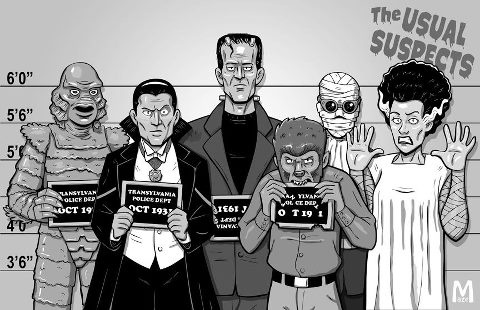
Universal-Monsters-halloween-36931352-480-310A second response calls for a good offense as the best defense. By attacking the shortcomings of others, I deflect attention away from my own. It doesn’t take much imagination, either, since virtually every religion and culture has enough dirty laundry to provide any supermarket-aisle tabloid with a supply of juicy banner headlines. But all that soiled laundry, aired in the light of day, only feeds our mistrust and paranoia, without providing any direction toward cleaning up the messes that we have made ourselves.

The only reasoned response to cultural insecurity and, as such, the most difficult, is for all of us to study and learn about our respective cultures and ideologies well enough that we immunize ourselves against the xenophobia that results from ambivalence in our convictions. When I truly understanding my own identity, my heritage, and my beliefs, when I take responsibility for my faults and begin working to correct them, only then can I move toward confidently separating attitudes that are wrongheaded from those that merely differ from my own.

“Know how to answer a heretic,” the Talmud says. You don’t necessarily have to engage him in debate, but you do have to know, for your own peace of mind, why his beliefs differ from yours. Without such knowledge, we are helpless to discern what hides behind the masks all around us, helpless to recognize the difference between dangerous fanatics and simple neighbors, between real monsters and children whose only wish is that we add a little sweetness to their lives.


 

Sue your loved ones: all’s fair in the insurance market place

embezzlement3Maybe the most disturbing factor in the bizarre story of the woman who sued her nephew for jumping into her arms is that her reason almost seems to make sense.

“From the start, this was a case was about one thing: getting medical bills paid by homeowners’ insurance,” explained Jennifer Connell’s attorneys.  Her nephew says he understands and harbors no ill feelings.

Whether the story here is family loyalty, embezzlement, or the inadequacies of our medical insurance system, the deeper issue is our collective attitude that someone else should take responsibility for everything that happens to us, which I addressed earlier this week regarding the man hit on the head by a pine cone.

Sometimes there is real guilt and should be real accountability.  Other times we’re just in the wrong place at the wrong time, or victims of a hug gone wrong.

We need to grow up and learn to tell the difference.