Home » Posts tagged 'Conflict' (Page 15)
Tag Archives: Conflict

Double Standards and the Death of Civilization
 “Don’t say what you’re thinking.”
“It doesn’t matter how you feel.”
“Honesty is not always the best policy.”
It sounds terrible, doesn’t it? And yet modern society has created an entire value system based on these axioms. It’s called political correctness.
At the same time, however, there seems to be a freakish disconnect between the cultural extremes of political correctness and libertinism. On the one hand, the list of socially unacceptable words, phrases, and ideas keeps growing longer; on the other hand, regard for verbal filtering plummets in virtual free-fall.
At first blush, we might explain this away as an obvious consequence of competing ideologies and worldviews. Certainly, the popularity of Donald Trump and Ted Cruz can be understood as a natural reaction to the vacuous rhetoric of our elected officials, and to the farcical condemnation of benign comments and legitimate opinions as “hate speech” by the chattering classes. When a prominent university attempts to censor of words like mothering, fathering, and American as “microaggressions,” the inevitable consequence will be an equal and opposite reaction from the other side of the ideological divide.
But what is truly baffling are the offenses committed by proponents of political correctness themselves.

Christopher Hitchens: Almost a Hero
 It’s remarkable how we can develop a deep fascination, sometimes to the point of fixation, toward people we despise.
This is not particularly healthy: we gain much more by studying those who are worthy of our admiration and reverence, both as models for the refinement of our own behavior and as sources of inspiration that demonstrate the heights to which human nobility can soar.
But human nature produces an incessant magnetism toward the negative, no matter how much we may know better. So I couldn’t resist clicking on Daniel Oppenheimer’s recent retrospective* on Christopher Hitchens, one of my least favorite intellectuals.
I’m glad I did.

8 Choices for Making a Happier Life
I’m a big fan of Malcolm Gladwell. His particular genius for collecting data and weaving together fresh insights has produced a wealth of practical wisdom to help us improve the quality of our lives.

But nobody’s perfect.
I recently came across Mr. Gladwell’s 2004 Ted Talk, in which he recounted the career of one Howard Moskowitz, a psychophysicist whose market research for Pepsi Cola, Vlasic Pickles, and Prego Spaghetti Sauce — beginning back in the early 70s — changed the food industry forever. It might seem obvious to us with the wisdom of hindsight but, to make a long story short, Howard Moskowitz discovered that there is no perfect pickle, no ideal type of cola, and no universal favorite recipe for spaghetti sauce.
How big a deal was this? I’ll let Mr. Gladwell explain:
Everyone else in the industry looked at what Howard had done, and they said, “Oh my God! We’ve been thinking all wrong!” And that’s when you started to get seven different kinds of vinegar, and 14 different kinds of mustard, and 71 different kinds of olive oil. And then eventually even Ragù hired Howard, and Howard did the exact same thing for Ragù that he did for Prego. And today, if you go to a really good supermarket, do you know how many Ragùs there are? 36! In six varieties: Cheese, Light, Robusto, Rich & Hearty, Old World Traditional — Extra-Chunky Garden.
All well and good. Now we can all have exactly what we like all the time, without sacrifice, without compromise, without effort.
But then Mr. Gladwell continues, moving on from tomato sauce to mustard. And it is here that Malcolm Gladwell exits the highway of reason and turns onto the backstreets of phantasmagoria.

A Short History of Mideast Violence
 Seemingly without end, political groups, government officials, and media outlets continue to blame Israel for unrest in the Mideast. At best, they lament the “cycle of violence,” suggesting that both sides are equally to blame.
With so many outlets providing platforms for misinformation, it’s no surprise how many people believe that Israel is at fault for denying the rights of the Palestinian people to live peacefully in the land that has been theirs since time immemorial.
However, as New York Senator Daniel Patrick Moynihan used to say: “You’re entitled to your own opinions, but you’re not entitled to your own facts.”
So here are the facts.
Before 1920, even the concept of a Palestinian people did not exist. Arabs living in the region considered themselves part of greater Syria, until the French and British divided the region and ended hope of a single commonwealth. Only then, in a desperate attempt to create a national identity out of whole cloth, local Arabs proclaimed themselves Palestinians and begin lobbying for a country of their own.
And they got what they wanted. The next year, Colonial Secretary Winston Churchill divided the region into what are now Jordan and Israel. The Arabs received 76% of the land. The rest was reserved as a Jewish homeland.
But even that was not enough. In 1947, the United Nations divided the remaining territory roughly in half, leaving Israel with 13% of the original Mandate. The Jews accepted the compromise. The Arabs launched a war against the Jews.
Between 540,000 and 720,000 Arabs fled Israel, encouraged by leaders who promised that they would return to their homes after the Jews had been pushed into the sea. Over 70 years later, about 5 million Arab refugees remain, many in squalid camps, unsettled by their own people because of their value as a bargaining chip to demand repatriation or restitution that Israel cannot afford to give.
All the way back in October, 1949, Egyptian Foreign Minister Muhammad Salah A-Din told the Cairo journal Al-Masri that, “In demanding the return of the Palestinian refugees, the Arabs mean their return as masters, not slaves; or, to put it quite clearly — the intention is the termination of Israel.”
You can’t make peace with people who don’t want peace. On, 11 Dec 1948, the UN passed Resolution 194, frequently invoked by Arab leaders b/c it calls for repatriation of (or compensation for) all refugees (Article 11). Every Arab country voted against the resolution, which also guarantees access to holy sites (Article 7) and calls for commitment to peace.
Of course, no one ever mentions the 860,000 Jews who fled for safety from Arab lands at the same time, resettled by Israel without ever receiving restitution from the Arab countries that expropriated their homes and property.
 We also don’t hear how, in 1949, Israel agreed to repatriate 100,000 Arabs as part of a peace negotiation; 35,000 were allowed to return, until repatriation was halted b/c of Arab refusal to make any compromises toward peace. In early 1950, the UN General Assembly established the United Nations Relief and Works Agency, with an annual budget of $54 million. Arab governments refused to cooperate. In 1959, only $7 million had been used while another $28 million lay available in a fund that was never used.
In fact, as early as 1960 King Hussein of Jordan admitted that “Arab leaders have approached the Palestine problem in an irresponsible manner… they have used the Palestine people for selfish political purposes. This is ridiculous and, I could say, even criminal.”
Khaled al-’Azm (Prime Minister of Syria 1948-49) wrote in his memoirs in 1973: “We have brought destruction upon a million Arab refugees, by calling upon them and pleading with them to leave their lands, their homes, their work and their business, and we have caused them to be barren and unemployed though each one of them had been working and qualified in a trade from which he could make a living.”
But the strategy of Arab leaders has always been to use the refugees as a pretext to reject peace in pursuit of their ultimate objective: genocide. Even after getting 87% of the mandatory territory in 1920 and 1947, they still rejected the UN partition, then tried to exterminate Israeli Jews in 1947, 1967, 1973, and have continued terror attacks until today.
By rejecting peace and inciting bloody uprisings, Arab leaders have condemned their own people to lives of poverty and violence. For years, families of suicide murderers were paid tens of thousands of dollars to encourage their “martyrdom.” Murders of Jews are celebrated and their perpetrators turned into heroes by naming streets and schools after them. Yasir Arafat, founder of the Palestinian Liberation Organization (which was established in 1964, three years before Israel had control of the West Bank region, Gaza, or the Golan Heights), embezzled billions of dollars that could have helped his own people.
There are many Palestinians who truly want peace, but any suspected of disloyalty to the power structure and the status quo are executed as sympathizers or collaborators, or else have their families threatened if they don’t “prove” themselves. And Palestinian children grow up in schools that teach hatred of and victimization by Israel, attend paramilitary camps that train them to kill Jews, and learn that the Holocaust is a myth fabricated by Jewish sympathizers in the Western World.
But facts don’t matter. Instead, again and again, Israel is smeared with the same slanderous refrain: occupation, oppression, expansion, apartheid. It doesn’t matter that Israeli Arabs enjoy greater prosperity, literacy, and life expectancy than the Arabs in the surrounding countries. Not to mention freedom. Just as it doesn’t matter that Israeli Arabs have been represented in every walk of life, including an Arab captain of the Tel Aviv football team, an Arab deputy speaker of Knesset, an Arab Supreme court justice, and an Arab Miss Israel.
 It also doesn’t matter that all the way back in 2000, Yasir Arafat refused to accept Israeli Prime Minister Ehud Barak’s offer to return 94% of the West Bank to the PLO.
It doesn’t matter that Israel withdrew from Gaza in 2005, after which Gazans destroyed the infrastructure of greenhouses left behind by the Israelis that could have fed them.
It doesn’t matter that Hamas leaders used their new autonomy to launch missiles against Israeli civilians, while using their own people as human shields in order to win over public opinion. It doesn’t matter that Hamas embezzled millions in humanitarian aid to build sophisticated terror tunnels under the border to attack Israelis.
It also doesn’t matter that the IDF goes to lengths no other country in the world would ever consider to minimize the collateral damage to Arab civilians, dropping leaflets warning of impending attacks and placing its own soldiers in far greater danger than the rules of warfare require or that make sense from a military point of view.
Instead, the propaganda campaign against Israel goes on, even when the casualties are Palestinians themselves. Like when a Palestinian girl stabs a Palestinian man whom she mistakenly believed to be Israeli, the headlines scream Palestinian teenager killed by Israeli forces. And like the 900 workers losing their jobs because the BDS zealots managed to coerce Sodastream to relocate over the green line; it doesn’t matter if a few hundred more martyrs are reduced to poverty if the ideologues can score a PR victory against Israel.
The European community and the Obama administration have ignored these facts and evidence to embrace political correctness and moral equivalence, thereby enabling Palestinian violence against Israeli Jews and prolonging the suffering of Jews and Arabs alike.
No one could say it more clearly or simply than Israeli Prime Minister Binyamin Netanyahu: “If the Arabs put down their weapons today, there would be no more violence. If the Jews put down their weapons today, there would be no more Israel.”
Expanded from an article originally published by Jewish World Review

Mistaking Identity
 Dennis Prager is at it again, this time with the simultaneously radical and reactionary, bigoted, sociopathic, and really-not-very-nice assertion that transgender people should take names and employ pronouns appropriate to their chosen identity.
Quick! Inside the nearest shelter… the sky is falling. Civil society may never recover.
Okay, yes, I am being sarcastic. Guilty as charged. But sometimes the logical and moral convolutions the politically-correct allow for no outlet other than simple mockery.
But I apologize if I hurt anyone’s feelings. I know it’s terribly bad form these days to speak the truth.
However, it should come as no surprise that the moral boundaries of civil society grow ever blurrier, in this case by design. These winds were already blowing with gale force when I published the following essay back in 2011:
When their third child, Storm, was born, Kathy Witterick and David Stocker announced the birth of their new baby with the following email:
“We’ve decided not to share Storm’s sex for now — a tribute to freedom and choice in place of limitation, a stand up to what the world could become in Storm’s lifetime (a more progressive place? …).”
Needless to say, friends and family alike have trouble understanding Witterick and Stocker’s unconventional approach to child-raising. With stereotyping, bullying, and social stigma inevitable parts of growing up, it’s easy to argue that manufacturing an additional obstacle to healthy social development is hardly in the child’s own best interest.
“Everyone keeps asking us, ‘When will this end?'” says Witterick. “And we always turn the question back. Yeah, when will this end? When will we live in a world where people can make choices to be whoever they are?”
FREEDOM WITHOUT LIMITS
A single family hardly constitutes a trend. But consider the Egalia preschool in Stockholm, Sweden, where staff avoid such culturally loaded words as “him” and “her,” addressing the children as “friends” rather than “boys and girls.” According to the AP, “breaking down gender roles is a core mission in [Sweden’s] national curriculum,” and many preschools have hired “gender pedagogues” to devisestrategies for eliminating “stereotypes.”
 Could they be right? Is sexual identity nothing more than arbitrary social programming? By eliminating every vestige of guidance from a child’s environment might parents actually help him learn to make better choices? Will indoctrinating a child with the conviction that every imaginable alternative is equally viable produce a canny, confident, and even-keeled adult?
Well, would it make travel easier if we uprooted every street sign and tore down every traffic signal? Would it make navigation easier if we burned every map and disabled every GPS?
The hazards of unrestricted freedom often go overlooked in a society that values personal autonomy above all else. But the formula for resolving the tension between individual expression and social boundaries was articulated by King Solomon, the wisest of all men, nearly three thousand years ago.
Hear, my son, the moral guidance of your father,
and do not forsake the teaching of your mother (Proverbs 1:8).
Giving voice to the self-evident truth that men are men and women are women, Solomon alludes to the distinct manner in which a father and a mother each makes a unique contribution to the psychological and ethical development of their child. From the father comes instruction— formal guidance in the ways of moral values and discipline. How to know right from wrong, and how to choose good over evil — this is the kind of wisdom most effectively communicated through fatherly counsel and direction.
Complementing the father’s instruction are the lessons absorbed from the mother, who plays the primary role in creating the atmosphere of personal responsibility and spiritual commitment that should permeate a home. It is mainly through the intangible, unquantifiable influence of the mother that a child develops moral sensitivity. Neither father nor mother can successfully assume the role of the other, for our distinct psycho-spiritual complexions are part of the design according to which the universe was formed.
Parents who refuse to assert moral principles, albeit in the name of tolerance and progressivism, succeed only in making their home an environment of intellectual anarchy that will inevitably lead to confusion and dysfunction later in life.
CHILD-RAISING, TAILOR-MADE
Train a youth according to his way;
even when he grows old he will not depart from it (Ibid. 22:6).
Often cited, correctly, as the source for individualizing education based upon the singular needs of every child, this proverb contains another element often overlooked: the word “youth” — na’ar, in Hebrew — implies immaturity. Truth be told, the majority of us suffer from a sophomoric certitude in the infallibility of our own wisdom. And children are the most susceptible of all to such delusions.
Wanting desperately to believe in their own independence, children seize hold of any excuse, no matter how irrational, to invalidate the wisdom of their parents. Left to his own devices, a youth will steer confidently into the heart of the nearest storm, delighted to be free from the steady guidance of the parent who could have saved him from catastrophe.
Like old wine and fine cuisine, genuine wisdom is an acquired taste, and the immature mind will reject its lessons as surely as the untrained palate will disdain the delicacies of a Cordon Bleu in favor of peasant’s fare smothered in salt and ketchup. But we do our children no favor by making it easier for them to marching confidently over the edge of the nearest precipice. Gentle instruction administered with care and consistency will lay the foundations of moral discernment as a child grows into adulthood.
A WORLD WITHOUT BORDERS
In his famous legal discourse regarding character development, Maimonides writes that “people are influenced by the society in which they live” (Hilchos Dayos 6:1). Among the many dangers of the modern world, none may be as insidious as the attack upon all natural and moral boundaries. Electric lighting pushes away the darkness of night, central air conditioning and heating insulate us from the changing of the seasons, cars and planes shrink the distance between faraway places, and electronic communication eliminates all delay in correspondence and information.
No one is suggesting that we live like the Amish and eschew modern technology. But these inventions are not as innocuous as we wish to believe: in the same way that physical boundaries have been breached, so too have moral boundaries become increasingly blurred and the path of moral conduct ever more difficult to find.
 Respect for traditional family structure continues to erode. The personal conduct of political leaders raises less concern than the carelessness that leads to getting caught. Violent criminals are cast as victims while defenders of life and limb are vilified as exploiters and oppressors. And the role of human sexuality in mental health and social stability is ever more profoundly misunderstood. Political correctness and moral equivalence have so muddied conventional wisdom that young and old alike often fear censure from their peers for daring to judge even the most abhorrent behaviors.
Yes, children need to learn to make their own choices, and today’s helicopter parents who micromanage every aspect of their children’s lives are more likely to produce crippled than capable adults. Nevertheless, we dare not overcompensate by throwing our children into the stormy waters of amorality and expecting them to swim. As Solomon has said, it is only through the guidance and teaching of moral values that we will keep our children afloat, as well as enabling them to navigate their way to safe harbor.
Originally published by Jewish World Review

Heading over the cliff
 Not following the usual conservative line, Bernie Goldberg articulates the train-wreck of Donald Trump, and Glenn Beck explains how we got here.

Free Judea Under Shimon Maccabee
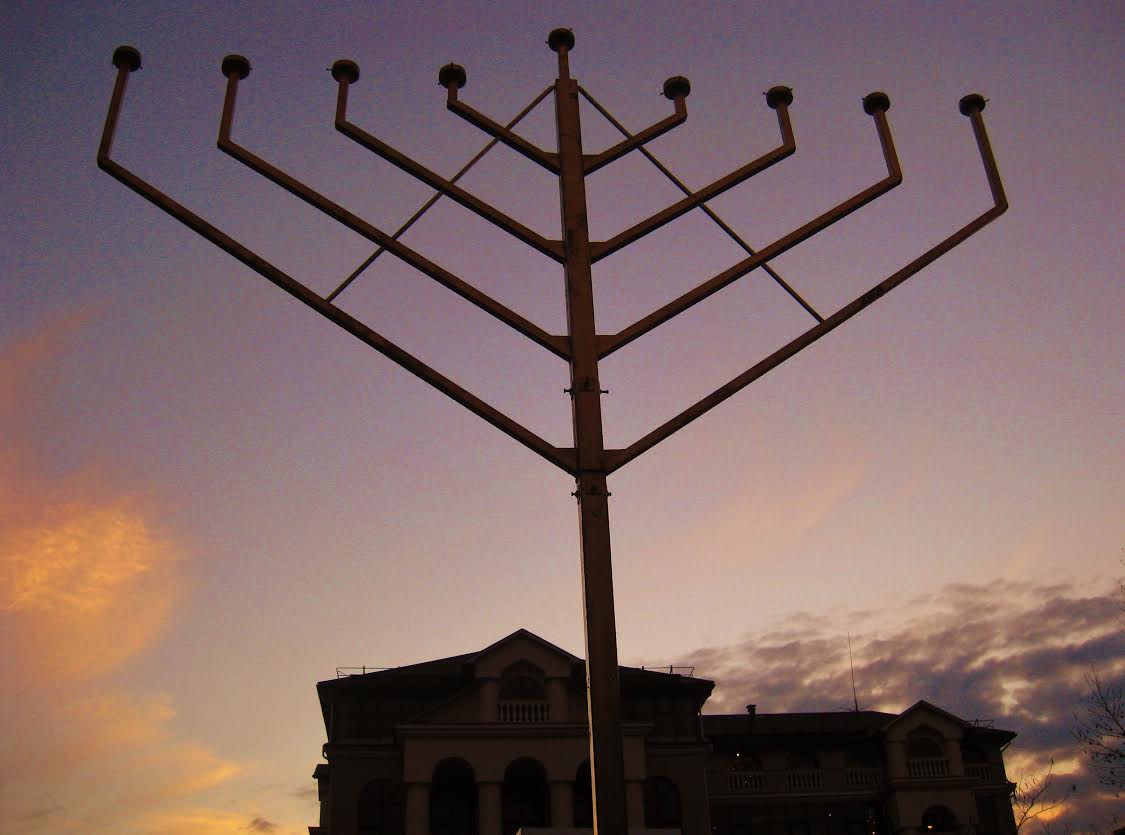 Virtually everyone has learned about the miracle of Chanukah and the rededication of the Temple in Jerusalem. But the tumultuous 22 years between the Hasmonean victory over the Seleucid Greek army and the establishment of an autonomous Jewish state are not nearly so well known.
In 165 BCE, the same year that the Maccabees recaptured the Temple, Demetrius I succeeded Antiochus IV as ruler of Syria. Immediately, the new monarch sought to consolidate his forces with the soldiers still garrisoned in Jerusalem and with the Hellenist Jews still determined to resist the authority of a Torah government.
The early success of the Maccabees evaporated before the renewed Syrian onslaught. Eleazar, eldest brother of Judah Maccabee, was the first Hasmonean casualty of war, crushed beneath the elephant he believed was carrying the king as he drove his sword upward into its belly during the battle of Beis Zecharyah. Only a year later, after defeating an army ten times greater his own and slaying the Seleucid general Nikanor, Judah Maccabee himself fell in battle as he attempted to defend Jerusalem with only 800 men. Both the capital and the Temple were lost, and Demetrius appointed Bacchides, a particularly cruel Seleucid officer, as governor over Judea.
CRISIS AND RECOVERY
After Judah’s death, his brother Jonathan assumed command of the Jewish resistance. Vastly outnumbered and in retreat, Jonathan prepared his army to flee across the Jordan river, where he hoped to reorganize his forces. Before he had completed the operation, however, enemy soldiers discovered and surrounded his hideout. Jonathan barely escaped with his life, while his brother Yochanon was captured and killed.
With his forces too weak to mount a conventional assault, Jonathan returned to the guerrilla tactics of the early Hasmonean revolt. Gradually, he rebuilt his strength until his own army attained parity with the Seleucid forces. Recognizing that Bacchides had lost the will to fight, Jonathan took advantage of the stalemate and dispatched messengers with offers of peace. Bacchides accepted, and Jonathan established himself north of Jerusalem in the village of Michmash, the early home of Saul, first King of Israel.
 Five years later, an attempted coup against Demetrius back in Syria provided Jonathan with the opportunity for which he had long been hoping. Preoccupied with his own fight for survival, Demetrius posed no threat at all as Jonathan advanced to seize Jerusalem and began refortifying the city’s defenses. Jonathan continued to monopolize on the fractious Seleucid government, playing Demetrius and his rival, Alexander Balas, one against the other. In short order, Jonathan secured his position in Jerusalem and reclaimed his hereditary position as High Priest in the Holy Temple. As the political situation in Syria deteriorated, Jonathan continued to expand his control over Judea.
TREACHERY AND REPRISAL
But Jonathan’s successes in diplomacy ultimately led him too far. When Tryphon, a new king in Syria, marched against Jerusalem, he found Jonathan waiting for him at the head of a much larger army of 40,000 men. Recognizing that he had no hope of victory, Tryphon convinced Jonathan to meet with him in Akko, where he captured Jonathan and subsequently murdered him.
After 17 years of Jonathan’s leadership, his brother Shimon, the last of the five Maccabean brothers, took his place as leader over Judea. In response to Tryphon’s treachery, Shimon threw his support to Tryphon’s rival, Demetrius II. In appreciation, on the 27th day of Iyar, 3619 (142 BCE), Demetrius formally exempted the Jews from their annual tribute and declared Judea fully independent, recognizing Shimon as its sovereign. Twenty-two years after the miracle of Chanukah, the Jews finally gained political autonomy for the first time since the era of the First Temple.
In the course of his rule, Shimon secured the boundaries of his tiny kingdom, repulsed an attack by Antiochus VII of Syria, and led his people into one of the greatest periods of prosperity of the Second Temple era.
Shimon’s own end was less glorious. He was assassinated by his son-in-law, Ptolemy, in the seventh year of his reign. Ptolemy’s ambitions profited him nothing, however, since Shimon’s son Yochanon drove him out of the kingdom. But Ptolemy did succeed in bringing the last of the sons of Mattisyahu to a violent death.
For the family who restored glory to the Jewish people, drove out the Selucid oppressors, resisted the corrosive influence of Hellenism, and returned the divine service to the Temple in Jerusalem, we hardly would expect such an inglorious end. We would also not expect such a mixed legacy: Shimon’s son and grandson both allied themselves with the heretical Sadducees; his great-grandsons began a civil war that resulted in the beginning of Roman rule over Israel and produced the bloody reign of Herod.
Where did the Hasmoneans go wrong?
THE DIVINE RIGHT OF KINGSHIP
Before his death, the Jewish patriarch Jacob prophesied that, “The scepter shall never depart from Judah,” meaning that no tribe other than Judah would ever rule legitimately over the Jewish people (Genesis 49:10). The reputation of Judah Maccabee as a brilliant general and an inspired leader remains unimpeachable. But from the moment he drove the Greeks out of Jerusalem, Jewish law required him to petition the Sanhedrin straight away for the appointment of a permanent leader from the dynasty of David. By retaining national leadership for himself and establishing a precedent followed by his brothers and their descendants, Judah sentenced the Hasmonean line to a destiny of one tragedy after another, until nothing remained but the memory of former greatness.
 There is another, deeper reason for the inevitable downfall of the Hasmonean dynasty. As members of the priestly kohanim,the Hasmonean family had their mission within the Jewish nation defined by the Torah as purely spiritual. Unlike the large majority of Jews who must strive to balance the pursuit of spiritual ideals with involvement in the material world, kohanim have no occupation other than Divine service and no portion in the Land of Israel other than the Temple itself.
Conversely, the kings, whose royal line descends from David himself, live a life of opulence and luxury, through which they endeavor to achieve an absolute synthesis of spirituality and materialism.
By shouldering the mantle of kingship, perhaps not in name but undeniably in practice, the
Hasmoneans encumbered themselves with the burden of kings — to harmonize the physical and the spiritual — obligating themselves in a service diametrically opposed to the austerity demanded by their intrinsic nature as priests.
Unable to succeed simultaneously as kohanim and as kings, the Hasmoneans condemned themselves to failure and, ultimately, self-destruction when they did not return the leadership of the Jewish nation to its rightful heirs, the descendants of the dynasty of David, the true kings of Israel.

The Candles and the Tree
 It was the December after my ninth birthday. A menorah rested on the bookshelf over the television console. Across the room, beside the fireplace, the lights of a tree twinkled red and green and blue. I was standing next to my mother as she held a candle in her hand. My father wasn’t there. He wasn’t into these things.
My mother lit the lone candle, ushering in the first night of Chanukah. She didn’t recite the blessing. She didn’t know it. I remember watching the wick catch, watching the flame grow bright, and asking myself, “Now what happens?”
“We light the candles for eight nights because the oil burned for eight days,” my mother had told me. What oil? I wondered. But something about her brief explanation stopped me before I asked. Maybe she didn’t know, either.
A year or two later, at my suggestion, the menorah had disappeared and only the tree remained. Waiting for the morning of December 25th when all the presents could be opened at once seemed far more dramatic than diluting the experience over a week, especially when those wrapped boxes mysteriously appeared under the tree day after day over the course of almost a whole month. Chanukah just couldn’t compete.
Only two decades later did I come to appreciate how much my own experience had truly been a Chanukah story.
SEEKING SPIRITUALITY FROM A TO ZEN
When I went away to college, I left behind the tree with the menorah. December 25th had become as irrelevant as Santa Claus, and I preferred an envelope with a check to wrapped presents that would most likely be returned for credit. I eagerly adopted the ambivalent agnosticism of so many of my peers, celebrating dormitory weekends by emptying six-packs rather than observing commercialized annual holidays with empty rituals.
Sometime toward the end of my university career I found myself attracted to Zen. Not in the traditional style, with its practices of discipline and self-mastery, but the pop-spiritual variety learned from Zen and the Art of Motorcycle Maintenance and similar modern scriptures.
Aligning myself with the spiritual energy of the universe became my goal. I wanted to choose good over evil because, ultimately, that brought good karma and tranquility. Surely, this was the road to Truth.
But we all know which road is paved with good intentions. As sincere as I may have been in my aspiration to travel the road to Truth, I found with annoying frequency that when my desire to do good clashed with my desire to indulge amoral self-interest, good threw in the towel at least two times out of three. Forced to take stock of myself, I had to concede that, for all its high-sounding ideals, a spiritual discipline that produced no moral discipline wasn’t worth its mantras.
TOO LATE FOR THE HIPPIES
 I hadn’t developed much discipline in my academic life, either. Oh, my grades were good enough, but four years studying English literature and writing had left me with neither gainful employment nor vocational direction. It was 1983, a decade late to join the hippies or beatniks, but that didn’t stop me from swinging a backpack over my shoulders and hitchhiking across the country. If I hadn’t found Truth in the ivory tower, perhaps I might find it in the heart of America.
Sixth months crisscrossing the country brought me no closer to Truth, but it did whet my wanderlust, and I soon boarded a flight across the Atlantic to continue my journey through Europe, after which Africa, Asia, and Australia lay upon my horizon.
Half a year into my journey, Europe ended with a short hop across the Mediterranean to Israel, where I sought to have a classical Jewish experience — volunteering to pick oranges on a kibbutz. But it was December, with little agricultural work to be done; moreover, the dollar was strong, resulting in some 9 million American tourists in Europe, many of them draining south into Israel as winter weather set in. I found the kibbutz placement office blocked by a line of 20-somethings camped out like they were waiting for tickets to a Rolling Stones concert, oblivious to the signs screaming, NO PLACEMENTS UNTIL JANUARY.
Desperate for a break from the stresses of travel on a shoestring, I cast about for some way of imposing routine upon my life before departing for Africa and, somehow, found myself invited to attend yeshiva.
Yeshiva? The word was unfamiliar, but the offer of a bed, hot meals, and a daily schedule of classes proved irresistible. It was two weeks before Chanukah, and I would finally learn about the secrets of the menorah and the miracle of the oil.
THE CLASH OF CULTURES
Although a period of peaceful coexistence followed Alexander the Great’s occupation of the Land of Israel, it didn’t take long after Alexander’s death before the ruling governments began to feel first discomfited and later threatened by their Jewish subjects and the Judaism they practiced. Greek philosophy recognized man as the pinnacle of creation, perfect in his accomplishments, answerable to no one but himself. Greek mythology embraced a pantheon of gods characterized by caprice and selfishness, by lust and vengeance, thereby sanctioning similar behavior among men.
And even though it was no longer the Greeks who controlled Israel, the Ptolemys of Egypt and later the Seleucids of Syria had thoroughly absorbed the cultural values of the empire that had briefly ruled over them. How offended they must have been by a Jewish society devoted to self-perfection through submission to a divine code of moral conduct.
When they could no longer tolerate the Jewish threat to their ideals, the Syrian-Greeks contrived to destroy Jewish ideology. Whereas their predecessors, Babylon and Persia, had turned to violent oppression, the cultural successors of Alexander’s empire posed a much more subtle danger: in place of physical violence or outright prohibition of Torah observance, Antiochus IV of Syria banned only three practices: the Sabbath, bris milah (circumcision), and Rosh Chodesh, the sanctification of the new month.
The Sabbath testifies to the divine nature of the physical universe: without this weekly reminder, we easily loose touch with and ultimately forget our relationship with the Creator of all. Bris milah testifies to the divinity of life: it is the sign of our higher calling, reminding us that we can control our physical impulses rather than allowing them to control us, that each of us is a work-in-progress striving toward self-completion and self-perfection. Rosh Chodesh testifies to the divinity of time: it is the ceremony that fixes the calendar and imbues the Jewish holidays with an intrinsic holiness. Without Rosh Chodesh, placement of the holidays would become arbitrary, leeching all meaning from them the way American Federal holidays have lost all substance in the eyes of most Americans.
 The Jews refused to submit, and in the end the Syrian-Greeks resorted to more draconian decrees and eventually violent repression. But their plan had been sound: had they succeeded in stopping our adherence to those three basic precepts, they would have succeeded also in reducing Torah observance to an empty ritual, one that might have continued on for generations, but would have quickly become bereft of all meaning and spiritual significance. For this reason, the observance of Chanukah always includes one Sabbath, always passes through Rosh Chodesh, and is eight days long as a remembrance of the bris, the covenant between the Jew and his Creator.
Chanukah celebrates victory not only over our Grecian oppressors, but also over the Hellenists, those Jews who promoted a new syncretism of Judaism, wherein they hoped to intermingle Jewish practice with that which they found most attractive in Greek culture. The Maccabees recognized the absolute incompatibility between Greek ideology and Jewish philosophy, and they foresaw that ultimately one would have to prevail over the other. Without staunch defenders fighting for Jewish identity, the torch of Judaism would inevitably be extinguished and only the tree of foreign culture would remain.
ILLUMINATING THE GENERATIONS
Despite the victory of the Maccabees, the threat from Greece did not disappear. To this day it persists in its cultural assault against the values of Jewish tradition. The nine year old boy in America, or Britain, or even in Israel, who looks at the Chanukah candles and wonders what they mean, who sees no difference between the flames of the menorah and the twinkling lights of the tree, testifies to the victory of the Greeks.
But not every child has forgotten the lights. The rekindling of the menorah each year reminds us that the torch of Jewish tradition continues to illuminate generation after generation and dispel the darkness of apathy and assimilation. However much the ideological descendants of the Greeks strive to extinguish the lights, the eternal flame that burns within the soul of the Jewish people still shines on and on.
In my own observance of Chanukah, I rejoice that my own children have grown up not only with the lights of the menorah, but with a growing understanding of what they mean. I’m grateful that I’ve been able to give them what my parents were unable to give me: self-knowledge, the greatest weapon against cultural extinction.
Through the generations and across the world, the Jewish people have successfully adapted to living as guests among disparate societies, but only by retaining a strong sense of our history, the values of our heritage, and a familiarity with the culture that keeps our sense of identity alive and vibrant. Compromise these, and the Jew, together with his Judaism, will surely vanish. Preserve them, and we guarantee that the victory of the Hasmoneans over the Greeks will be renewed in every generation as a victory of the Jewish people over assimilation.
Originally published in the St. Louis Jewish Light and Aish.com.

Creating a Culture of Violence
 I wish there was no reason to repost this essay. But with “random” violence becoming a cultural norm, we can’t run away from the root causes of radicalization, whether Muslim or otherwise. President Obama may not be totally off the mark in his belief that the West created this problem — but our contribution is not what he thinks, and his policies are only adding fuel to the fire.
Read the whole article here:
http://yonasongoldson.com/2015/05/18/remembering-the-boston-bombing/

Spiritual Gridlock

With congress increasing paralyzed by gridlock and our president usurping monarchic power by executive fiat, it seems appropriate to revisit this essay from 2008, originally published by Jewish World Review and adapted in my book Proverbial Beauty.
New York Mayor Michael Bloomberg wants to end traffic congestion in Manhattan. However, as sympathetic as New Yorkers may be to Mr. Bloomberg’s vision, his proposed method is most likely to produce madness.
To curb the number of vehicles entering downtown (which has grown annually by an average of 8000 per day since the 1920s, according to U. S. News and World Report), the proposed law would encourage (or coerce) commuters to rely on public transportation by imposing a daytime tax of $8 per car and $21 per truck traveling onto the island. City officials believe that this “congestion pricing” would reduce traffic by as much as 12 ½ percent.
Whether or not commuters can be persuaded to practice even occasional abstinence in their love affairs with their cars makes for interesting speculation. However, the concept itself is sound. In fact, it has been used for some time on a much larger scale, implemented throughout every borough of the world by the Mayor of the Universe.
EXPRESS LANES TO FREEDOM
The most the dramatic experiment in mass transit came over 3300 years ago when the Almighty split the Sea of Reeds, allowing the Jews to pass through and escape their Egyptian pursuers. In contrast to Cecil B. DeMille’s famous recreation, the sages teach that the sea opened up into twelve distinct passageways, one for each of the Tribes of Israel. As they passed through, the water separating the passages turned clear like glass, so that each tribe could see its fellow tribesmen traveling alongside them.
The design of this miracle teaches three lessons. First, the division of the sea into separate passageways demonstrates that there is more than one way to have a relationship with G-d. The Almighty does not want us to be automatons or clones, sheepishly following whoever is in front of us. Each individual is unique, and his divine service should be tailored to the nature of his singular soul.
Second, the water turning clear like glass reveals the lengths to which we must go to master the human ego. Had the walls of each passageway remained opaque, each tribe would have thought that it alone had discovered the correct avenue to reach the other side, and that it alone was traveling in the right direction to serve G-d. When they saw the other tribes traveling along side them, the Jews of each tribe recognized that they were not the only ones who had discerned the proper path.
 The final lesson can be learned from recognizing that there were a limited number of paths. Anyone who did not follow one of the twelve passageways was, literally and figuratively, under water. Every spiritual movement does not become legitimate simply because it declares itself so, no matter how sincere its leaders or followers may be. Every self-proclaimed “holy man” is not genuine simply because he hangs out his shingle or attracts parishioners. Natural laws govern the operation of the spiritual universe just as they govern the workings of the physical world. One cannot render those rules null and void simply by wishing them out of existence or declaring them defunct, any more than congress can annul the force of gravity.
THE PRICE OF PRIDE
There is yet one more insight to be gained from the illustration of the Jews’ passage through the sea, one that is echoed by the New York mayor’s effort to cure his city’s traffic woes.
Consider the car as an allegory for personal autonomy. In a very real sense, we are all control freaks. We want to control our destiny, to chart our own heading, to have our hands on the wheel. Often the greatest demonstration of inner strength comes through humbling ourselves, giving up control and placing our fate in the hands of another. Often this is a concession we are either unwilling or unable to make.
But do we consider the cost? For car owners, the cost is rolled up in the price of the vehicle itself, of gas, insurance, repairs, parking fees, tolls and, perhaps, congestion tax. Public transportation is far cheaper and often more efficient. But still we refuse to relinquish control.
In business, the most efficient workers are those who work as part of a team, who coordinate their efforts with the efforts of others and trust their coworkers to get their own jobs done. Those who try to do everything themselves, or to micromanage others at their work, create confusion, inefficiency, and frustration.
Our relationships, marriages, and families function best when the individuals within them tend to their own responsibilities and allow others to look after theirs. Hovering, ordering, or criticizing before a spouse or child has even had a chance to complete an assigned task breeds resentment and destroys trust.
Spirituality is much the same. We like to think that we are in control of defining our own relationship with the Almighty. We strike out in whatever direction seems right to us, often without any roadmap or compass to guide us in distinguishing good from bad, right from wrong, moral from immoral. We believe that intuition alone will get us to our goal, when we have only the faintest notion of where we are trying to get.
Worst of all, there is available transportation ready to take us to our final destination in the most efficient way. By keeping G-d’s laws and following in His ways, we guarantee ourselves the smoothest possible journey through this world until we arrive at the World to Come.
THE FAST TRACK
 But still many of us won’t give up control. So the Almighty levies His “taxes,” creating obstacles that make the paths of personal autonomy increasingly difficult. We feel stifled in our jobs, unhappy with our families, and discontented with the direction of our lives. So we seek out “detours,” looking for fulfillment in the least likely places: alcohol, drugs, gambling, or extramarital affairs. We think change will make us feel better, but we usually find ourselves worse off than before.
Rabbi Elyahu Dessler explains that we find ourselves in emotional or spiritual darkness at those times when we have cut ourselves off from the source of spirituality in the world. But when we “look into the darkness,” when we recognize that we have created the darkness for ourselves by distancing ourselves from the ways of the Creator, then and only then will we begin to find our way back to the light. By giving up control over our destiny, we regain mastery over our soul.
Whether taxing drivers will solve New York’s traffic problems remains a mystery. But it is in our hands to solve the mysteries of the spirit by following the well-trodden path of the generations that have gone before us. By retracing their steps, we can have confidence that we are not solely dependent upon our own devices to chart our way out of the darkness of confusion, but that we have a clearly marked path to follow toward the light of true meaning.
 Yonason Goldson