Home » Posts tagged 'Culture' (Page 38)
Tag Archives: Culture
Sanity vs. Compassion — how to choose?
 Would you accept an invitation to the Mind and Life Institute’s International Symposium for Contemplative Studies? Or does it all sound too flaky?
It’s hard not to sound pretentious when trying to be substantive in a superficial world. I might easily have dismissed the headline — Creating a Caring Society — as so much new-age twaddle… but if I had I’d have been guilty of the same superficiality that I frequently decry.
Citing Tania Singer, a social neuroscientist from The Max Planck Institute, the article offers an intriguing distinction between empathy and compassion. The first is a mere sharing of feelings; the second is an impulse to turn feelings into action. Sure, empathy is a good start. But feeling another’s pain doesn’t help feed the poor, shelter the homeless, enlighten the ignorant, or comfort the bereaved.
In fact, failure to take action may actually cause distress and suffering to the empathizer, who feels frustrated and inadequate for having provided no relief to the one in need.
The more pervasive problem, however, is our increased detachment from the plight of others so that we don’t feel at all. No surprise there… if we responded as we should to every news story of poverty, illness, and violence, we’d all be on a perpetual Valium drip. So instead we plug into our electronic kaleidoscopes and tune out the real world.
We can only preserve our sanity by deadening ourselves to the flood of human suffering that washes over us day and night. But to ignore the call of compassion leaves us less than human.
As with so many things, the answer lies somewhere in the middle. Feel pain, but not too much pain. Respond to the pain of others with concrete action. No, it’s not easy. But it’s the only avenue we have for restoring an emotionally and morally healthy society.
Bad Hair Day at CSI
 Since 2012, the FBI has been reviewing some 2600 convictions from the ’80s and ’90s that depended on hair analysis. With 268 cases reviewed so far, more than 95% have been called into question, according to NewScientist.
This doesn’t mean that science is unreliable. Rather, it reinforces the well-known computer adage of GIGO — garbage in, garbage out. In other words, technology is only as good as the people using it.
So when it comes to understanding the origins of the universe, the evolution of man, the nature of human psychology, or the changing climate patterns of our planet, perhaps a bit more humility is in order before we jump to conclusions that new discoveries might force us to reverse tomorrow or the next day.
Our world is a complicated place. Instead of insisting that we have everything figured out, let’s watch the sun rise and listen to the rain fall while we enjoy the mystery of it all.
The New Polarization
 A college student who rarely attended classes and turned in assignments poorly done or not at all, emailed his professor after receiving his final grade to ask if there was any way he could raise his grade — an F earned with a 25% average — to a C. Even grade inflation couldn’t help this hapless soul.
But hope springs eternal, and wishful thinking has become so pervasive that it has a new name: magical thinking, as if wishing just isn’t enough anymore.
It’s everywhere. Government programs with no revenue to pay for them. Students acquiring massive debt from loans to procure degrees in art history, classical philosophy or — no joke — viking studies. State sponsored alternative energy schemes built on nothing but high-minded intentions. School boards hiring puppet administrators and then firing them when student performance crashes.
On the one hand, we indulge in the most irrational flights of fancy with no concern for the consequences. On the other, we resist thinking out of the box by denying ourselves the opportunity to engage people with opposing viewpoints in civil discourse.
Is this the new face of polarization? Not just between groups, but within our own minds?
Instead, let’s turn it around: challenge yourself to seek out new viewpoints and strategies, not to escape from reality but to deal with it and succeed.
Dangerous Freedom
 With the holiday of Passover behind us, the dangers of freedom become more threatening than ever.
Freedom is a privilege, not an inheritance. Freedom is an obligation, not a right. Freedom calls us to duty, not to indulgence.
And the illusion of freedom may be the cruelest tyrant of all, seducing us into accepting the slavery of ego, impulse, and comfort.
Every day we should ask ourselves: are we fighting to deserve and to preserve the freedom that our fathers fought so hard for us to have?
Speak your mind… or not
 How much damage is caused talking about other people? And for what? Usually to make ourselves feel superior at the expense of others.
And what if it’s true? So what if it is? If there’s no benefit, why say it?
How much time do we spend talking about the obvious or the irrelevant? The weather? The economy? Last night’s episode of Letterman?
As an icebreaker, small talk serves a purpose. But if it becomes a staple, if it leads nowhere except the next inanity, wouldn’t we be better off with silence?
Of course, that would leave us alone with our own thoughts, and that can be a pretty scary place to be.
Keeping Trust
 Distance yourself from falsehood. – Exodus 23:7
We all like to think of ourselves as honest. But are we?
Do we rationalize white lies? Do we fudge our taxes? Do we return to the counter when we’re undercharged or when we get too much change? Do we make hasty promises that we forget to keep? Do we exaggerate? Do we embellish? Do we state as fact when in fact we aren’t so sure?
Do we lie outright when we’re caught in a compromising position?
It’s easy to justify “little” lies, or even big ones under pressure. How often are we lied to by our politicians — increasingly without shame or consequence? If they can do it, why shouldn’t we?
It comes down to trust. We want to be trusted. And we want to be able to trust others. So it’s not enough not to lie. Distance yourself from falsehood — whether a false word or a false thing or a false friend.
Not only do we become known by the company we keep; we become the company we keep. And once we lose our sensitivity to falsehood, it’s a near-impossible struggle to get it back.
The Hazards of Headline News
 Here’s an insidious little headline: Money, Not Marriage, Makes Parents Better
Family structure, family meals, limiting television, extracurriculars. No worries. None of it makes much of a difference. Your child’s success or failure in life will have more to do with how much money you have. If it’s in LiveScience, it must be true. No?
Thanks to the U.S. Census Bureau for using our tax dollars to produce such a sinister study. Maybe their next project will offer similarly insightful results. How about something like this: Wings, Not Landing Gear, Make Air Travel Safer.
Well, sure, up to a point. But what does one really have to do with the other?
Read the whole post here.
Higher Education?
 On March 9, the Supreme Court refused to hear an appeal by the University of Iowa College of Law challenging Teresa Wagner’s successful lawsuit claiming political discrimination for her conservative views.
The decision comes a year after a more dramatic victory by Mike Adams, a conservative sociology professor who won a similar suit. Professor Adams was awarded a promotion, a raise, $50,000 in back pay and $710,000 in legal fees from the University of North Carolina-Wilmington.
Underlying both stories is the more serious concern that the culture of ideological narrow-mindedness and bullying has transformed college campuses around the nation from centers of higher thinking into indoctrination centers for political and philosophical uniformity.
 And it’s not just universities. My Google search for this story turned up only two headlines, one from the conservative Washington Times and the other from the local Iowa Press Citizen. The print media, it seems, has no more interest in open discussion and debate over opposing viewpoints than does academia. Better to man the battlements and defend the ivory towers from that most dangerous of all enemy attackers — rational thinking and reasoned argument.
The same principle holds true in business, in education, in religion, and in every arena of social discourse. If we can’t articulate the position of our ideological opponents, we can’t refute their arguments and, more important, we can’t fully understand our own.
For a more thorough discussion regarding the evils of groupthink, please see my article here.
No Direction
 “You just could not make this up,” tweeted Alan Price of the British employment law firm Peninsula.
Of course, I couldn’t have made it up at all, since I’d never heard of Zayn Malik or the boyband One Direction until this morning. That’s when I learned about the aftermath of Mr. Malik’s change of direction in headline news.
According to the Telegraph, Peninsula received 480 calls from employers asking how to respond to workers requesting compassionate leave so they can grieve over the music idol’s decision to go rogue — and that was just between Wednesday and Friday morning.
One shudders to think how these workers will react when real tragedy enters their lives. Or maybe they’re so removed from reality that the foibles of the entertainment industry are the only events in which they can find any relevance at all.
But that’s what happens in a world without direction.
The Illusion of Knowledge
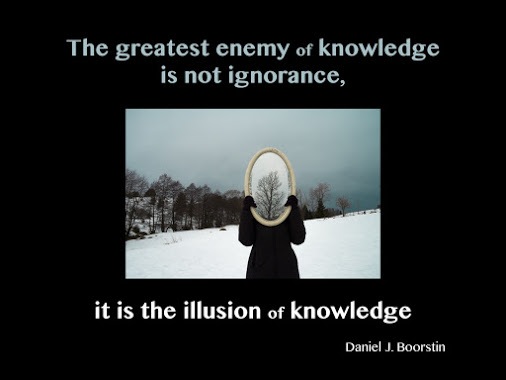
Nothing could be more true in the age of unlimited access and information overload. King Solomon wrote in Ecclesiastes, “One who tears a hole in a fence invites in a snake.” In other words, no fence is better than a broken fence, since the former demands constant vigilance while the latter allows a false sense of security. The more we think we know, the more ignorant we actually are.
Please take a look at how modern research backs this up here.
 Yonason Goldson