Home » Posts tagged 'Discipline' (Page 15)
Tag Archives: Discipline

Rejecting the new Age of Inevitability
 Isn’t it great to live in an age when machines can do anything? Cars drive themselves, jetliners land themselves, and smartphones do just about everything but tuck us into bed.
Recognition software can read our moods and even catch us telling lies. (That’s a good thing, right?) Programs can analyze our handwriting and predict our likes, dislikes, and likely actions by tracking our digital footprints. Soon, Amazon may be filling orders for us that we haven’t even placed yet.
In the workplace, software programs may start deciding who gets hired or promoted based on models constructed from data gathered about the highest performing employees. This may include variables based on medical history, psychological markers, and virtual clues to everything about us including age, gender, political leanings, and sexual preference.
In a recent Ted Talk, Zeynep Tufekci acknowledges that these programs may make decisions more objectively than humans do. But she cautions that machines trained to infer and predict are only as good as their programming, and will of necessity reflect the biases of their programmers — which could mean compounding, not eliminating, bias.
What’s more, the algorithms that produce this kind of “machine learning” don’t allow for human insight and intuition. It’s all statistical analysis, which turns probabilities into absolutes with no assessment by human reasoning and without allowing room for appeal to a higher authority.
The more troubling issue is our willingness to abdicate the responsibility implicit in free choice. In a culture that has long conflated judgment with judgmentalism, it’s hardly surprising to find how eager people are to reduce every decision to a binary option and thereby eliminate all shades of gray from the mix. And if that’s not enough, we can simply block any information that doesn’t conform to our way of thinking.

How to End a Conversation
 A classic riddle asks: Using three periods (.), two commas (,), and one question mark (?), punctuate the following line to produce a logical and grammatically correct sentence:
That that is is that that is not is not is that it it is
If you know the answer, don’t text it to your friends. You might hurt their feelings.
However, just between us, here’s the solution:
That that is, is. That that is not, is not. Is that it? It is.
The beauty of a brainteaser like this one is not just that it gets us to think. More important, it gets us to think about thinking, to appreciate how communication is critical to critical thinking, and to think about how the same string of words can be fashioned into a cogent message or left as a meaningless hodgepodge of phonetic symbols.
But don’t say so out loud. You might offend someone.
That’s what Professor Celia Klin and researchers at Binghamton University found when they asked undergraduates to interpret text messages responding to an invitation. Their study revealed that students perceived responses properly punctuated with a period at the end as less sincere and, in some cases, psychologically combative.
In other words, it’s antisocial to be articulate, crass to follow convention, and reprobate to observe the rules.
Click here to read the whole essay.

Walking in Circles
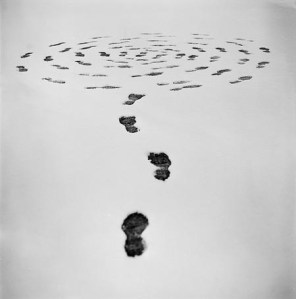 As the two contenders for the job of Leader of the Free World continue to confirm our worst fears about their competence and character, it’s worth revisiting these thoughts from 2010 about how we keep ending up in the same place.
“The whole world is a narrow bridge,” taught the great Chassidic master Rabbi Nachman of Breslav (1772 -1810), in one of his most famous aphorisms, “but the main thing is to have no fear at all.”
According to German scientist Jan Souman, however, it seems that we have good reason to be afraid. After exhaustive research devoted to the study of walking, Dr. Souman has amassed a mountain of evidence proving that human beings possess a natural inclination to travel in circles.
Like some impious prankster, Dr. Souman took his subjects out to empty parking lots and open fields, blindfolded them, and instructed them to walk in a straight line. Some of them managed to keep to a straight course for ten or twenty paces; a few lasted for 50 or a hundred. But all of them ended up circling back toward their points of origin.
Not many of them. Not most of them. Every last one of them.
“And they have no idea,” says Dr. Souman. “They were thinking that they were walking in a straight line all the time.”
Dr. Souman’s research team explored every imaginable explanation. Some people turned to the right while others turned to the left, but the researchers could find no discernable pattern. Neither left-handed nor right-handed subjects as a group demonstrated any propensity for turning one way over the other; nor did subjects tested for either right- or left-brain dominance. The team even tried gluing a rubber soul to the bottom of one shoe to make one leg longer than the other.
“It didn’t make any difference at all,” explains Dr. Souman. “So again, that is pretty random what people do.”
In fact, it isn’t even limited to walking. Ask people to swim blindfolded or drive a car blindfolded and, no matter how determined they may be to go straight, they quickly begin describing peculiar looping circles in one direction or the other.
And if, as the research indicates, human brains are hardwired to lead us in circles, why does Rabbi Nachman insist that “the main thing is to have no fear at all”?
 After all, a narrow bridge is a dangerous place to walk in circles.
Perhaps the answer lies in the words of King Solomon: G-d made man straight, but mankind sought many intrigues (Ecclesiastes 7:29).
The sages teach us that, in his original form, Adam towered above every other manner of creation and radiated a light of spiritual illumination. The inner purity of the First Man shone forth through the physical body that clothed his supernal soul, and the godliness that defined his essence drove him forward in unwavering pursuit of his divine purpose.
But Adam allowed his desire for spiritual elevation to confound his reason, rationalizing that by consuming the forbidden fruit he could internalize the influence of evil and thereby conquer it from within. Despite his noble intentions, by violating the divine word Adam strayed from his straight course and lost himself amidst the winding paths of a crooked world.
The history of Adam’s descendants testifies to the crookedness of man. The moral corruption of the generation of the Flood, followed by rebellion in the formof the Tower of Babel, marked mankind’s steady drift away from the path of Truth. The incipient Jewish nation, even before they had the opportunity to receive G-d’s Law at Sinai, twisted their spiritual yearning into worship of the Golden Calf and condemned themselves to wander directionless in the desert for 40 years.
Only upon entering their land did the Jews have another chance to find their way back to the straight and narrow. But again they lost their sense of purpose, refusing to accept upon themselves a leader who might steer them back on course toward a renewed national mission. And so the prophet declares that, “In those days there was no king; every man did what was upright (yashar) in his own eyes” (Judges 21:25).
The Hebrew word yashar, rendered here as upright, translates literally as straight. Indeed, no matter how much the Jews may have then convinced themselves of the straightness of their path, they were truly wandering in circles.

Dr. Souman explains what might otherwise seem obvious, that there is a simple solution to the circular inclinations of the internal human compass. With external clues, like a mountaintop or other promontory on the horizon, people have no trouble at all traveling a straight line.
Perhaps now we are ready to appreciate the meaning of Rabbi Nachman’s metaphor. We walk through life as if blindfolded, unable to see either the true nature of the world or the true purpose of our existence, bemused by all the material vanities that surround us and vie for our attention. The world is indeed a narrow bridge, with the winds of fad and fancy buffeting us on every side, relentlessly threatening to topple us into the abyss of spiritual oblivion if we place one foot off the path to either side.
But if we raise our eyes above the fray, if we pull the blindfold from our eyes and set our sights upon the mountaintop that beckons us across 3300 years of history, then we can march confidently into the future with no fear of straying from the true course that promises to lead us safely home.

Why Feeling Good about Yourself Is Not Always Good for You
 Take a ride in a glass elevator, from ground level to rooftop in a single ride. How do you feel?
If you’re like most people, you feel – no surprise here – like you’re on top of the world. You feel good about yourself and believe in your ability to overcome any obstacle and conquer every challenge. The only downside is – well, going down. By the time you get to the bottom, not only have your feelings of grandeur evaporated, but now you feel a bit puny, somewhat insignificant, and less than capable.
But wait! You can save yourself the effort. Researchers have discovered that you can awaken the same responses by merely imagining yourself soaring skyward or plummeting earthward. With a little visualization, you can create your own mood.
But what happens next?
That’s what Max Ostinelli, David Luna, and Torsten Ringbergat wanted to find out. The three University of Wisconsin, Milwaukee, psychologists had people imagine themselves rising up into the sky, then asked them to solve a series of SAT-style math problems. With all that positive and high self-esteem pumping up their neural pathways, certainly, their performance should have increased significantly. Right?
Wrong. They did worse. A lot worse. In fact, the performance gap between those who had their self-esteem artificially inflated and those who had theirs artificially diminished was between 20 and 30 percent.
As Max Ostinelli explains to NPR,
“When we boost self-esteem in this way, people are motivated to maintain their high self-esteem. So they say, well, I’ll withdraw from the task.”
In other words, when we know that our feelings of accomplishment are unearned or undeserved, our defense mechanism kicks in to protect our fragile bubble of fantasy from the nasty pinprick of reality. Conversely, when we feel we have to prove ourselves, an inner voice prompts us to engage and persevere rather than sit around wallowing in our feelings of inadequacy.

When the plane falls from the sky
With Tom Hanks’s new movie “Sully” allowing us to re-experience the dramatic events of January, 2009, I’m taking the opportunity to revisit my thoughts from the aftermath of the heroic rescue, originally published on Aish.com.

There are three great stories in the averted disaster of US Airways Flight 1549.
First is the story of Divine Providence, which placed a pilot with precisely the right training, experience, and temperament at the helm of the crippled jetliner and the only feasible landing strip — the Hudson River — close enough at hand for a safe, if chilly, touchdown.
Second is the story of heroism. The pilot, Chesley Sullenberger, drew upon his experience with both military fighters and gliders to bring the passenger plane safely down from the sky. The flight crew quickly and efficiently instructed the people to prepare for impact and then hastened them off the sinking plane. The rescuers, both professional and private citizens, steered their craft to the crash site within minutes. Not one life was lost.
But the third story is that of the passengers. For the most part untrained and unprepared, without exception the passengers on Flight 1549 did precisely what they needed to do in order to survive.
They followed instructions.
In moments of crisis, bold leaders act decisively, heroes rise to the occasion and show their true colors, and acts of selflessness inspire those of us thousands of miles away who find our faith — in both Divine mercy and in our fellow man — renewed.
But heroes cannot succeed in a vacuum. Had the passengers on the stricken plane responded with panic, had they stormed the cockpit in a frenzied attempt to seize the controls, had they ignored the directions of the captain and the flight attendants, had they fought one another to reach the emergency exits first, then this story would have a much less happy ending.
The sages of the Talmud teach: “In a place where there are no leaders, strive to become a leader.” On the surface, this means precisely what it appears to mean. It is leaders who impose the unity and direction that constitutes the difference between a community and a mob, between order and chaos, between a chance for survival and self-destructive pandemonium. Where there is no one to take charge, every individual must see himself as a potential leader and do all he can to shoulder the responsibilities of leadership.
 At the same time, the sages tell us that this principle applies only in a place where there are no leaders. Wherever there is someone qualified and willing to lead, then it becomes the responsibility of others to follow, to become good soldiers and carry out orders. It was the passengers of Flight 1549 who enabled the heroes of the story to perform heroically.
Perhaps the exultation we feel over the survival of Flight 1549 stems from a deeper, often subconscious conviction in the unity of mankind. We can transform ourselves from a divided rabble into a society of leaders and followers, of captains and foot soldiers. We can achieve great things when we come together in a common cause for the common welfare.
Nothing catalyzes us like crisis. When the ship is sinking, when the plane is going down, when the enemy is at the gates, we find ourselves motivated to set aside our egos and our petty differences and stand together for the sake of our own survival.
Perhaps this is the most relevant lesson of Flight 1549. At a moment in history when the world has become less predictable than ever, when unstable nations like Iran and North Korea are on the brink of acquiring nuclear weapons, when terrorists strike against our most beloved kinsmen without reason or pretext, when enemies at our borders would rather suffer self-destruction than make peace, when the world economy teeters on the brink of collapse and our leaders spin like weather vanes grasping for solutions — what better time to reflect upon our potential to come together in the most hopeless moments, as when a hundred thousand tons of steel is falling out of sky, as when all human society seems ready to fall back into the dark ages, and change the outcome, against all odds, from tragedy to triumph.
With common purpose, we can accomplish virtually anything, as the Framers did when they envisioned a great nation with the motto e pluribus unum — out of many, one — hearkening back to a day over 3000 years earlier, when a people newly freed from bondage stood in the wilderness at the foot of a mountain and accepted their divine mission, as one man, with one heart.

The Sound of Silence
 [Rabbi] Shimon [ben Gamliel] says: All my days I grew up among the sages, and I never found anything better for a person than silence. Action, not study, is the main thing; and excessive talk inevitably leads to sin.
~Ethics of Fathers 1:17
Listen, my son, to the guidance of your father, and do not forsake the teaching of your mother; for they are a charm of grace upon your head and precious gems about your neck.
~Proverbs 1:8-9
Traditionally, discipline came from the father, whose stern and urgent words provided guidance along the path of life. However, it was the quiet lessons learned by example from the mother that defined that path and had the most enduring influence as children grew up into the adults they were meant to become.
No matter how parenting roles may have changed, the general principles remain. Intellectual maturity, symbolized here as a charm of grace upon the head, guides the steps we take; the intuitions of the conscience, when articulated through speech, are the precious gems about the neck, which keep us turned toward our ultimate destination.
Only when our thinking and speaking are filtered through the wisdom absorbed from responsible parents and trustworthy teachers will we be able to find our place in the world and live in harmony among our fellows.

Love Work
 Shemayah says: Love work, despise high position, and do not seek to become intimate with power.
~ Ethics of Fathers 1:10
How far we have come from the wisdom of the sages, who remind us that there is no deeper feeling of satisfaction and fulfillment than that of a purposeful job well-done, no more corrupting influence than the desire for mastery over others, and no more corrosive influence in the erosion of our values than currying favor with those we think can change our fortunes.
When we look at the twisted lives of so many politicians and celebrities, do we need any further reminder that we ought to revel in the blessings of humble productivity and quiet dignity?



Louisiana and the Waters of Life and Death
As residents across Louisiana struggle against catastrophic flooding, we should all take a few moments to contemplate how quickly nature can become our greatest adversary. Water is both the source of all life and the greatest destructive force on earth. I ponder the paradox in these reflections from after the Pacific Rim tsunami of 2005.
 Volcanoes. Hurricanes. Earthquakes. Fires. Tornadoes. Blizzards. Drought.
In a time when reports of terrorism have become all too common, it is sobering to consider the myriad ways nature possesses to inflict death and violence on a scale surpassing the most destructive instruments devised by man. Of all these, however, destruction by water, whether from the sea or from the sky, holds a unique terror in the scope and measure of its devastation.
Aside from the 150,000 lives already reported lost across nearly a dozen countries along the Indian Ocean, dehydration, disease and hunger threaten as many as 5 million more in the wake of the recent tsunami. And rare though tidal waves may be, the more familiar trial-by-water of floods has, with much greater frequency, left similar numbers homeless and in danger of starvation.
It seems ironic that water, the source and foundation of all life upon our planet, can become nature’s most malevolent instrument against the beings whose lives depend upon it.
Devastation by water occupies a prominent place in human history. Virtually every ancient culture records the tradition of a great flood that inundated the world, lending credence to the biblical account of Noah and the ark. Jewish tradition describes this not as a random event, but as a divine response to the corruption of mankind.
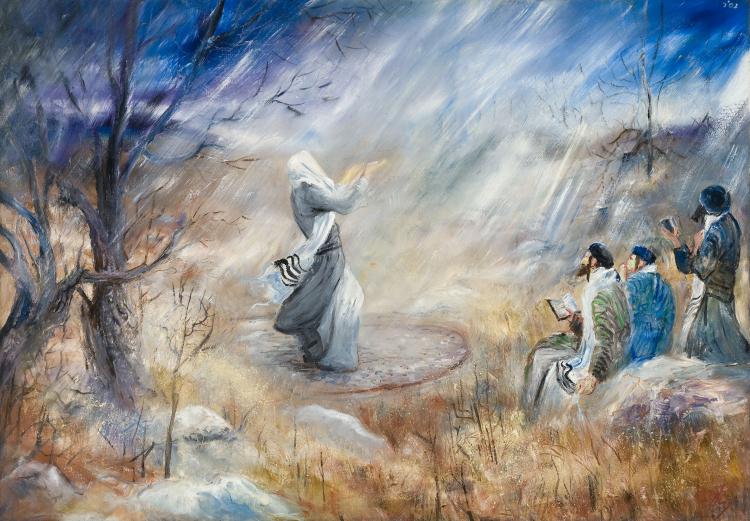
The Talmud, however, reports a much more enigmatic account of divine intervention through water. It was in a time of terrible drought that the Jewish people approached the sage Choni HaMagil and beseeched him to pray for rain on their behalf. When Choni’s supplications to the Almighty went unanswered, he drew a circle in the dust and stepped inside of it, vowing not to leave the circle until G-d bestowed rain upon His people.
Immediately, a fine mist settled upon the earth, too little to alleviate the drought but sufficient to free Choni from his vow.
Choni called out to heaven: “I asked not for this, but for a rain to fill all the wells and cisterns.” Immediately, raindrops larger than melons began to fall, wreaking destruction upon homes and fields.
 Again Choni called out to heaven: “Neither did I ask for this, but for a rain of blessing.” Immediately a normal rain began to fall, filling the wells and cisterns of the people as Choni had requested. But the rain did not stop, and soon the entire population of the land feared that they would drown in the rising waters.
One last time Choni called out heavenward: “Master of the World, Your people, Israel, whom You brought out from Egypt, can tolerate neither too much blessing nor too much misfortune.” Immediately the waters abated, and the people returned to their fields. From this time onward, people referred to Choni by the name HaMagil — the Circle-maker.
What was the point of G-d’s demonstration to the people of Israel? What did Choni mean that the people could not tolerate too much blessing? And why did Choni find it necessary to remind the Almighty, at this particular moment, that He had brought the Jewish people out from Egypt?
The Exodus from Egypt may be described, in commercial terms, as the largest loan ever extended in the history of man. During the generations of slavery in Egypt, the Jewish people had forgotten their Creator and lapsed into the same idolatries as their Egyptian masters. And although, to their credit, the Jews had guarded themselves against assimilation, this alone was insufficient to earn them the privilege of miraculous redemption. Nevertheless, G-d gave them an incalculable line of credit: Freedom from slavery, freedom from oppression, freedom to chart their own course into the future.
Moreover, He promised them immeasurable blessing and unbounded prosperity, on condition that they would repay their loan — repay it by living according to G-d’s law, repay it by rising above material pursuits and petty self-interest, repay it by using all the blessing that G-d would bestow upon them to aspire to moral, ethical, and spiritual perfection.
In this light, blessing may be understood as a double-edged sword. Wielded in one direction, it cuts down all enemies and obstacles that stand before us. Wielded in another, it obligates us to a standard of righteousness and moral behavior that we may find nearly impossible to meet.
This was the meaning behind the Almighty’s response to Choni the Circle-maker’s plea:
Two roads lie before My people, and it is their choice which to follow. One leads back to Egypt, back to the oppression of materialism and the slavery of self-indulgence, back to spiritual emptiness and the absence of all blessing. The other road leads forward, to spiritual fulfillment and spiritual greatness, if My people will only find within themselves the potential to seek greatness and discard all lesser goals. It is for this that I redeemed them, that they might cast off the chains of physicality and reach for the heavens.
 And this too was the meaning behind Choni’s appeal to the Almighty:
Master of the World, You brought your people out from slavery and oppression on condition that they would use their freedom and the blessings to strive for spiritual heights. Your people, however, have demonstrated from their beginnings that, whatever their potential may be, they still suffer from human failings and human shortcomings. They cannot tolerate too little material blessing, lest the struggle to survive overwhelms them and they abandon all higher aspirations. And they cannot tolerate too much blessing, lest they cower before the goal set for them and lose all hope of its attainment.
By all accounts, the world that we live in today enjoys a level of material affluence unattained and unimagined by previous generations. Such basic necessities as rapid transit, instantaneous communication, indoor plumbing, electrical lighting and refrigeration, which we take for granted, provide us with an ease of living simply unavailable to even the wealthiest, most powerful monarchs until the last century. The very existence of an “entertainment industry,” much less the staggering sums of money devoted to it, testifies to our abundance of resources — which is to say, our abundance of material blessing.
Nowhere does Jewish tradition teach the condemnation of wealth or of recreation.
Nowhere does Jewish law mandate the forcible redistribution of wealth from those blessed with good fortune to those less fortunate. But Jewish tradition does warn us of the responsibilities of prosperity. It warns us in the narrative of the flood, in the story of Choni HaMagil, and also in the Hebrew word for charity: tzedakah, derived from the word tzedek, or justice.
It is only just that those who are blessed share a portion of their blessing with their less fortunate neighbors. It is only just that, before overindulging in one’s own good fortune, he ponders why he deserves having received such blessing while his neighbor has not. And it is only just that he ask himself how, even in the absences of tax incentives or legal mandate, he might reach out with his blessing to ease his neighbor’s plight.
If the waters of the earth, the life-giving waters that are the source of our greatest blessing — life itself — have risen up to inflict enormous tragedy, swallowing human life and draining billions of dollars of aid to spare human suffering, we will all be remiss if we do not pause to consider whether we have used our blessings wisely, and what we must do to ensure that we will continue to deserve them.

Falling Skies
 The death of any young person is tragic, and all the more tragic when unnecessary. In today’s world where sensory-gratification is king and accountability is unknown, few question the wisdom of jumping out of an airplane for kicks, especially when the chances of anything going awry are so small.
But those odds assert themselves eventually, as they did last month in Acampo, California. The two young men who lost their lives were jumping about an hour’s drive from where I jumped myself almost four decades ago. It seemed like a good idea at the time. But I’ve come to reconsider, as I explain in this essay from 1999, originally published in the St. Louis Post-Dispatch.
“Middle age has finally arrived,” I said to myself as I confronted a life insurance application form for the first time ever. But as I filled in the blanks and checked off the boxes, I suddenly paused, suspended between youth and old age, as I read and reread one question midway through the form: Have you ever been skydiving?
I consider myself an honest person, so I found myself in the midst of a moral struggle as I contemplated how I should answer. The reasoning behind the question seemed obvious: why should any business gamble a quarter of a million dollars on the life of someone foolish enough to jump out of an airplane?
The way I figured it, however, there are three reasonable explanations why an otherwise sane person would do such a thing.
One, as in the case of former President George Bush, to save his life when his plane has been hit by enemy fire in WWII.
Two, also as in the case of George Bush celebrating his 75th birthday, when one is winding down his life and figures he hasn’t much of it left to lose anyway.
And three, as in my own case, when one is not yet sufficiently mature to appreciate that his life is far too precious a thing to be thrown casually out of an open hatch at 3000 feet.
Barring any of these three excuses, an insurer would be entirely justified in refusing coverage or inflating charges. But why, since I now regard jumping from an airplane as ample cause for mandatory psychiatric observation, should I be burdened with doubled insurance premiums because of a momentary lapse in good sense when I was half my present age?
As it turned out, I went with a different company, one whose application phrased the question this way: “Have you been skydiving in the last ten years?” That’s much more fair, I think.
Of course, insurance companies may just be looking for excuses to jack up their prices. After all, compared to BASE jumping, ice climbing, and other extreme sports, skydiving is positively run of the mill. Could George Bush, a former president of the United States, former director of the CIA, and former member of the NRA, be so completely off-the-wall? (Never mind that the poor former first lady could hardly bear to watch her husband’s escapades.)
Indeed, my diving instructor (whose name was also George) told us repeatedly: “Skydiving is no riskier than crossing the street!”
George isn’t alive any more. He wasn’t killed crossing the street, either.
 As a 19-year-old undergraduate still looking for a major course of study, life seemed to have little to offer me except cheap thrills. If something would go wrong, and I would splatter against the plowed earth of the Sacramento valley, well, what was the point of being alive if I didn’t experience all life had to offer?It goes without saying that children of all ages will be drawn like moths to the fire of every kind of sensory stimuli. It is our job as responsible adults to shield them from the flames of both real danger or virtual thrills, to gently prod them along the road to wisdom by exposing them to more rewarding and enduring highs than those brought on by adrenaline rush.
In the same way that chomping on spearmint gum deadens the palate to the subtle complexities of fine food and wine, the instant gratification of putting one’s life at risk may, in the end, kill off any hope of ever savoring the subtle joys of maturity, even if those dangerous pastimes do not themselves prove fatal.
The Talmud offers the following insight into human nature: “If someone says, ‘I struggled but did not achieve,’ don’t believe him; if he says, ‘I achieved without struggle,’ don’t believe him; but if he says, ‘I struggled and achieved,’ believe him.”
The Talmud goes beyond the simple axiom that there is no sense of accomplishment without exertion. It tells us that exertion and effort will inevitably produce a sense of accomplishment. And unlike the transient high produced by LSD, PCP, or any contrived brush with danger, the sense of accomplishment produced by struggle will not vanish into nothingness, leaving behind an emotional void or the anguish of physical or psychological withdrawal. It will endure, and spur us on to greater struggles and greater accomplishments.
Without intellectual effort, we would never graduate from Dr. Seuss to Shakespeare, from Marvel Comics to Monet, or from music videos to Mozart. Without psychological effort we would never learn the practical skills to succeed professionally or the interpersonal skills to succeed as spouses and parents and friends and neighbors. Without effort we would never learn to appreciate the small, subtle pleasures life has to offer because we would be ever waiting impatiently for the next emotional quick-fix.
Acquired taste is accessible to the young. As parents, we must not shy away from the challenge of inculcating patience and prudence in our children. Through persistent effort we can teach them that cultivating a taste for the more refined pleasures of life is not so hard, no harder really than falling out of an airplane.
 Yonason Goldson