Home » Posts tagged 'Integrity' (Page 19)
Tag Archives: Integrity

Willful Ignorance: the new normal

Maybe we really are living in the Matrix.
Day by day, even hour hour by, the headlines become more surreal and the actions of our leaders become more incomprehensible. Who could have imagined that all the conspiracy theories of extraterrestrial mind-control and computer-generated mass-delusion would start to seem like the most reasonable explanations for where we are and how we got here.
The most recent administration scandal over the United States Central Command (CentCom) deleting military intelligence brings to a crescendo the chorus of claims of the White House stifling inconvenient truths about the Islamic State to avoid dealing with the real threat of terrorism. Last year, the Pentagon’s inspector general began investigating after CentCom analysts protested that their findings had been manipulated to whitewash their conclusions. Now it appears that files and emails were not only misrepresented but actually erased.
As we pass the 30th anniversary of the Challenger Space Shuttle disaster, it’s beyond mind-boggling that the culture of denial has grown worse than ever. Back then, NASA administrators ignored warnings that O rings lose resilience at low temperatures and might fail on takeoff — which is exactly what happened.
But as irresponsible as it seems to disregard objections as insubstantial or unfounded, by what conceivable logic does one erase information because it supports an undesirable conclusion? Can we make pneumonia vanish from a patient’s lungs by shredding x-ray images? Can we make a brain tumor disappear by dragging the MRI results across the desktop and into the trash file?
Come to think of it, maybe this was the original strategy intended to make Obamacare viable: destroying evidence of disease would certainly keep medical costs to a minimum.
WE HAVE SEEN THE ENEMY…
It’s not just the government. As a society, we have become increasingly disinterested in a pesky little problem once known as reality. Perhaps this is the inevitable result of fantasy movies and fantasy football, of virtual images and virtual messaging, of games that have become more compelling than reality, and of reality that has become more mind-bending than science fiction. All this aided and abetted by the undo and reset buttons that instantaneously restore our make-believe worlds to perfection when things go wrong.
The rejection of reality cuts across every major issue of our times and infects every corner of political and social ideology. Climate change advocates and skeptics alike exaggerate their claims and malign objectors. Pro-choice zealots dismiss the horrors of late-term abortions, while pro-life zealots often refuse to even consider the complex issues of rape and incest, and sometimes even the life of the mother. Supply-side Republicans continue to trumpet the effectiveness of a trickle-down tax structure despite the widening gap between rich and poor, while tax-and-spend Democrats cry out for fairness despite empirical and historical evidence that everyone loses.
In our information age, we are less concerned with facts than ever. With a single click of the mouse, anyone can find legions of pundits asserting preconceived half-truths and countless articles defending outright falsehoods. We are all adrift on a sea of misinformation, carried along by the winds of self-validation. Had Samuel Coleridge imagined this, he might have written, experts, experts, everywhere, nor anyone to think.
Unsurprisingly, in the field of politics it’s even worse. The most brazenly untruthful political figure in the history of the country calls for her opponents to take a lie-detector test, and a master of reality-television who has reversed himself on almost every substantive issue is winning hearts (if not minds) by branding himself as the candidate who “tells it like it is.”
If Laurence Fishburne appeared to offer us a choice between the red pill and the blue pill, which would we choose? Have we so lost our interest in reality that we would happily opt for a world of illusion, or are we still capable of recognizing that a life of illusion is no life at all?
And again, it’s even worse in the world of politics, where neither red nor blue is likely to offer us any escape from our waking nightmare.
THE CHOICE
But we really don’t need a pill at all.
King Solomon said, “The wise man’s eyes are in his head.” Closer to the brain than to the heart. Looking outward, seeing inward.
What we really need to do is ask ourselves a few hard questions, then follow them up with a few honest answers.
We need to ask ourselves why we no longer value our word the way our parents and our grandparents did. We need to ask why they felt more connected to one another corresponding through written letters than we do through face time. We need to ask why they were willing to sacrifice for higher values when we have forgotten what higher values are.
First we have to be willing to ask ourselves these questions. Then we might be ready to face the universal truths that are self-evident from the answers: that trusting others and being trustworthy go hand in hand; that relationships are only worth as much as the effort that we put into maintaining them; that commitment to something greater than ourselves is the only thing that makes life worth living.
True, the world seems to be spinning toward its own destruction. But even if we can’t save the world, we can stand strong and not allow the world to pull us down with it. Keeping our word, showing respect to those we disagree with, offering a kind word to a stranger or a smile to a passerby — these few faint beatings of a butterfly’s wings might be enough to stir the winds of change, blowing away the clouds of chaos to let the light of reason shine once again.

Is Ted Cruz to blame?
 This isn’t about politics. It’s not even about Ted Cruz. It’s about life.
If you want people to trust you, you have to appear trustworthy. All the more so if you’re going to accuse your opponents of dishonesty and make TrusTed your campaign slogan.
Senator Cruz did the right thing — the only possible thing, really — by firing top aid Rick Tyler for his role in circulating a video falsely accusing Marco Rubio of disparaging the Bible.
But it may be too late for damage control. Because the question everyone’s asking is this: whether or not Ted Cruz knew about or approved of the video, was Rick Tyler only doing what he thought his boss would want him to do?
I’m not suggesting that I know the answer. I’m only underscoring the urgency of the question. And I’m offering this historical precedent.
After leading the Children of Israel to victory in the battle against Jericho, Joshua received a message from the Almighty accusing the entire Jewish people of having lied, stolen, and violated their covenant with the Divine.
In fact, it had been one person who had stolen one object from the banned spoils of war — and this without any other person even knowing of the perpetrator’s actions. If so, why was the entire nation condemned as if they were complicit in the crime?
The answer is simple: the thief would never have committed his act of thievery unless he believed that he would be able to get away with it. Had there been a sufficient awareness of social conscience, had there been a palpable sense woven into the fabric of Jewish society that no one would tolerate his crime, the would thief never have dared to reach out his hand to take something that was not his.
Because an atmosphere of moral complacency permeated the national culture, the entire nation was held accountable for the actions of one man.
If we want to live in a society governed by integrity and character, we have to hold others to a high standard of personal behavior. But that only works if we hold ourselves to an even higher standard, and show the same disdain for corruption toward our friends as we do toward our enemies.

Christopher Hitchens: Almost a Hero
 It’s remarkable how we can develop a deep fascination, sometimes to the point of fixation, toward people we despise.
This is not particularly healthy: we gain much more by studying those who are worthy of our admiration and reverence, both as models for the refinement of our own behavior and as sources of inspiration that demonstrate the heights to which human nobility can soar.
But human nature produces an incessant magnetism toward the negative, no matter how much we may know better. So I couldn’t resist clicking on Daniel Oppenheimer’s recent retrospective* on Christopher Hitchens, one of my least favorite intellectuals.
I’m glad I did.

In Memorium
 Today marks the second anniversary of my father’s death. He was a man of unyielding principle and discipline, of meticulous honesty and unwavering standards. He had the ability to create an instant rapport with others and charm them without guile or manipulation, but he never seemed able to completely let down his emotional guard to truly connect. He could be hard, but he instilled in me a code of ethics and integrity that have formed the foundation of my sense of self and my worldview.
I wrote this tribute to him for Father’s Day in 2001:
Honor (is learned from) Thy Father
Always Faithful
 My son at his induction ceremony into the IDF.
May the Almighty watch over all those who put the lives of others before their own.
May we all find within ourselves the clarity and courage to stay true to the values that lie at the core of our humanity.

The Second Amendment and the Oral Law
 As president Obama embarks upon his latest unilateral campaign to repair the world, this time by expanding restrictions on gun ownership, it’s worth revisiting my article on the Second Amendment from 2010.
Perhaps the greatest danger to the Constitution is manipulating its words to validate predetermined conclusions. By doing so, we violate the talmudic admonition against making the law “a spade for digging,” i.e., a tool to advance our own ends.
To preserve constitutional integrity, we have to familiarize ourselves with the context of its times, then apply those observations to the times in which we live. That only works when we are committed to honoring the system, rather than exploiting the system to fit our own agenda.
Last month’s Supreme Court ruling affirming Second Amendment states’ rights (and coinciding with the predictable Republican grilling of Supreme Court nominee Elana Kagan over the same issue) has brought back into the spotlight the constitutional ambiguity regarding gun ownership in the U.S. of A.
A well regulated Militia, being necessary to the security of a free State, the right of the people to keep and bear Arms, shall not be infringed. So states the Second Amendment to the United States Constitution. At first glance, the stipulation seems clear enough. American citizens may own guns, plain and simple.
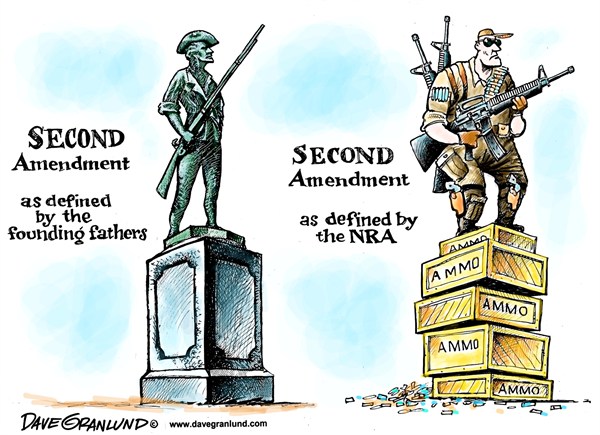 Or maybe not. The qualifying phrase that introduces the amendment appears to restrict constitutional protection to dependence upon a militia, or citizen army, to defend the nation. Accordingly, in times such as ours, when a standing army has assumed responsibility for the common defense, there may be no constitutional guarantee at all. And so, on second thought, the amendment seems to clearly limit the extent of private gun ownership.
Or, again, maybe not.
Perhaps the Founding Fathers meant that, since every citizen ultimately owns an equal share of the responsibility to defend his country, the right to bear arms is part and parcel of each person’s national duty to fight for the public welfare should the need ever arise. This would explain why the authors of the amendment might have mentioned a militia even if they never meant to restrict said right.
So what was the original intent of the Framers? If they were here, we could ask them. Since they are not, each side seems to have a fair and reasoned claim to support its respective position.
Is there any way to resolve the question of what was intended by men who passed away long before our grandfathers were born?
In fact, there may be.
THE REST OF THE STORY
Imagine that, as you pass by a window, you see a man wearing a mask raise a knife and plunge it into the chest of another man lying prone beneath him. You scream for the police, certain that you have just witnessed a murder.
Or, yet again, maybe not.
Now imagine that you were unfamiliar with the concept of open-heart surgery. Only after the police arrive and explain that the man in the mask is a surgeon working to repair the heart of the man on the table beside him will you understand that he is in fact saving a life and not taking one.
Context is everything. It orients us in time, space, and circumstance, transforms isolated acts into links in a chain of connected events, none of which can be understood in isolation. And so, if the words of our forebears sometimes appear to us muddled or imprecise, the surest way to achieve clarity is to examine comments and opinions from the same thinkers and the same era.
 Here are a few examples to provide historical context:
James Madison, on the principle of individual rights: [A bill of rights] should more especially comprise a doctrine in favour of the equality of human rights; of the liberty of conscience in matters of religious faith, of speech and of the press; of the trial by jury… of the writ of habeas corpus; of the right to keep and bear arms.
Massachusetts Representative Fisher Ames: The rights of conscience, of bearing arms, of changing the government, are declared to be inherent in the people.
Supreme Court Justice James Wilson, contributor to the drafting of the Constitution:The defense of one’s self, justly called the primary law of nature, is not, nor can it be abrogated by any regulation of municipal law.
Vice President Elbridge Gerry, signatory to the Declaration of Independence, on national defense: What, sir, is the use of militia? It is to prevent the establishment of a standing army, the bane of liberty.
In the context of the times, the intention of the Framers becomes difficult to debate. Only in relatively recent times, when the concept of a militia has become an anachronism, has it become possible to question the true meaning of the Second Amendment.
PRESERVING THE INTEGRITY OF THE LAW
Is there any way for words to retain their clarity despite the persistent evolution of cultural references and values? Is there any method for protecting ideas from the ravages of changing times and sensitivities?
Indeed there is. It predates the United States Constitution by 31 centuries, and it is called the Oral Law of the Torah.
Consider these biblical commandments:
Remember the Sabbath Day and keep it holy… And this will be a sign upon your arm and a remembrance between your eyes … Slaughter your [livestock] in the manner that I have prescribed… Do not seethe a kid in its mother’s milk.
 These precepts, as they are written in the Torah, are impossible to observe. What does it mean to keep the Sabbath “holy,” and what actions — if any — are required to “remember” it? What kind of sign are we to place upon our arms, if elsewhere the Torah prohibits the application of any tattoo, and how do we place a “remembrance” between our eyes? Nowhere does the Torah outline any prescription for ritual slaughter, nor does it imply what is commonly understood, that that the prohibition against cooking a baby goat in its mother’s milk extends to every mixture of meat and dairy products.
In spite of these and many other ambiguities, the basic practices of the Torah observant community have remained essentially unchanged for over 3300 years. The explanation is simple. Unlike the family encyclopedia which once gathered dust on the shelf and now gathers dust on the CD rack, the Oral Torah forces every committed Jew to see himself as custodian of a living tradition that connects him with the origins of his identity and enables him to live in the modern world without compromising the values of his ancestors.
No longer purely oral, the discussions and debates of past authorities have been recorded for their children in the writings of the Talmud and the commentaries that elucidate them. Unlike the records left behind by the Framers of the Constitution, however, these records have become canonized as part of the structure and process through which Jewish law is determined in each and every generation. Even when questions and disagreements arise, there is no debate within the Torah community over the methods through which answers and solutions are to be found.
Society changes, technology changes, and the values of human beings twist in the winds of time like a weather vane spinning before a storm. Electricity, automobiles, computers, cloning, and in vitro fertilization may have once been unimagined, but we have inherited a legacy that teaches us how those earlier generations would have resolved the problems of our changing world if they were here themselves today. And so the Torah Jew never loses his bearings, for he is guided by the words of his forefathers and finds comfort in the knowledge that the ancient wisdom of the Torah will never become stagnant, corrupted, or out of date.
As my teacher Rabbi Nota Schiller often says, the Oral Torah allows the Jews to change enough to stay the same.
Originally published by Jewish World Review

Guest Post: No Good Deed…
 A poor Jew finds a wallet with $700 in it. At his synagogue, he reads a notice saying that a wealthy congregant lost his wallet and is offering a $100 reward for it. He spots the owner and gives him the wallet.
The rich man counts the money and says, “I see you already took your reward.”
The poor man answers, “What?”
“This wallet had $800 in it when I lost it.”
They begin arguing, and eventually come before the rabbi.
Both state their case. The rich man concludes by saying, “Rabbi, I trust you believe ME.”
The rabbi says, “Of course,” and the rich man smiles. The poor man is crushed.
Then the rabbi hands the wallet to the poor man.
“What are you doing?!” yells the rich man.
The rabbi answers, “You are, of course, an honest man, and you say the wallet you lost had $800 in it. Therefore I’m sure it did. But if the man who found this wallet is a liar and a thief, he wouldn’t have returned it at all. Which means that this wallet must belong to somebody else. If that man steps forward, he’ll get the money. Until then, it belongs to the man who found it.”
“What about my money?” the rich man asks.
“Well, we’ll just have to wait until somebody finds a wallet with $800 in it…”

Donald Trump: Obama 2.0
A magic rests on the lips of the king;
Let his mouth not betray him in judgment.
~Proverbs 16:10
 However improbable it seemed at the start, it’s not hard to understand the initial popularity of Donald Trump. In an age of mealy-mouth, equivocating, do-nothing, business-as-usual, avaricious politicians, many found it refreshing to have a larger-than-life presence who seemed to speak his mind and didn’t pander to popular opinion. But by now the flirtation should have revealed itself for what it is — a cheap one-night stand with no basis for a solid relationship.
Donald Trump represents everything that is wrong with this country: arrogance, self-promotion, pettiness, bellicosity, irresponsibility, bigotry and, despite his hugely successful self-branding, dishonesty and insincerity. In truth, Donald Trump is exactly the opposite of the persona that originally made him so appealing; on closer inspection, he reveals himself to be nothing less than a fun-house reflection of Barack Obama.
Like Mr. Obama, Donald Trump believes in nothing but himself; each man genuinely believes he is the smartest person in the world, and each reacts with seething contempt toward anyone who questions or disagrees with him. Armed with the conviction that comes from infallibility, each will say whatever he has to say, without a flicker of shame, to advance his own personal agenda.
Mr. Trump had only good things to say about Hillary Clinton in his 2012 interview with Greta Van Susteren, but last July he told Meet the Press that Ms. Clinton was “the worst Secretary of State in history.” In 1999 he said, “I love universal health coverage,” but now he chastises the Republican congress for not putting an end to Obamacare. In 1999 he was “very pro-choice,” but now he’s anti-abortion. Apparently, this qualifies him to be president. in 2014, the Washington Post awarded President Obama for having told 3 of the 12 biggest political lies of the year. In 2013, it was 3 out of 10 — an average good enough for an MLB All-Star.
The issues are not the issue; brazen disregard for the truth is. Much more disturbing is the persistent popularity of Mr. Trump based on the illusion that “he tells it like it is.
Pollard and Nuremberg
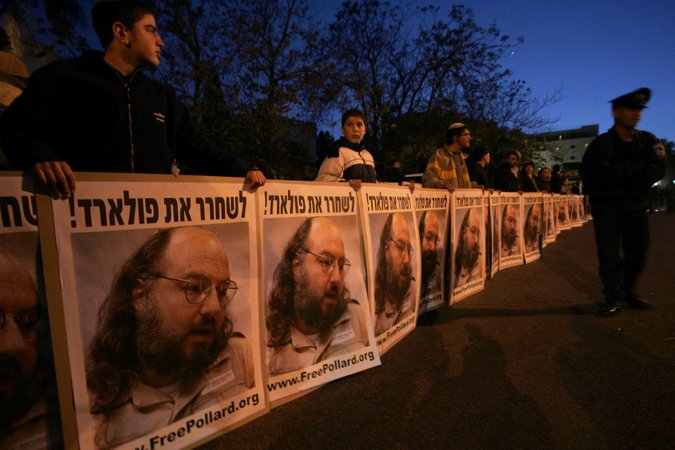 The case of Jonathan Pollard was more complicated than most people understood. His actions may have placed others in danger, and may have contributed to the death of agents he compromised. But almost everyone agrees that his punishment was disproportionate to his crime, and the sense of joy upon his release is more than justified.
The real take-away is this: whether one agrees with or disagrees with what Mr. Pollard did, he followed his conscience, and he was prepared to accept the consequences of his actions. If only more of our fellow citizens and more of our political leaders demonstrated the same courage and conviction.
Of course, not everyone’s moral compass is adequately calibrated. Edward Snowden also believed that he was following his conscience, and the morality of his actions is far more questionable for his having caused more damage by far than did Jonathan Pollard.
The Nuremberg trials after WW II changed forever the interrelationship between civil and moral law. No longer would it be legitimate to claim “I was only following orders” as a defense for crimes against man. A soldier has an obligation to refuse to carry out an immoral order, even if by doing so he puts himself in danger of court martial.
We should all consider ourselves foot-soldiers in the culture wars that threaten our society. But moral obligation implies more than just following our conscience. It means investing the effort, energy, and thought necessary to understand the decisions we will have to make and their consequences. Otherwise, our claim to the moral high ground can become a smokescreen to hide our moral irresponsibility.
That’s what makes Jonathan Pollard a hero in the eyes of so many, and Edward Snowden, perhaps, something very different indeed.

Did That Really Happen?
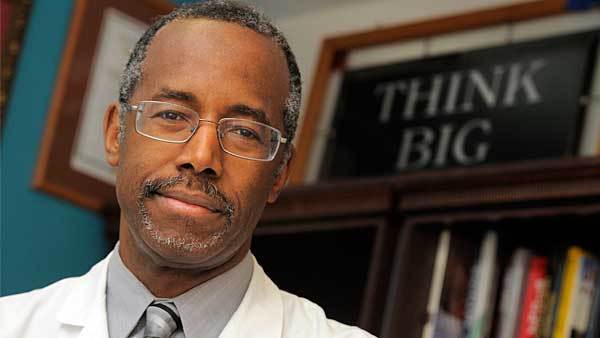 Well, it was probably inevitable. Dr. Ben Carson, quintessential political outsider and man of integrity, has been caught in a … well, let’s call it a modest inaccuracy for the time being. The inspirational narrative of his turning down a full scholarship to West Point proved somewhat less dramatic: at best, he was encouraged to attend West Point and chose otherwise.
This may have been an honest misstatement or trick of memory decades after the fact. It certainly can’t be compared to claims of having been shot down in a helicopter or having had to duck under sniper fire, and if it doesn’t emerge as part of a pattern of prevarication then the doctor can be forgiven.
It does demonstrate, however, how careful we should be with our words, especially in this day and age when everything is recorded and almost everything can be verified or disproven.
It’s a topic I address in this essay, published by Jewish World Review back in 2010.
Having circled the globe one and a half times before finding my way to Torah observance, having lived for nine years in Israel and one year in Hungary, having taught adolescents for nigh on two decades, it’s only natural that I have more than a few stories to tell. Consequently, it never fails to discomfit me when friends or neighbors respond to my essays by asking:
“Did that really happen?”
Are my anecdotes so truly unbelievable? After all, I never claimed to have flown to the moon on gossamer wings, to have crossed the Alps with Hannibal and his elephants, or to have led the attack against Custer’s army at Little Big Horn. No, I’ve merely looked to pluck useful insights from slightly quirky encounters and bring to light the Torah wisdom that resides within myriad aspects of the human condition.
 And so I’ve penned essays about my white fedora, which fellow travelers reported noticing as our paths crisscrossed throughout Europe; about the Israeli gentlemen who rebuked me in an elevator for wearing an earring while sporting tzitzis, the fringed tassels worn over the belt line according to Torah law; and about the ragged man who stopped in his tracks on the streets of Budapest, apparently overwhelmed and overjoyed to discover a religious Jew having survived the travails of the Holocaust and assimilation; these, together with assorted episodes from my high school class room.
“I loved your article,” an acquaintance will say. And then, with alarming frequency: “Did that really happen?”
I even get it from my mother.
To be honest, I can’t say that I’m surprised. After all, narrative accuracy has seen its market value tumble over the years. As candidate for president, John Kerry described how Christmas in Cambodia was “seared in his memory.” A stirring narrative, aside from the fact that he wasn’t actually there. In the Democratic primary four years later, Hillary Clinton reported that her parents had named her in honor of Sir Edmund Hillary — an impressive feat of prescience, since Sir Edmund had not conquered Mount Everest until five years after Ms. Clinton was born and named. Even Ronald Reagan, although never caught embellishing his own history, nevertheless brought tears to the eyes of his audiences with poignant war stories that turned out to be scenes from old movies.
Popular motion pictures that are “based on” or “inspired by” true stories often undergo such embellishment that they emerge bearing little resemblance to the events they claim to portray. Tonight Show host Jay Leno, in his autobiography, reportedly included anecdotes that actually happened to other people, but explained that he had permission to use one story, and that he had paid for the right to use the other.
As in so many cases, the Torah prohibition against speaking untruths extends far beyond the simple meaning of the words. MiDavar sheker tirchak translates, simultaneously, as “Distance yourself from a false word” and as “Distance yourself from a false thing.” From the perspective of Jewish philosophy, words are not mere symbols or labels; they possess a substance and a reality all their own. Consider how a cruel word can inflict more pain than a sharp blow between the eyes, or how a well-placed compliment can produce more pleasure than the sweetest dessert.
When does a word or a thing become false? In principle, the slightest embellishment or exaggeration constitutes a violation of Torah values, if not Torah law. If one is uncertain about the details of a story, it is easy enough to add “I think” or “something like” to one’s narrative. That small concession to veracity helps us preserve our respect for the lines between truth and falsehood — lines that grow increasingly blurred amidst the moral confusion of our generation.
 The Hebrew word emes, commonly translated as truth, is formed by the three letters that come, in sequence, at the very beginning, the precise middle, and the very end of the Hebrew alphabet. Before we can be certain that anything is true, we must have a sufficiently broad perspective; we must have all the information, accurately and in context; and we must have a clear understanding of the propriety of revealing that information and the consequences of doing so. Only then is it emes.
Consequently, sometimes even absolute truth may be considered false. In the case of malicious gossip, the accuracy of the information may result in harm even worse than slander by damaging relationships that would have been secure against rumor or innuendo. Similarly, details taken out of context, although factual, often imply conclusions that have no bearing on reality. They may be true, but they are not emes.
The distinction between words that are true and words that are emes easily leads us onto thin moral ice. What about “white lies” intended to spare the feelings of others, or “harmless” untruths meant to warm another person’s heart?
At first glance, Torah tradition seems to endorse such ideas. The sages teach that Aaron, the High Priest, upon discovering that two friends had come to quarrel, ran back and forth reporting to each how sorry the other was and how desperately he longed for reconciliation, until the two friends resolved their dispute and became friends once again. The same sages tell us to always call a bride beautiful, no matter what she actually looks like.
On deeper reflection, however, is it not true that true friends, divided by conflict, miss the relationship they once had and deeply long to restore their friendship? And is it not similarly true that every bride glows with an inner beauty projected at the moment of her greatest joy, and that she is truly beautiful in the eyes of her bridegroom? If so, is it not also true that the sages were offering us a profound lesson in how to interpret human nature?
Indeed, even if there may be cases that require us to speak some literal untruth to protect another person’s physical, mental, or spiritual welfare, such cases are few and far between. If we are honest with ourselves, we will concede that most of us will have rare occasion to bend or break the truth.
Perhaps, if we all exert more effort to ensure that all our words are words of emes, we will not find ourselves suspicious of those stories of little miracles and inspirational irony that can make our eyes sparkle and our hearts swell. And if a more profound commitment to honesty helps us become less cynical and more easily inspired, then what do we really have to lose?
 Yonason Goldson