Home » Posts tagged 'Jewish Philosophy' (Page 3)
Tag Archives: Jewish Philosophy

When bubbles burst
 Raise your glass of champagne to toast the new year. And then, before you take your first sip, ask yourself this question: where do the bubbles come from?
You see them, don’t you – those strings of tiny bubbles rising steadily from the bottom of your fluted goblet? They seem to appear out of nothing and come from nowhere. And yet they keep coming, like refugees from some parallel universe escaping through an inter-dimensional portal, yearning to be free.
The explanation is quite simple. What is more compelling is how the mystery of champagne bubbles can lead us to victory in the modern culture wars.
It can also provide a deeper insight into history’s first culture war, which culminated in the miracle of Chanukah.
TRAPPED IN THE DEPTHS
An average glass of champagne contains about 20 million microscopic bubbles, produced when fermentation under pressure forces carbon gas into wine. The relatively few bubbles that rise to the surface burst and release their CO2. As for the rest, the even distribution of internal pressure across the surface of each bubble keeps the gas trapped within.
Along the interior surface of the glass, however, are tiny imperfections. When bubbles come in contact with any such imperfection, the slightest change in pressure at the point of contact is enough to cause them to burst. Once released, the gas inside streams upward to the surface in a race for freedom.
Now think of champagne as an allegory for life.
A WORLD OF BUBBLE-DWELLERS
Never in history has a society been more comfortable than in this generation. Our homes are climate controlled within a two-degree range. Our cars have automatic entry, heated leather seats, and full entertainment centers. We buy our groceries and holiday gifts with the click of a mouse and wait for them to be delivered by bonded messenger or drone. We text people in the same room and find it too burdensome to open our email.
And what do we have to show for it? We have lost all ability to cope with inconvenience, delay, and change. A website refusing to load, a text not returned in 15 seconds, or our favorite TV show preempted by an amber alert — these are the crises of our times, the insufferable challenges of our era. It’s both laughable and tragic to imagine how we would manage had we to face the hardships of the crossing of the Mayflower, the Great Depression, or the Battle of the Bulge — let alone Auschwitz or the Soviet gulag. The plight of Syrian refugees right now across the sea is too horrific for us to even contemplate.
So we don’t. We’re too comfortable inside our bubbles, insulated from the cold, hard realities that most humans have had to endure through the ages. We hide away from the rest of the word, until something pricks the surface to burst our bubbles — leaving us in pieces and gasping for breath.
But really, we should be grateful for those pinpricks, both great and small. Like the gas that remains trapped beneath the surface, our own potential for greatness remains dormant within us until we are forced to confront the sharp edges of life. Instead of trying to hide from them, we need to prepare ourselves for when they inevitably arrive.
HIGHS AND LOWS
This was the state of affairs in Judea under the rule of the Seleucid Empire 2180 years ago. The prevailing culture of Greek philosophy worshipped aesthetic idealism. Graceful lines, elegant syllogisms, and harmonic symmetry represented the highest expression of human civilization.
But it also represented the lowest. Where the ancient Greeks revered physical and intellectual beauty, they abandoned children with physical deformities or mental impairments and left them to die. They valued the philosophic sophistication of their greatest thinkers less for its content and more for the polished sophistry of its expression. They ruthlessly stamped out all dissonance – as they did by sentencing Socrates, the greatest among them, to death for the crime of exposing the logical contradictions of their philosophy.
Enamored with the cultural idealism of Greece, Jewish Hellenists believed they could blend their practice of Judaism with the prettified ways of their masters. But Jewish philosophy demands that we challenge the external status quo, that we push our personal boundaries outward even as we strive to refine our commitment to the traditions on which our nation is founded. It is a prickly discipline, one in which bubbles cannot long survive.
And so the culture of Greece tried to swallow the soul of Judaism. But in the end, the weak rose up against the strong and the few prevailed over the many. Instead of capitulating to the apparent inevitability of their defeat, the Jews fought for their physical and spiritual lives. By doing so, they broke through the boundaries of what anyone imagined possible, and they set free the potential that would have remained forever hidden if the Greeks had not tried to crush it into non-existence.
And when the hidden spark of determination inside them caught fire, it light up the darkness of exile, just like the tiny container of oil that burned miraculously for eight days – a sign of divine favor because they refused to exchange spiritual identity for the comfort of cultural superficiality.
When we reject comfortable confinement and fight our way out of the bubbles we live in, there is no limit to the miracles we can expect to see in our daily lives.

Lighting our way to the Palace of the King
 There is a story of a prince, a true prodigal son, whose antics and excesses taxed his father’s patience until the king, with no other recourse, sent his son penniless into exile to learn responsibility and humility.
The prince wandered from place to place, half-starving, unqualified for any craft or labor, until he finally found work as a shepherd in a distant land. The job of shepherding was not overly difficult, but the sun burned the prince’s back by day, the wind froze him at night, and the rain soaked through his clothes in winter.
Other shepherds built little huts to protect them from the elements, but whenever the poor prince tried to build himself a hut it toppled over in the first strong breeze.
Years went by, until at last the prince heard that the king was coming to the province where he lived. There was a custom in the kingdom that people would write their wishes upon scraps of paper and throw them at the king’s carriage. Any requests that the king picked up a read would be granted immediately. So the prince positioned himself along the parade route and, as the king’s carriage passed, he took careful aim and tossed his note.
The paper fell at the king’s feet. He unrolled it and, recognizing his son’s handwriting, he began to weep. For the note asked if the king would give the prince a little hut to protect him from the sun and the wind and the rain.
“My son could have asked to return to the palace,” cried the king, “but he no longer knows he is a prince.”
So it was in the days of the Maccabees, when the Jewish people were so steeped in the physical aestheticism and indulgences of Greek culture that many of them forgot that they were in exile, forgot that they were inheritors of a priceless spiritual legacy, forgot that they were children of the King.
But a few didn’t forget. A few risked their lives to honor the Sabbath, to circumcise their sons, to study the Torah of their fathers and grandfathers, to preserve the divine spark that had guided their ancestors for a thousand years. And, when their moment came, those few took up arms against their oppressors and fought for the privilege of living as Jews. They recaptured the Holy Temple and, as they rekindled the menorah, divine light flooded the streets and courtyards of Jerusalem, pushing off the darkness of exile, waking the people from cultural forgetfulness, inspiring a generation to remember its ancient roots cast its aspirations once more toward the heavens.
Today, 2,180 years later, we too live in an age of spiritual darkness, when the loudest and most persistent voices in our surrounding culture cry out to expunge every mention of the divine, to condemn every moral judgment, to sanctify every perversion in the name of “tolerance.” We live in an era of unprecedented material comfort and convenience, tranquilizing our bodies and our minds so that we can easily stifle the yearning of our souls.
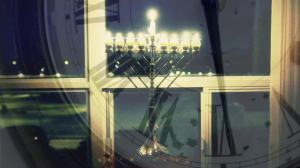 But when the days are shortest and the nights are coldest, just then can a little light shine forth and dispel much darkness. Like a lighthouse guiding a ship home, the lights of the Chanukah menorah can draw us back from the abyss of spiritual oblivion. And as we add candle upon candle and light upon light, the growing radiance of the menorah reminds us of the divine flame that has guided us through the darkness of exile and saved us from the darkness of assimilation for generation after generation.
If we, like the Hellenist Jews, allow the material values of contemporary culture to shape our thinking and guide our actions, then we have truly forgotten who we are. Like the prince whose soul longed for nothing but a little hut to protect him from the sun and the rain, we will be destined to live out our days in futility.
But if we cling to all that which is noble within us, if the values of our tradition drive us to perform acts of kindness and charity, to devote a few moments each day to heartfelt and meditative prayer, to treat neighbors and strangers alike with respect, to set an example of morality and character for our children — then we will have rekindled the spark of divinity inside us, and we will have earned the privilege to have our Father, the King, bring us home.
Originally published in 2003 by Jewish World Review



It’s right before your eyes
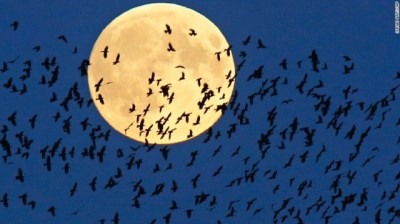 Yesterday’s supermoon, the closest and brightest in seven decades, is dramatic precisely because it fails to push back the darkness of night. King Solomon warns us of the pitfalls of living “under the sun,” reminding us that too much light can blind us to the dangers posed by our own misperception — a theme that figures prominently in my book Proverbial Beauty. I’m taking the opportunity to revisit this article from 2009.
Imagine if, in the late 1990s, a freshman congressman in the House of Representatives had submitted, as his first piece of legislation, a bill requiring airlines to install high-security doors on all passenger planes between the cockpit and the cabin. Imagine that the bill narrowly passed, was signed into law, and resulted — at great inconvenience and expense — with enhanced security for every commercial flight crew by the summer of 2001.
What would such an initiative have produced? Most notably (or really, just the opposite), September 11 would be a date of no greater significance than August 3. No terrorists would have seized those airliners and flown them into the Twin Towers that day. Perhaps American troops would never have gone into Afghanistan or Iraq. Perhaps the economy would not (yet) have collapsed. Quite possibly, Barack Obama would never have been elected president in an anti-George W. Bush backlash.
In his book The Black Swan: The Impact of the Highly Improbable , economist Nassim Nicholas Taleb proposes just such a scenario. But Mr. Taleb focuses less on the global consequences than on the fate of our fictional congressman — let’s call him Joe Smith. Congressman Smith will not be remembered as the hero who prevented the worst terrorist attack in history, precisely because he successfully prevented it. In all likelihood, he will be loudly denounced as the architect of an expensive and irrelevant measure and hounded out of office. He may live out his life regret his own lack of political saavy, which ended his career before it had even begun.
A complicated and often elusive treatise, The Black Swan proposes a correlation between history’s most significant events and the degree to which they were unanticipated. The stock crashes of 1929 and 1987; the outbreak of both world wars; the collapse of the Soviet bloc and the rise of Islamic fundamentalism. Each of these came as a profound shock to the world; only with the benefit of hindsight have historians explained all of them as political and economical inevitabilities.
Moreover, the lessons learned from history’s most earth-shattering events tend consistently to be exercises in locking the barn door after the horse has run away. Both individually and collectively, we implement strategies that would have changed the course of history had we applied them earlier, failing to realize that our measures to correct address the specific circumstances that shaped the past rather than the broader principles that will determine the future. The more closely we focus on what we expect to happen, the more we increase the probability that the future will arrive from an entirely unimagined direction.
DON’T LOOK NOW
The human eye is a truly remarkable organ. It is self-focusing, adjusts instantly from close-range to distance, discerns color and texture, judges distance, and adapts to bright sunlight, inky darkness, and everything in between. It allows us to focus on a single point of interest while, through our faculty of peripheral vision, we continue to process information coming in from all sides to provide context and enable us to respond to changing conditions.
 Instinctively and intuitively, we place the object of immediate interest at the center of our optic and cognitive attention. But this is not always the most effective means of perception. We have all experienced instances of looking directly at an object and failing to see it, either because it is so familiar or unremarkable that our minds filter it out as irrelevant, or because it is so incongruous that our subconscious refuses to accept its presence. In such cases, we may notice an object only when we are looking elsewhere and our peripheral vision, unencumbered by the censorship of our expectations, draws our attention back to that which had previously hidden in plain sight.
This phenomenon — called averted vision — was first alluded to by Aristotle and has become particularly important among astronomers, who have found that observing an object peripherally may increase its resolution by up to three or four magnitudes. Because the center of the eye contains only cones, which perceive brightness and color, fainter objects are more easily detected by the rods, which perceive dim, monochromatic light and occupy the outer regions of the eye.
LOOK AWAY AND ALL WILL BE REVEALED
We live in a world that, on its surface, seems well-ordered and readily understood. The cycle of seasons follows its natural course with relative predictability. The habits of animals remain virtually unchanged. The waters of the earth flow downward from the mountains to the seas, evaporate and rise up to the firmament, then return to the earth as rain.
On closer inspection, however, the world is a place of profound mystery. Solid objects are composed of increasingly tiny particles, many of which are spinning wildly in microscopic orbits at nearly the speed of light. Hundreds of other sub-atomic particles waft about our universe, many without any clear direction or purpose. The beginnings of physical existence and life itself cannot be substantiated through any empirical evidence or rational theory. The force of gravity, which is so fundamental that we scarcely give it any thought, has no satisfactory explanation.
Atoms, the building blocks of our universe, had never been directly observed until last year, when an electronic microscope powerful enough to view them was finally engineered. The protons, neutrons, and electrons, as well as those myriad other sub-atomic particles, are still yet to be seen. So how do we know they exist? Indirect evidence — the averted vision of science. By analyzing observable evidence, scientists have determined that these particles must exist to explain otherwise unexplainable phenomena.
But why should our universe be so impenetrably shrouded in mystery? The sages of the Talmud explain that ours is a world of hester ponim — a world in which the Almighty “hides His face.” The familiarity of the material world draws all our attention, distracts us from the true spiritual nature that reveals itself only at the periphery of our vision. The unanswered questions of science, the anomalies of nature, the enigmas of philosophy, the improbability of the cosmic and individual “coincidences” that surround us daily — all these testify to the order and the One who imposed order upon the universe. They whisper to us from the corners of our consciousness and beckon us from the edges of our awareness, vanishing to insignificance amidst the cacophony of physical existence the moment we try to focus on them, then reappearing as soon as we turn our attention elsewhere.
Search for G-d and all His might, says King David, seek His presence always.The harder we try to find order in our lives, the more chaotic our world seems to become. By allowing the subtle evidence that flutters at the fringes of Creation to hold out attention, however indirectly, the more we make our hearts and minds sensitive to the spiritual reality that is the foundation of the physical universe and the human condition.

How to End a Conversation
 A classic riddle asks: Using three periods (.), two commas (,), and one question mark (?), punctuate the following line to produce a logical and grammatically correct sentence:
That that is is that that is not is not is that it it is
If you know the answer, don’t text it to your friends. You might hurt their feelings.
However, just between us, here’s the solution:
That that is, is. That that is not, is not. Is that it? It is.
The beauty of a brainteaser like this one is not just that it gets us to think. More important, it gets us to think about thinking, to appreciate how communication is critical to critical thinking, and to think about how the same string of words can be fashioned into a cogent message or left as a meaningless hodgepodge of phonetic symbols.
But don’t say so out loud. You might offend someone.
That’s what Professor Celia Klin and researchers at Binghamton University found when they asked undergraduates to interpret text messages responding to an invitation. Their study revealed that students perceived responses properly punctuated with a period at the end as less sincere and, in some cases, psychologically combative.
In other words, it’s antisocial to be articulate, crass to follow convention, and reprobate to observe the rules.
Click here to read the whole essay.

My Interview with Bill Martinez
 Listen in on my conversation about political correctness and the culture wars with nationally syndicated radio host Bill Martinez on 10/19.

A Present for Heaven
 When my youngest daughter was three years old, she discovered the helium balloons in the flower section of our local supermarket, handed out free to every child who asks for one. I tied the string around her wrist so the precious balloon wouldn’t escape up to the rafters. She bounced it on its string as I tugged it this way and that to avoid bumping other shoppers. She hugged it as we climbed into the car for the ride home.
As I pulled into the driveway, my daughter flew out of the car, her balloon bobbing along behind her, raced in through the front door and out again to our back yard, slipped the string off her wrist and gazed upward as the balloon rose into the sky and slowly drifted away.
“Why did you let go of your balloon?” I asked, slightly miffed that she had so casually cast away the new toy she had been fussing over for the last half hour.
My daughter just shrugged, giggled, and watched the balloon disappear from sight.
After our next trip to the market she did it again. Then again, over and over for months. Every time I asked the same question. “Why did you let go of your balloon?”
Finally I got an answer. My daughter looked me in the eye and replied with a smile, “It’s a present for God.”
* * *
She doesn’t do it anymore. And part of me mourns for the pure, innocent faith that prompted a little girl to give up her toy as an offering to the Almighty.
For all our experience and the sophistication, for all our indulgent smiles at the simplicity of our children’s beliefs, is it not likely that our children know something we don’t, something they themselves soon won’t know or even remember they once knew? And perhaps it is precisely their power of belief that sets them apart from the adults they will become.
Children believe in God, believe in their parents, believe in their country and their school and their friends and that good will always win out over evil. Their trust and faith haven’t yet been sullied by the lies of politicians, the corruption of law and justice, the avarice of sports heroes, the superficiality of Hollywood or, most importantly, the cynicism of their parents, who may try for a time to put on an act to spare their children from their own disillusionment.
But what if it worked the other way, that we could learn an old lesson from our children instead of imposing yet another new lesson upon them? What if we could turn the clock back and recapture even a whiff of the innocence of youth? Would we reach out to grasp it, or have we grown too jaded even to try?
This Rosh Hashana, Jews around the world will fill synagogues to inaugurate the first day of the Jewish new year. But Rosh Hashana celebrates much more than the beginning of another calendrical cycle. It celebrates birth and rebirth; it celebrates beginning and renewal, for it commemorates nothing less than the Creation of the world and Mankind.
 As we approach the New Year, let us ask ourselves how we can turn back the clock, exchanging bad habits for new challenges, routine for renewal, and cynicism for enthusiasm. Instead of smiling with adult condescension at the innocence of children, let us consider instead that the difference between childhood and maturity is not whether we give presents to our Creator, but what kind of presents we choose to give. A child serves God by sending a balloon up into the sky. An adult serves God by releasing his spirit to soar to the heights of Godliness.
Have we given charity in proportion with our means? Have we visited the sick and comforted the distressed? Have we consistently spoken with kindness to our neighbors, with respect to our superiors, and with patience to our children? Have we honored the Sabbath and studied the ancient wisdom of our people?
It’s not enough to make resolutions; we need to inspire ourselves to see them through. We need to awaken in ourselves an awe of the Almighty by reflecting upon the vastness of creation, the unfathomability of the stars in their courses, the mysteries of life, and the limitless potential of the soul — to behold for a lingering moment the immeasurable beauty and majesty of our universe.
And if we can follow through, if we can make the moment last without slipping back into our well-traveled rut of discounting every noble and beautiful thought and deed, then perhaps we can retain our faith in those things truly worthy of faith throughout the coming year.
Originally published in 2008 by the St. Louis Post-Dispatch and Aish.com.

Rosh Hashanah Tailor-Made
Nobody likes fundraising dinners. The speeches are dry, the menu is dull, and the seating arrangements seem to have been drawn up by the Marquis de Sade. No one looks forward to these affairs, and we attend them only out of a sense of obligation.
Since one dinner I attended last year, however, I have become more wary than ever of this kind of event.
The evening began unremarkably and proceeded unremarkably — up to a point. The food was better than usual, the speeches ran longer than usual, the company was as good as could be hoped for, and I never saw the dinner plate that slipped from the tray of the passing waiter and struck me squarely on the forehead.
 “I didn’t hit you, did I?” asked the waiter in response to the alarmed gasps and cries from the people who shared my table, several of whom assured him that he had, indeed, scored a direct hit.
“Are you all right?” he asked, inevitably. A silly question, really.
A pound-and-a-half of glazed ceramic packs quite a wallop after accelerating at thirty-two feet-per-second-squared from a height of six feet in the air.
At least I was still conscious, still sitting upright, and I didn’t think I was bleeding.
“Get a doctor,” someone said.
“He doesn’t need a doctor,” said someone else. “Get him a lawyer.”
The manager arrived with an ice pack. “Here, take this.”
“I was hoping for scotch with my ice,” I said.
He laughed, but didn’t bring me any scotch. “I’ll need your name and address, sir,” he said, handing me a pen and paper.
“Don’t sign anything,” yelled someone from the next table.
I scribbled my vital statistics. “I’m really very sorry, sir,” he said.
“Is there anything else I can do for you?”
“Just the scotch.” He laughed again and went away. I had figured the manager would offer me vouchers for a complimentary night’s stay. He hadn’t. (I never even got a letter of apology.) I hadn’t gotten my whisky, either.
I began regaining my bearings to a medley of more lawsuit jokes. From across the table, however, my next door neighbor offered the only profound comment of the evening: “What were you thinking about before you got hit?”
I knew exactly what he meant. According to Talmudic philosophy, there are no accidents, no coincidences, no random events. Everything comes about through the guiding hand of Divine Providence, what we call hashgochoh pratis: the spiritual imperative that governs how the external world acts upon each and every one of us. In other words, if I got smacked on the head, I must have had it coming to me.
This is a far cry from the popular notion that whatever I want, I have coming to me. As much as contemporary culture may insist that privileges and entitlements are birthrights, the Talmud recognizes only our responsibilities, both to other individuals and to society. When we live up to our obligations, we may expect certain rewards to come our way. But if we do receive an apparently undeserved blow, great or small, we should assume that the equilibrium of the cosmic scales of justice somehow needed to be set back in balance, and we should reflect upon the message that has just been sent us from on high.
Sometimes we can easily identify a concrete lesson to glean from such mishaps. Other times not. But the principle holds, even when we can’t perceive any clear cause and effect: this was necessary; now we need to brush ourselves off and get on with life.
The traditional Yom Kippur liturgy provides a poignant example in its narrative concerning Rabbi Yishmoel, the High Priest, who died as the skin of his face was peeled away to suit the whim of the Roman governor’s daughter.
The malachim, the divine beings who inhabit the heavenly spheres, protested in outrage: “Is this the reward for living a life committed to holiness?” they demanded.
“Be silent!” commanded the Almighty, “or I will return the world to void and nothingness.”
 The incomparable 18th century genius, Rabbi Elyahu of Vilna, explains G-d’s reply with an allegory: a king once received a gift of fine Turkish wool, the most luxurious fabric in the world. It was so beautiful, in fact, that the king could not bear to think that even a tiny piece of it should end up as scrap on the cutting floor. He went to every tailor in his kingdom and asked each to make him a suit without letting even one thread of the wool go to waste. But every tailor claimed that such a feat was beyond his ability.
Finally, the king found a tailor who agreed to do the job. When the king returned to the tailor’s shop on the appointed date, he discovered that the tailor had indeed produced an exceptional suit of clothes. The king was elated.
“But have you fulfilled your promise?” asked the king. “Did you use every thread?”
“You really don’t know,” answered the tailor. “And the only way you will ever will find out is if you tear your beautiful suit apart and lay out all the pieces in the original shape of the fabric.”
Similarly, we often think that life is full of unfair knocks or is missing essential pieces. But to know for sure, we would have to see all of human history undone before our eyes. Only then would we have the right to assert that there were flaws in the slow sculpture of creation.
The days from Rosh HaShonnah to Yom Kippur — the traditional season of judgment — afford us the opportunity to strengthen our trust that the Master Tailor has done His job well, that He has stitched together the fabric of eternity according to a plan He understands far better than we do — even when bricks, or china plates, fall out of the sky upon our heads.
Should I have sued the hotel? the waiter? the school holding the event? the principal, who was speaking when I got hit? No doubt, I could have found any number of lawyers eager to take the case. If a woman could receive 4 million dollars for spilling a cup of coffee in her own lap, this should be worth at least as much.
But life is full of honest accidents resulting in superficial scrapes and bruises. It’s better for us (and better instruction for our children) to look for what we can learn from life’s bumps and knocks, not to look for whom we can blame and how much we can squeeze out of them.
 The waiter returned, contrite and apologetic, perhaps more shaken than I was. “In twelve years this has never happened to me,” he said. Evidently, he also had a date with Providence. “Is there anything else I can do for you, sir?”
“I wouldn’t mind a scotch on the rocks.”
“I’ll see what I can do.”
He did. It wasn’t four million dollars, but it was better than a knock on the head.

Rosh Hashanah and the Mysteries of the Universe
 Originally published by Jewish World Review in 2003.
96% of the matter in the universe is invisible. Mysterious “dark energy” is pushing all of space apart. Empty space is not really empty, but filled with subatomic “foam.” At least seven parallel universes exist, each a trillionth the size of a proton.
Science fiction? Fantasy? The product of opium hallucinations?
Guess again. According to an article in U.S. News and World Report, these hypothesized phenomena represent the mainstream of current scientific thought.
In the wake of observations reported last March by NASA’s Wilkinson Microwave Anisotropy Probe, astronomers and physicists are resorting to these and other fantastic models to explain anomalous temperature variations in the background radiation permeating the heavens.
And who knows? They may be right. After all, once upon a time a round earth, a heliocentric solar system, and manned flight were all scorned as flights of the wildest fancy. Perhaps entire universes really do exist, wrapped up in a particle of dust beneath your finger nail.
On the other hand, increasingly complex and convoluted theories begin to look like the frantic flailings of scientists drowning in the mysteries of human existence. Indeed, one noted physicist confessed that, if he’d been presented with these theories not long ago, “I’d either ask what you’ve been smoking or tell you to stop telling fairy tales.”
Of course, one almost has to feel sorry for these scientists. Every discovery, every revelation, every insight, opens up a new Pandora’s Box of inexplicable phenomena. A few short decades ago, we knew of about half a dozen known sub-atomic particles. Today there are hundreds, with the number growing all the time, and often only the haziest guesses as to why they exist. Relativity theory and quantum theory both seem to describe the workings of the universe, but only the most strained and unproven theory suggests how to unite these two approaches.
 It’s almost enough to make one contemplate — dare we say it? — Divine Creation. Indeed, man’s desire to plumb the secrets of the universe is nothing new. Newton, Descartes, Galileo, Aristotle, all of these and many others grappled with physics and metaphysics in their labors to comprehend the vast expanse of time and space that stretches toward the boundaries of existence.
But long before the first scientist or philosopher raised his eyes to gaze into outer space and contemplate the stars, another man searched inner space seeking understanding. His name was Job.
A righteous man who lost his fortune, his family, and his health, Job questioned whether there was any rhyme or reason to explain the suffering of the righteous and the prosperity of the wicked. And as he sank into the mire of self-pity and nihilism, a Voice from above answered him:
“Where were you when I laid the foundations of the earth?” asked the Almighty. “What is the path where light dwells? And darkness, where is its place, that you may take it to its boundary, that you may understand the paths of its home?”
The Creator never explains Job’s suffering, but He does provide Job with the answer that restores his faith: The complexity of creation is not only more that you know, but more than you can begin to imagine. Every star above you in the sky, every drop of water in the sea, and every grain of sand upon the shore resides in its place and follows the course chosen for it; so too is every seeming whim of fate rather an unfathomable pulse from the primordial machine that steers the unfolding of eternity.
And so we say in the Rosh HaShanah liturgy, “This day is the anniversary of the beginning of Your handiwork, a remembrance of the First Day.” As we stand in the murky spiritual twilight between the end of one year and the start of another, we contemplate that amidst the mystery and uncertainty that surrounds us, one constant offers us security and safety if we take hold of it: the indivisible relationship between the Creator of all and His ultimate creation — Mankind, for whom He brought all else into being.
This day. This day of Rosh HaShanah begins a new year, a new season, a new opportunity to draw near to the Master of Creation. This day offers us a poignant reminder of how to cling to the godliness the resides within us, to strive to become more devoted in our relationships and less demanding in our expectations, more focused on others and less fixated on ourselves, less passionate about material gain and more ardent in our pursuit of spiritual fulfillment.
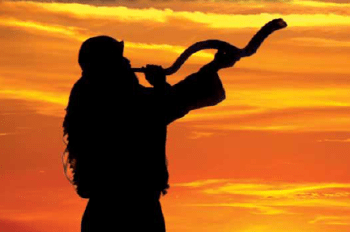 This day reminds us that we hold in our hands an awesome privilege, as well as an awesome responsibility. How willingly are we seduced into looking for simplistic solutions to the moral and ethical dilemmas that life throws at us day after day? How longingly do we embrace superficial cliches and bromides that urge us to pull the warm covers of apathy over our heads?
This day. Rosh HaShanah is our wake up call, and the sound of the shofar signals our reveille to open our eyes and behold the breathtaking magnificence that is Creation. And if our minds reel as we try to grasp the limitless expanse of the universe, we can yet grasp onto this certainty: that the One who placed us in its midst has revealed Himself through His Word and has given each of us a priceless gift, no less than the sand and the sea and the stars — an indispensable role to play in the completion of His masterpiece and the means through which we can become one with the infinite and with the divine.

When the plane falls from the sky
With Tom Hanks’s new movie “Sully” allowing us to re-experience the dramatic events of January, 2009, I’m taking the opportunity to revisit my thoughts from the aftermath of the heroic rescue, originally published on Aish.com.

There are three great stories in the averted disaster of US Airways Flight 1549.
First is the story of Divine Providence, which placed a pilot with precisely the right training, experience, and temperament at the helm of the crippled jetliner and the only feasible landing strip — the Hudson River — close enough at hand for a safe, if chilly, touchdown.
Second is the story of heroism. The pilot, Chesley Sullenberger, drew upon his experience with both military fighters and gliders to bring the passenger plane safely down from the sky. The flight crew quickly and efficiently instructed the people to prepare for impact and then hastened them off the sinking plane. The rescuers, both professional and private citizens, steered their craft to the crash site within minutes. Not one life was lost.
But the third story is that of the passengers. For the most part untrained and unprepared, without exception the passengers on Flight 1549 did precisely what they needed to do in order to survive.
They followed instructions.
In moments of crisis, bold leaders act decisively, heroes rise to the occasion and show their true colors, and acts of selflessness inspire those of us thousands of miles away who find our faith — in both Divine mercy and in our fellow man — renewed.
But heroes cannot succeed in a vacuum. Had the passengers on the stricken plane responded with panic, had they stormed the cockpit in a frenzied attempt to seize the controls, had they ignored the directions of the captain and the flight attendants, had they fought one another to reach the emergency exits first, then this story would have a much less happy ending.
The sages of the Talmud teach: “In a place where there are no leaders, strive to become a leader.” On the surface, this means precisely what it appears to mean. It is leaders who impose the unity and direction that constitutes the difference between a community and a mob, between order and chaos, between a chance for survival and self-destructive pandemonium. Where there is no one to take charge, every individual must see himself as a potential leader and do all he can to shoulder the responsibilities of leadership.
 At the same time, the sages tell us that this principle applies only in a place where there are no leaders. Wherever there is someone qualified and willing to lead, then it becomes the responsibility of others to follow, to become good soldiers and carry out orders. It was the passengers of Flight 1549 who enabled the heroes of the story to perform heroically.
Perhaps the exultation we feel over the survival of Flight 1549 stems from a deeper, often subconscious conviction in the unity of mankind. We can transform ourselves from a divided rabble into a society of leaders and followers, of captains and foot soldiers. We can achieve great things when we come together in a common cause for the common welfare.
Nothing catalyzes us like crisis. When the ship is sinking, when the plane is going down, when the enemy is at the gates, we find ourselves motivated to set aside our egos and our petty differences and stand together for the sake of our own survival.
Perhaps this is the most relevant lesson of Flight 1549. At a moment in history when the world has become less predictable than ever, when unstable nations like Iran and North Korea are on the brink of acquiring nuclear weapons, when terrorists strike against our most beloved kinsmen without reason or pretext, when enemies at our borders would rather suffer self-destruction than make peace, when the world economy teeters on the brink of collapse and our leaders spin like weather vanes grasping for solutions — what better time to reflect upon our potential to come together in the most hopeless moments, as when a hundred thousand tons of steel is falling out of sky, as when all human society seems ready to fall back into the dark ages, and change the outcome, against all odds, from tragedy to triumph.
With common purpose, we can accomplish virtually anything, as the Framers did when they envisioned a great nation with the motto e pluribus unum — out of many, one — hearkening back to a day over 3000 years earlier, when a people newly freed from bondage stood in the wilderness at the foot of a mountain and accepted their divine mission, as one man, with one heart.
 Yonason Goldson