Home » Posts tagged 'Leadership' (Page 4)

Tag Archives: Leadership

The Real Rainbow Coalition

The story of a Great Flood can be found in virtually every human culture.  However, the biblical record stands alone in its dramatic conclusion: as Noah emerges from the ark, the Almighty sets His rainbow in the heavens as a sign that never again will He visit the waters of devastation upon the earth.

Much has been made of the shape of the rainbow – an inverted bow to direct the arrows of divine wrath away from mankind.  But is this a hopeful sign?  Does it not imply that we are in fact deserving of destruction?  Does it not contain a warning, that only because of God’s promise to Noah are we spared the natural consequences of our own moral corruption?

And what do the colors and beauty of the rainbow signify?  Is it not incongruous to invoke something so beautiful as a reminder that a 4000 year-old covenant is all that stands between us and annihilation?

WANTING IT BOTH WAYS AND NO WAYS

In the old Peanuts comic strip, Linus once declared that, “I love humanity; it’s people I can’t stand.”

It’s no longer a joke.  As human society grows ever more fractured, we see everyone else as either too traditional or too progressive, too dovish or too hawkish, too far left or too far right.  Unity remains a dream we no longer believe in as we divide ourselves up into increasingly tribal enclaves.

Paradoxically, it is the strength of conviction that separates people from one another.  Too many of us believe that our way is more “beautiful” than anyone else’s way, that only we are the chosen standard-bearers, and that we alone speak Truth while all others are heretics or infidels.

Why do we find it so difficult to celebrate our — dare I use the word — diversity?  We give lip service to the value of multiculturalism, recognizing that our differences can make us greater than the sum of our parts.  But then we use distinctiveness as a wedge to set ourselves apart from others.

In modern society, diversity often becomes a club to bludgeon into submission all whose sense of traditional values or personal integrity compels them to reject the moral anarchy that defines our times.  Intolerance masquerades as forbearance, proclaiming an open-mindedness that is reserved only for those who conform to ideologically acceptable standards of cultural elites.

THE CHALLENGE OF MORAL EQUILIBRIUM

It was the same kind of violent division that brought the devastation of the Flood upon mankind.  In that benighted generation, the law of the jungle drove human beings to an unthinkable level of bestial corruption.  Had the Almighty not brought the waters of destruction upon the earth, human beings would surely have destroyed themselves.

Back then, it was selfishness and greed that tore society apart.  Today, it is ego and ideology.

True, it’s not easy to achieve the delicate balance between acceptance on the one hand and conviction on the other.  Tilting too far to one side catapults us toward moral dogmatism; tilting too far to the other sets our moral compass spinning in all directions.

So what is the solution?

The answer lies is seeing the rainbow as both beautiful and terrifying.  It is a symbol of diversity and how much we can achieve by celebrating our differences; but simultaneously it is a reminder of how much destruction we can bring upon our world when differences become justification for divisiveness.

To truly love our fellow human beings we cannot retreat into ideological isolation.  If we do, we will succeed only in marginalizing others in our own minds.  Ultimately, we must take great care to chart a course between the extremes of ideology and accommodation.

So reach out to connect with someone outside your own close, closed, comfortable group.  Engage people who think differently, not to debate but to exchange ideas and seek understanding.  Remember as well that the most exquisite flowers, the most dramatic seascapes, and the most inspiring mountain peaks are those that reflect all the colors of the rainbow.

Published in Jewish World Review

Honor Thy Fathers

Meritocracy.  Collaboration.  Personal achievement.

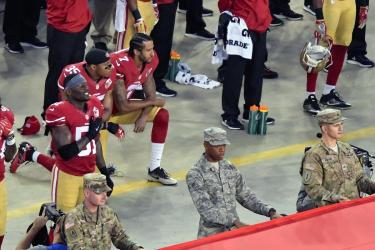
These are the ideals upon which was the United States was founded, the ideals that have made and continue to make America great.  They are also the ideals that have traditionally been associated with professional sports.

How ironic, therefore, that the NFL has been overtaken by a sentiment of rejectionism against the symbol of those very values.  How tragic to witness players use the freedom represented by the flag to show contempt and disdain for the country that has afforded them an opportunity for success they might never have otherwise had.

No, our country is not perfect.  But the flag represents that values that allow us to strive together toward a more perfect union.

That being said, it’s not the job of the president to call for the NFL to penalize those players.  It’s his job to demonstrate the responsible use of free speech by conducting himself with principled determination and disciplined self-restraint.

Our Chief Executive is responsible for passing fair and effective legislation while creating a national tone of respect and personal responsibility.  Implicit in that is knowing and showing where the division between the two must be drawn.


The Beauty of Misfortune

What would Gandhi say?

There’s not much question, really.  The icon of civil disobedience disdained every form of violence.  He most certainly would have condemned riotous demonstrations protesting any courtroom verdict, no matter how unpalatable.  So would Martin Luther King.

It’s easy to understand why many St. Louis residents took to the streets over the acquittal of former police officer Jason Stockley in the shooting death of Anthony Lamar Smith.  Officer Stockley’s comments and conduct raised serious questions about the credibility of his own testimony.  And civil protest is one of the foundational principles of a free society.

But on the other hand, the shooting followed the high-speed pursuit of a suspected heroin dealer, and video footage failed to substantiate the claim that Officer Stockley planted a weapon.  In the end, Judge Timothy Wilson concluded that there was insufficient evidence for conviction.

So did Jason Stockley get away with murder?  We may never know.  But that’s not the point.

TO ERR IS HUMAN

We all know that our justice system is imperfect, as any system designed and implemented by human beings must be.  Sometimes honest people make mistakes.  Sometimes authority is corrupt.  Sometimes the truth hides its face, and sometimes we have to accept that justice can be painfully blind.

It’s what we do next that matters most.

Some respond to frustration by venting their anger on whatever target crosses their path – in this case, by smashing the windows of 23 storefronts in my hometown, the St. Louis suburb of University City.

But from these senseless acts of misdirected destruction emerged an exquisite silver lining, an example of how human beings can discover within themselves true nobility in the face of injustice.

The morning after the carnage, volunteers appeared on the streets and began sweeping up the broken glass and boarding up the broken windows with plywood.  But even at that, the kindness of strangers had only just begun.

Before long, local artists showed up to paint the plywood panels, transforming stark reminders of wanton violence into beautiful murals of friendship and neighborhood harmony.

FACING THE FUTURE

This week, the Jewish community stands between Rosh Hashanah and Yom Kippur, between the Day of Judgment and the Day of Atonement.  On those awesome days, we gather together in prayer, one people with one heart, to recite the High Holiday prayers.  And as the liturgy rises to a crescendo, it impels us to ponder the uncertain future that awaits us in the coming year:

Who will live and who will die; who by water and who by fire; who by the sword or wild beast, who by famine or thirst; who by storm or plague or violence.  Who will rest and who will wander; who will have peace and who will suffer; who will be poor and who will have wealth; who will be cast down and who will be raised high.

We have no idea what the future holds.  Ultimately, we have no control over where fortune will take us.  What we do control, however, is how we respond to our own fortunes and the fortunes of our fellows.

When we see our neighbors in distress, will we drop everything and hurry to their aid?  When we behold injustice, will we add to injustice by lashing out impulsively?  Or will we stand shoulder to shoulder in a show of solidarity?

And when we witness senseless suffering, will we close our eyes and harbor vengeance in our hearts, or will we resolve inwardly to do better ourselves, to ensure that we never contribute to the problems of the world but apply our energies toward finding solutions?

There is so much good in the world from which to find inspiration.  And while some may add to the darkness with misdirected violence, let us call upon ourselves to rise to every challenge, to shine bright so we can inspire others to shine themselves.

Published by Jewish World Review

Video: What are Ethics? Communication is Power

Video — What are Ethics? The art of losing the deal

Irma and Harvey: a love story

If the stars should appear one night in a thousand years, how would men believe and adore.
~Ralph Waldo Emerson

It’s a sad reality of human nature:  we miss out enjoying the blessings that fill our lives because we take them for granted.  Until we don’t have them any more.

How many hours do we fritter away on texts and tweets and Facebook updates?  Are these more satisfying than friends and family, more enlivening than smelling the roses and gazing at the stars?  Not in a thousand years.

We think we can have it both ways.  After all, the roses will be there tomorrow; and the stars will be there forever.

Until they aren’t.  Having been bred for beauty, many of our roses have no fragrance whatsoever.  And most of us have never beheld the wonder of the Milky Way.  It disappeared decades ago behind the veil of urban pall.

AWAKE, MY GLORY!

Nature has its own way of reminding us to pay attention.  Sometimes it’s through extraordinary beauty.  And sometimes it’s through awesome power.  Last month, the light of the sun disappeared at midday as the eclipse moved across the country.  This month, the fury of life-giving water uprooted the lives of millions.

Photo Credit: Washington Post

The misery inflicted by Hurricanes Harvey and Irma was horrific to watch, and exponentially more horrific to endure.  From thousands of miles away, Americans shook their heads at scenes of devastated communities, shattered homes, and displaced families.  We wrote relief checks, offered prayers, gave thanks for our own safety, and carried on with our lives.

We wished we could do more.  But what more we could do?

Consider this:  Maimonides writes that anyone who hears of human suffering and does not respond with repentance and good deed is a cruel person.

The most effective way to make the world a better place is by making ourselves better people.  Yes, I can work to save the rainforests and save the whales.  I can raise money for refugees and volunteer my time to Habitat for Humanity.  I can do these things, and I should.

Ultimately, however, the only thing I can be certain of changing is myself.

If I give charity out of guilt, I’m really just bribing my conscience to leave me alone.  If I write a check because I think I’m going to relieve human suffering, I’m merely indulging my ego.  It’s true, of course, that the recipients will benefit from any act of giving regardless of motivation.  But am I benefitting myself as well?

LEARNING TO LOVE

Acts of kindness and charity should be expressions of sharing another’s pain – a natural, reflexive response to human suffering.  When I give what I can, whether a lot or a little, I join with others to raise our collective voice and proclaim that we will not stand idly by and abandon others to their fate, even if we have no real control over how fate will deal with them.
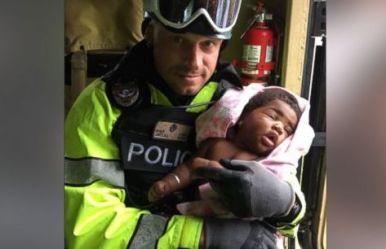
Purely motivated giving transforms us into giving people.  By taking action when others are in need we learn to love our fellows as we love ourselves.  And when we do, we become more appreciative of the relationships that are the source of true happiness.

The Jewish prayer book contains a series of blessings we recite each morning to acknowledge who we are and why we exist.  Among those blessings we find the following:

Blessed are You, L-rd, our G-d, King of the universe, who stretches out the earth above the waters.

Our place in this world is precarious.  The laws of nature operate with both granite consistency and fickle unpredictability.  If we want to weather the storms of life, we need the support of others, which means we have to be there when others need support from us.

As individuals, we are exposed and vulnerable to the vagaries of happenstance.  As a community, we find that the winds of fortune will not overturn our lives, and the waters of uncertainty will never extinguish our spirit.  Out of the darkness of misfortune, the light of fellowship will shine down on us like the brightest of stars.

Published in Jewish World Review

Caravan to Midnight 2

It was my pleasure to be invited for a return interview with John B. Wells on Caravan to Midnight.

Listen to the interview here:

Video — What are Ethics? Part 29

Lessons from the Hurricane Harvey

Our hearts go out to the suffering people of Houston and the Gulf Coast who are beset by the violence of nature.  Rather than just shake our heads in wonder, we should reflect upon our own fortunes and the illusion of security in a capricious world.

The following is adapted from an article originally published by Jewish World Review after the Pacific Rim Tsunami of 2004.

The Tsunami and the Circle-Maker

Volcanoes. Hurricanes. Earthquakes. Fires. Tornadoes. Blizzards. Drought.

In a time when reports of terrorism have become all too common, it is sobering to consider the myriad ways nature can inflict death and violence on a scale surpassing the most destructive instruments devised by man. Of all these, however, water holds a unique terror in the scope and measure of its devastation.

Aside from the 300,000 lives lost across nearly a dozen countries along the Indian Ocean, millions more suffered dehydration, disease and hunger in the wake of the catastrophic tsunami. And rare though tidal waves may be, the more familiar trial-by-water of flooding leaves similar numbers homeless and in danger of starvation almost every year.

It seems ironic that water, the source and foundation of all life upon our planet, can become nature’s most malevolent instrument against the beings whose lives depend upon it.

Of course, devastation by water occupies a prominent place in human history. Virtually every ancient culture records the tradition of a great flood that inundated the world, lending credence to the biblical account of Noah and the ark. Jewish tradition describes this not as a random event, but as a divine response to the corruption of mankind.

Talmudic tradition, however, hands down a much more enigmatic account of heavenly intervention through water.

BLESSING AND CURSE

It was a time of terrible drought.  The Jewish people approached the sage Choni HaMagil and beseeched him to pray for rain on their behalf. When Choni’s supplications to the Almighty went unanswered, he drew a circle in the dust and stepped inside of it, vowing not to leave the circle until God bestowed rain upon His people.

Immediately, a fine mist settled upon the earth, too little to alleviate the drought but sufficient to free Choni from his vow.

Choni called out to heaven: “I asked not for this, but for a rain to fill all the wells and cisterns.” Immediately, raindrops larger than melons began to fall, wreaking destruction upon homes and fields.

Again Choni called out to heaven: “Neither did I ask for this, but for a rain of blessing.” Immediately a normal rain began to fall, filling the wells and cisterns of the people as Choni had requested. But the rain did not stop, and soon the entire population of the land feared that they would drown in the rising waters.

One last time Choni called out heavenward: “Master of the World, Your people can tolerate neither too much blessing nor too much misfortune.” Immediately the waters abated, and the people returned to their fields. From this time onward, people referred to Choni by the name HaMagil   —   the Circle-maker.

What is the point of this story? What did Choni mean that the people could not tolerate too much blessing?

START-UP NATION

The history of the Jewish nation begins with the Exodus from Egypt.  In commercial terms, this was the largest line of credit ever extended in the history of man.  It was a loan from on high for the greatest start-up enterprise ever, a nation built on the principles of moral and spiritual refinement.  With no credit-history of any kind, the Jews were given freedom from slavery, freedom from oppression, and freedom to chart their own course into the future.

Moreover, the coffers would remain open and accessible:  immeasurable blessing and unbounded prosperity would continue to flow from heaven on one condition — that the people would repay their loan by living according to the dictates of ethical and moral values.  By rising above material pursuits and petty self-interest, the Jewish nation would continue to receive an infusion of capital enabling them to pursue spiritual goals and ideals.

In this light, blessing may be understood as a double-edged sword. Wielded in one direction, it cuts down all obstacles that stand before us. Wielded in another, it obligates us to a standard of righteousness and refinement that we may find nearly impossible to meet.

TWO ROADS DIVERGE

This was the symbolism of the Almighty’s response to Choni the Circle-maker’s plea:

Two roads lie before this people, and it is their choice which to follow.  Misuse of the abundance of this world leads back to the oppression of materialism and the slavery of self-indulgence, back to spiritual emptiness and the absence of all blessing. Aspiring toward the fulfillment of a higher purpose and discarding lesser goals, however, leads to moral greatness accompanied by the many blessings of the material world.

And this too was the meaning behind Choni’s prayer:

Master of the World, whatever potential this people may have, they still suffer from human failings and human shortcomings. They cannot tolerate too little material blessing, lest the struggle to survive overwhelms them and they abandon all higher aspirations.  Nor can they tolerate too much blessing, lest they cower before the goal set for them and lose all hope of its attainment.

By all accounts, the world we live in today enjoys a level of material affluence unattained and unimagined by previous generations. Such basic necessities as rapid transit, instantaneous communication, indoor plumbing, electrical lighting and refrigeration, which we take for granted, provide us with an ease of living simply unavailable to even the wealthiest, most powerful monarchs until the last century.

Spiritual refinement demands neither abstinence from material pleasures nor the forcible redistribution of wealth from the haves to the have-nots.  But it does require us to recognize the responsibilities of prosperity.

So how should we respond when the waters of the earth that are the source of our greatest blessing — life itself — rise up to inflict enormous tragedy, swallowing human life and draining billions of dollars of aid to spare human suffering?  We should pause to consider whether we are using our blessings wisely, and what we must do to ensure that we will continue to deserve them.

Winning Through Consensus

From the moment our current president began preparing for his ascension to power, the outgoing president began showing signs of concern — if not outright anxiety — over his legacy. And he had good reason.

Whether or not one approved of Mr. Obama’s policies or performance, there is one undeniable fact: as president, he made little effort to govern by consensus.

Click here to read the whole article.