

Home » Posts tagged 'Personal Growth' (Page 12)

Tag Archives: Personal Growth

The Key to Personal Success… Just Ask!

ask_questionsDoes this sound familiar?

You’re running out the door to take your wife to the airport, only to discover you have a flat tire.  You don’t have time to wait for a taxi or the auto club.  You want to ask your neighbor for a ride, but you’re afraid it’s too much of an imposition.

Or… you see someone on the subway reading a book by your favorite author or about a topic you find fascinating.  You want to strike up a conversation, but you’re afraid of intruding on the other person’s privacy.

Or… you have a lead on a promising job opportunity, and an acquaintance has dealings with your prospective employer.  You want to ask her to make an introduction, but you don’t want to put her in an uncomfortable position.

Maybe you’re afraid of rejection; maybe you’re afraid of overstepping the bounds of the relationship; maybe you’re afraid of being a pest.

Sure, there are boundaries, and sometimes we do cross them.  So if these scenarios arise often, you might need to examine whether you’re overly needy.  

But most of us aren’t looking for such situations; they just happen.  And when they do, here’s the key:  just ask!

Click here to read the whole article.

…as effortless as drawing breath

PB Meme -- For the virtuous

Order now on Amazon and learn to love life

Are you a brick?

Daily-Quotes-Life-Is-The-Most-Difficult-Exam-Inspirational-Quotes-PicturesA rabbi walked into a brick-making factory.

No, this isn’t a joke.  It really happened, many decades ago when Jerusalem was still a quiet, provincial village.  The rabbi watched as workmen filled up iron trays with moistened clay and slid them into large baking kilns, removing each tray to make room for the next.

“Tell me something,” the rabbi asked one of the workers.  “The clay looks exactly the same coming out of the kiln as it does going in.  What would happen if you didn’t put it into the fire?”

The worker laughed.  “It may look the same,” he replied, “but without the mold holding the clay together it would disintegrate the moment it began to dry.  You have to bake it in the fire if you want it to become a brick.”

The rabbi learned an important lesson from the brick-maker:  Our schedules and responsibilities “hold us together,” keeping us productive and forcing us to be efficient.  But what happens after work, on the weekends, or over vacation?  Do we remain disciplined with our time and solid as a brick, or do we crumble like so much dust into idleness and fritter away our time?

For parents especially, summer vacation poses a challenge, with two months of unstructured time looming before their children.

On the one hand, children need free time to learn to create their own schedules and manage their own time.  Too much structure deprives children of a critical component in their development.

But children shouldn’t be left entirely on their own, particularly in this generation when electronic toys provide limitless junk food for their growing minds.

As in all things, the best parents are consultants, gently but persistently helping their children to recognize the options in front of them and prodding them to make the choices that will serve them best.

And the best way to teach our children is by modeling the behaviors we want them to learn.  Be a brick, and your children will be bricks, too.

The Power to Change the World

With so much senseless violence dominating the headlines, from Charleston, South Carolina, to Syria and beyond, it’s worth revisiting this story of heroism and the power of the individual to change the world.

On the afternoon of September 18th, 2014, a teenage driver lost control of his SUV as he sped down Salt Lake City’s Indiana Avenue. The GMC Yukon tore through the safety barrier, went airborne into a ravine, and landed upside down in three feet of water and the bottom of the gully. Dazed or unconscious, strapped in by their seat belts, the driver and his two passengers had minutes before they would drown.

article-0-21869C9000000578-789_634x608What happened next offers a welcome relief from the relentless litany of strife and suffering that fills the headlines. Moments after the crash, nearly a dozen bystanders waded into the waist-high water and, working in unison, flipped the massive vehicle over onto its wheels, lifting the crash victims out from under the water and saving their lives.

But it might never have happened. As horrified onlookers stood frozen and stared at the capsized SUV, Leo Montoya, Jr., an out-of-work locksmith, overcame the Bystander Effect, plunged into the current and dove under the water in an effort to save the occupants. Unable to free them from their seat belts, only one option presented itself.

Turning toward the crowd, Mr. Montoya shouted, “We have to get this vehicle back on its wheels. Now, now, now!” Prompted by his commands, some of the men standing on the roadside began following him into the water. With so many pairs of hands and shoulders at work together, the Yukon rolled up and over until it was back on all four wheels and the passengers were clear of the water. When firefighters arrived, they freed the occupants and rushed them to the hospital.

The collective effort of bystanders saved three lives. But only because one person showed them the way and convinced them to follow.

The incident calls to mind another scene that happened 3,326 years ago after the exodus from Egypt at the splitting of the Sea. Faced with Pharaoh’s chariots bearing down on them from behind and the imposing expanse of water ahead, the Jewish people’s faith in God wavered. “Were there not enough graves in Egypt that you had to bring us out here to die?” they railed against Moses. The situation was impossible; there was no hope.

Until one man spoke up. Nachshon ben Aminadav, the prince of the tribe of Yehudah, cried out to the people: “If the only way to escape the Egyptian army is to go forward, then forward we must go. Let us do what we can and trust God to do the rest.” And with that, he waded out into the sea.

Inspired by his words, the people followed him. Deeper and deeper they advanced into the waters until, as the water reached Nachshon’s chin, the sea split before and around them, offering both the means of the Jews’ escape and the method of the Egyptians’ destruction.

What kind of person marches into the sea assuming that a path will open up to make way for a desperate nation? The same type of person who would charge forth and rally a dozen men to overturn a ton of steel, the type of person who understands that no matter how daunting the odds, there is no way to know the limit of human potential until we have pushed human potential to the limit.

What’s more, the potential of the many may remain unrealized until a singular individual shows that he has no interest in probabilities and, through sheer determination, awakens the collective spirit through which the impossible becomes reality.

We all want to be good and do good, and change the world for the better. But we lack confidence in ourselves, we lack the conviction to act, we lack the courage to risk failure. So we miss opportunities for greatness – not just by failing to charge into the breach, but by not expecting more from ourselves, by not setting the bar of human achievement and human integrity a little higher.

In one heroic moment, one man can inspire a world of others to change themselves. And the more we change ourselves, the more we change the world.

Just ask Leo Montoya. “As far as I know, a couple of kids get to live because of my actions,” Mr. Montoya told reporters. “I feel like I’m somebody.”

Originally published at Aish.com.


Honor (is learned from) Thy Father

Pearland defensive back Matt La Chiusa and his teammates stand during the playing of the National Anthem before the Oilers' opening game of the 2014 Texas high school football season against the Conroe Woodlands College Park Cavaliers played on August 29, 2014 at Woodforest Bank Stadium in Shenandoah, Texas. Pearland would go on to win the contest 25-14.

I was ten or twelve years old. My father and I had arrived at the stadium early, and I felt a thrill of excitement as we stood up for the Star Spangled Banner. Down on the field, our home team, the Los Angeles Rams, stood in a line holding their helmets under their arms. And in the row in front of us, a middle aged man stood with his hat perched casually upon his head.

The man didn’t respond.  “Hey you,” my father said, louder, “take off your hat.”

The man grunted an unintelligible, though clearly dismissive remark.

“You unpatriotic SOB,” growled my father; he didn’t abbreviate, either.

Dad!” I whispered, mortified and afraid, but also faintly confused.  My father had never before demonstrated any dramatic displays of patriotism.

The national anthem ended, the game began, and I guess I forgot about the incident because I never discussed it with my father, never asked him to explain an indignation that seemed entirely out of character.

But now I’m a father myself, and I don’t find my father’s action thirty years ago perplexing at all.

Why should we take off our hats for the national anthem?  Why should we stand up for the flag?  Why should we address strangers as “Sir” or “Madam,” wear coats and ties to church or synagogue, and give up our seats to the elderly?

It’s a matter of respect.  Respect for people.  Respect for institutions.  Respect for wisdom and values and human dignity.

Unfortunately, respect has been going out of fashion for a long time.  Sex scandals and no-fault divorce have eroded respect for marriage and commitment.  Partisan politics has eroded respect for leadership.  Inflated grades and deflated standards have eroded respect for teaching.  Abortion-on-demand and doctor-assisted suicide have eroded respect for life.  “Reality television” has eroded respect for ourselves.

Which was our first step onto this slippery slope?  Maybe it was the noble ideal of social equality, set spinning so wildly out of control that we began to equate respect with elitism.  Maybe the information glut convinced us that we know as much about medicine as our doctors, as much about cars as our mechanics, and as much about education as our children’s teachers.  Maybe our relentless pursuit of leisure time has made us too selfish to value age and experience, too lazy to act civilly toward our neighbors.

When respect is not earned, it disintegrates; when respect is exploited, it implodes.  Indeed, after his desperate quest for legacy, Bill Clinton was best remembered at the time of his departure as the American president who made his underwear preferences a matter of public policy, who pilfered the White House china,  and for whom a large percentage of once-self-respecting Americans so casually excused perjury in federal court.  Barack Obama will leave behind the first video of an American president making faces in the mirror in preparation for an historic selfie.

conversation-startersBut we should never rely on respect to percolate down from the top; it is our responsibility to grow it up from the grass roots.  It is the job of parents to teach their children to say “please” and “thank you,” to not interrupt and not talk with their mouths full, to speak civilly and give up their seats to the elderly, to pick up their own litter and maybe even someone else’s.  By doing so, parents instill in their children an intuitive sense of respect for others, even if their children may not understand why all these social minutiae are indispensable.

But too many parents have abdicated that job, either because they’re not around enough or because they never learned to be respectful themselves.

The Talmud says that where there are no leaders, strive to be a leader yourself.  In today’s increasingly fatherless society, teachers, scout leaders, and little league coaches have a greater obligation than ever to teach respect by showing respect for others — and so do we all every time we walk down the street or through the supermarket aisle.

A journey of a thousand miles begins with a single step.  And a journey through life begins with a step in the right direction.  Help a child take that step and, many steps later, his success will speak his thanks louder than words.

Every Father’s Day offers a reminder to say every day:  Thanks, Dad.

Originally published in the St. Louis Post-Dispatch

Proverbial Beauty: Browse paperback and Kindle versions at Amazon

Have you changed the world?

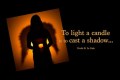
Candle proverbial beauty wisdom proverbsIf you’re walking into the sun, you can’t see the shadow you cast, no matter how long it might be.

If you’re looking for your shadow, you’re looking away from the light.

When the sun is at it’s highest and brightest, the shadow you cast is hiding under your feet.

Only when the source of light is about to disappear does your shadow stretch out toward infinity.

We don’t always get to see how we change the world.

Read the intro to Proverbial Beauty on Amazon.

Who’s Number One?

“The  fragile beauty of narcissism.”

That’s the title of a blog post I came across.  The author tries to make the case — in engagingly poetic prose — that arrogance is a virtue.  Having just published a book illustrating how to turn negatives into positives, I was intrigued by his efforts, but fear the gentleman doth protest too much.  We have enough blights upon society without turning more vices into virtues.

The author posits that,

Arrogance is “claiming ownership without justification”, in other words, more commonly, an inflated sense of self-worth. Why is it inflated? Because it assumes that that which is the source of pride endures, when the truth is it does not.

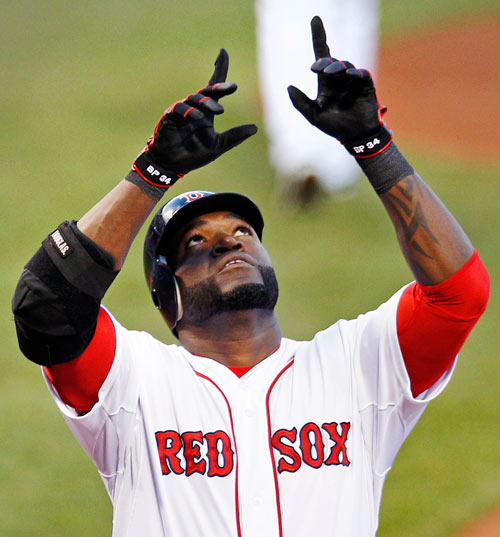
David-OrtizWell, he’s half-right.  “Inflated sense of self-worth” is definitely accurate.  But the real root of arrogance is the assumption the one is the source of one’s own power.

Why is the arrogance of starlets, sports “heroes,” and members of Mensa so irksome?  Because to be born with brains or beauty has more to do with genetics and fate than with innate worth.  And although most successful athletes work and train hard to succeed, a certain amount of inborn talent is requisite to anything they may achieve through practice.

The laudable custom among many (mostly Hispanic) baseballers to point toward Heaven after getting a hit shows the humble acknowledgement that athletic prowess is not one’s own.  With a single, small gesture they remind themselves — and countless spectators — Who is really Number One.

When our innate abilities lead us to believe in our own superiority, we think we have the right to devalue  not only the contributions but the very existence of others.  The Torah describes Moses as both “the most humble man who ever lived” and “the greatest prophet who ever would live.”  Moses’ knowledge of his own greatness did not impair his humility.  Just the opposite — he recognized that whatever ability he possessed came from outside himself, and also how much more he was obligated because of his natural abilities.

To paraphrase a certain president (who meant something else entirely), “You didn’t create that!”

“My point is that arrogance, narcissism, pride, all forms of hubris, are not without aesthetic value. The arrogant man believes, or at least attempts to believe, that he is or has something of unique and special value.”

The author errs by conflating arrogance with self-confidence.  To believe in my own value, to seek to fulfill my potential, and to strive to push myself beyond my comfort zone toward new horizons — all that has nothing to do with arrogance.  Just the opposite:  an arrogant person believes he is already great and therefore has nothing to prove.  In fact, studies have shown that people who overvalue their own worth are less likely to take up challenges lest they expose themselves as frauds.

Humility and modesty have largely gone out of style in our society, which is a loss for us all.  Let’s try to hang on a bit longer to our contempt for arrogance.

Are you too sure for your own good?

“Understanding the distinctions between probability and certainty is one of the keys to developing a sociological imagination (and becoming an educated citizen, for that matter). One of the fascinating aspects of social science is using research tools to test assumptions through collected data—typically through multiple studies in a variety of settings.”

odds-in-your-favor.jpg.423x318_q100_crop-centerThis insightful post by Karen Sternheimer raises two critical points.

First, aside from death and taxes, there’s no such thing as a sure thing.  Everything we do is based in probable outcomes.  In the game of life, we are all gamblers.

But that’s as it should be.  The difference between a gambler and an investor is largely semantic.  We take a chance every time we cross the street, and success in any enterprise depends on weighing risk against reward, assessing the odds of winning against the odds of losing, calculating how much might be won and how much might be lost.

“Thinking about probabilities, rather than certainties, leads us to ask questions that help us understand sociological phenomena in much more depth than assumptions do.”

The problem is that most of us don’t want to do the hard work of making sure our facts are in order and our reasoning is sound.  We’d rather listen to our gut, which is notoriously unreliable; after all, it’s a lot easier to take confidence in feelings and assumptions, than to deal with uncertainty.

The second point is the likelihood of children learning from their parents’ examples.  If we gamble, chances are our children will, too.  If we gamble recklessly, we are setting them up for disaster.  But if we never take risks, our children may grow up timid and unaccomplished.

However, if we play the odds wisely, not waiting for the sure thing that will never come but neither betting the farm on long-shots… if we do our due diligence to make cautious bets when the probabilities are in our favor and the potential losses are manageable, then odds are our children will learn to be responsible gamblers themselves and will have the best chance for success in life that we can pass on to them.


Are your kids ready? They’ll let you know.

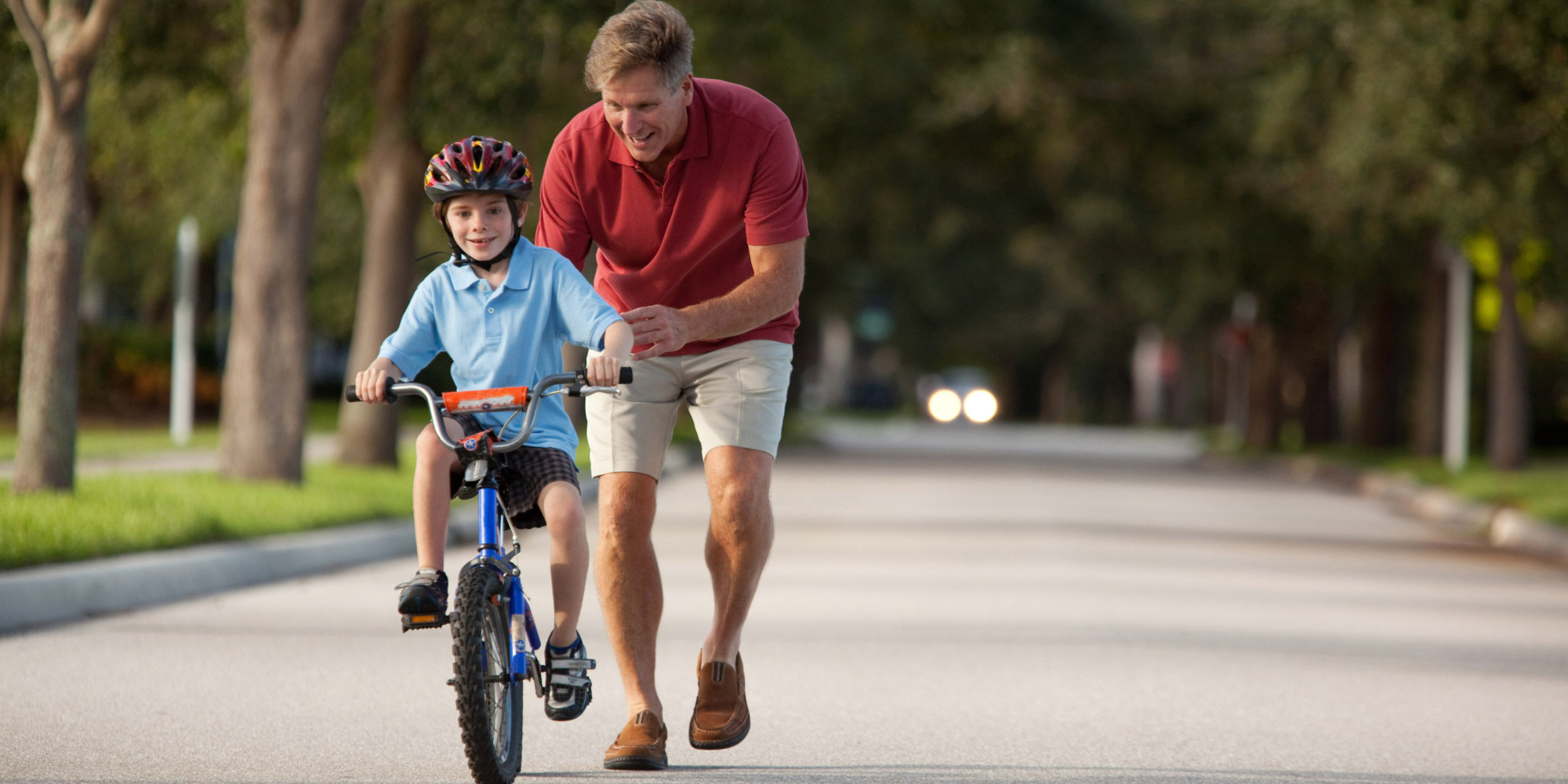
On a summer afternoon many years ago, I stood in my front yard and watched my neighbor teaching his four-year-old son how to pedal a new bicycle. The father hovered nervously as the boy tried to balance himself between his bike’s rear training wheels. Just then a blurred figure whisked by – my own four-year-old son, riding confidently on his own two-wheeler, sans training wheels.

“That’s amazing,” my neighbor gasped.

Was it? I hadn’t thought so, even though I couldn’t ride a bike with confidence until I was nearly 12.

Father teaching son how to ride a bike

I’m not one of those parents who push their children to become hyper-achievers. Rather, it was my son’s relentless petitions to remove his training wheels that had prompted me to reach into the tool box and retire that extraneous hardware to the back of the garage with so much other junk. I never consulted books or articles or experts about the age at which a boy is developmentally ready to ride a bicycle.

My son wanted to learn. Who was I to stand in his way?

It took some time on my part, and a good bit of huffing and puffing, gripping the back of the seat with white knuckles and running along beside him, first in the back yard and later in the street. But who ever said being a parent was easy?

In less than a week my son was tooling around on his own, a bit shaky at first, but more boldly and self-assured with each circuit around the neighborhood. By the end of the school year, he was still in only boy in his class who had learned to ride. It was hard not to be proud. Maybe my son really was amazing. Maybe he would excel in basketball or football as well as bicycling. Maybe he would win an athletic scholarship to UCLA or Ohio State, become a college all-star and a first-draft pick, break every professional record, and land a $50 million endorsement contract with Nike.

Or maybe not. Was I already turning into one of those over-zealous parents who live vicariously through their children and make them neurotic in the process? What if I pushed my son too hard and made him hate sports forever, or convinced him to set his heart on an unachievable goal? Wasn’t it safer to take it slow and err on the side of caution rather than encourage him to reach for the sky and risk setting him up for anxiety or disappointment?

THE ROOT OF ALL FAILURE

For decades now, psychology and education gurus have been telling us that all our problems stem from a single root: low self-esteem. When we don’t feel good about ourselves, we lack confidence in our own ability to achieve; without confidence, we can’t motivate ourselves to try; unmotivated, we never do achieve, reinforcing our feelings of inadequacy and perpetuating a vicious circle of substandard performance.

By lowering expectations, by diluting standards, by broadening the definition of success to include effort and attitude and environment, we make it possible for our children to succeed and enable their self-esteem to flourish. That’s the theory. The problem is that it doesn’t work, mostly because kids are neither as shallow nor as fragile as its advocates would have us believe.

If I have learned anything in my years standing in front of a class room, it is that kids can spot a phony a mile off – and certainly when it’s standing only a few feet away at the front of the class. Students know whether they have had to work for their grades. And every student, no matter how grade-conscious or grade-indifferent, feels better about himself for having earned a B than he does for having been given an A. Even the student who fails because of laziness learns the consequences of inaction and, with a little guidance, learns that he can climb out of the hole he has dug for himself.

THE ULTIMATE GIFT

True, low self-esteem will produce a vicious circle of low achievement. But high yet realistic standards will create a virtuous circle wherein genuine achievement begets sincere aspirations to attain ever-higher goals. By sheltering our children from expectations that challenge their abilities, we steal from them the opportunity to experience the joy of meaningful accomplishment and condemn them to a life of complacency and mediocrity… as well as that bugaboo, low self-esteem.

King Solomon warned us, parents and educators alike: teach every youth according to his own way. Each child is a unique combination of talents, abilities, emotions, and desires. To help our children channel those qualities in the pursuit of excellence, to awaken in them the passion to reach for the stars – this is the greatest gift we can give them.

7604866396_d2182f8058_bMy son hasn’t grown up to become an Olympic athlete. I’ll probably never find his name in a sports almanac or see his picture on a box of Wheaties. But I’ll always remember the expression on his face that summer’s day as he zipped up and down the street, standing up on his pedals, shooting me a grin as he watched me watching him and recognized the pride I felt.

No one ever told him that four-year-olds can’t ride bicycles.

On his next pass, he locked down his coaster breaks and skidded to a stop. “Will you teach me to ride with no hands?” he asked, eager to conquer his next mountain.

“Not today,” I said with a smile. Understanding limits also builds self-esteem.

“Okay,” he said. And, still grinning, he was on his way again.

Originally published in the St. Louis Post-Dispatch


Remembering Forgetfulness

positivethinkingToo many people become members of the ‘Bad Memory Club’ and focus on the 5% of the time that their memory fails them. If you think you have a bad memory, it means you have a good one because you can remember where your memory has gone wrong. Think about how much data you already have stored in your memory… Your memory does a lot right, so ask yourself, “How does my memory serve me – how did it serve me today?

Kevin Horsley

We all have the power to radically improve the quality of our lives by turning negatives into positives.  With modest but consistent effort, we can train ourselves to focus on the good, initiating a virtuous circle of positive thinking that leads to increasingly positive actions and results.

Sometimes all it takes is remembering to try.