Home » Posts tagged 'Tension' (Page 2)
Tag Archives: Tension

Spitting Image 2:6 — The FBI vs. Apple: Lessons Learned
 Good news, everybody! The FBI has found a workaround to break into the iPhone of suspected San Bernardino terrorist Syed Rizwan Farook, and the Department of Justice is backing down from Defcon 1. So now that the crisis is averted, what are some practical lessons we can learn about confrontation and conflict resolution?
Here are a few suggestions:
Both sides might be right. The FBI and Apple each claimed national security as its top concern. The FBI was thinking short-term — stop more terrorist attacks now; Apple was thinking long-term — don’t make ourselves vulnerable later. It’s entirely possible that both parties were sincere and correct.
So here’s the first takeaway. Until evidence proves otherwise, assume positive intent. Your adversary is not necessarily evil; he may just be looking at things from a different angle. Trying to understand his position before going into attack mode may avert conflict and promote mutually beneficial cooperation.
Go around roadblocks, not through them. Apple refused to cooperate. The FBI refused to back down. But as each party dug in and the deadlock stretched out, government officials did something that should renew our hope in government officials: they looked for another way of solving the problem. When the most straightforward plan of action isn’t panning out, don’t give up on finding a detour.
There might already be a solution. After arguing for months that it was impossible to break the phone’s encryption without Apple’s help, the government apparently found hackers who did what hackers said they could do from the beginning: find a way in. So if you don’t know what to do, ask someone who knows more than you do.
Nothing is foolproof. It’s a cliche, but cliches are usually true. Anything that can be protected can be broken into; and any plan can be thwarted. Or, as Yogi Berra used to say: Good pitching will always beat good hitting; and vice versa.
There are no perfect fixes. Although the Department of Justice isn’t releasing details, some believe that breaking into the phone may have caused some of its data to be irretrievably lost. A win doesn’t have to be 100%. In business, in diplomacy, and in most of life, it rarely is. If you end up with most of what you want, don’t let what you had to give up spoil your victory dance.
Save litigation as a last resort. Law suits cost everybody; except the lawyers. So if you’re not a lawyer, try everything else before you push the nuclear button.
Working together makes you look better. Black eyes and bloody noses are painful and unattractive, even when you win. I’m reminded of the Karate master who was accosted by hoods as he was leaving his dojo. “Do you want to beat me?” he asked. “Yeah, we want to beat you,” their leader replied.
The master could easily have dispatched the young miscreants without breaking a sweat. Instead, he took of his jacket and laid down on the sidewalk. “Now you have beaten me,” he said. The hoods looked at him in confusion, then drifted away.
Maybe cooperating means giving up a little more now. But you will almost certainly come out ahead in the end.

Behind the Hero on the Screen
 In the aftermath of this weekend’s Academy Awards Ceremony, I’m revisiting these thoughts from 2009. If you didn’t follow the link when I posted it a few weeks ago, now you have another chance.
Which of the following quotes does not belong with the others:
It is not what I am underneath, but what I do that defines me.
With great power comes great responsibility.
It is a far, far better thing that I do than I have ever done before.
Literary mavens will quickly identify the third quote as different from the first two for several reasons. First, it was written in the 19th century, where the others were written in the 21st. Second, it is a line from novel, where the others are lines from motion pictures. And third, it is the only one of the three not spoken by a Marvel Comic superhero.
On a more substantive level, however, all three have very much in common.
The first of the three is spoken by Bruce Wayne in his guise as Batman, explaining away his public playboy persona as a device to conceal his secret identity. The second is spoken by Peter Parker, aka Spiderman, explaining why he is walking away from the woman he loves in order to protect her from the enemies that would try to strike at him through the people closest to him.
The third quote is the closing line of Charles Dickens’s classic A Tale of Two Cities, in which the heretofore-undistinguished Sydney Carton expresses his love for Lucie Darnay by taking the place of her husband, Charles, and suffering death by guillotine so that Charles might live.
All three quotes issue from heroes who not only do great things at personal risk, but who sacrifice life, love, and reputation for a higher ideal. From a brooding moralizer like Dickens, we expect nothing less. From Hollywood scriptwriters and producers, however, we expect anything else.
FOLLOW THE MONEY
As the Oscar season descends upon us, its worth reflecting that Hollywood is known as Tinsel Town for good reason. Glitz, superficiality, and immediate gratification have become synonymous with the land responsible for most of today’s entertainment industry. Revolving door marriages and divorces, infidelity, and recreational drugs are only the most obvious symptoms of a culture that glorifies the pursuit of pleasure and the deification of personal autonomy.
Predictably, the film industry can be counted on to turn out major motion pictures that are thinly veiled propaganda pieces. Such unmemorable productions as Brokeback Mountain, Lions for Lambs, and The Good Shepherd may have curried favor with Hollywood politicos eager to promote alternative lifestyles or government conspiracy theories, but the movie-going public has shown considerably more enthusiasm for traditional good versus-evil-stories in which good triumphs in the end. (For the record, haven’t seen either Brokeback Mountain or Lions for Lambs.)
 If box office receipts are any indication, there can be no doubt that audiences will choose classic heroism every time. The musings of a couple of culturally conflicted cowboys on the open plain can hardly compete with such memorable moments as the President of the United States (played by Harrison Ford) throwing an international terrorist out the cargo hold of his plane in Air Force One or Kevin Kline’s presidential impersonator cutting government pork at a cabinet meeting to save funding for an orphanage in Dave.
That Hollywood did in fact release such movies as Batman Begins, Spiderman, and Air Force One, however, reveals an insight into Left Coast Culture that is at once obvious and surprising.
What is obvious is that money trumps ideology. When all is said and done, filmmakers would rather see increased revenues than the spread of counter-culture ideology. Fair enough. But what is truly remarkable is how well they understand the nobility, the selflessness, and the heroism of personal sacrifice that are so often at the heart of successful moviemaking.
MANKIND’S INNER HERO
Once upon a time, heroism in Hollywood was the norm. But we don’t have to go all the way back to Humphrey Bogart’s “the problems of three little people don’t add up to hill of beans” speech in Casablanca when he gives up Ingrid Bergman. When Helen Hunt refused to abandon her family for Tom Hanks in Cast Away, when Kelly McGillis refused to abandon her Amish community for Harrison Ford in Witness, when Robert Redford emptied out of his life’s savings to rescue Brad Pitt in Spy Games, the positive resolution of their inner conflicts provided some of the most powerful emotional climaxes in modern cinema. And let’s not forget this year’s biggest hit, The Dark Knight, in which Batman takes the blame for murder to allow Gotham City to keep its illusion of hope.
Perhaps the culture of make-believe that turns out movies of heroism is incapable of believing in either real heroism or the values that turn ordinary people into heroes. Why else would they persist in churning out so many ideological flops in between traditionalist blockbusters? One almost feels sorry for the creative geniuses that can portray such compelling drama on the screen but seem incapable of applying it to the reality of their lives.
The classical philosopher Rabbi Moshe Chaim Luzzato describes the human condition thus:
And so [man] finds himself truly in the midst of a raging battle, in which all the matters of the material world, whether good or evil, serve as trials for man. Poverty confronts him on the one side and wealth on the other… comfort on the one side, and suffering on the other, until he faces a battlefront before him and behind. But if he will be valiant and prevail against his adversaries on every side, then he will become a Complete Man.
Movies can remind us of the moral battles we face constantly in our own lives between what we know and what we feel, between what is right and what is pleasing, between rising to each new challenge or abdicating struggle for the line of least resistance. We rejoice when silver screen heroes emerge triumphant from their inner struggles, for they remind us that we too can emerge triumphant. But we despair when they fail, for they remind us how easily we too can fall prey to our inner demons.
It’s ironic that Hollywood filmmakers can describe the human condition so vividly with so little understanding of it. Perhaps they should watch their own movies – the ones that audiences go to see.

Spiritual Gridlock

With congress increasing paralyzed by gridlock and our president usurping monarchic power by executive fiat, it seems appropriate to revisit this essay from 2008, originally published by Jewish World Review and adapted in my book Proverbial Beauty.
New York Mayor Michael Bloomberg wants to end traffic congestion in Manhattan. However, as sympathetic as New Yorkers may be to Mr. Bloomberg’s vision, his proposed method is most likely to produce madness.
To curb the number of vehicles entering downtown (which has grown annually by an average of 8000 per day since the 1920s, according to U. S. News and World Report), the proposed law would encourage (or coerce) commuters to rely on public transportation by imposing a daytime tax of $8 per car and $21 per truck traveling onto the island. City officials believe that this “congestion pricing” would reduce traffic by as much as 12 ½ percent.
Whether or not commuters can be persuaded to practice even occasional abstinence in their love affairs with their cars makes for interesting speculation. However, the concept itself is sound. In fact, it has been used for some time on a much larger scale, implemented throughout every borough of the world by the Mayor of the Universe.
EXPRESS LANES TO FREEDOM
The most the dramatic experiment in mass transit came over 3300 years ago when the Almighty split the Sea of Reeds, allowing the Jews to pass through and escape their Egyptian pursuers. In contrast to Cecil B. DeMille’s famous recreation, the sages teach that the sea opened up into twelve distinct passageways, one for each of the Tribes of Israel. As they passed through, the water separating the passages turned clear like glass, so that each tribe could see its fellow tribesmen traveling alongside them.
The design of this miracle teaches three lessons. First, the division of the sea into separate passageways demonstrates that there is more than one way to have a relationship with G-d. The Almighty does not want us to be automatons or clones, sheepishly following whoever is in front of us. Each individual is unique, and his divine service should be tailored to the nature of his singular soul.
Second, the water turning clear like glass reveals the lengths to which we must go to master the human ego. Had the walls of each passageway remained opaque, each tribe would have thought that it alone had discovered the correct avenue to reach the other side, and that it alone was traveling in the right direction to serve G-d. When they saw the other tribes traveling along side them, the Jews of each tribe recognized that they were not the only ones who had discerned the proper path.
 The final lesson can be learned from recognizing that there were a limited number of paths. Anyone who did not follow one of the twelve passageways was, literally and figuratively, under water. Every spiritual movement does not become legitimate simply because it declares itself so, no matter how sincere its leaders or followers may be. Every self-proclaimed “holy man” is not genuine simply because he hangs out his shingle or attracts parishioners. Natural laws govern the operation of the spiritual universe just as they govern the workings of the physical world. One cannot render those rules null and void simply by wishing them out of existence or declaring them defunct, any more than congress can annul the force of gravity.
THE PRICE OF PRIDE
There is yet one more insight to be gained from the illustration of the Jews’ passage through the sea, one that is echoed by the New York mayor’s effort to cure his city’s traffic woes.
Consider the car as an allegory for personal autonomy. In a very real sense, we are all control freaks. We want to control our destiny, to chart our own heading, to have our hands on the wheel. Often the greatest demonstration of inner strength comes through humbling ourselves, giving up control and placing our fate in the hands of another. Often this is a concession we are either unwilling or unable to make.
But do we consider the cost? For car owners, the cost is rolled up in the price of the vehicle itself, of gas, insurance, repairs, parking fees, tolls and, perhaps, congestion tax. Public transportation is far cheaper and often more efficient. But still we refuse to relinquish control.
In business, the most efficient workers are those who work as part of a team, who coordinate their efforts with the efforts of others and trust their coworkers to get their own jobs done. Those who try to do everything themselves, or to micromanage others at their work, create confusion, inefficiency, and frustration.
Our relationships, marriages, and families function best when the individuals within them tend to their own responsibilities and allow others to look after theirs. Hovering, ordering, or criticizing before a spouse or child has even had a chance to complete an assigned task breeds resentment and destroys trust.
Spirituality is much the same. We like to think that we are in control of defining our own relationship with the Almighty. We strike out in whatever direction seems right to us, often without any roadmap or compass to guide us in distinguishing good from bad, right from wrong, moral from immoral. We believe that intuition alone will get us to our goal, when we have only the faintest notion of where we are trying to get.
Worst of all, there is available transportation ready to take us to our final destination in the most efficient way. By keeping G-d’s laws and following in His ways, we guarantee ourselves the smoothest possible journey through this world until we arrive at the World to Come.
THE FAST TRACK
 But still many of us won’t give up control. So the Almighty levies His “taxes,” creating obstacles that make the paths of personal autonomy increasingly difficult. We feel stifled in our jobs, unhappy with our families, and discontented with the direction of our lives. So we seek out “detours,” looking for fulfillment in the least likely places: alcohol, drugs, gambling, or extramarital affairs. We think change will make us feel better, but we usually find ourselves worse off than before.
Rabbi Elyahu Dessler explains that we find ourselves in emotional or spiritual darkness at those times when we have cut ourselves off from the source of spirituality in the world. But when we “look into the darkness,” when we recognize that we have created the darkness for ourselves by distancing ourselves from the ways of the Creator, then and only then will we begin to find our way back to the light. By giving up control over our destiny, we regain mastery over our soul.
Whether taxing drivers will solve New York’s traffic problems remains a mystery. But it is in our hands to solve the mysteries of the spirit by following the well-trodden path of the generations that have gone before us. By retracing their steps, we can have confidence that we are not solely dependent upon our own devices to chart our way out of the darkness of confusion, but that we have a clearly marked path to follow toward the light of true meaning.

Maybe they really can’t handle the truth
 Earlier this week, James Zogby, president of the Arab-American Institute, told Andrea Mitchell on MSNBC that “Palestinian lives matter,” drawing a comparison between the violence in Israel and Ferguson, Missouri.
I was asked to comment on the Crane Durham radio program in a discussion about the historical and political origins of Mideast violence.
You can listen to the interview here.

South Carolina and the Great Flood
 As residents of South Carolina begin to emerge from the floodwaters that inundated their state, Jews around the world are reading the story of Noah and the ark this week in their synagogues. Water is both the source of all life and the greatest destructive force on earth. I ponder the paradox in these reflections from after the Pacific Rim tsunami of 2005.
Volcanoes. Hurricanes. Earthquakes. Fires. Tornadoes. Blizzards. Drought.
In a time when reports of terrorism have become all too common, it is sobering to consider the myriad ways nature possesses to inflict death and violence on a scale surpassing the most destructive instruments devised by man. Of all these, however, destruction by water, whether from the sea or from the sky, holds a unique terror in the scope and measure of its devastation.
 Aside from the 150,000 lives already reported lost across nearly a dozen countries along the Indian Ocean, dehydration, disease and hunger threaten as many as 5 million more in the wake of the recent tsunami. And rare though tidal waves may be, the more familiar trial-by-water of floods has, with much greater frequency, left similar numbers homeless and in danger of starvation.
It seems ironic that water, the source and foundation of all life upon our planet, can become nature’s most malevolent instrument against the beings whose lives depend upon it.
Devastation by water occupies a prominent place in human history. Virtually every ancient culture records the tradition of a great flood that inundated the world, lending credence to the biblical account of Noah and the ark. Jewish tradition describes this not as a random event, but as a divine response to the corruption of mankind.
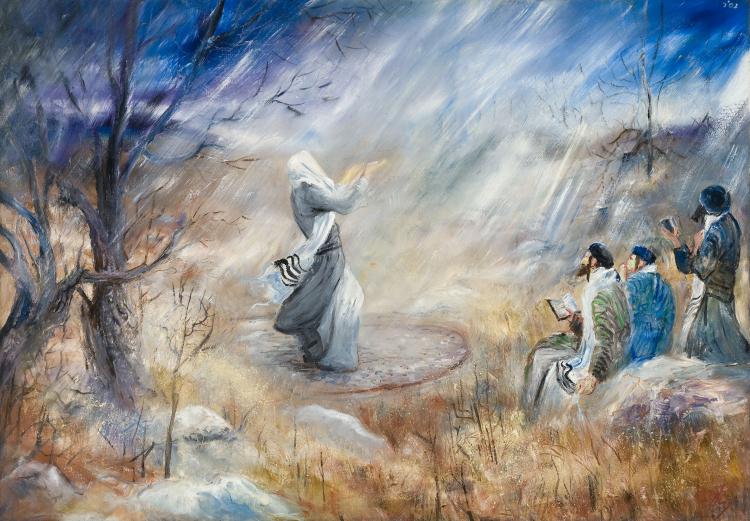
The Talmud, however, reports a much more enigmatic account of divine intervention through water. It was in a time of terrible drought that the Jewish people approached the sage Choni HaMagil and beseeched him to pray for rain on their behalf. When Choni’s supplications to the Almighty went unanswered, he drew a circle in the dust and stepped inside of it, vowing not to leave the circle until G-d bestowed rain upon His people.
Immediately, a fine mist settled upon the earth, too little to alleviate the drought but sufficient to free Choni from his vow.
Choni called out to heaven: “I asked not for this, but for a rain to fill all the wells and cisterns.” Immediately, raindrops larger than melons began to fall, wreaking destruction upon homes and fields.
 Again Choni called out to heaven: “Neither did I ask for this, but for a rain of blessing.” Immediately a normal rain began to fall, filling the wells and cisterns of the people as Choni had requested. But the rain did not stop, and soon the entire population of the land feared that they would drown in the rising waters.
One last time Choni called out heavenward: “Master of the World, Your people, Israel, whom You brought out from Egypt, can tolerate neither too much blessing nor too much misfortune.” Immediately the waters abated, and the people returned to their fields. From this time onward, people referred to Choni by the name HaMagil — the Circle-maker.
What was the point of G-d’s demonstration to the people of Israel? What did Choni mean that the people could not tolerate too much blessing? And why did Choni find it necessary to remind the Almighty, at this particular moment, that He had brought the Jewish people out from Egypt?
The Exodus from Egypt may be described, in commercial terms, as the largest loan ever extended in the history of man. During the generations of slavery in Egypt, the Jewish people had forgotten their Creator and lapsed into the same idolatries as their Egyptian masters. And although, to their credit, the Jews had guarded themselves against assimilation, this alone was insufficient to earn them the privilege of miraculous redemption. Nevertheless, G-d gave them an incalculable line of credit: Freedom from slavery, freedom from oppression, freedom to chart their own course into the future.
Moreover, He promised them immeasurable blessing and unbounded prosperity, on condition that they would repay their loan — repay it by living according to G-d’s law, repay it by rising above material pursuits and petty self-interest, repay it by using all the blessing that G-d would bestow upon them to aspire to moral, ethical, and spiritual perfection.
In this light, blessing may be understood as a double-edged sword. Wielded in one direction, it cuts down all enemies and obstacles that stand before us. Wielded in another, it obligates us to a standard of righteousness and moral behavior that we may find nearly impossible to meet.
This was the meaning behind the Almighty’s response to Choni the Circle-maker’s plea:
Two roads lie before My people, and it is their choice which to follow. One leads back to Egypt, back to the oppression of materialism and the slavery of self-indulgence, back to spiritual emptiness and the absence of all blessing. The other road leads forward, to spiritual fulfillment and spiritual greatness, if My people will only find within themselves the potential to seek greatness and discard all lesser goals. It is for this that I redeemed them, that they might cast off the chains of physicality and reach for the heavens.
 And this too was the meaning behind Choni’s appeal to the Almighty:
Master of the World, You brought your people out from slavery and oppression on condition that they would use their freedom and the blessings to strive for spiritual heights. Your people, however, have demonstrated from their beginnings that, whatever their potential may be, they still suffer from human failings and human shortcomings. They cannot tolerate too little material blessing, lest the struggle to survive overwhelms them and they abandon all higher aspirations. And they cannot tolerate too much blessing, lest they cower before the goal set for them and lose all hope of its attainment.
By all accounts, the world that we live in today enjoys a level of material affluence unattained and unimagined by previous generations. Such basic necessities as rapid transit, instantaneous communication, indoor plumbing, electrical lighting and refrigeration, which we take for granted, provide us with an ease of living simply unavailable to even the wealthiest, most powerful monarchs until the last century. The very existence of an “entertainment industry,” much less the staggering sums of money devoted to it, testifies to our abundance of resources — which is to say, our abundance of material blessing.
Nowhere does Jewish tradition teach the condemnation of wealth or of recreation.
Nowhere does Jewish law mandate the forcible redistribution of wealth from those blessed with good fortune to those less fortunate. But Jewish tradition does warn us of the responsibilities of prosperity. It warns us in the narrative of the flood, in the story of Choni HaMagil, and also in the Hebrew word for charity: tzedakah, derived from the word tzedek, or justice.
It is only just that those who are blessed share a portion of their blessing with their less fortunate neighbors. It is only just that, before overindulging in one’s own good fortune, he ponders why he deserves having received such blessing while his neighbor has not. And it is only just that he ask himself how, even in the absences of tax incentives or legal mandate, he might reach out with his blessing to ease his neighbor’s plight.
If the waters of the earth, the life-giving waters that are the source of our greatest blessing — life itself — have risen up to inflict enormous tragedy, swallowing human life and draining billions of dollars of aid to spare human suffering, we will all be remiss if we do not pause to consider whether we have used our blessings wisely, and what we must do to ensure that we will continue to deserve them.
Life is no different
 Can I possibly count how many things I desperately wanted that I later rejoiced not having gotten?
Can I possibly remember how many things I thought I needed that I would have been better off without?
Can I possibly imagine how different my life would be if all my wishes had come true?
In medicine, the cures are often more painful than the afflictions. Life is no different.

How will we survive the drone culture?
I haven’t read this entire excerpt, but the rise of the drone raises more questions than the obvious ones concerning basic morality and “rules of engagement.”
 At the end of the movie classic “Patton,” the general responds to a reporter’s question about the “wonder weapons” of the coming era:
“Wonder weapons? By G-d, I don’t see the wonder in them. Killing without heroics? Nothing is glorified? Nothing is reaffirmed? No heroes, no cowards, no troops, no… generals. Only those who are left alive, and those who are left… dead. I’m glad I won’t live to see it.”
The message here is not the glorification of warfare. What Patton understood is that conflict brings out the true essence of a person. Cowards are revealed as cowards, providing the opportunity for reappraisal. Heroes are not merely revealed… they are created through their engagement on the field of combat. The heat of battle requires them to tap into unrealized potential.
This doesn’t require a battlefield of armies. It does require that we take up arms against our lesser selves and strive to conquer our baser impulses and inclinations. It demands that we grapple with the complex issues of good and evil and not take refuge in political slogans or groupthink.
In a culture of automation, we have a harder fight not to become automatons ourselves. We can comfortably join the army of drones, or we can meet the challenge, rise to the occasion, and emerge victorious as heroes.

When does encouragement turn deadly?
A New York Times article last month highlighted suicide clusters among Palo Alto high school students over the past few years. Many believe the reason lies in mixed messages from parents who tell their children to do their best and be happy, but who clearly won’t be happy themselves if their children’s best doesn’t get them into Ivy League universities.
Dr. Glenn McGee, the district superintendent, thinks that parents don’t get it. “My job is not to get you into Stanford,” he said he tells parents and students. “It’s to teach them to learn how to learn, to think, to work together — learn how to explore, collaborate, learn to be curious and creative.”

But the pressure to compete and perform remains. During this past school year, three boys laid down on local train tracks and took their own lives. Their parents’ words of assurance couldn’t offset the pressure of uncompromising expectations.
Indeed, one wonders whether Dr. McGee gets it himself. “Can we put sensors up there?” he wonders, suggesting some sort of system to alert the train operators. “This is Silicon Valley. There ought to be something we can do.”
But the solution isn’t to monitor the train tracks. As the old cliche goes, you don’t save people from falling of a cliff by putting an ambulance down in the valley.
The only answer is to change the culture so that success is measured not by standardized test scores and status but by cultivating individual talents and the attitudes that contribute to a healthy society. When parents make it their mission to fulfill each child’s unique potential — and not to satisfy their own dreams — then children are likely not only to meet parents’ expectations but to exceed them.
Don’t Beat Stress… Meet Stress
 Doctors can’t tell you much about migraines. According to Healthline.com, a partial list of triggers includes lack of sleep, caffeine, foods, food additives, hunger, dehydration, alcohol, strong odors, bright lights, loud sounds, weather change, exercise, hormones and — my personal favorite — stress.
At their best, migraines will interrupt my sleep several times a night. At their worst, they shoot burning needles of agony into my brain for 14 hours straight until I finally pass out from exhaustion.
I’ve dealt with migraines for about a quarter century now. During my last series, a new neurosurgeon put me on steroids to relax my muscles, a regimen that prevents headache Armageddon while allowing the cycle to slowly run its course.
It’s working, mostly, for which I’m enormously grateful. But not without a curious side-effect.
Now I’m too relaxed.
 Yonason Goldson