Home » Communication (Page 15)
Category Archives: Communication

Six Recalibrations to get Success Back on Track
 In an earlier post, I outlined six misconceptions that stifle success. They are:
- Pleasure equals happiness
- Opinion equals fact
- Winning equals success
- Autonomy equals freedom
- Convenience equals peace of mind
- Legal equals ethical
When we use words without concern for their meaning, we deprive ourselves of the ability to think clearly. We confuse goals with side-effects, assets with obstructions, and benefits with pitfalls. We sabotage our own success because we aren’t clear about where we’re going or how we’re going to get there.
When we mistake happiness for pleasure, we end up chasing after instant gratification, which is emotional junk food. When we don’t consider ourselves winners unless someone else is losing, we drive away potential allies and advocates. When we refuse to reexamine our opinions, we are often denying reality.
The belief that freedom means no restrictions destroys discipline and makes us slaves to our bad habits. The notion that convenience leads to tranquility leaves us unable to cope with life’s difficulties and disappointments. And exploiting legal loopholes makes us untrustworthy and untrusted.
So let’s get down to definitions.

The Pathology of Praise
 You’re so cute. You’re so sweet. You’re such a doll.
You slob. You moron. You’re such a loser.
Anyone who has studied education or taken parenting classes has heard the eight-to-one rule: offer eight positive comments for every negative one. The theory is sound. By responding to good behavior, we accomplish three things:
- reinforce that behavior so it will be repeated more often
- encourage a positive self-image inconsistent with bad behavior
- legitimize occasional criticism so it will be taken to heart
All well and good. Except when it doesn’t work.
In her acclaimed bestseller, Mindset, Dr. Carol Dweck reports that grade school teachers criticize boys eight times more often than girls. If that weren’t enough, school-age boys typically pepper their conversation with insults, put-downs, and name-calling. Consequently, we should expect to find that girls grow up into self-confidant over-achievers and boys grow up into meek underperformers.
In fact, just the opposite is true.
Professor Dweck observes that the constant negativity directed at boys makes them increasingly impervious to criticism, which may boost their confidence but leaves them unreceptive to constructive advice. In contrast, the praise lavished on girls can leave them hypersensitive to criticism, to the point where they are afraid to take risks and tend to indulge in constant self-doubt.
Applied to society at large, this may explain a lot about our collective cultural dysfunction.

Down with Democracy?
 AMERICANS AGAINST HATRED AND BIGOTRY.
DUMP TRUMP.
NOT MY PRESIDENT.
[EXPLETIVE] UR WALL.
WE WON’T GIVE UP. WE WON’T GIVE IN.
UNITED WE’RE STRONGER (you have to love the irony).
These are just a few of the slogans that bedecked the nation-wide protests against Donald Trump’s electoral victory, i.e., against the American democratic system. Accompanying images included swastikas and pictures of Adolf Hitler.
Of course, protest is a fundamental part of our democracy, guaranteed by the First Amendment (which, incidentally, many Yale students petitioned to repeal). But protest is only productive when it advocates a viable solution to a problem. When protest is nothing more than collective whining, it easily turns into mob violence — indeed, as it did in several instances.
So what do the protesters actually want? To repeal the democratic process? To overthrow a legally elected chief executive? Public lynching?
If they want to advocate dismantling the electoral college, they might find support on both sides of the aisle… but only for the next election cycle. And they could make their point without vandalism, arson, or public obstruction.
On the other extreme, you have college students so traumatized by the election results they have requested exemptions from classwork and midterm exams. Such fragility does not bode well for the future leadership of the country.
It’s a pity we can’t conjure up an alternative reality portal; it would be amusing to get a glimpse of how the anti-Trump contingent would be reacting — had the election gone the other way — to disgruntled Trump supporters protesting the “rigged” election that stole victory from their candidate.
But one does have to acknowledge that sometimes the left is right. One protest sign manages to say it all:


Six Misconceptions that Stifle Success
 Why aren’t we more successful? Why aren’t we happier? Why do we have so many problems? Why can’t we get along?
We might blame it all on any number of things:
- Texting
- The internet
- Political correctness
- Self-esteem philosophy
The truth is, all of these are symptoms of the real problem:
The devaluation of self-discipline and personal responsibility.
More and more, we live in a culture that teaches us to expect what we want without effort and without concern for consequences. We know this doesn’t apply at work or in the gym; we should know that it doesn’t apply in school, in relationships, or in government.
But the social messages of immediate gratification and entitlement have seeped in everywhere, most of all into the one area on which all others depend.

How we move forward
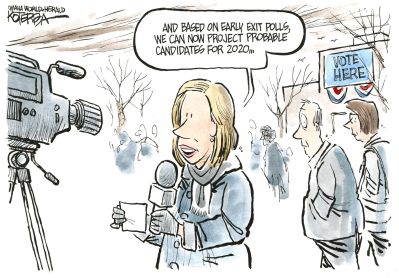 Too many voters held their noses yesterday as they entered the polling booth to vote for the candidate they considered least toxic. A smaller number could only make peace with their conscience by voting for some unexceptional third-party candidate. Then there were those who couldn’t bring themselves to vote at all.
Will the country survive this winter of our discontent? Only time will tell. But the question that lingers in the aftermath of electoral acrimony is this: are we going to start this all over again in two more years?
Sadly, we just might. Back in January, David Gelertner proposed in the Weekly Standard that the problem with the political left is that liberalism has become their new religion. For most people, religion is not a rational but an emotional commitment that emerges from some amorphous inner voice or feeling. And when people cannot defend their religious beliefs intellectually, they lash out with disproportionate ferocity at anyone who challenges those beliefs. Mr. Gelertner argues that the irrational dogmatism of many liberals bears less resemblance to political discourse and more to the religious fervor of blind faith.
He’s right, of course. But he’s wrong when he contends that this is overwhelmingly a phenomenon of the left.

4 Lessons for Successful Leadership
(Expanded from a previous article.)

Tom Hanks’s recent movie “Sully” allows us to re-experience the dramatic events of January, 2009. Looking back, there are three great stories in the averted disaster of US Airways Flight 1549 that can change our outlook on life’s unexpected twists and turns.
First is the story of providence, which placed a pilot with precisely the right training, experience, and temperament at the helm of the crippled jetliner while placing the aircraft within reach of the only feasible landing strip — the Hudson River — for a safe, if chilly, touchdown.
Lesson 1: Even when things go wrong, look for an unexpected solution at hand to make them go right.
Second is the story of heroism. The pilot, Chesley Sullenberger, drew upon his experience with both military fighters and gliders to bring the passenger plane safely down from the sky. The flight crew quickly and efficiently instructed the people to prepare for impact and then hastened them off the sinking plane. The rescuers, both professional and private citizens, steered their craft to the crash site within minutes. Not one life was lost.
Lesson 2: With the right people ready and waiting, almost anything is possible.
But the third story is that of the passengers. For the most part untrained and unprepared, without exception the passengers on Flight 1549 did precisely what they needed to do in order to survive.
They followed instructions.

Rejecting the new Age of Inevitability
 Isn’t it great to live in an age when machines can do anything? Cars drive themselves, jetliners land themselves, and smartphones do just about everything but tuck us into bed.
Recognition software can read our moods and even catch us telling lies. (That’s a good thing, right?) Programs can analyze our handwriting and predict our likes, dislikes, and likely actions by tracking our digital footprints. Soon, Amazon may be filling orders for us that we haven’t even placed yet.
In the workplace, software programs may start deciding who gets hired or promoted based on models constructed from data gathered about the highest performing employees. This may include variables based on medical history, psychological markers, and virtual clues to everything about us including age, gender, political leanings, and sexual preference.
In a recent Ted Talk, Zeynep Tufekci acknowledges that these programs may make decisions more objectively than humans do. But she cautions that machines trained to infer and predict are only as good as their programming, and will of necessity reflect the biases of their programmers — which could mean compounding, not eliminating, bias.
What’s more, the algorithms that produce this kind of “machine learning” don’t allow for human insight and intuition. It’s all statistical analysis, which turns probabilities into absolutes with no assessment by human reasoning and without allowing room for appeal to a higher authority.
The more troubling issue is our willingness to abdicate the responsibility implicit in free choice. In a culture that has long conflated judgment with judgmentalism, it’s hardly surprising to find how eager people are to reduce every decision to a binary option and thereby eliminate all shades of gray from the mix. And if that’s not enough, we can simply block any information that doesn’t conform to our way of thinking.


How to End a Conversation
 A classic riddle asks: Using three periods (.), two commas (,), and one question mark (?), punctuate the following line to produce a logical and grammatically correct sentence:
That that is is that that is not is not is that it it is
If you know the answer, don’t text it to your friends. You might hurt their feelings.
However, just between us, here’s the solution:
That that is, is. That that is not, is not. Is that it? It is.
The beauty of a brainteaser like this one is not just that it gets us to think. More important, it gets us to think about thinking, to appreciate how communication is critical to critical thinking, and to think about how the same string of words can be fashioned into a cogent message or left as a meaningless hodgepodge of phonetic symbols.
But don’t say so out loud. You might offend someone.
That’s what Professor Celia Klin and researchers at Binghamton University found when they asked undergraduates to interpret text messages responding to an invitation. Their study revealed that students perceived responses properly punctuated with a period at the end as less sincere and, in some cases, psychologically combative.
In other words, it’s antisocial to be articulate, crass to follow convention, and reprobate to observe the rules.
Click here to read the whole essay.

My Interview with Bill Martinez
 Listen in on my conversation about political correctness and the culture wars with nationally syndicated radio host Bill Martinez on 10/19.
 Yonason Goldson