Home » Culture (Page 20)
Category Archives: Culture

The Pathology of Praise
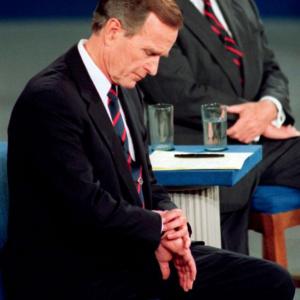 You’re so cute. You’re so sweet. You’re such a doll.
You slob. You moron. You’re such a loser.
Anyone who has studied education or taken parenting classes has heard the eight-to-one rule: offer eight positive comments for every negative one. The theory is sound. By responding to good behavior, we accomplish three things:
- reinforce that behavior so it will be repeated more often
- encourage a positive self-image inconsistent with bad behavior
- legitimize occasional criticism so it will be taken to heart
All well and good. Except when it doesn’t work.
In her acclaimed bestseller, Mindset, Dr. Carol Dweck reports that grade school teachers criticize boys eight times more often than girls. If that weren’t enough, school-age boys typically pepper their conversation with insults, put-downs, and name-calling. Consequently, we should expect to find that girls grow up into self-confidant over-achievers and boys grow up into meek underperformers.
In fact, just the opposite is true.
Professor Dweck observes that the constant negativity directed at boys makes them increasingly impervious to criticism, which may boost their confidence but leaves them unreceptive to constructive advice. In contrast, the praise lavished on girls can leave them hypersensitive to criticism, to the point where they are afraid to take risks and tend to indulge in constant self-doubt.
Applied to society at large, this may explain a lot about our collective cultural dysfunction.

It’s right before your eyes
 Yesterday’s supermoon, the closest and brightest in seven decades, is dramatic precisely because it fails to push back the darkness of night. King Solomon warns us of the pitfalls of living “under the sun,” reminding us that too much light can blind us to the dangers posed by our own misperception — a theme that figures prominently in my book Proverbial Beauty. I’m taking the opportunity to revisit this article from 2009.
Imagine if, in the late 1990s, a freshman congressman in the House of Representatives had submitted, as his first piece of legislation, a bill requiring airlines to install high-security doors on all passenger planes between the cockpit and the cabin. Imagine that the bill narrowly passed, was signed into law, and resulted — at great inconvenience and expense — with enhanced security for every commercial flight crew by the summer of 2001.
What would such an initiative have produced? Most notably (or really, just the opposite), September 11 would be a date of no greater significance than August 3. No terrorists would have seized those airliners and flown them into the Twin Towers that day. Perhaps American troops would never have gone into Afghanistan or Iraq. Perhaps the economy would not (yet) have collapsed. Quite possibly, Barack Obama would never have been elected president in an anti-George W. Bush backlash.
In his book The Black Swan: The Impact of the Highly Improbable , economist Nassim Nicholas Taleb proposes just such a scenario. But Mr. Taleb focuses less on the global consequences than on the fate of our fictional congressman — let’s call him Joe Smith. Congressman Smith will not be remembered as the hero who prevented the worst terrorist attack in history, precisely because he successfully prevented it. In all likelihood, he will be loudly denounced as the architect of an expensive and irrelevant measure and hounded out of office. He may live out his life regret his own lack of political saavy, which ended his career before it had even begun.
A complicated and often elusive treatise, The Black Swan proposes a correlation between history’s most significant events and the degree to which they were unanticipated. The stock crashes of 1929 and 1987; the outbreak of both world wars; the collapse of the Soviet bloc and the rise of Islamic fundamentalism. Each of these came as a profound shock to the world; only with the benefit of hindsight have historians explained all of them as political and economical inevitabilities.
Moreover, the lessons learned from history’s most earth-shattering events tend consistently to be exercises in locking the barn door after the horse has run away. Both individually and collectively, we implement strategies that would have changed the course of history had we applied them earlier, failing to realize that our measures to correct address the specific circumstances that shaped the past rather than the broader principles that will determine the future. The more closely we focus on what we expect to happen, the more we increase the probability that the future will arrive from an entirely unimagined direction.
DON’T LOOK NOW
The human eye is a truly remarkable organ. It is self-focusing, adjusts instantly from close-range to distance, discerns color and texture, judges distance, and adapts to bright sunlight, inky darkness, and everything in between. It allows us to focus on a single point of interest while, through our faculty of peripheral vision, we continue to process information coming in from all sides to provide context and enable us to respond to changing conditions.
 Instinctively and intuitively, we place the object of immediate interest at the center of our optic and cognitive attention. But this is not always the most effective means of perception. We have all experienced instances of looking directly at an object and failing to see it, either because it is so familiar or unremarkable that our minds filter it out as irrelevant, or because it is so incongruous that our subconscious refuses to accept its presence. In such cases, we may notice an object only when we are looking elsewhere and our peripheral vision, unencumbered by the censorship of our expectations, draws our attention back to that which had previously hidden in plain sight.
This phenomenon — called averted vision — was first alluded to by Aristotle and has become particularly important among astronomers, who have found that observing an object peripherally may increase its resolution by up to three or four magnitudes. Because the center of the eye contains only cones, which perceive brightness and color, fainter objects are more easily detected by the rods, which perceive dim, monochromatic light and occupy the outer regions of the eye.
LOOK AWAY AND ALL WILL BE REVEALED
We live in a world that, on its surface, seems well-ordered and readily understood. The cycle of seasons follows its natural course with relative predictability. The habits of animals remain virtually unchanged. The waters of the earth flow downward from the mountains to the seas, evaporate and rise up to the firmament, then return to the earth as rain.
On closer inspection, however, the world is a place of profound mystery. Solid objects are composed of increasingly tiny particles, many of which are spinning wildly in microscopic orbits at nearly the speed of light. Hundreds of other sub-atomic particles waft about our universe, many without any clear direction or purpose. The beginnings of physical existence and life itself cannot be substantiated through any empirical evidence or rational theory. The force of gravity, which is so fundamental that we scarcely give it any thought, has no satisfactory explanation.
Atoms, the building blocks of our universe, had never been directly observed until last year, when an electronic microscope powerful enough to view them was finally engineered. The protons, neutrons, and electrons, as well as those myriad other sub-atomic particles, are still yet to be seen. So how do we know they exist? Indirect evidence — the averted vision of science. By analyzing observable evidence, scientists have determined that these particles must exist to explain otherwise unexplainable phenomena.
But why should our universe be so impenetrably shrouded in mystery? The sages of the Talmud explain that ours is a world of hester ponim — a world in which the Almighty “hides His face.” The familiarity of the material world draws all our attention, distracts us from the true spiritual nature that reveals itself only at the periphery of our vision. The unanswered questions of science, the anomalies of nature, the enigmas of philosophy, the improbability of the cosmic and individual “coincidences” that surround us daily — all these testify to the order and the One who imposed order upon the universe. They whisper to us from the corners of our consciousness and beckon us from the edges of our awareness, vanishing to insignificance amidst the cacophony of physical existence the moment we try to focus on them, then reappearing as soon as we turn our attention elsewhere.
Search for G-d and all His might, says King David, seek His presence always.The harder we try to find order in our lives, the more chaotic our world seems to become. By allowing the subtle evidence that flutters at the fringes of Creation to hold out attention, however indirectly, the more we make our hearts and minds sensitive to the spiritual reality that is the foundation of the physical universe and the human condition.

Down with Democracy?
 AMERICANS AGAINST HATRED AND BIGOTRY.
DUMP TRUMP.
NOT MY PRESIDENT.
[EXPLETIVE] UR WALL.
WE WON’T GIVE UP. WE WON’T GIVE IN.
UNITED WE’RE STRONGER (you have to love the irony).
These are just a few of the slogans that bedecked the nation-wide protests against Donald Trump’s electoral victory, i.e., against the American democratic system. Accompanying images included swastikas and pictures of Adolf Hitler.
Of course, protest is a fundamental part of our democracy, guaranteed by the First Amendment (which, incidentally, many Yale students petitioned to repeal). But protest is only productive when it advocates a viable solution to a problem. When protest is nothing more than collective whining, it easily turns into mob violence — indeed, as it did in several instances.
So what do the protesters actually want? To repeal the democratic process? To overthrow a legally elected chief executive? Public lynching?
If they want to advocate dismantling the electoral college, they might find support on both sides of the aisle… but only for the next election cycle. And they could make their point without vandalism, arson, or public obstruction.
On the other extreme, you have college students so traumatized by the election results they have requested exemptions from classwork and midterm exams. Such fragility does not bode well for the future leadership of the country.
It’s a pity we can’t conjure up an alternative reality portal; it would be amusing to get a glimpse of how the anti-Trump contingent would be reacting — had the election gone the other way — to disgruntled Trump supporters protesting the “rigged” election that stole victory from their candidate.
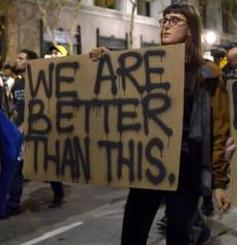
But one does have to acknowledge that sometimes the left is right. One protest sign manages to say it all:

Our thanks to those who served
“As we express our gratitude, we must never forget that the highest appreciation is not to utter words, but to live by them.”
—John F. Kennedy

“In the beginning of a change, the patriot is a scarce man, and brave, and hated and scorned. When his cause succeeds, the timid join him, for then it costs nothing to be a patriot.”
—Mark Twain

Six Misconceptions that Stifle Success
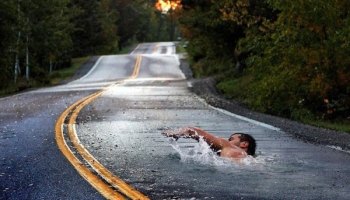 Why aren’t we more successful? Why aren’t we happier? Why do we have so many problems? Why can’t we get along?
We might blame it all on any number of things:
- Texting
- The internet
- Political correctness
- Self-esteem philosophy
The truth is, all of these are symptoms of the real problem:
The devaluation of self-discipline and personal responsibility.
More and more, we live in a culture that teaches us to expect what we want without effort and without concern for consequences. We know this doesn’t apply at work or in the gym; we should know that it doesn’t apply in school, in relationships, or in government.
But the social messages of immediate gratification and entitlement have seeped in everywhere, most of all into the one area on which all others depend.

How we move forward
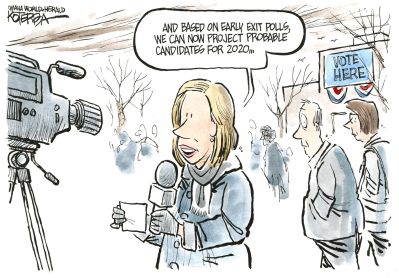 Too many voters held their noses yesterday as they entered the polling booth to vote for the candidate they considered least toxic. A smaller number could only make peace with their conscience by voting for some unexceptional third-party candidate. Then there were those who couldn’t bring themselves to vote at all.
Will the country survive this winter of our discontent? Only time will tell. But the question that lingers in the aftermath of electoral acrimony is this: are we going to start this all over again in two more years?
Sadly, we just might. Back in January, David Gelertner proposed in the Weekly Standard that the problem with the political left is that liberalism has become their new religion. For most people, religion is not a rational but an emotional commitment that emerges from some amorphous inner voice or feeling. And when people cannot defend their religious beliefs intellectually, they lash out with disproportionate ferocity at anyone who challenges those beliefs. Mr. Gelertner argues that the irrational dogmatism of many liberals bears less resemblance to political discourse and more to the religious fervor of blind faith.
He’s right, of course. But he’s wrong when he contends that this is overwhelmingly a phenomenon of the left.

Of frogs legs and scorpion tails

Indifferent to the specter of unleashed state-sponsored terrorism, France and China announced this week that they have joined forces to help Iran develop its natural gas fields. Apparently, an enriched and empowered radical theocracy is nothing to worry about — assuming the infamous Iran nuclear deal actually ensures any measure of global security.
It’s hard not to recall the parable of the frog and the scorpion:
A scorpion once asked to ride on the back of a frog to reach the other side of a river. At first, the frog refused, fearing for its life. But then the scorpion reasoned that the frog had nothing to worry about since, if it stung the frog, it would drown in the river as well. The frog could not argue with the scorpion’s logic and allowed it to climb aboard.
Midway across the river, the scorpion stung the frog. “Why did you do that?” cried the frog. “Now we will both die.”
“I couldn’t help it,” replied the scorpion. “It’s in my nature to sting, so I had to sting.”
The truth is that it’s easier to sympathize with the frog than with the French. The frog wanted to do a good deed and — albeit mistakenly — saw no cause for mistrusting the scorpion.
In contrast, the French and the Chinese want nothing but a larger slice of the world-economic pie, and they are willing to ignore the inevitable long-term dangers for short-term profit. The mild satisfaction of being able to tell them “we told you so” some years down the line will hardly supply adequate consolation for the precarious state the world will find itself in.
Of course, the allegory is imperfect for a different reason. France and China are scorpions, too. Dangerous, irresponsible, and unwilling to change their natures.
At the very least, however, their self-serving self-deception should make us ask ourselves: Are we frogs or scorpions? What about the candidates we vote into office?
And if we refuse to change our individual and collective natures, how far across the river can we expect to get?

4 Lessons for Successful Leadership
(Expanded from a previous article.)

Tom Hanks’s recent movie “Sully” allows us to re-experience the dramatic events of January, 2009. Looking back, there are three great stories in the averted disaster of US Airways Flight 1549 that can change our outlook on life’s unexpected twists and turns.
First is the story of providence, which placed a pilot with precisely the right training, experience, and temperament at the helm of the crippled jetliner while placing the aircraft within reach of the only feasible landing strip — the Hudson River — for a safe, if chilly, touchdown.
Lesson 1: Even when things go wrong, look for an unexpected solution at hand to make them go right.
Second is the story of heroism. The pilot, Chesley Sullenberger, drew upon his experience with both military fighters and gliders to bring the passenger plane safely down from the sky. The flight crew quickly and efficiently instructed the people to prepare for impact and then hastened them off the sinking plane. The rescuers, both professional and private citizens, steered their craft to the crash site within minutes. Not one life was lost.
Lesson 2: With the right people ready and waiting, almost anything is possible.
But the third story is that of the passengers. For the most part untrained and unprepared, without exception the passengers on Flight 1549 did precisely what they needed to do in order to survive.
They followed instructions.

Rejecting the new Age of Inevitability
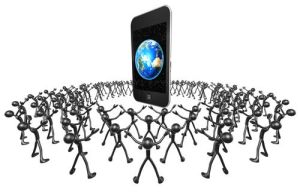 Isn’t it great to live in an age when machines can do anything? Cars drive themselves, jetliners land themselves, and smartphones do just about everything but tuck us into bed.
Recognition software can read our moods and even catch us telling lies. (That’s a good thing, right?) Programs can analyze our handwriting and predict our likes, dislikes, and likely actions by tracking our digital footprints. Soon, Amazon may be filling orders for us that we haven’t even placed yet.
In the workplace, software programs may start deciding who gets hired or promoted based on models constructed from data gathered about the highest performing employees. This may include variables based on medical history, psychological markers, and virtual clues to everything about us including age, gender, political leanings, and sexual preference.
In a recent Ted Talk, Zeynep Tufekci acknowledges that these programs may make decisions more objectively than humans do. But she cautions that machines trained to infer and predict are only as good as their programming, and will of necessity reflect the biases of their programmers — which could mean compounding, not eliminating, bias.
What’s more, the algorithms that produce this kind of “machine learning” don’t allow for human insight and intuition. It’s all statistical analysis, which turns probabilities into absolutes with no assessment by human reasoning and without allowing room for appeal to a higher authority.
The more troubling issue is our willingness to abdicate the responsibility implicit in free choice. In a culture that has long conflated judgment with judgmentalism, it’s hardly surprising to find how eager people are to reduce every decision to a binary option and thereby eliminate all shades of gray from the mix. And if that’s not enough, we can simply block any information that doesn’t conform to our way of thinking.

 Yonason Goldson