Home » Moral Compass (Page 22)
Category Archives: Moral Compass

Before the Flood
 “Things will last my time,” said the Marquise de Pompadour, “But after me, le deluge.”
More prophetic words were never spoken. The mistress of Louis XV foresaw clearly the collapse of the French monarchy and the flood of violence and chaos that would engulf the next generation. But that was the future’s problem. Why should she care?
In some ways, her brutal disregard for future suffering is more palatable than the utopian fantasies and rhetorical flourishes of modern leaders. At least the Marquise knew what lay ahead, and at least she didn’t pretend that she had an easy fix to prevent the future from arriving on tomorrow’s doorstep.
But today we face an impending crisis no less ominous. Our expectations for national leadership have sunk so low that we are willing to overlook pathological, craven, and unapologetic dishonesty from one presidential candidate and volcanic, adolescent recklessness from the other. One can scour the nation’s capital without turning up even a smidgen of character and statesmanship, evidence of a political culture rife with cronyism, gridlock, and groupthink.

Tony Soprano Redux
 A good friend of mine, who is usually more clear-headed, sent me a slimy little video asserting that character doesn’t matter, since both FDR and Winston Churchill smoked and drank while Adolf Hitler was a teetotaler and a vegetarian. His point was that Donald Trump’s crude, impulsive, petty, and narcissistic behavior has no bearing on his fitness for office.
While it is true that people are complicated, and that no one is completely virtuous or completely lacking in virtue, the indulgence in moral relativism is particularly galling when it comes from the right, after so many years of denouncing it as the Kool-Aid of choice among the left.
But the blurring of lines has been going on for a long time. It particularly hit its stride about ten years ago with the success of the Sopranos, which prompted an op-ed that I revisit here.
Psychoanalyst Glen Gabbard, author of The Psychology of The Sopranos: Love, Death, Desire and Betrayal in America’s Favorite Gangster Family, has an interesting take on the phenomenon of Tony Soprano.
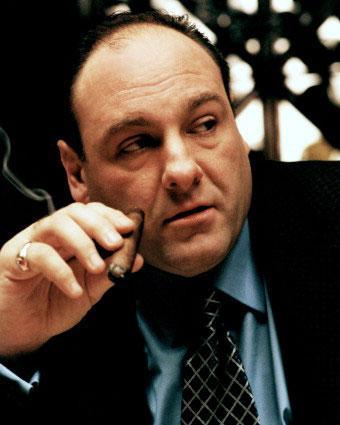 The success of The Sopranos, it seems, depends not on Tony Soprano the mobster, but on Tony Soprano the psychoanalysis patient. Whereas in daily life, Tony is a crook, a thug, and a murderer, on the couch Tony is a regular guy, with the same hopes, dreams, problems, and anxieties as the rest of us.
Dr. Gabbard explains that people love to root for Tony the regular guy to prevail over Tony the violent criminal; they want more than anything to be able to find a noble everyman at the heart of the worst of the worst and the lowest of the low.
Simply stated, viewers don’t want to believe that anyone is really evil.
This is a remarkable turnabout from the early 80s when everyone’s favorite television creep was J.R. Ewing on Dallas. Back when “Who shot J.R.?” was on everybody’s lips, it wasn’t because we wanted to see the would-be assassin brought up on charges — we wanted to see him handed the key to the city. We didn’t want to understand J.R. — we wanted to hate him. We loved to hate him.
 J.R. never killed anybody, never even beat anyone up, yet we cheered from our couches when he got what was coming to him and hoped desperately that his every nasty scheme would fail. If so, why do viewers in record numbers forgive everything for Tony Soprano, the Godfather who terrorizes and murders for fun and profit, just because he worries about his marriage and his children? C’mon, even J.R. loved his daddy.
Perhaps there’s no better barometer for the moral pressure of society than our relationship with television’s most popular characters. When we cheer for the good guys and boo the bad guys, isn’t it because of our desire to see that justice is done?
But when we sympathize with a violent criminal, when we identify with him because he cares about his kids just as we do, isn’t it a sign of abandoning the commitment to differentiate between right and wrong?
The job of making moral decisions, of balancing right and wrong in complex circumstances, is no simple business. But instead of challenging us to recognize that Tony is a villain in spite of his human side, The Sopranos (and, more generally, the entertainment industry) manipulates us into identifying with Tony’s humanity so that we overlook his wickedness.
Based on Dr. Gabbard’s assessment, it seems that we yearn to deny that genuine evil walks this earth. Indeed, it may be admirable to look for the good in all people and give our neighbor the benefit of the doubt, but not to the exclusion of recognizing that sometimes there is no doubt, that what little good remains in some people has been hopelessly buried under a mountain of evil. The Hitlers, Stalins, and Ahmadinejads of the world may love their children and may have had troubled youths, but evil remains evil whether we choose to look it in the face or to bury our heads in the sand.
Too often, it seems, we avoid looking evil in the face at any cost. It should come as no surprise, therefore, that a growing element in our society blames the United States for Pearl Harbor, blames Israel for Palestinian suicide bombers, blames all of Western Civilization for September 11. But making excuses for evil does not make evil go away.
It just keeps coming back, each time bolder and more brazen than before.
The Talmud warns us to distance ourselves from a bad neighbor and not to associate with a wicked friend. Even if he loves his kids. Even if his name is Tony Soprano. Perhaps, especially if his name is Tony Soprano.
Originally published in 2007 by the St. Louis Post-Dispatch, Jewish World Review, and Aish.com.

Take action against terror
Rabbi Mici Mark, the beloved Executive Director of the Torat Shraga talmudic academy in Israel, was murdered by terrorists last month while driving his car on his way to Jerusalem to celebrate his mother’s 80th birthday. He was 46 years old. His wife, Chavi and 2 of his 10 children were in the car with him and, with G-d’s help, are recovering from their injuries.
The community of Otniel has suffered greatly from terror attacks. Mici, was the 11th victim.
Please participate in the Go Fund Me campaign to sponsor a bullet proof van to prevent the Otniel community from further tragedy and trauma.
Details can be found by clicking here.

Look in the Mirror, Mr. President
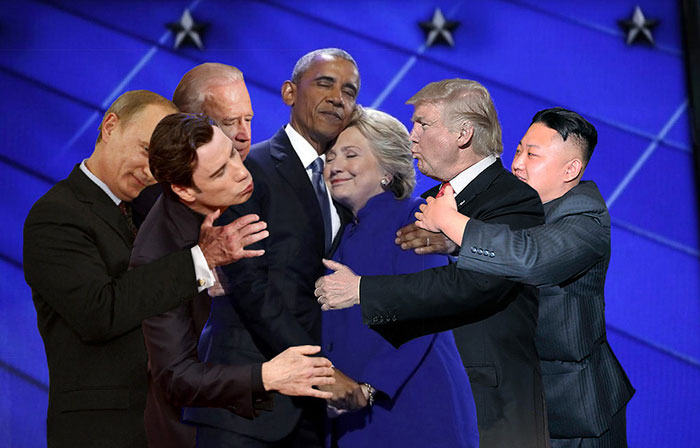 “The Republican nominee is unfit to serve as president.”
Such is the gospel according to Barack Obama, who went on to defend his verdict by citing “the repeated denunciations of his statements by leading Republicans.”
He’s right, of course. But his critique might carry more weight if it were not a classic case of the pot calling the kettle black.
(OMG, did I just write that?)
Before his very public embrace and endorsement of Hillary Clinton at the Democratic convention, Mr. Obama might have taken a look at the recent incendiary assessment of Ms. Clinton by NYT columnist Maureen Dowd, who’s about as far to the left as one can get without falling off the edge of the earth.
Here are a few choice quotes:
[The Clintons’] vast carelessness drags down everyone around them…
In a mere 11 days, arrogant, selfish actions by the Clintons contaminated three of the purest brands in Washington…
Hillary willfully put herself above the rules — again — and a president, campaign and party are all left twisting themselves into pretzels defending her.
The Clintons work hard but don’t play by the rules. Imagine them in the White House with the benefit of low expectations.
If even the most ardent defenders of liberal ideology give Ms. Clinton a failing grade in character, surely that must call into question her credibility as an aspirant for the country’s highest office.
So answer us this, President Obama: how can you, with a straight face and in all earnest, chide Republicans for not rejecting an unfit candidate when you so brazenly refuse to do so yourself?

One Cheer for Tim Kaine

A few election cycles ago, a politician I greatly admired was tapped as running mate for a nominee I did not so greatly admire. What followed was a classic example of what is commonly known as the Waffle.
Prior to accepting the vice-presidential nomination, Mr. Waffle met with the presumptive nominee to discuss their respective positions and differences, of which there were more than a few. The future vice-presidential candidate emerged from the meeting and announced to the press that, after a 45 minute-long meeting, he had been convinced to reverse his position on all points of disagreement and now, wholeheartedly, supported the nominee’s entire platform.
I’ll take my Waffle with syrup, please.
At the time, I wasn’t sure what was more disheartening: that a man I admired could so easily abandon his own convictions, or that he and his team believed it would be politically advantageous to do so. In either case, it was a sad day for integrity.
That’s why I have to tip my hat to Tim Kaine.
In Memorium
 Yesterday, we held a memorial service for Rita Cholet White, one of Block Yeshiva High School’s most beloved teachers for over 20 years. After hearing the many stories and reflections, it’s hard to know whether she loved more or was loved more by her students. Perhaps the question contains its own answer. She was 85 years old.
Several years ago, when Madame White was honored by the school, I was asked to write her bio for the Scholarship Gala journal.
I present the text here as it appeared. She loved it then. I have no doubt that she will love it now.
Rita Cholet White has been involved in primary, secondary, and higher education for over half a century (an extraordinary achievement, especially for a woman who is only 49 years old). A Fulbright scholar, Madame White has appeared in Who’s Who in Education, Who’s Who in American Women, and Who’s Who International. Presumably, one of these organizations will eventually discover who Madame White truly is.
A stalwart member of Block Yeshiva’s distinguished faculty since 1992, Madame White demonstrates her pedagogical dexterity by wearing many hats – as French teacher, English teacher, college adviser, and yearbook adviser. Fortunately, the French like to wear hats.
More than just a faculty member, Madame White adds flare and panache to the halls of Block Yeshiva, dazzling students and staff alike with her sense of style and fashion, her stratified vocabulary in several languages, her pluck, her wit, her irrepressible good humor, and her remembrances of the McKinley administration.
Additional distinctions include a degree from the Sorbonne and the University of Nice, the HEW Certificate of Merit, the University of Richmond Certificate of Recognition as an outstanding teacher, and numerous honors that are beyond the capacity of our computer’s spell-check software.
Persistent rumors that Madame White posed as a model for the Mona Lisa and has BASE jumped from the Eiffel Tower remain unconfirmed.
Adieu, Madame. We will miss you with all our hearts.

Someone is Always Watching
 “They did not listen, they’re not listening still. Perhaps they never will.”
~ Don McLean
After Hillary Clinton shot herself in both feet with her email indiscretions, after the Panama Papers and Ashley Madison and (assuming anyone remembers him) Rod Blagojevich, you’d think that Debbie Wasserman-Schultz might have gotten the memo, at least by email.
But no, she didn’t. And who knows what other revelations will be forthcoming from Wikileaks that will bring down the high and the mighty. In the meantime, the latest outing gives me a chance to revisit these thoughts from last October.
“Someone is always watching.” Movie fans will recognize this as the punchline from “Ocean’s Eleven,” a glib repartee that ultimately recoiled on Andy Garcia and drove Julia Roberts back into the arms of George Clooney. Political observers might remember it, now that former Illinois Governor Rod Blagojevich is back (briefly) in the news, as a line the convicted politico should have uttered when he found himself the subject of state and federal investigators.
But just the opposite was true. The AP reported:
“You would think he would see his life collapsing around him,” said Chicago defense lawyer John Beal, who was in the courtroom with Blagojevich this week and noted how carefree he seemed. “But he was the center of attention and seemed to love it.”
One almost envies Mr. Blagojevich the comfort of his delusions.
At the beginning of the last century, the invention of electric lighting,telecommunication, and cinematography began to change the complexion of modern society. At the time, the leader of European Jewry, the venerable Chofetz Chaim, observed that the introduction of technologies scarcely imagined a generation before provided a lesson for any spiritually sensitive person to recognize that the Universe is not indifferent to our moral conduct.
Previously, the natural cycle of night and day imposed strict order upon human activity. Because most people in those times could not afford the limitless supplies of candles necessary to transform night into day, all activity was cut short early by the long nights of winter, and only in summer could the workday stretch late into the evening. Now, inexpensively and with the flick of a switch, the night could be expelled and the secrets of the darkness instantly revealed.
Can you say AshleyMadison?

A Tale of Too Many Egos
 This isn’t about the 2016 presidential campaign. It’s not about the candidates or the conventions; it’s not about about political ideology or the political process.
It’s all about We The People.
But that requires talking about — at least briefly — the candidates I’d rather not talk about.
Some of us had dared to hope that Donald Trump, after securing the Republican nomination, would disclose that it had all indeed been an act and that he was ready to start acting like an adult. After all, he’s a super-successful billionaire real estate mogul. And he has such great kids. Surely, he’s capable of acting presidential.
Ah, hope springs eternal.
Then the ghost of Ted Cruz reappeared. To be fair, Mr. Trump has a legitimate grievance against Mr. Cruz, who should have either endorsed his former rival or declined the invitation to speak from the convention pulpit. As a career politician, Senator Cruz must understand that the purpose of a national convention is to inspire party solidarity, not to posture for the next election cycle. Mustn’t he?
Of course, life isn’t any better in Philadelphia, where DNC head Debbie Wasserman-Schultz finally agreed to disappear into the night in exchange for one last grandstand, after she was caught exploiting her position to skew the supposedly even-handed primary process in favor of Hillary Clinton.
Not than anyone was surprised. Whatever your political bent, principles have largely become a thing of the past.
That may be because too many Americans have no notion of the values on which this country was founded: Equal opportunity, equal rights, and equal protection under the law. These do not ensure equal wealth or power. But they are part of a culture that once recognized a moral, as opposed to a legal, commitment to place the lowest rung of the ladder of fortune within reach of its most downtrodden citizens, to protect the minority from the tyranny of the majority, and to shape a society bound together by commitment to higher values and national destiny.

Spiritual Impressionism
?
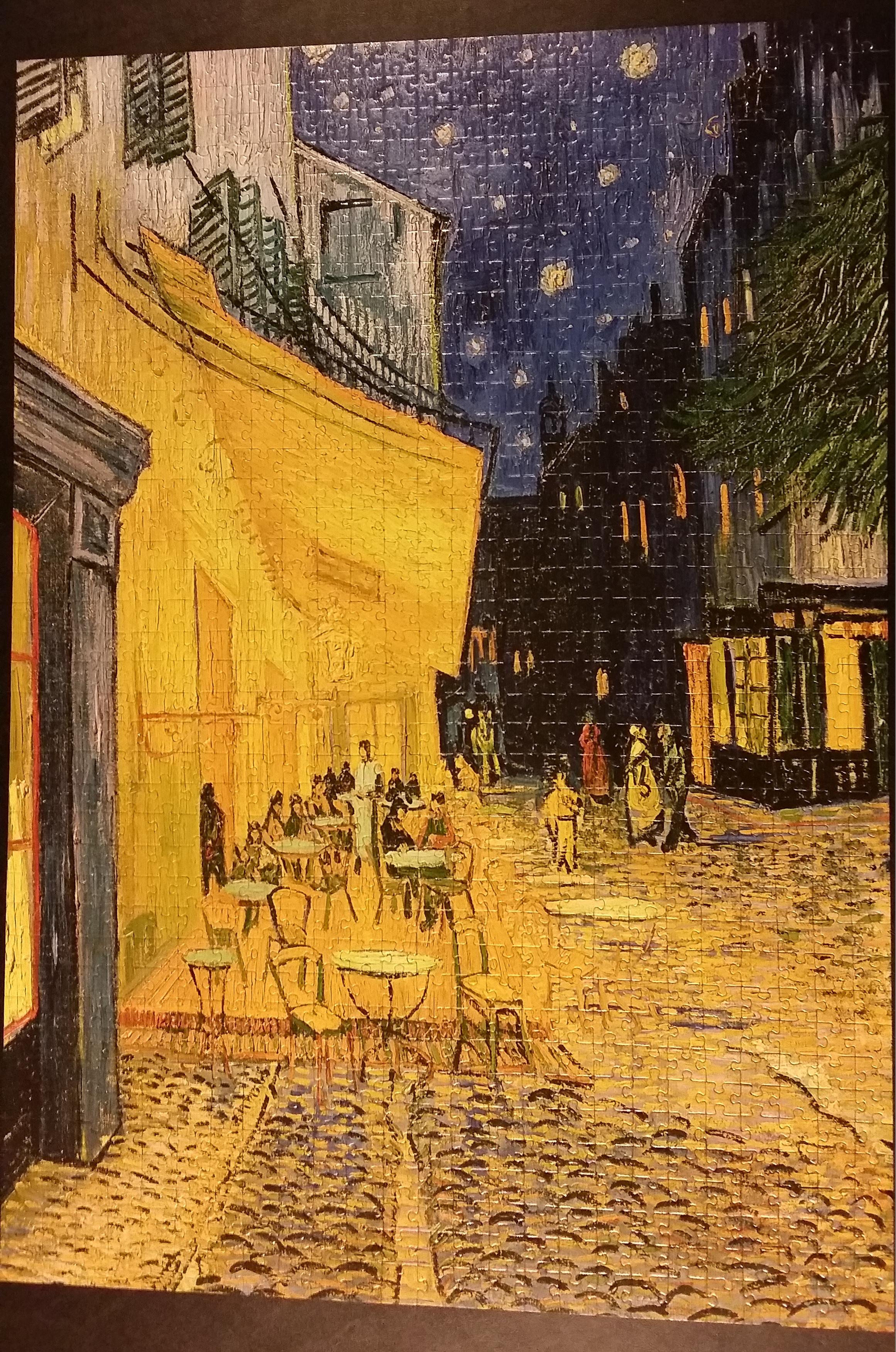
My wife and I finished this 1000 piece jigsaw of Vincent Van Gogh’s “Cafe Terrace at Night,” providing an excuse to revisit this essay from 2011.
210 years as slaves in Egypt. 40 years wandering in the desert. 70 years of suffering in Babylon. 1,931 years scattered to the far ends of the earth… and counting.
Exile has defined most of the history of Jewish people, always as a response to our failure to value our relationship with the Almighty. When we turn our backs on Him (or on one another), He responds by allowing us to experience the consequences of separation through the loneliness of exile.
How remarkable, then, that at times extraordinarily pious have undertaken journeys of self-imposed exile, wandering anonymously from place to place, begging for bread and lodging, concealing their true character and brilliance, and never knowing what awaited them around the next corner. There was nothing remotely romantic about these adventures. They were intended to inure budding Torah leaders against attachment to material comforts, and also to teach them humility as a safeguard against the reverence and adulation showered upon the learned. During the days of the Chassidic masters of the 18th and 19th centuries, stories of the tribulations of exile abounded.
I knew nothing of this when I embarked upon the most foolhardy undertaking of my life and set off to hitchhike across the United States after I finished college. What I did know was that my existence had become too comfortable and too easy. I had never had to overcome serious obstacles or grapple with substantial challenges. I had spent five years acquiring a degree that prepared me for nothing, and I lacked even the faintest outline of a plan for the future.
As I had approached the culmination of my college career, I found myself disconcerted — not because I had no idea what I would do next, but because my lack of prospects didn’t seem to bother me at all. I had been carried by the current along the River of Least Resistance, without ever learning to navigate or deciding upon a destination. Now the river was about to empty into the Sea of Countless Possibilities, and my boat was not seaworthy.
 So I slung a pack over my back and hit the road. I didn’t think of it as exile, but as escape. Escape from too much comfort and too much security; escape from too little responsibility and too little accountability. And as much as I tried to make it sound romantic, all such illusions were swept away my first night on the road clambering out into the cold to stake out my tent as it buckled before the November wind that swept out of a still evening sky.
I wasn’t Jack Kerouac — indeed, I was already old enough to see through Kerouac, whose revelations had lost their drama by the early eighties and who, when he ran out of money the first time out, caught a bus back home to his mother.
I wasn’t Christopher McCandless, who walked away from his prospects and possessions to go off into the wild. After all, I had $500 in traveler’s checks, carried two credit cards, and I was never far from a phone in case of emergency. On the other hand, I didn’t die of exposure after eating poison berries.
And I certainly wasn’t Rabbi Zusia of Annipoli, whose secret acts of piety in the face of astonishing adversity have become legend.
But I did learn to look at myself and at the world around me through different eyes. And one of the most powerful lessons came, albeit inadvertently, from a most unlikely teacher.
I met Steve at a youth hostel in Santa Fe, New Mexico, from where he agreed to drive me as far as Fort Worth, Texas. I remember the blue desert sky and dazzling sun that morning, and I remember going out in shirt sleeves as I would have in California, only to be driven back inside by an air temperature ten degrees below freezing. I was already starting to learn.
Steve was in no hurry. He was taking the two weeks before starting a new job to see the country, but he was on a budget and insisted upon driving 50 miles per hour to save on gas. Having begged my ride I was in no position to argue. I certainly wasn’t in a hurry myself, except to keep pace with the advancing cold front as I headed south.
Nevertheless, I gritted my teeth in frustration as we crawled along the highway. Cars, trucks, and trailers sped past us, each a blur of motion, as did birds and tumbleweeds — or so I imagined. But it was going to be a long trip, and as I forced myself to make peace with the inevitable, I began to notice something completely unexpected:
Detail.
 By slowing down a mere fifteen miles per hour, the world beyond the roadside changed from a blur into a sharply defined landscape; trees and shrubs transformed from shapeless, green masses into a nuanced tapestries of leaves reflecting sunlight in infinite combinations as they rippled softly in the breeze; every lonely farmhouse acquired a unique character, whether from weathered paint or strewn tractor parts or kitschy statuary or slung hammocks and yard swings. Even the gray asphalt of the highway and the painted white lines took on texture and depth.
Stripped completely of any control over our rate of progress, I relaxed enough to recognize the view beyond my window not as a continuously rolling panorama but as a carefully fashioned composition of myriad parts and variegated pieces. Like an impressionist masterpiece, the apparent randomness of details up close belied the order of design revealed by distance, and the holism achieved at a distance belied the attention to detail that only became recognizable up close.
The wise man’s eyes are in his head, says King Solomon. Well, where else would they be? As the wisest of all men, Solomon never wasted time stating the obvious. Rather, he was commenting on the Creator’s placement of the eyes, upon which we rely most for sensory input, adjacent to the brain, which enables us to process and interpret the information we acquire.
A wise may does not merely look, nor does he merely see. He perceives. And he understands that perception requires looking at the world in many different ways, from different directions, and in different environments. As the great impressionists demonstrated through an innovative style that was originally derided by traditionalists, the appearance of any object or phenomenon can change dramatically depending on how we view them. Things do not look the same at morning as they do in the afternoon, or in the afternoon as they do at evening. Light, shadow, angle, context — these are the elements that create perspective, which is the key to genuine understanding.
It might seem logical to race through the exile of this world in order to more quickly escape its travails and come out on the other side. But only by paying attention to where we are can we chart a course toward where we need to go. As we race through our lives, too busy to notice the subtleties that make our world a place of limitless fascination, too preoccupied to take revel in the development of our own children and the maturing of our own relationships, too distracted by the blur of ephemeral attractions to contemplate the eternal complexion of our souls, we cheat ourselves of the opportunity to learn the lessons of exile. And it is only by learning those lessons that we can truly shorten the road that leads us home.

The Continuing Culture of Violence
 I’ve had too many opportunities to repost this article. Violence begets violence, and as chaos becomes the new normal we have to find a way to restore order and civility to our societies. If we do, we can make Ft. Myers and Munich and Dallas and Boston nothing more than the names of cities once again.
https://yonasongoldson.com/2015/05/18/remembering-the-boston-bombing/
 Yonason Goldson