Home » Moral Compass (Page 28)
Category Archives: Moral Compass

And Justice for All?
 Two Israelis have been sentenced by an Israeli court for the murder of a Palestinian teenager.
How many Palestinians have been sentenced by Palestinian courts for the murder of Jews?

The next new thing all over again
Why didn’t I think of that?
 Can you remember the world before Post-It notes? Have you ever paused to appreciate the brilliant simplicity of the Phillips-head screw and screwdriver?
How many times have you cursed yourself for sloshing tea onto the table or dropping your keys between the car seat and console? But you never thought of the Tea-Pot Frame of the Drop-Stop Car Seat Gap Filler, did you?
Don’t feel too bad; you have plenty of company. That’s why we might all benefit from reading Adam Grant’s new book, The Originals: How Non-Conformists Move the World.
 But here’s the problem: For years, Dr. Pepper challenged the cola establishment with it’s tag-line, Be Original. Promoters knew that we all like to think of ourselves as one-of-a-kind, to imagine that we are masters of our own destiny, a breed apart from the herd. The sad truth is, however, that we only want to imagine it; in reality, nothing scares us more than the fear that we don’t belong.
Even the Dr. Pepper ads reflected our ambivalence toward non-conformity: a whole room full of people line-dancing, in perfect sync with one another, singing “Be original.”
Anti-conformity is easy. Just say no to the party line, and you can always find a cadre of nay-sayers willing to accept you into the ranks of their new conformity. Just look at some of the most unlikely front-runners in our political primary race.
 True non-conformity is much more difficult. It requires thought, courage, integrity, perseverance, conviction, and the willingness to be able to join when it’s right to join and stand alone when popular opinion will crucify you for breaking ranks.
It’s just too hard for most of us most of the time. But then, nothing good comes easy, does it?

Oscar Equality
Click here to listen to my interview with Christal Frost of WCTM Michigan on the Oscars and racism.
You can read last week’s article “Black Actors Matter” here.

The Obama Legacy: A World Beyond Cynicism
 It really makes you want to scream and cry bang your head against the wall, hoping against hope that you’ll wake from a dystopian nightmare.
The toxic combination of delusion and narcissism that characterizes President Obama and his administration churns through our society like venom as the president trumpets one imagined victory after another and vilifies every critic, all while overseeing the catastrophic disintegration of moral standards, common values, and national security.
By what kind of perverse calculation does the leader of the free world negotiate a hostage release — which should have been part of any treaty from the outset — for the sole purpose of masking the corrosive consequences of that very treaty at the moment of its implementation? Such contrived deception mixed with political incompetence literally staggers the imagination.
The only thing worse is the chilling reality that the president actually believes that he is making the country and the world safer and better. Like Jimmy Carter, Mr. Obama will live out his life believing that he was one of the country’s greatest presidents, and he will remain utterly baffled why no one recognizes his greatness.
Read Charles Krauthammer’s dispiriting post-mortem here.

Affluenza: Nothing new but the name
 Some verbal atrocities are either too offensive or too absurd to ever be forgotten. Like Jonathan Gruber’s candid admission that “the stupidity of the American voter … was really, really critical for [Obamacare] to pass.” Or Brian Williams misremembering that he had been shot down in a helicopter. Or Al Gore’s claim that he invented the internet (although, in all fairness, that was not quite what he said).
But few violations of common sense and common decency compare to that of Jean Boyd, the judge who concluded that probation and rehab were sufficient punishment for Ethan Crouch — after he pled guilty to taking the lives of four people while driving drunk — because he was a victim of affluenza.
Now, two years later, after Ethan Crouch has violated his parole, fled to Mexico with his mother, and finally ended up back in custody, the Washington Post would like us to reconsider whether the diagnosis is really so ridiculous after all. Rallying experts to support his case, Post editor Fred Barbash suggests that affluenza may indeed be an authentic malady, citing ASU professor of psychology Suniya S. Luthar and Barry Schwartz of Swarthmore College:
“High-risk behavior, including extreme substance abuse and promiscuous sex, is growing fast among young people from communities dominated by white-collar, well-educated parents. These kids … show serious levels of maladjustment as teens, displaying … marijuana and alcohol abuse, including binge drinking [and] abuse of illegal or prescription drugs.”[What also stands out] is the type of rule-breaking – widespread cheating and random acts of delinquency such as stealing from parents or peers among the affluent, as opposed to behavior related to self-defense, such as carrying a weapon, among the inner-city teens.”
“[What also stands out] is the type of rule-breaking – widespread cheating and random acts of delinquency such as stealing from parents or peers among the affluent, as opposed to behavior related to self-defense, such as carrying a weapon, among the inner-city teens.”
And finally: Serious depression or anxiety among affluent kids is “is two to three times national rates.”
No arguments from this quarter. But what does not appear in Mr. Barbash’s lengthy commentary is even the most meager attempt to identify why affluence produces teenage miscreants. What is it about growing up with every possible advantage that predisposes so many children to criminally irresponsible behavior?
The answer is quite simple.

Sean Penn — the twelfth monkey?
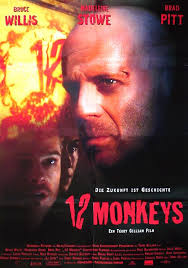 It may be the real-world incarnation of 12 Monkeys, the cult flick in which Bruce Willis goes back in time to save mankind and inadvertently causes the holocaust he is trying to prevent.
Sean Penn has traveled far and wide to uncover the warm, fuzzy side of such political personalities as Hugo Chavez and Raul Castro. We can only speculate on the motives behind his latest adventure, an elaborately staged meeting with El Chapo, the infamous Mexican drug kingpin Joaquin Guzman, who was recently recaptured after escaping from his maximum security prison cell.
Irony of ironies, it was Sean Penn himself who inadvertently led authorities to Guzman’s location. And although Mr. Penn has had little to say about his role in the apprehending of El Chapo, it’s tantalizing to wonder whether he might seek help from Bruce Willis to travel back in time in hope of undoing what he has done.
Always Faithful
 My son at his induction ceremony into the IDF.
May the Almighty watch over all those who put the lives of others before their own.
May we all find within ourselves the clarity and courage to stay true to the values that lie at the core of our humanity.

The Second Amendment and the Oral Law
 As president Obama embarks upon his latest unilateral campaign to repair the world, this time by expanding restrictions on gun ownership, it’s worth revisiting my article on the Second Amendment from 2010.
Perhaps the greatest danger to the Constitution is manipulating its words to validate predetermined conclusions. By doing so, we violate the talmudic admonition against making the law “a spade for digging,” i.e., a tool to advance our own ends.
To preserve constitutional integrity, we have to familiarize ourselves with the context of its times, then apply those observations to the times in which we live. That only works when we are committed to honoring the system, rather than exploiting the system to fit our own agenda.
Last month’s Supreme Court ruling affirming Second Amendment states’ rights (and coinciding with the predictable Republican grilling of Supreme Court nominee Elana Kagan over the same issue) has brought back into the spotlight the constitutional ambiguity regarding gun ownership in the U.S. of A.
A well regulated Militia, being necessary to the security of a free State, the right of the people to keep and bear Arms, shall not be infringed. So states the Second Amendment to the United States Constitution. At first glance, the stipulation seems clear enough. American citizens may own guns, plain and simple.
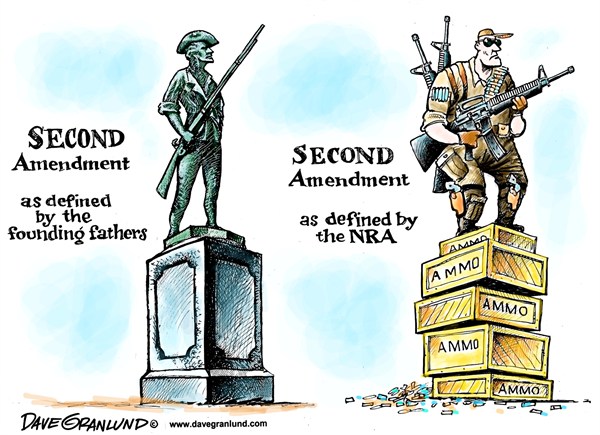 Or maybe not. The qualifying phrase that introduces the amendment appears to restrict constitutional protection to dependence upon a militia, or citizen army, to defend the nation. Accordingly, in times such as ours, when a standing army has assumed responsibility for the common defense, there may be no constitutional guarantee at all. And so, on second thought, the amendment seems to clearly limit the extent of private gun ownership.
Or, again, maybe not.
Perhaps the Founding Fathers meant that, since every citizen ultimately owns an equal share of the responsibility to defend his country, the right to bear arms is part and parcel of each person’s national duty to fight for the public welfare should the need ever arise. This would explain why the authors of the amendment might have mentioned a militia even if they never meant to restrict said right.
So what was the original intent of the Framers? If they were here, we could ask them. Since they are not, each side seems to have a fair and reasoned claim to support its respective position.
Is there any way to resolve the question of what was intended by men who passed away long before our grandfathers were born?
In fact, there may be.
THE REST OF THE STORY
Imagine that, as you pass by a window, you see a man wearing a mask raise a knife and plunge it into the chest of another man lying prone beneath him. You scream for the police, certain that you have just witnessed a murder.
Or, yet again, maybe not.
Now imagine that you were unfamiliar with the concept of open-heart surgery. Only after the police arrive and explain that the man in the mask is a surgeon working to repair the heart of the man on the table beside him will you understand that he is in fact saving a life and not taking one.
Context is everything. It orients us in time, space, and circumstance, transforms isolated acts into links in a chain of connected events, none of which can be understood in isolation. And so, if the words of our forebears sometimes appear to us muddled or imprecise, the surest way to achieve clarity is to examine comments and opinions from the same thinkers and the same era.
 Here are a few examples to provide historical context:
James Madison, on the principle of individual rights: [A bill of rights] should more especially comprise a doctrine in favour of the equality of human rights; of the liberty of conscience in matters of religious faith, of speech and of the press; of the trial by jury… of the writ of habeas corpus; of the right to keep and bear arms.
Massachusetts Representative Fisher Ames: The rights of conscience, of bearing arms, of changing the government, are declared to be inherent in the people.
Supreme Court Justice James Wilson, contributor to the drafting of the Constitution:The defense of one’s self, justly called the primary law of nature, is not, nor can it be abrogated by any regulation of municipal law.
Vice President Elbridge Gerry, signatory to the Declaration of Independence, on national defense: What, sir, is the use of militia? It is to prevent the establishment of a standing army, the bane of liberty.
In the context of the times, the intention of the Framers becomes difficult to debate. Only in relatively recent times, when the concept of a militia has become an anachronism, has it become possible to question the true meaning of the Second Amendment.
PRESERVING THE INTEGRITY OF THE LAW
Is there any way for words to retain their clarity despite the persistent evolution of cultural references and values? Is there any method for protecting ideas from the ravages of changing times and sensitivities?
Indeed there is. It predates the United States Constitution by 31 centuries, and it is called the Oral Law of the Torah.
Consider these biblical commandments:
Remember the Sabbath Day and keep it holy… And this will be a sign upon your arm and a remembrance between your eyes … Slaughter your [livestock] in the manner that I have prescribed… Do not seethe a kid in its mother’s milk.
 These precepts, as they are written in the Torah, are impossible to observe. What does it mean to keep the Sabbath “holy,” and what actions — if any — are required to “remember” it? What kind of sign are we to place upon our arms, if elsewhere the Torah prohibits the application of any tattoo, and how do we place a “remembrance” between our eyes? Nowhere does the Torah outline any prescription for ritual slaughter, nor does it imply what is commonly understood, that that the prohibition against cooking a baby goat in its mother’s milk extends to every mixture of meat and dairy products.
In spite of these and many other ambiguities, the basic practices of the Torah observant community have remained essentially unchanged for over 3300 years. The explanation is simple. Unlike the family encyclopedia which once gathered dust on the shelf and now gathers dust on the CD rack, the Oral Torah forces every committed Jew to see himself as custodian of a living tradition that connects him with the origins of his identity and enables him to live in the modern world without compromising the values of his ancestors.
No longer purely oral, the discussions and debates of past authorities have been recorded for their children in the writings of the Talmud and the commentaries that elucidate them. Unlike the records left behind by the Framers of the Constitution, however, these records have become canonized as part of the structure and process through which Jewish law is determined in each and every generation. Even when questions and disagreements arise, there is no debate within the Torah community over the methods through which answers and solutions are to be found.
Society changes, technology changes, and the values of human beings twist in the winds of time like a weather vane spinning before a storm. Electricity, automobiles, computers, cloning, and in vitro fertilization may have once been unimagined, but we have inherited a legacy that teaches us how those earlier generations would have resolved the problems of our changing world if they were here themselves today. And so the Torah Jew never loses his bearings, for he is guided by the words of his forefathers and finds comfort in the knowledge that the ancient wisdom of the Torah will never become stagnant, corrupted, or out of date.
As my teacher Rabbi Nota Schiller often says, the Oral Torah allows the Jews to change enough to stay the same.
Originally published by Jewish World Review

Justice in Oregon — Color Blind and 20/20
 A broken clock is right twice a day and, gratefully, the justice department has found the sweet spot — at least for the moment — in Oregon.
Certainly, the armed occupation of a national wildlife refuge is cause for concern. But it is not cause for panic and, in light of past notorious government interventions, definitely not cause for military confrontation.
In both the 1992 Ruby Ridge, Idaho, incident and the 1993 Branch Davidian raid in Waco, Texas, the level of intervention was clearly disproportionate to the danger posed and the resulting bloodshed largely indefensible. This is not to say that the government did not have just cause; rather, it failed to employ that resource that is more endangered than any other: common sense.
3 people died at Ruby Ridge; 76 died at Waco.
It’s heartening, therefore, that authorities are approaching the current crisis near Burns, Oregon, with circumspection. Of course, they can’t ignore the occupation. But with no one in danger, a wait-and-see strategy is the best of all available options.
The broader relevance of the story arises from the inevitable accusations of racism by leaders in the black and Muslim communities. It’s only because the so-called Citizens for Constitutional Freedom are white, they say, that the government has not charged in with guns blazing.
Which is, of course, pure nonsense. Two dozen right-wing trespassers in the middle of nowhere is hardly comparable to Ferguson, Missouri, or San Bernardino, California.
The response is different because the situations are different. And in this case, stuck between the real fears that inaction will embolden extremists to further acts of defiance while over-reaction will provide the opportunity for martyrdom, wait-and-see offers the best possible compromise between unattractive alternatives.
It’s also arguable that the occupiers have legitimate grievances against government overreach, which has grown into a systemic malady, evidenced by a rash of executive orders and a culture of bureaucratic strong-arming. Compared with the nebulous jeremiads of the Occupy Wall Street crowd and, more recently, students at Yale and the University of Missouri, the very real plaints of the Oregon occupiers appear level-headed and downright mainstream.
Competent leadership is characterized by the ability to gauge every situation according to its unique combination of factors, risks, and potential consequences. One-size-fits-all solutions rarely prove effective, and accusations of inconsistency are childish at best, opportunistic at worst. What we need most in these troubled times is cool-headed calculation that looks to strike the sanest balance between principled action and pragmatic compromise.
When we start demanding that level of aptitude and integrity from our leaders, maybe we will find ourselves with leaders worthy of our confidence and trust.

Guest Post: No Good Deed…
 A poor Jew finds a wallet with $700 in it. At his synagogue, he reads a notice saying that a wealthy congregant lost his wallet and is offering a $100 reward for it. He spots the owner and gives him the wallet.
The rich man counts the money and says, “I see you already took your reward.”
The poor man answers, “What?”
“This wallet had $800 in it when I lost it.”
They begin arguing, and eventually come before the rabbi.
Both state their case. The rich man concludes by saying, “Rabbi, I trust you believe ME.”
The rabbi says, “Of course,” and the rich man smiles. The poor man is crushed.
Then the rabbi hands the wallet to the poor man.
“What are you doing?!” yells the rich man.
The rabbi answers, “You are, of course, an honest man, and you say the wallet you lost had $800 in it. Therefore I’m sure it did. But if the man who found this wallet is a liar and a thief, he wouldn’t have returned it at all. Which means that this wallet must belong to somebody else. If that man steps forward, he’ll get the money. Until then, it belongs to the man who found it.”
“What about my money?” the rich man asks.
“Well, we’ll just have to wait until somebody finds a wallet with $800 in it…”
 Yonason Goldson