Home » Philosophy (Page 10)
Category Archives: Philosophy

The Boundaries of the World
 This week, the world observed the 100th anniversary of Albert Einstein publishing his General Theory of Relativity. The effects of his revelation extend far beyond what most of us imagine, as I outline in this excerpt from my book Proverbial Beauty: Secrets for Success and Happiness from the Wisdom of the Ages.
Do not remove the boundaries of eternity, which were set in place by your forefathers (Proverbs 22:28).
Writing for Environmental Health Perspectives, Ron Chepesiuk cites research that exposure to artificial light can prevent trees from adjusting to seasonal variation, affecting the behaviors, foraging areas, and breeding cycles of insects, bats, turtles, birds, fish, rodents, and reptiles even in rural settings. Urban light has caused disorientation in migrating birds, accounting for avian deaths estimated between 98 million and one billion each year.
The 24-hour day/night cycle, known as the circadian clock, affects physiologic processes in almost all organisms. These processes include brain wave patterns, hormone production, cell regulation, and other biologic activities. Disruption of the circadian clock is linked to several medical disorders in humans, including depression, insomnia, cardiovascular disease, and cancer, says Paolo Sassone-Corsi, chairman of the Pharmacology Department at the University of California, Irvine, who has done extensive research on the circadian clock. “Studies show that the circadian cycle controls from ten to fifteen percent of our genes,” he explains. “So the disruption of the circadian cycle can cause a lot of health problems.”
A meeting sponsored by the National Institute of Environmental Health Sciences (NIEHS) concluded that, although there is still no conclusive evidence, the correlation between altered patterns of light and dark in the modern world and dramatic increases in the risk of breast and prostate cancers, obesity, and early-onset diabetes appears more than coincidental.
And, of course, we can no longer see the stars.
Breaches in natural boundaries have taken many other forms as well:
- In 1884, a farmer visiting the Cotton States Exposition in Louisiana brought back a few Venezuelan water hyacinths to decorate the fountain outside his home in Florida. Today, the aggressive purple flowers choke 126,000 acres of waterways.
- Kudzu, a Japanese vine imported in 1876 to prevent erosion, is currently spreading through the southern United States and expanding at a rate of 150,000 acres a year.
- The European rabbit, introduced to Australia in 1859, has reached a population of over 200 million, necessitating the construction of a 2000 mile long rabbit-proof-fence to prevent the wholesale destruction of farmlands.
- In 1956, African bees brought over by Brazilian scientists to breed for honey production escaped their quarantine and gave rise to the noted “killer bee” scare.
The list goes on and on. In the United States alone, containment costs of invasive species are estimated at $138 billion annually.
But the violation of natural boundaries has even more broad-reaching consequences, affecting not only the stability of our physical world but the integrity of the moral universe as well. In his book Modern Times: the world from the twenties to the nineties, historian Paul Johnson analyzes the impact of Albert Einstein’s theory of relativity upon the way Western society began to look at the established values of the ages:
All at once, nothing seemed certain in the movements of the spheres… It was as though the spinning globe had been taken off its axis and cast adrift in a universe which no longer conformed to accustomed standards and measurement. At the beginning of the 1920s the belief began to circulate, for the first time at a popular level, that there were no longer any absolutes: of time and space, of good and evil, of knowledge, above all of value. Mistakenly but perhaps inevitably, relativity became confused with relativism.
No one was more distressed than Einstein by this public misapprehension. He was bewildered by the relentless publicity and error which his work seemed to promote…
Einstein was not a practicing Jew, but he acknowledged a God. He believed passionately in absolute standards of right and wrong… He wrote to [colleague Max] Born: “You believe in a God who plays dice, and I in complete law and order in a world which objectively exists and which I, in a wildly speculative way, am trying to capture. I firmly believe, but I hope that someone will discover a more realistic way or rather a more tangible basis than it has been my lot to find.”
But Einstein failed to produce a unified theory, either in the 1920s or thereafter. He lived to see moral relativism, to him a disease, become a social pandemic, just as he lived to see his fatal equation bring into existence nuclear warfare. There were times, he said at the end of his life, when he wished he had been a simple watchmaker…
[T]he public response to relativity was one of the principal formative influences on the course of twentieth-century history. It formed a knife, inadvertently wielded by its author, to help cut society adrift from its traditional moorings in the faith and morals of Judeo-Christian culture.
It’s hard not to be impressed by the prescience of King Solomon. When civilization depended upon candlelight to hold back the darkness, the inexorable cycle of day and night forced us to conform to the natural order. True, our lives have become more convenient and more comfortable, but once electric lighting pushes away the darkness of night, once central air conditioning and heating insulate us from the changing of the seasons, once cars and planes shrink the distance between faraway places, once electronic communication eliminates all delay in correspondence and information and, indeed, once science itself seems to provide justification that all boundaries are negotiable, is it not inevitable that society will begin to challenge moral boundaries as well?
There are no absolutes when every established norm is threatened by the inertia of change for the sake of change and an idealized vision of unrestricted freedom. Once change becomes the new normal, human society has little hope of curbing the headlong rush into chaos and social disintegration into moral anarchy.
In the same way that we have to defend the integrity of natural and moral boundaries as a society, we have to guard the boundaries between ourselves and those around us when the order of society begins to crumble. But no matter how much we try, we can never completely seal ourselves off from the influences of the culture in which we live.
I discovered this frightening truth on a trip to southern Asia, where a popular joke is repeated only half-jokingly:
In America people drive on the right side of the road.
In England, people drive on the left side of the road.
In India, it’s optional.
Only when society as a whole preserves its respect for the traditions that have been handed down through the ages will the structure of that society endure. But if each generation believes that it can reject the standards of its forbears from a position of moral superiority, the next age of darkness can be found lurking right around the corner.

The Other Butterfly Effect
 Earlier this month, Daniel Cohen joined the ranks of Israeli victims of unprovoked Arab knife attacks. The only difference in his story is that it was the best thing the could have happened to him.
As doctors worked to stop the bleeding and stabilize his condition, they discovered that the 31-year-old father of five was suffering from an undiagnosed case of intestinal cancer. Now receiving treatment, his prospects are good. Had he not been stabbed, who knows how long it might have been before the cancer was discovered.
How many things that look really bad eventually turn out to be really good? How many little things that go unnoticed may end up changing our lives in ways we can’t imagine?
It’s a topic worth revisiting, so I offer these thoughts from 2010:
On August 29, 1776, General George Washington’s first field command was about to end in disaster. Having divided his forces, Washington now found half his Continental army trapped between a superior redcoat contingent advancing on his position on one side and a fleet of British warships sailing up the East River to bombard his men from the other.
Instead, the rising winds of a nor’easter turned back the British ships, allowing the American force of over 9000 to escape across the river by night without losing a single man. As dawn broke, an impenetrable fog concealed the final stages of the withdrawal so that, when the air cleared around 7 AM, the British discovered an empty landscape where there had been an army only hours before.
On account of a timely wind and a providential fog, the American army survived to fight another day and the failure of the American Revolution was averted.
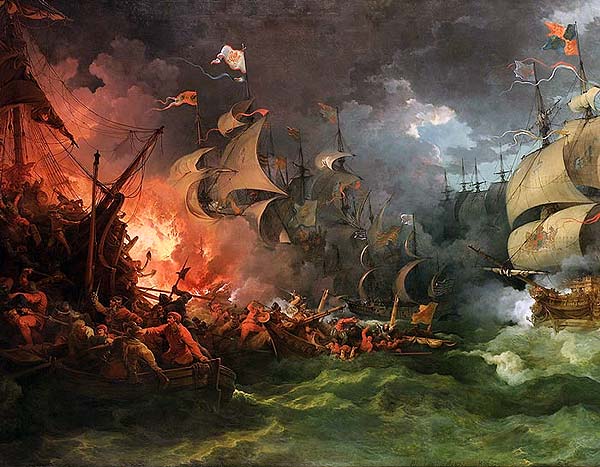 Two centuries earlier, it was the British who found salvation from a change in the wind. In 1588, King Philip II of Spain dispatched his fearsome Armada to depose the Protestant Queen Elizabeth and make Europe safe for Catholicism. On the night of August 7, however, a powerful north wind sped a plucky fleet of English fireships from its southern harbor up into the English Channel. By engaging the enemy flotilla, the British ships delayed the Spanish from their rendezvous with an invasion force of 27,000 soldiers that would almost certainly have captured London and executed Elizabeth. The wind then drove the Spanish on into the North Sea where they posed no further threat to England.
If not for the strong north breeze, Spain, not Britain, would have prevailed as the dominant power in Europe, the counter-Reformation might well have purged Protestantism from Europe, and Spanish would today be the preeminent language of world commerce and politics.
ALL THINGS GREAT AND SMALL
Even before the popular movie of the same name, virtually everyone had heard of the “butterfly effect,” the theoretical phenomenon whereby a tiny breeze begins with the flapping of a butterfly’s wings in Africa and gathers strength until it becomes a typhoon in the Pacific Ocean. A seemingly insignificant event on one side of the world may produce events of titanic proportions on the other.
And although it took winds stronger than the humble breeze of a butterfly’s wings to carry British ships to within reach of the Spanish Armada in the 16th century and hold them back from trapping Washington’s army 200 years later, in comparison with the rise and fall of nations we would generally consider weather conditions on any given day to be equally inconsequential.
In the grand scheme of creation, however, nothing is without consequence. The kabbalists tell us that nothing occurs on earth unless it is first decreed On High, and that nothing is decreed above unless it is first determined below. This is not a contradiction. Every event in this world is a reflection of the Divine Will, which changes each and every moment according to the behavior of man, the same way a mother and father may alter their parenting style to match every action of their child. The blessings and the retributions that come to the world, therefore, are a heavenly response to the conduct of human beings.
In the final moments before the destruction of the Second Temple, not satisfied to have razed Jerusalem to the ground and set fire to the House of G-d, the Roman general Titus showed his contempt for the sanctity of the Jewish nation by taking the Torah scroll, unrolling it upon the floor of the Holy of Holies, and laying with a prostitute upon it. In the place where the High Priest once performed the most intensely spiritual act of divine service, Titus committed the most despicable act of defilement.
Why did the Almighty allow Titus to so desecrate His innermost sanctuary? Rabbi Chaim of Volozhin, founder of the great Talmudic academy of 18th century Europe, explains that Titus gained divine sanction for his act because the Jews had, in a manner of speaking, already done the same thing themselves.
Just as the Temple once served as the focal point of Jewish society, similarly should every Jew see himself as a microcosm of the Temple. And just as the focal point of the Temple was the Holy of Holies, wherein resided the Ark of the Covenant, similarly is the mind the holiest sanctuary of the human being, for therein resides the soul. By allowing the philosophies of Greece and Rome to infiltrate their thinking and shape their values, the Jews had yielded to the carnal seduction of their souls and defiled the inner sanctuary of their own minds. For that reason alone was Titus allowed to perpetrate his abomination.
Despite the Temple serving as a constant reminder of their spiritual purpose, the Jews in ever increasing numbers had compromised their cultural integrity by adopting Greek and Roman styles of dress, by eagerly attending the spectacles of the Greek gymnasia and the Roman coliseums, by passionately studying sophistry from the philosophers of Greece and courting the aristocracy of Rome – all the while convinced that their dabbling in foreign culture was as innocent as the flitting of a butterfly on the breeze. But the moral corruption that lay at the core of these societies released a hurricane of spiritual confusion, eroding the foundations of Jewish values until the Jews forfeited the merit to serve their Creator in the great Temple of Jerusalem.
FROM ANY SOURCE, AT ANY MOMENT
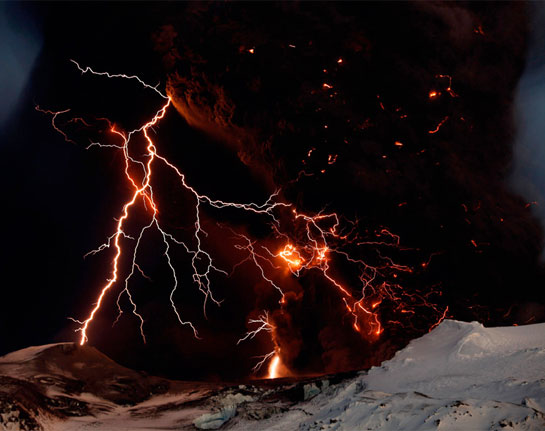 Though the guidance of Divine Providence, however, the flutter of the butterfly’s wings need not always result in devastation. In November 1991, a long and painful drought in Israel ended dramatically with rain and snow falling at record levels to fill the dangerously low Sea of Galilee beyond capacity and replenish underground aquifers. Climatologists attributed the precipitous weather to the eruption of Mount Pinatubo, on the Philippine island of Luzon, five months earlier. Coming after nearly 500 years of inactivity, Pinatubo’s eruption was the second largest of the 20th century.
After months of special prayers and fasting, the religious community had a different explanation. When the Almighty wants it to rain in Israel, He causes a volcano to erupt on the Pacific rim of Asia. Indeed, a more recent volcano eruption revealed the hand of Providence less globally but no less dramatically.
Earlier this year, an 18 year old seminary student in Israel was diagnosed with fulminate hepatic failure. Following the advice of his doctors and rabbi, the young man traveled to Brussels, the world center for liver transplants, which offered his only hope of recovery. But with five patients on the list ahead of him and his health deteriorating rapidly, the young man’s prospects were bleak. And so he waited and prayed for a miracle.
In mid-April, a liver became available. The medical center contacted the patient whose name topped the list, but he was unable to get to Brussels within the lifespan of the liver. Patients numbers two, three, four, and five could not arrive in time, either. The young student waiting for a miracle in Brussels received word that a liver was available. The transplant surgery was successful.
Why were none of the other candidates able to get to Brussels to benefit from the liver? Because only days earlier, the eruption of Iceland’s Eyjafjallajokull volcano had shut down all air traffic in Europe. What should have been a journey of only a few hours now became an unbridgeable gap for all except the prayerful seminary student who waited seemingly without hope.
After seeing his diseased liver, doctors agreed that if not for the transplant the young man would have died within a week.
Nothing occurs on earth unless it is first decreed On High, and nothing is decreed above unless it is first determined below. As we mourn the loss of the Temple in Jerusalem today, Tisha B’Av, let us consider that the flapping of butterfly wings begins in our hearts, in our conduct toward our Creator and toward our fellow men. The breeze produced by every act of kindness and devotion works its way up to the highest reaches of the heavens, then wafts back down to earth as the wind of change that visits upon us the consequences of our misdeeds or, if we are worthy, the blessings of our virtue.

The War to End all Wars
Originally published by Jewish World Review in September, 2001, two weeks after the attacks on the Twin Towers.
 Once upon a time there were three little pigs. One built a house of straw, until the big, bad wolf blew it down and gobbled him up. One built a house of sticks, until the big, bad wolf blew it down and gobbled him up. But one built a house of bricks and was safe from all the huffing and puffing of the big, bad wolf.
Society teaches values to successive generations through its children’s stories. The story of the Three Little Pigs is one of our most enduring fables, teaching the importance of good planning and disciplined effort. But it also carries with it a more subtle message, that safety rests in our own hands and our own labors, that security can be bought for the price of a pile of bricks and a bucket of mortar. This ideal, if it was ever true, went up in flames together with New York City ‘s skyline and Washington’s military nerve center on September 11.
More appropriate now than the Three Little Pigs is Robert Burns’s adage about “the best laid schemes of mice and men.” Indeed, the World Trade Center towers were each designed to absorb the impact of a 727; what the architects failed to factor in was how the fuel carried aboard a transcontinental airliner would create an inferno capable of compromising the structural strength of steel support beams. Of course, we don’t blame the architects; none of us imagined the acts of incomprehensible evil that brought down those towers.
 Which is precisely the point. We cannot imagine the design and the reach of evil. We can make our best effort, erect walls of brick around ourselves and roofs of steel over our heads, but we will never be completely safe. The world is too unpredictable an arena, the mind of the wicked too dark a cavern.
As if to drive home the instability of temporal existence, observant Jews around the world will disrupt their normal lives this week by moving out of their homes into little stick houses to live as our ancestors lived in the desert after their exodus from Egypt. But more than an attempt to recreate the experience of a fledgling nation traveling toward its homeland, the holiday of Sukkos offers us an opportunity to attune our minds to a most fundamental principle of Judaism — that however great our strength and the might of our own hands, however elaborate and well conceived our plans, life strews unexpected obstacles in our path that can scuttle our most certain victories and demolish our most solid edifices.
A sukkah may be built of virtually any material: wood, brick, steel, canvas, or even string may be used to construct its walls. But no matter how stable or how precarious its walls, the roof of a sukkah must be composed of s’chach, thin strips of wood or leaves, through which the light of the stars can shine at night. And when one sits in the sukkah and looks up at the s’chach — the barest representation of a roof that won’t protect him from even the lightest rainfall — he is inspired by the recollection of his ancestors who trusted in the protection of the Almighty, the One who took them out from under the rod of their oppressors and guided them through the inimical desert before bringing them safely home.
In his visionary writings, the prophet Ezekiel describes a great battle on the eve of the messianic era, when the all forces of evil in the world combine themselves into a great army called by the name Gog and Magog. The brilliant eighteenth century thinker Rabbi Samshon Raphael Hirsch interprets the prophet’s vision not as a military battle but as an ideological war between the philosophy of gog — “roof”– and the philosophy of sukkah, where those convinced that their fate lies in the power of their own hands and their own resources will attack the values of those who recognize the limits of human endeavor to influence the world.
In the immediate wake of the World Trade Center destruction, cries rang out for vengeance and military retribution. Since then, more measured voices have asserted that this war will be like no other, without defined enemies or defined borders, without clear strategies or decisive victories. This is an unfamiliar kind of crisis, where we find our capacity to respond in our own defense or to secure our own future profoundly diminished in a new world order.
So now the citizens and leaders of the world’s last remaining superpower must grapple with the uncertainties of a violent present and a murky future. Some will respond by declaring that we must work harder to take control of our own fate. Others will concede that we will never be secure again. And they will be right: no building, no bunker, no shelter made of brick or concrete or iron will guarantee our safety from the perverse imagination of extremists who can rationalize indiscriminate mass murder.

Yet for all that, the Jew sitting in his sukkah will look up at the heavens and be at peace. He will recognize that the best laid schemes often come to naught and that, after doing all that can be done, we are best off leaving our fate in the hands of the One who placed the stars in their courses, the One from whom protection ultimately comes for those who trust not in their own strength, but in the source of all strength.
As the winds of autumn blow with the first hint of winter, we may shiver with cold but never with fear. The illusion of the roof we can see reminds of the invisible reality of the wings of the Divine presence. We neither abandon ourselves to fate nor try to seize hold of it, but turn with confidence to face the future, secure in the knowledge that we have prepared ourselves as best we can to meet whatever life holds in store for us.

Gaining Entry to the Glorious Kingdom
Aaron [the High Priest] shall place lots upon the two goats: one lot “for God” and one lot “for Azazel.” Aaron shall bring close the goat designated by lot for God and make it a sin-offering. And the goat designated by lot for Azazel shall be stood alive before God, to provide atonement though it, to send it to Azazel into the wilderness.
Leviticus 16:8-10
 One of the most puzzling and disturbing rituals in Jewish practice is the goat “for Azazel.” During the afternoon of Yom Kippur, two goats are brought before the Kohein Gadol, the High Priest. By lot, one is chosen to be placed upon the altar as a sin-offering, while the other is taken out into the desert and thrown alive over the edge of a sheer cliff.
What purpose could such a practice possibly serve?
In truth, the symbolism of this ritual is astonishingly simple and frighteningly relevant. The two goats, identical in every way, symbolize the two possible futures that stretch out before every single human being. Like these goats – which appear indistinguishable from one another – many of the paths open to us in our youth seem equally attractive and filled with opportunity. Every child demonstrates both qualities of virtue and qualities of selfishness. Whether our higher or lower nature will win out in the end can never be reliably predicted.
Only over the course of a lifetime will it become evident whether the individual has chosen the path of righteousness, dedicating his life “to God,” like the goat offered up on the altar, or abandoned virtue for the path of wickedness, wandering through life into the wasteland of moral confusion and making himself into an offering “to Azazel,” a name commonly associated with the Satan but often left undefined.
Rabbi Samson Rafael Hirsch explains that the name Azazel can be understood as a composite of two Hebrew words: az azal – “wasted strength.”[1] Rather than devoting his life to the ways of virtue defined by God’s law, a person may use his human potential for pleasure seeking, for ego-gratification, for ultimately self-serving ends. By doing so, he squanders the resources of physical health, intelligence, and imagination in pursuit of temporal rewards that leave him, for all his efforts, with nothing of real value. He will have wasted his life, as surely as the life of the goat flung over the precipice in the wilderness comes to a wasted end. Like that goat, his life will have served no purpose except as a warning to others.
On this Day of Atonement, we remind ourselves of the urgency of daily reflection upon our past and our future, of the need to contemplate the awesome indictments of the Day of Judgment that we have only just survived, and of the priceless opportunity we have to influence the verdict of the Celestial Court as it determines our fate for the coming year.
Will we choose to offer ourselves on the altar of divine service by committing ourselves to take greater care in our speech, in our actions, and in our thoughts? Will we show more consideration for our fellow men and conduct ourselves with modesty and humility? Or will we continue on as we have, like the goat wandering blindly into the wilderness of oblivion, persisting in the habits of spiritual and moral insensitivity that may have already led us to the brink of eternal desolation?
It should be an easy choice. But the most important choices that confront us are rarely easy; instead, we grope through the darkness of confusion, blundering through the days and years of our lives.
Except for one day a year, when our eyes are opened wide.
 The sages tell us that one who answers amen has greater merit than one who recites the blessing itself: no praise of the Almighty is complete until it is reaffirmed by another.[2] However, we learn elsewhere that in the Holy Temple in Jerusalem, the congregation did not answer with the tradition amen but with the phrase “baruch sheim kovod malchuso l’olam vo’ed– Blessed is the name of His glorious kingdom forever and ever.”[3]
Rabbi Samuel Eliezer Edels (Maharsha) explains that amen is an expression of emunah, the faithfulness that compels us to remain true to God’s Law and to our spiritual mission even when the darkness of exile envelops us, even when human logic would abandon all hope that there is any rhyme or reason, that there is either Judge or justice.[4] Amen is the affirmation of our faithful belief in the existence and the divine plan of our Creator even when our senses can make little sense of our existence. When we declare amen – it is so! – not as an obligatory act but as a willing response, we testify to others and to ourselves that the hidden face of God hides from us only so that we can raise ourselves to new spiritual heights by seeking out the divine presence.
In the courtyard of the Temple, however, the radiance of the Shechina (the Divine presence) illuminated the eyes of all who stood in the holy courtyard facing the inner sanctum. Those who made the pilgrimage and passed through those gates were rewarded with a vision of such profound spiritual clarity that every shred of doubt evaporated and absolute certainty overtook them. There was no room left for emunah, and no need to cry out amen.
Instead, the ministrants would proclaim blessed is the name of His glorious kingdom forever and ever, a formula reserved for the malachim — the celestial emissaries that reside in the heavenly spheres — but which we are allowed to intone only in a whisper.
And why are we not permitted to say these words out loud? Since we do not know and cannot know the name – the essence – of God’s glorious kingdom, at least not until we have lived out our lives in this world and made our transition into the next. We have no right to praise that of which we have no knowledge, and so we dare only speak of it softly in anticipation of the day when it becomes our inheritance.
But in the Temple, in the presence of the Shechina enwrapped in the light of holiness, one gained sufficient clarity so that he could cry out with the malachim, not as an expression of faith but as declaration of absolute knowledge.
And there is one other occasion when we are permitted to proclaim this formula aloud: on Yom Kippur.
On Yom Kippur, we shed the trappings of our material existence and enter the realm of the malachim. Indeed, if we have prepared ourselves properly over the Ten Days of Repentance, then we do not merely give up eating and drinking; rather, we lose all interest in physical indulgences, attaining a vision of such spiritual clarity that we might as well be in the Temple itself, or in the celestial spheres alongside God’s divine emissaries.
And when the day is over and we return to the mundane existence of the physical world, we should find ourselves transformed, no longer malachim but much more than flesh and blood. With renewed spiritual energy and awareness, we are equipped to resolve the contradictions of the higher and lower worlds, and the paradox of the Almighty’s hidden and revealed self.
And this we can accomplish a hundred times a day, with every blessing we pronounce and every amen we answer.
Maharsha goes on to explain that the Tetragrammaton — the four letter name of God as it is spelled out in Hebrew – yud-kay-vav-kay – represents the Almighty in His ultimate form, all powerful and eternal, Master of the glorious kingdom whose name is known only to the malachim. On the other hand, the spoken name of God, the name in our prayers and our blessings – Ado-noy – represents the Creator as He reveals Himself to us as Master of our world.
With every blessing that we recite, we have an opportunity to act upon the revelation we experienced on Yom Kippur, uniting the revealed and the concealed names of God, proclaiming the unity of the Master of the Universe. And even more so when we respond amen.
According to Jewish numerology, or gematria, every letter in the Hebrew alphabet has a numerical equivalent. The numerical values of God’s written name – yud-kay-vav-kay – is 26. The gematria of God’s name as we pronounce it – Ado-noy – is 65. And when we respond to another’s blessing, affirming our faithful conviction that the same God we perceive imperfectly through our limited human eyes is one with the ineffable God who created the heavens and the earth, we ourselves transcend both the simple obligations of Torah observance and the finite nature of our earthly existence with one simple word: amen – with the gematria of 91, the sum of 26 and 65, representing the absolute unity of the Almighty.
And if we can achieve this awareness, despite all the darkness and confusion of our world, the malachim can do nothing but look on and covet the opportunity all of us have to serve our Creator in the way that is uniquely our own.
[1] Commentary on Chumash, loc. cit.
[2] Berachos 53b; Rashba, Sha’alos and Teshuvos 5:53
[3] Sotah 40b
[4] Ibid.

Do we really want a leader?
 The second Republican debate provided three indisputable facts:
- The mainstream press can barely disguise its bias in favor of the democrat party. Virtually every question was designed to promote inter-party bickering rather than elicit either policy positions or evidence of executive experience and aptitude. Whether in the debate itself or beyond, the press devotes disproportional attention to Donald Trump, not because he is the front-runner, nor even because he’s good for ratings, but because he discredit the Republican party in the eyes of most Americans with his ill-mannered and self-serving bluster.
- Far too high a percentage of the electorate lacks any real understanding of the responsibility implicit in the right to vote. Donald Trump has insulted a war hero, insulted women, insulted his fellow candidates, and has skirted giving meaningful responses to specific questions while telling us all to trust how great a job he will do. That he maintains such a commanding lead over so many truly qualified candidates is perhaps the most depressing aspect of the primary race so far. True, represents a reaction against political corruption and political correctness. But incivility is not the opposite of either.
- Carly Fiorina stands head and shoulders above every other candidate. She is well-informed, specific and to the point, poised and articulate, strong yet civil. She’s exactly what the country needs, and she should be leading by a mile.
When the Children of Israel approached Samuel the Prophet to ask for a king, Samuel responded with anger and rebuke. It was not the people’s request that was wrong; it was their reason.
“Give us a king,” the people said, “like all the other nations.”
The surrounding nations submitted to the rule of kings to absolve themselves of the responsibility of making choices and of the consequences of their actions. A Jewish king was supposed to inspire the people to live up to their mission as children of the Almighty. But the people wanted to take the easy way rather than challenge themselves to strive for greatness.
Ultimately, this country will only find its way back to greatness when we, the people, stop looking at the window dressing, stop looking for an entertainer-in-chief, stop looking for who will promise us the most goodies or tell us what we want to hear. We can only restore our country to greatness when we rally behind a true leader who is qualified to understand complex issues, who is willing to make difficult choices that are best for the nation, and who has the character to earn trust and respect from friends and enemies alike, at home and across the world.

Yom Kippur: Playoff Season for the Soul
Guest post by Mendel Horowitz

Like a field of dreams Yom Kippur counts on ghosts to inspire. In Kevin Costner’s sentimental role, his character Ray Kinsella carves a baseball diamond from a cornfield after hearing a mysterious whisper “if you build it he will come.” Encouraged by the prophecy and by the spirits of departed ballplayers, Ray in the end discovers his estranged father behind the plate and engages him in a seraphic game of catch. The High Holidays too can be stirred by fantastic voices – inexplicable motivators of contrition, correction, change. On Yom Kippur, standing solemn before my Maker with ghosts of past defeats and not-yet triumphs at hand, I too will aspire to engage Him. I too will hew a future from the past.
This year, the portentous Day of Atonement falls on the eve of September 23, while Sir David Wright hosts the Braves and the Mets delight in their amazing dream. For believers in Flushing, on that weekend baseball might seem delightfully temporal, repentance as distant a notion as spring. For me, our pastime is irresistibly spiritual, her diamond silhouette an invocation, her metaphors as vibrant as her checkered outfield grass. In my synagogue, that holy day will be celebrated as an occasion of longing, an extra-inning playoff of abstinence and prayer. I may not be rooting for the home team that afternoon but I will be encouraged by baseball’s oddities.
Our national pastime is peculiar indeed. When Yogi Berra quipped “it ain’t over till it’s over” during the summer of 1973, the Mets were in last place, finishing July a dismal 44-57. By August 30 the team was 61-71, 6.5 games back with 29 to play. Before the season closed the Mets would claim the NL East, victorious in 21 of their last 29 contests. The Mets infiltrated the postseason with a record of 82-79, to date the worst percentage by a division champion. After raising the NL pennant and battling to a World Series Game Seven, it was finally over when the Mets fell to the Mustache Gang and their swaggering MVP.
Yogi was only half right. In all professional team sports – baseball included – a playoff berth is routinely clinched before the season officially ends. It can be over before it’s over. Baseball is, however, unique in disallowing any single game to be over before its final out. Only on a diamond can a team come back from any deficit with no buzzer, whistle, or horn interrupting its rally. No game is over till it’s over. Just ask Mookie Wilson, who in 1986 delegitimized Billy Buckner on the tenth pitch of his heroic at-bat after the Red Sox were at three times one strike from deliverance. Baseball is a game of second chances.
For diehards, Yom Kippur is a final opportunity in a season of do-overs. When the Israelites forged a golden calf at Sinai Moses was compelled to smash the original tablets, tossing the first pitch in an epic struggle for God’s favor. Throughout a heated summer Moses labored valiantly atop the hill, earning the right to carve new tablets by offering himself for his team. On Yom Kippur, his efforts rewarded, the prophet descended triumphant, with God’s unassuming pardon and trophy slabs in hand. From the assurance of spring through the worry of summer, Moses carried his team to a fall salvation. Not bad for a rookie.
Relived annually, the Jewish season of second chances gets underway with the advent of Elul, the final month before the New Year. From then, each morning after services a shofar sounds and a special psalm is recited, calling to mind the far-reaching potential of the ensuing homestand. For a meritorious few and their less fortunate opposites, Rosh Hashanah, thirty days later, is the conclusive day of judgement, when the righteous and the wicked are inscribed in their respective tomes. Yom Kippur occurs ten days after that, allowing unremarkable journeymen extra innings to settle their score. Before the season’s final strike everyone will have their say at the plate.
A forty day homestand of penitence offers adequate occasions for transcendance. The process of repentance can invigorate, awakening dormant courage from slumber. But introspection is notoriously difficult to maintain, the stretch from Elul to Yom Kippur wearisome, draining. Like an ordinary baseball season (which spans three of four climatic seasons) the Days of Awe rely more on storylines than thrills, more on drama than excitement. Baseball is neither raucous nor bold. When “90% of the game is half mental” its energy is bound to be subtle.
 By some estimates 90% of the game is also spent standing around. According to the WSJ baseball’s fleeting moments of action account for but 17 minutes and 58 seconds of a typical three hour game. From on-deck circle to bullpen, from pathological glove adjustments to obsessive shaking off signs, baseball is an exhibition of exaggerated preparedness. Everything important in baseball happens in the heartbeats between anticipation. Apprehension is baseball’s charm; waiting, her mystique.
What made the pennant race endearing in ‘73 and the rally against Boston amazing in ‘86, were the unhurried ways they unfolded. Few things happen suddenly in baseball, it’s magic evolves leisurely in plain sight. No need for rapid eye movement or instant replay; baseball’s feats are taken in with a pencil and a stomach for suspense. In baseball, time is not something to play against but to toy with, the moments between activity more moving than the action itself.
The Day of Atonement is itself drawn out, prone to rushes of emotion and spans of boredom too. Between its haunting first inning and expectant last are 25 self-denying hours, an ascetic journey of supplication, ceremony, and song. Like baseball, Yom Kippur is a slow game, one that rewards patience with equal measures of elation. The enchantment of the day lingers in its tensions, its allure apparent in its yearning. A classic Yom Kippur unfolds without hurry, its promise swelling cautiously, its hesitancy bursting my heart.
As a religious orientation, baseball imbues the virtue of readiness, the modesty of reacting to something thrown at you really fast. At the plate and on Yom Kippur I can never be sure what may be tossed my way. All I can do is to prepare. Before the ghosts arrived, Ray Kinsella sculpted sacred space from profane, building it so “he will come.” Before knowing who he was, Ray was prepared for his arrival.
Absolution is never assured. To encounter Him on September 23 I will rely on ritual and superstition to get myself ready. My personal playoff will be lengthy, and if all goes well, improbable. I envision a nail-biter until late innings when, like Kirk Gibson, I will limp to the plate and achieve the impossible. Preferably with a longball. Preferably on a full count.

Remembering 9/11: Visionaries and Ideology
 Who knew a trip to New York could be so emotional?
Our first stop was the 9/11 museum. I marveled at the artistic vision that had conceived the memorial pools, the water channeling down in rivulets that mirrored the face of the fallen towers, the continuous downward rush balanced by the redemptive feeling of water — the source of life — returning to the heart of the world. Here there was solace, closure, and consolation.
But a very different feeling accosted me inside. Almost upon entering the doors a single word brandished itself across my mind’s eye: Holocaust.
Obviously there is no comparison between the monstrosity of wantonly dehumanizing genocide and any single act of terror; obviously there is no equivalence between the systematic psychological, spiritual, and physical destruction of millions and a few thousand relatively instantaneous murders.
But then again, yes there is.
Read the whole article here:
Balancing the Scales of Freedom
Originally published in the St. Louis Post-Dispatch the week after 9/11, between Rosh HaShonah and Yom Kippur.
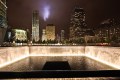
 It was Judgment Day — exactly one week after the World Trade Center buildings collapsed and so many illusions along with them.
“Judgment Day” is the expression found in the traditional liturgy for Rosh HaShonah, the first day of the Jewish new year. And as I stood in the midst of the congregation intoning the High Holiday prayers, the vision of exploding passenger planes and twin towers crumbling to dust hovered before my eyes.
On Rosh HaShonah we will be inscribed … who will live and who will die … who by water and who by fire … who by storm and who by plague … Who will have peace and who will suffer … who will be cast down and who will be exalted.
The judgment upon Jews became kinder after the United States opened her doors to us a century ago. Where no one else would have us, America took us in, allowing us to live both as Americans and as Jews without persecution.
Yet for all that, American Jews often feel torn by opposing cultural forces, especially approaching our Day of Judgment in a society where there is no greater sin than “judgmentalism.”
Without judgment, however, society cannot endure. As good citizens we must judge others – not based on race or religion but upon actions and behavior. And we must judge ourselves as well, by constantly reexamining our motives and our prejudices and our values and our goals. To condemn even this kind of judgment as a threat to freedom is to retreat from our responsibility to discern right from wrong; it is to embrace the illusion of absolute theoretical freedom – moral anarchy – which is in reality no freedom at all.
September 11 brought us face to face with moral anarchy in the form of incomprehensible evil. Perhaps the first step toward confronting it is to remind ourselves that freedom is not a right – it is a privilege, and privileges carry with them obligations that are often inconvenient and occasionally painful. When Thomas Jefferson wrote that the tree of liberty must sometimes be refreshed with the blood of patriots, he warned that the threat against freedom can only be met by not taking freedom for granted.
Freedom is not democratic, as less than a score of suicidal zealots understood when they commandeered four transcontinental airliners. The duties of freedom are non-negotiable, as New York firefighters and policemen understood when they rushed into crumbling skyscrapers. And the rules of freedom cannot always be legislated: sometimes we have to choose between necessary evils, as the passengers aboard United Airlines flight 93 understood when they drove their plane into a Pennsylvania field.
These are the kinds of judgments we must make, every day and every year, to preserve our society, all the more so in a nation built out of so many cultures and beliefs as ours. Every freedom of the individual cannot be permitted if it threatens the collective, nor can every interest of the collective be observed if it oppresses the individual. But when we share the collective will to make our society stable and secure, then the individual will set aside his personal freedoms for the national good and the nation will bend over backward to protect individual freedom.
This is the mark of a great civilization, and it rests upon an informed and devoted citizenry prepared to debate, sometimes passionately but always civilly, the moral direction of our collective journey.
This Rosh HaShonah I stood shoulder to shoulder with friends and neighbors singing ancient liturgical poems in praise of our Creator, just as so many Americans stood together the week before singing “G-d Bless America.” There were no agendas, no politics, no grudges, no rivalries. All of a sudden we were one nation, indivisible, a people with one noble history and many noble ideals whose differences vanished in the shadow of our many common values and common goals.
As the Jews have had ample opportunity to learn, now America has learned that nothing brings us together like a common enemy. What we have yet to learn is how to continue to stand together even in times of peace.

Rosh Hashanah Tailor-Made
 NOBODY LIKES fundraising dinners. The speeches are dry, the menu is dull, and the seating arrangements seem to have been drawn up by the Marquis de Sade. No one looks forward to these affairs, and we attend them only out of a sense of obligation.
Since one dinner I attended many years ago, however, I have become more wary than ever of this kind of event.
The evening began unremarkably and proceeded unremarkably — up to a point. The food was better than usual, the speeches ran longer than usual, the company was as good as could be hoped for, and I never saw the dinner plate that slipped from the tray of the passing waiter and struck me squarely on the forehead.
“I didn’t hit you, did I?” asked the waiter in response to the alarmed gasps and cries from the people who shared my table, several of whom assured him that he had, indeed, scored a direct hit.
“Are you all right?” he asked, inevitably. A silly question, really. A pound-and-a-half of glazed ceramic packs quite a wallop after accelerating at thirty-two feet-per-second-squared from a height of six feet in the air.
At least I was still conscious, still sitting upright, and I didn’t think I was bleeding.
“Get a doctor,” someone said.
“He doesn’t need a doctor,” said someone else. “Get him a lawyer.”
The manager arrived with an ice pack. “Here, take this.”
“I was hoping for scotch with my ice,” I said.
He laughed, but didn’t bring me any scotch. “I’ll need your name and address, sir,” he said, handing me a pen and paper.
“Don’t sign anything,” yelled someone from the next table.
I scribbled my vital statistics. “I’m really very sorry, sir,” he said.
“Is there anything else I can do for you?”
“Just the scotch.” He laughed again and went away. I had figured the manager would offer me vouchers for a complimentary night’s stay. He hadn’t. (I never even got a letter of apology.) I hadn’t gotten my whisky, either.
I began regaining my bearings to a medley of more lawsuit jokes. From across the table, however, my next door neighbor offered the only profound comment of the evening: “What were you thinking about before you got hit?”
I knew exactly what he meant. According to Talmudic philosophy, there are no accidents, no coincidences, no random events. Everything comes about through the guiding hand of Divine Providence, what we call hashgochoh pratis: the spiritual imperative that governs how the external world acts upon each and every one of us. In other words, if I got smacked on the head, I must have had it coming to me.
This is a far cry from the popular notion that whatever I want, I have coming to me. As much as contemporary culture may insist that privileges and entitlements are birthrights, the Talmud recognizes only our responsibilities, both to other individuals and to society. When we live up to our obligations, we may expect certain rewards to come our way. But if we do receive an apparently undeserved blow, great or small, we should assume that the equilibrium of the cosmic scales of justice somehow needed to be set back in balance, and we should reflect upon the message that has just been sent us from on high.
Sometimes we can easily identify a concrete lesson to glean from such mishaps. Other times not. But the principle holds, even when we can’t perceive any clear cause and effect: this was necessary; now we need to brush ourselves off and get on with life.
The traditional Yom Kippur liturgy provides a poignant example in its narrative concerning Rabbi Yishmoel, the High Priest, who died as the skin of his face was peeled away to suit the whim of the Roman governor’s daughter.
The malachim, the divine beings who inhabit the heavenly spheres, protested in outrage: “Is this the reward for living a life committed to holiness?” they demanded.
“Be silent!” commanded the Almighty, “or I will return the world to void and nothingness.”
The incomparable 18th century genius, Rabbi Elyahu of Vilna, explains G-d’s reply with an allegory: a king once received a gift of fine Turkish wool, the most luxurious fabric in the world. It was so beautiful, in fact, that the king could not bear to think that even a tiny piece of it should end up as scrap on the cutting floor. He went to every tailor in his kingdom and asked each to make him a suit without letting even one thread of the wool go to waste. But every tailor claimed that such a feat was beyond his ability.
 Finally, the king found a tailor who agreed to do the job. When the king returned to the tailor’s shop on the appointed date, he discovered that the tailor had indeed produced an exceptional suit of clothes. The king was elated.
“But have you fulfilled your promise?” asked the king. “Did you use every thread?”
“You really don’t know,” answered the tailor. “And the only way you will ever will find out is if you tear your beautiful suit apart and lay out all the pieces in the original shape of the fabric.”
Similarly, we often think that life is full of unfair knocks or is missing essential pieces. But to know for sure, we would have to see all of human history undone before our eyes. Only then would we have the right to assert that there were flaws in the slow sculpture of creation.
The days from Rosh HaShonnah to Yom Kippur — the traditional season of judgment — afford us the opportunity to strengthen our trust that the Master Tailor has done His job well, that He has stitched together the fabric of eternity according to a plan He understands far better than we do — even when bricks, or china plates, fall out of the sky upon our heads.
Should I have sued the hotel? the waiter? the school holding the event? the principal, who was speaking when I got hit? No doubt, I could have found any number of lawyers eager to take the case. If a woman could receive 4 million dollars for spilling a cup of coffee in her own lap, this should be worth at least as much.
But life is full of honest accidents resulting in superficial scrapes and bruises. It’s better for us (and better instruction for our children) to look for what we can learn from life’s bumps and knocks, not to look for whom we can blame and how much we can squeeze out of them.
The waiter returned, contrite and apologetic, perhaps more shaken than I was. “In twelve years this has never happened to me,” he said. Evidently, he also had a date with Providence. “Is there anything else I can do for you, sir?”
“I wouldn’t mind a scotch on the rocks.”
“I’ll see what I can do.”
He did. It wasn’t four million dollars, but it was better than a knock on the head.
When we aren’t who we think we are
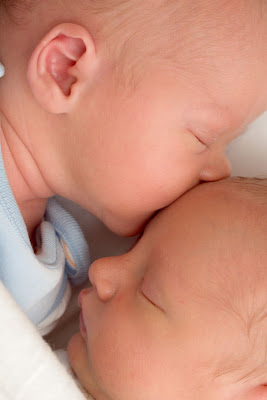 After several months, two babies switched in an El Slavador hospital were both reunited yesterday with their biological parents, respectively, in Dallas, Texas, and the United Kingdom.
But it didn’t have to turn out that way. Like this story from the news in 2009.
It sounds like a movie. Nurses bring a newborn daughter back to her mother after bathing. The mother insists that she’s been given the wrong baby. The nurses, who clearly know better, dismiss her concerns.
But 56 years later, DNA testing proves that Marjorie Angell, the real mother in this real story, was right.
Kay Rene Reed and DeeAnn Angell were both born on the third of May, 1953 in eastern Oregon’s Pioneer Memorial Hospital. As babies they were switched, presumably while being given baths, and grew up to become wives, mothers, and grandmothers. Less than a year ago Kay Rene’s brother discovered an old photograph of Kay Rene in middle school. Except that it wasn’t a picture of Kay Rene; rather, the schoolgirl who could have been her twin was in fact the sister of DeeAnn.
Subsequent DNA testing proved what had already become obvious. Kay Rene wasn’t a Reed, and DeeAnn wasn’t an Angell.
“I cried,” said Kay Rene. “My life wasn’t my life.”
MISTAKEN IDENTITY
Imagine waking up one morning and discovering that you were someone else. Nothing has changed, yet everything has changed. You have the same friends, the same family, the same job. But you also have another family and another past — a whole different identity about which you know nothing. A careless moment over which you had no control and an innocent mistake outside your knowledge conspired to leave you wondering how your whole life might have unfolded if not for that momentary twist of fate.
What would you do? What would you think? How would you feel?
If you have lived a happy and well-adjusted life, you’d probably wrestle with some inner confusion and then return to your friends and family. But if your life had been difficult, if you had endured an existence of hardships and traumas that had left you broken and bitter, how might you cry out against the cruelty of chance that had snatched away the happy life you might have had.
And what if, somehow, it had actually been your own fault?
THE ULTIMATE ANGUISH
The Sages teach that when a soul departs from this world, it lets out a scream that can be heard from one end of the universe to the other. Contemporary scholars have explained their meaning as follows:
Once freed from the bonds of physical existence, every soul ascends to the next world and comes before the Heavenly tribunal for judgment. Upon our arrival, each of us will witness a reenactment of his entire life on earth, as if projected upon a giant screen, with all of our good deeds and accomplishments, but also with all our carelessness and self-absorption. Recognizing the futility of excuses or apologies, we will feel the shame and remorse of a life poorly lived, with no further chance of redemption.
Simultaneously, as if on a split-screen, a different story plays out. Here we will behold the life of a tzaddik, a truly righteous and pious individual whose every thought and deed is for others and whose efforts are directed entirely toward moral and spiritual self-perfection. The contrast between the two images will be astonishing.
As the painful exercise concludes, each of us will pose a question to the court: “I recognize my own life, but who is this tzaddik that lived so perfect a life, and why was his story projected next to mine?”
“That tzaddik,” the court replies, “is the person you could have been.”
With sudden clarity, the ascendant soul will understand the consequences of a life lived in pursuit of physical pleasure and material goals. Perceiving that there had resided within him the potential to become someone else altogether and, realizing that it is too late to go back and relive his life, the unfortunate soul will emit a scream that can be heard from one end of the universe to the other.
BEFORE IT’S TOO LATE
As long as we remain alive in this world, however, there is time to go back. What’s past is not necessarily past, for the Creator has programmed into his universe the extraordinary capability to go back in time and reshape what has already been done. This is teshuva — repentance or, literally, return.
The Jewish concept of repentance is not mere chest-clopping and confession.Teshuva is a process of self-transformation, of changing ourselves into the kinds of individuals incapable of ever again committing our earlier transgressions and indiscretions. Through sincere self-reflection, our genuine remorse will catapult us to new levels of spiritual and moral sensitivity. By returning to the straight path the Creator laid out before us from the moment we were born, we literally re-create ourselves and severe all connection to the errors of the past.
What’s done is now undone, and we have nothing to fear from the ultimate Day of Judgment. It is no longer our past that defines us. It is what we have made of ourselves, and what we do from this point forward, that will define our future.
 The two women switched at birth have gotten on with their lives, and they have even become friends. Kay Rene introduces DeeAnn as her “swister.”
“I’m trying to move forward and look at the positive,” DeeAnn said. “You can’t look back. It just drives you crazy.”
As we approach Rosh Hashanah, the day on which all the world is judged for the coming year, it would serve us well to contemplate both who we are and who we ought to be.
 Yonason Goldson