Home » Psychology (Page 14)
Category Archives: Psychology

Swearing makes you smarter. REALLY?
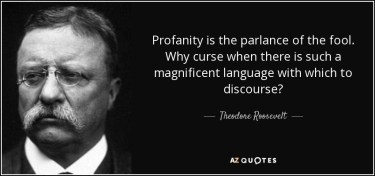 Experts have revealed [that] the use of profanity can in fact be a sign of a smart person.
This provocative assertion opened a recent article in the Daily Mail. The problem is, it’s not true.
Of course, that’s not the only problem. There’s also the problem of sloppy reporting, which comes from sloppy thinking, which comes from sloppy language. Which is what this story is really all about.
The alleged correlation between profanity and intelligence was inferred from a study concluding that people who know more curse words also know more words in general. Ipso facto, people who curse are smarter than people who don’t.
How much swearing do you suppose goes on at the Daily Mail?
Or you could ask a different question: Why should anyone take the Daily Mail seriously?
That’s a fair point. But the story also appeared in the Washington Post which, although avoiding the spurious equation between foul mouths and intelligence, still could not resist the lure of this equally misleading headline:
Why it’s a good sign if you curse. It isn’t. Which is clear from the Post article itself.

Of Doors and Windows
When the Lord closes a door, somewhere He opens a window.

No, I didn’t make that up. Julie Andrews says it in The Sound of Music. Half a century later, it may sound trite, but with the drama and trauma of this American election cycle finally behind us, it sure feels appropriate.
With uncharacteristic unity, liberals and conservatives alike long ago attained consensus that the ideological pendulum was never going to swing back again. The polling data had us all convinced that Hillary Clinton would continue the policies of our Visionary-In-Chief, opening up America’s borders, tearing down real and figurative walls, and redistributing wealth while running up debt toward the 15-figure mark.
Some welcomed this as advancement down the highway to Utopia. Some lamented it as racing headlong toward the abyss. But all that’s behind us now. The door to the past is closed. Where the window to the future will lead, only time will tell.
Be that as it may, a few thousand years before Julie Andrews, King Solomon offered his own observations about open doors. With respect to wisdom, he said:
Fortunate is the one who listens for me, attentively waiting by my doors day by day, keeping watch by my doorposts and entryways. For whoever finds me finds life…
From Solomon’s perspective, when a door closes, it likely means we have to work harder to find a way in.
After all, what is a door?
Click here to read the whole essay, from this month’s issue of The Wagon Magazine.

When Satan Calls
 Few people set out wanting to do evil. So how does evil happen?
Most evil begins with the desire to do good. But when we don’t recognize where good ends and evil begins, then we’re bound to cross the line between them.
Something about a certain road paved with good intentions.
But the most insidious kind of evil is the kind that continues to masquerade as good long after we’ve crossed the line. This is the favorite device of Satan, one that we usually recognize too late, after we have everything we wanted… and we’re stuck with it.
We’ve embraced the information revolution, which has so efficiently opened the floodgates of knowledge that we’re now drowning in a sea of pseudo-facts and misinformation. We’ve embraced the communication revolution, which has so thoroughly created lines of connection that we are more deeply disconnected than ever from one another and from reality.
Now that correspondence is effortless, we often leave emails unopened and, even more often, unanswered. Now that recorded messages are a click away, we’re too distracted to check our voice mail. We think it’s rude to call without texting first, and we consider it rude to end a text with a period.
We click to the next page only halfway through the current page, and we escape exposure to ideas that make us uncomfortable because mysterious algorithms are filtering the information that reaches us. And when unpleasant news does make it through the gauntlet of ideological censorship, we sink into a morass of emotional angst and cry out against a world that defies our comprehension.
Satan is laughing all the way to the motherboard.
But not everyone is deceived. There’s a growing, grassroots movement to observe a technology Sabbath, to unplug in order to turn on and disconnect in order to reconnect. No phones, no computers, no videos, no texting.
Does that sound horrifying? Impossible? Cruel and unusual?
Convince your friends and family to try it. Pull a dusty book of the shelf and remember what it’s like to feel what you’re reading. Go to the park, play softball, plan a progressive meal with friends and neighbors, enjoy a family game night.
Feel the technology toxins flow out of your body. Once the shock wears off, you’ll wonder why you didn’t start it years ago. And when you start the new week, you’ll be more rested, more relaxed, more focused, and the envy of your coworkers.
And then you’ll wonder how you will make it all the way to your next Sabbath.
The Gift of Gratitude
 If I were to say, ‘God, why me?’ about the bad things, then I should have said, ‘God, why me?’ about the good things that happened in my life.
— Arthur Ashe
There’s no arguing that tennis legend Arthur Ashe had good reason to complain. His mother died when he was four years old. His brilliant tennis career was cut short at age 36 by a heart attack, followed by two open-heart bypass operations and one brain surgery, only to discover that he had contracted AIDS via blood transfusion. He died at age 49.
It’s extraordinary that a person could suffer so much and not cry out against his fate with anger and bitterness. But the explanation used to be obvious, before it became increasingly rare:
Gratitude.



The Pathology of Praise
 You’re so cute. You’re so sweet. You’re such a doll.
You slob. You moron. You’re such a loser.
Anyone who has studied education or taken parenting classes has heard the eight-to-one rule: offer eight positive comments for every negative one. The theory is sound. By responding to good behavior, we accomplish three things:
- reinforce that behavior so it will be repeated more often
- encourage a positive self-image inconsistent with bad behavior
- legitimize occasional criticism so it will be taken to heart
All well and good. Except when it doesn’t work.
In her acclaimed bestseller, Mindset, Dr. Carol Dweck reports that grade school teachers criticize boys eight times more often than girls. If that weren’t enough, school-age boys typically pepper their conversation with insults, put-downs, and name-calling. Consequently, we should expect to find that girls grow up into self-confidant over-achievers and boys grow up into meek underperformers.
In fact, just the opposite is true.
Professor Dweck observes that the constant negativity directed at boys makes them increasingly impervious to criticism, which may boost their confidence but leaves them unreceptive to constructive advice. In contrast, the praise lavished on girls can leave them hypersensitive to criticism, to the point where they are afraid to take risks and tend to indulge in constant self-doubt.
Applied to society at large, this may explain a lot about our collective cultural dysfunction.

Down with Democracy?
 AMERICANS AGAINST HATRED AND BIGOTRY.
DUMP TRUMP.
NOT MY PRESIDENT.
[EXPLETIVE] UR WALL.
WE WON’T GIVE UP. WE WON’T GIVE IN.
UNITED WE’RE STRONGER (you have to love the irony).
These are just a few of the slogans that bedecked the nation-wide protests against Donald Trump’s electoral victory, i.e., against the American democratic system. Accompanying images included swastikas and pictures of Adolf Hitler.
Of course, protest is a fundamental part of our democracy, guaranteed by the First Amendment (which, incidentally, many Yale students petitioned to repeal). But protest is only productive when it advocates a viable solution to a problem. When protest is nothing more than collective whining, it easily turns into mob violence — indeed, as it did in several instances.
So what do the protesters actually want? To repeal the democratic process? To overthrow a legally elected chief executive? Public lynching?
If they want to advocate dismantling the electoral college, they might find support on both sides of the aisle… but only for the next election cycle. And they could make their point without vandalism, arson, or public obstruction.
On the other extreme, you have college students so traumatized by the election results they have requested exemptions from classwork and midterm exams. Such fragility does not bode well for the future leadership of the country.
It’s a pity we can’t conjure up an alternative reality portal; it would be amusing to get a glimpse of how the anti-Trump contingent would be reacting — had the election gone the other way — to disgruntled Trump supporters protesting the “rigged” election that stole victory from their candidate.
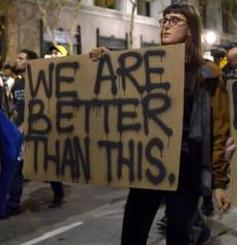
But one does have to acknowledge that sometimes the left is right. One protest sign manages to say it all:

Six Misconceptions that Stifle Success
 Why aren’t we more successful? Why aren’t we happier? Why do we have so many problems? Why can’t we get along?
We might blame it all on any number of things:
- Texting
- The internet
- Political correctness
- Self-esteem philosophy
The truth is, all of these are symptoms of the real problem:
The devaluation of self-discipline and personal responsibility.
More and more, we live in a culture that teaches us to expect what we want without effort and without concern for consequences. We know this doesn’t apply at work or in the gym; we should know that it doesn’t apply in school, in relationships, or in government.
But the social messages of immediate gratification and entitlement have seeped in everywhere, most of all into the one area on which all others depend.

Of frogs legs and scorpion tails

Indifferent to the specter of unleashed state-sponsored terrorism, France and China announced this week that they have joined forces to help Iran develop its natural gas fields. Apparently, an enriched and empowered radical theocracy is nothing to worry about — assuming the infamous Iran nuclear deal actually ensures any measure of global security.
It’s hard not to recall the parable of the frog and the scorpion:
A scorpion once asked to ride on the back of a frog to reach the other side of a river. At first, the frog refused, fearing for its life. But then the scorpion reasoned that the frog had nothing to worry about since, if it stung the frog, it would drown in the river as well. The frog could not argue with the scorpion’s logic and allowed it to climb aboard.
Midway across the river, the scorpion stung the frog. “Why did you do that?” cried the frog. “Now we will both die.”
“I couldn’t help it,” replied the scorpion. “It’s in my nature to sting, so I had to sting.”
The truth is that it’s easier to sympathize with the frog than with the French. The frog wanted to do a good deed and — albeit mistakenly — saw no cause for mistrusting the scorpion.
In contrast, the French and the Chinese want nothing but a larger slice of the world-economic pie, and they are willing to ignore the inevitable long-term dangers for short-term profit. The mild satisfaction of being able to tell them “we told you so” some years down the line will hardly supply adequate consolation for the precarious state the world will find itself in.
Of course, the allegory is imperfect for a different reason. France and China are scorpions, too. Dangerous, irresponsible, and unwilling to change their natures.
At the very least, however, their self-serving self-deception should make us ask ourselves: Are we frogs or scorpions? What about the candidates we vote into office?
And if we refuse to change our individual and collective natures, how far across the river can we expect to get?
 Yonason Goldson