Blog: The Ethical Echo Chamber

Liar, liar, house on fire
 In its never-ending quest for editorial balance and integrity, the venerable New York Times gave equal time to Israeli and Palestinian news channels in its reporting of the devastating fires sweeping through Israel.
Israeli news expressed the widely-held opinion that arson is behind the unprecedented rash of urban and forest conflagrations, the latest tactic of Palestinian terrorism.
Palestinian news reported that fires in Israel are started primarily by discarded cigarette butts and children playing with matches, with the remainder caused by electrical malfunction.
An Arab spokesman observed that Israel should take measures to ensure that these causes are addressed to prevent future fires. He failed to explain why fires anywhere near this scale have been unknown for the entire 68 year history of the State of Israel.
Thank you once again, New York Times, for honoring your famous motto:
All the news that fits, we print.

When Satan Calls
 Few people set out wanting to do evil. So how does evil happen?
Most evil begins with the desire to do good. But when we don’t recognize where good ends and evil begins, then we’re bound to cross the line between them.
Something about a certain road paved with good intentions.
But the most insidious kind of evil is the kind that continues to masquerade as good long after we’ve crossed the line. This is the favorite device of Satan, one that we usually recognize too late, after we have everything we wanted… and we’re stuck with it.
We’ve embraced the information revolution, which has so efficiently opened the floodgates of knowledge that we’re now drowning in a sea of pseudo-facts and misinformation. We’ve embraced the communication revolution, which has so thoroughly created lines of connection that we are more deeply disconnected than ever from one another and from reality.
Now that correspondence is effortless, we often leave emails unopened and, even more often, unanswered. Now that recorded messages are a click away, we’re too distracted to check our voice mail. We think it’s rude to call without texting first, and we consider it rude to end a text with a period.
We click to the next page only halfway through the current page, and we escape exposure to ideas that make us uncomfortable because mysterious algorithms are filtering the information that reaches us. And when unpleasant news does make it through the gauntlet of ideological censorship, we sink into a morass of emotional angst and cry out against a world that defies our comprehension.
Satan is laughing all the way to the motherboard.
But not everyone is deceived. There’s a growing, grassroots movement to observe a technology Sabbath, to unplug in order to turn on and disconnect in order to reconnect. No phones, no computers, no videos, no texting.
Does that sound horrifying? Impossible? Cruel and unusual?
Convince your friends and family to try it. Pull a dusty book of the shelf and remember what it’s like to feel what you’re reading. Go to the park, play softball, plan a progressive meal with friends and neighbors, enjoy a family game night.
Feel the technology toxins flow out of your body. Once the shock wears off, you’ll wonder why you didn’t start it years ago. And when you start the new week, you’ll be more rested, more relaxed, more focused, and the envy of your coworkers.
And then you’ll wonder how you will make it all the way to your next Sabbath.

The Gift of Gratitude
 If I were to say, ‘God, why me?’ about the bad things, then I should have said, ‘God, why me?’ about the good things that happened in my life.
— Arthur Ashe
There’s no arguing that tennis legend Arthur Ashe had good reason to complain. His mother died when he was four years old. His brilliant tennis career was cut short at age 36 by a heart attack, followed by two open-heart bypass operations and one brain surgery, only to discover that he had contracted AIDS via blood transfusion. He died at age 49.
It’s extraordinary that a person could suffer so much and not cry out against his fate with anger and bitterness. But the explanation used to be obvious, before it became increasingly rare:
Gratitude.



Donald Trump has finally gone too far
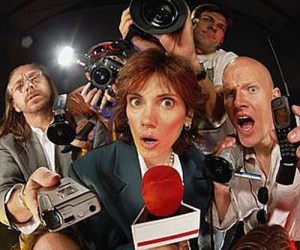 Perhaps we can forgive the president-elect for his crassness, his coarseness, his ultra-nationalist rhetoric, his mockingly superior tone, and for dragging the electoral process deeper into the mud than anytime in the last century.
But now he has officially gone too far.
Donald Trump has committed the unpardonable sin of not telling the press where he went for dinner last Tuesday evening.
By doing so, reports the Washington Post, Mr. Trump has “dispensed with generations-old traditions and formalities,” adopting a “combative approach to press relations” in a way that shows “he clearly doesn’t respect the media.”
Gee, is this the same media that rallied all its collective forces to discredit Donald Trump as a candidate and convince the country that a humiliating electoral defeat to Hillary Clinton awaited him come November 8? Might that have something to do with his perceived lack of respect?
But that’s not even the real issue.
More significant is the sense of entitlement the media feels to invade the private lives of every public figure, and the selective metric they apply when they do so. They grudgingly accord scant airtime and column space to stories that don’t fit their ideological agenda, then cry foul when they’re denied access to the not-yet-president’s family meal and frame the perceived offense as a threat to national security.
If the election results taught us anything, it’s that the media has become so skewed in its reporting that it can’t even trust itself. Maybe if reporters learn that lesson they’ll find themselves more welcome beside the presidential dinner table.

Six Recalibrations to get Success Back on Track
 In an earlier post, I outlined six misconceptions that stifle success. They are:
- Pleasure equals happiness
- Opinion equals fact
- Winning equals success
- Autonomy equals freedom
- Convenience equals peace of mind
- Legal equals ethical
When we use words without concern for their meaning, we deprive ourselves of the ability to think clearly. We confuse goals with side-effects, assets with obstructions, and benefits with pitfalls. We sabotage our own success because we aren’t clear about where we’re going or how we’re going to get there.
When we mistake happiness for pleasure, we end up chasing after instant gratification, which is emotional junk food. When we don’t consider ourselves winners unless someone else is losing, we drive away potential allies and advocates. When we refuse to reexamine our opinions, we are often denying reality.
The belief that freedom means no restrictions destroys discipline and makes us slaves to our bad habits. The notion that convenience leads to tranquility leaves us unable to cope with life’s difficulties and disappointments. And exploiting legal loopholes makes us untrustworthy and untrusted.
So let’s get down to definitions.

The Pathology of Praise
 You’re so cute. You’re so sweet. You’re such a doll.
You slob. You moron. You’re such a loser.
Anyone who has studied education or taken parenting classes has heard the eight-to-one rule: offer eight positive comments for every negative one. The theory is sound. By responding to good behavior, we accomplish three things:
- reinforce that behavior so it will be repeated more often
- encourage a positive self-image inconsistent with bad behavior
- legitimize occasional criticism so it will be taken to heart
All well and good. Except when it doesn’t work.
In her acclaimed bestseller, Mindset, Dr. Carol Dweck reports that grade school teachers criticize boys eight times more often than girls. If that weren’t enough, school-age boys typically pepper their conversation with insults, put-downs, and name-calling. Consequently, we should expect to find that girls grow up into self-confidant over-achievers and boys grow up into meek underperformers.
In fact, just the opposite is true.
Professor Dweck observes that the constant negativity directed at boys makes them increasingly impervious to criticism, which may boost their confidence but leaves them unreceptive to constructive advice. In contrast, the praise lavished on girls can leave them hypersensitive to criticism, to the point where they are afraid to take risks and tend to indulge in constant self-doubt.
Applied to society at large, this may explain a lot about our collective cultural dysfunction.

It’s right before your eyes
 Yesterday’s supermoon, the closest and brightest in seven decades, is dramatic precisely because it fails to push back the darkness of night. King Solomon warns us of the pitfalls of living “under the sun,” reminding us that too much light can blind us to the dangers posed by our own misperception — a theme that figures prominently in my book Proverbial Beauty. I’m taking the opportunity to revisit this article from 2009.
Imagine if, in the late 1990s, a freshman congressman in the House of Representatives had submitted, as his first piece of legislation, a bill requiring airlines to install high-security doors on all passenger planes between the cockpit and the cabin. Imagine that the bill narrowly passed, was signed into law, and resulted — at great inconvenience and expense — with enhanced security for every commercial flight crew by the summer of 2001.
What would such an initiative have produced? Most notably (or really, just the opposite), September 11 would be a date of no greater significance than August 3. No terrorists would have seized those airliners and flown them into the Twin Towers that day. Perhaps American troops would never have gone into Afghanistan or Iraq. Perhaps the economy would not (yet) have collapsed. Quite possibly, Barack Obama would never have been elected president in an anti-George W. Bush backlash.
In his book The Black Swan: The Impact of the Highly Improbable , economist Nassim Nicholas Taleb proposes just such a scenario. But Mr. Taleb focuses less on the global consequences than on the fate of our fictional congressman — let’s call him Joe Smith. Congressman Smith will not be remembered as the hero who prevented the worst terrorist attack in history, precisely because he successfully prevented it. In all likelihood, he will be loudly denounced as the architect of an expensive and irrelevant measure and hounded out of office. He may live out his life regret his own lack of political saavy, which ended his career before it had even begun.
A complicated and often elusive treatise, The Black Swan proposes a correlation between history’s most significant events and the degree to which they were unanticipated. The stock crashes of 1929 and 1987; the outbreak of both world wars; the collapse of the Soviet bloc and the rise of Islamic fundamentalism. Each of these came as a profound shock to the world; only with the benefit of hindsight have historians explained all of them as political and economical inevitabilities.
Moreover, the lessons learned from history’s most earth-shattering events tend consistently to be exercises in locking the barn door after the horse has run away. Both individually and collectively, we implement strategies that would have changed the course of history had we applied them earlier, failing to realize that our measures to correct address the specific circumstances that shaped the past rather than the broader principles that will determine the future. The more closely we focus on what we expect to happen, the more we increase the probability that the future will arrive from an entirely unimagined direction.
DON’T LOOK NOW
The human eye is a truly remarkable organ. It is self-focusing, adjusts instantly from close-range to distance, discerns color and texture, judges distance, and adapts to bright sunlight, inky darkness, and everything in between. It allows us to focus on a single point of interest while, through our faculty of peripheral vision, we continue to process information coming in from all sides to provide context and enable us to respond to changing conditions.
 Instinctively and intuitively, we place the object of immediate interest at the center of our optic and cognitive attention. But this is not always the most effective means of perception. We have all experienced instances of looking directly at an object and failing to see it, either because it is so familiar or unremarkable that our minds filter it out as irrelevant, or because it is so incongruous that our subconscious refuses to accept its presence. In such cases, we may notice an object only when we are looking elsewhere and our peripheral vision, unencumbered by the censorship of our expectations, draws our attention back to that which had previously hidden in plain sight.
This phenomenon — called averted vision — was first alluded to by Aristotle and has become particularly important among astronomers, who have found that observing an object peripherally may increase its resolution by up to three or four magnitudes. Because the center of the eye contains only cones, which perceive brightness and color, fainter objects are more easily detected by the rods, which perceive dim, monochromatic light and occupy the outer regions of the eye.
LOOK AWAY AND ALL WILL BE REVEALED
We live in a world that, on its surface, seems well-ordered and readily understood. The cycle of seasons follows its natural course with relative predictability. The habits of animals remain virtually unchanged. The waters of the earth flow downward from the mountains to the seas, evaporate and rise up to the firmament, then return to the earth as rain.
On closer inspection, however, the world is a place of profound mystery. Solid objects are composed of increasingly tiny particles, many of which are spinning wildly in microscopic orbits at nearly the speed of light. Hundreds of other sub-atomic particles waft about our universe, many without any clear direction or purpose. The beginnings of physical existence and life itself cannot be substantiated through any empirical evidence or rational theory. The force of gravity, which is so fundamental that we scarcely give it any thought, has no satisfactory explanation.
Atoms, the building blocks of our universe, had never been directly observed until last year, when an electronic microscope powerful enough to view them was finally engineered. The protons, neutrons, and electrons, as well as those myriad other sub-atomic particles, are still yet to be seen. So how do we know they exist? Indirect evidence — the averted vision of science. By analyzing observable evidence, scientists have determined that these particles must exist to explain otherwise unexplainable phenomena.
But why should our universe be so impenetrably shrouded in mystery? The sages of the Talmud explain that ours is a world of hester ponim — a world in which the Almighty “hides His face.” The familiarity of the material world draws all our attention, distracts us from the true spiritual nature that reveals itself only at the periphery of our vision. The unanswered questions of science, the anomalies of nature, the enigmas of philosophy, the improbability of the cosmic and individual “coincidences” that surround us daily — all these testify to the order and the One who imposed order upon the universe. They whisper to us from the corners of our consciousness and beckon us from the edges of our awareness, vanishing to insignificance amidst the cacophony of physical existence the moment we try to focus on them, then reappearing as soon as we turn our attention elsewhere.
Search for G-d and all His might, says King David, seek His presence always.The harder we try to find order in our lives, the more chaotic our world seems to become. By allowing the subtle evidence that flutters at the fringes of Creation to hold out attention, however indirectly, the more we make our hearts and minds sensitive to the spiritual reality that is the foundation of the physical universe and the human condition.

Down with Democracy?
 AMERICANS AGAINST HATRED AND BIGOTRY.
DUMP TRUMP.
NOT MY PRESIDENT.
[EXPLETIVE] UR WALL.
WE WON’T GIVE UP. WE WON’T GIVE IN.
UNITED WE’RE STRONGER (you have to love the irony).
These are just a few of the slogans that bedecked the nation-wide protests against Donald Trump’s electoral victory, i.e., against the American democratic system. Accompanying images included swastikas and pictures of Adolf Hitler.
Of course, protest is a fundamental part of our democracy, guaranteed by the First Amendment (which, incidentally, many Yale students petitioned to repeal). But protest is only productive when it advocates a viable solution to a problem. When protest is nothing more than collective whining, it easily turns into mob violence — indeed, as it did in several instances.
So what do the protesters actually want? To repeal the democratic process? To overthrow a legally elected chief executive? Public lynching?
If they want to advocate dismantling the electoral college, they might find support on both sides of the aisle… but only for the next election cycle. And they could make their point without vandalism, arson, or public obstruction.
On the other extreme, you have college students so traumatized by the election results they have requested exemptions from classwork and midterm exams. Such fragility does not bode well for the future leadership of the country.
It’s a pity we can’t conjure up an alternative reality portal; it would be amusing to get a glimpse of how the anti-Trump contingent would be reacting — had the election gone the other way — to disgruntled Trump supporters protesting the “rigged” election that stole victory from their candidate.
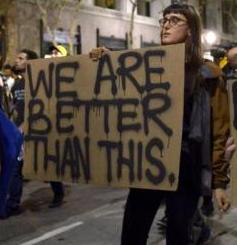
But one does have to acknowledge that sometimes the left is right. One protest sign manages to say it all:

Our thanks to those who served
“As we express our gratitude, we must never forget that the highest appreciation is not to utter words, but to live by them.”
—John F. Kennedy

“In the beginning of a change, the patriot is a scarce man, and brave, and hated and scorned. When his cause succeeds, the timid join him, for then it costs nothing to be a patriot.”
—Mark Twain


 Yonason Goldson