Home » Posts tagged 'Conflict' (Page 13)

Tag Archives: Conflict

Near-death experience

1You’re ten years old and a sound sleeper, so it’s already unusual that something has woken you up in the middle of the night.  You go out into the hall to investigate.  There are strangers in the house and flashing lights out the window.  Your father tells you to go back to bed.

When you wake up the next morning, your mother has disappeared from your life.

It’s 1970, before school counselors or lettered conditions like PTSD.  Your father means well, but he’s not the communicative type, not one for expressing his feelings to others or eliciting others to share their feelings with him.  He’s from the Depression Era, and he barely saw his own father growing up during those desperate years.  He’s a veteran of the Second World War; difficulties are part of life.

He’s also dealing with his own trauma, as his wife lingers between life and death.

You get shipped off to stay with friends, or with your grandmother.  Very little is explained to you, and you understand even less.  Years later, there won’t be much that you remember, aside from the indelible images of that first night.

You won’t remember waking up the next morning to find your grandmother home with you instead of you parents.  You won’t remember when they took you to visit your mother one last time because no one thought she had much time left.  You won’t remember shouting at her for having abandoned you.  You won’t remember the outgoing, cheerful little boy you were before that cold, winter’s night.

You only remember how hard it was for you to talk to people from that moment forward.  You remember how easily you cried during the years that followed, and how much you hated yourself for crying so easily without understanding what made you that way.  You remember how you considered taking your own life, but always managed to convince yourself that you could do it tomorrow.

A decade passes before you really recover.  In some ways, you never recover at all.

Click here to read the whole essay.

Radio Interview with Steve Curtis

democracy_thumbMore discussion about my recent article in the Times of Israel Blog, “The Danger of Democracy.”

My interview with Steve Curtis of KLZ-AM in Denver ran a full hour segment.  Enjoy!

Can I remain I after we become we?

63No man is an island, wrote John Donne. Neither is any nation, even if it’s the island nation of Great Britain.

This contradiction lies at the heart of the current political crisis facing British Prime Minister David Cameron. And as the British contemplate their future place in the world community, the rest of us should contemplate what the world will look like for our children and their children after them.

There are two legitimate, opposing arguments facing Britain in deciding whether or not to remain part of the European Union. To compete in the world marketplace as part of an economic powerhouse works to the advantage of every European country, Britain included. On the other hand, the threat to employment and security posed by unrestricted immigration may offset any benefits.

But whatever the British end up deciding for themselves in this month’s referendum, there is a deeper issue in play, one that has implications for all of us.

Click here to read the whole article.

At last, a hero

Just when you thought there was no hope for sanity left in America, the light of reason breaks through the clouds of ideology, if only for a moment.

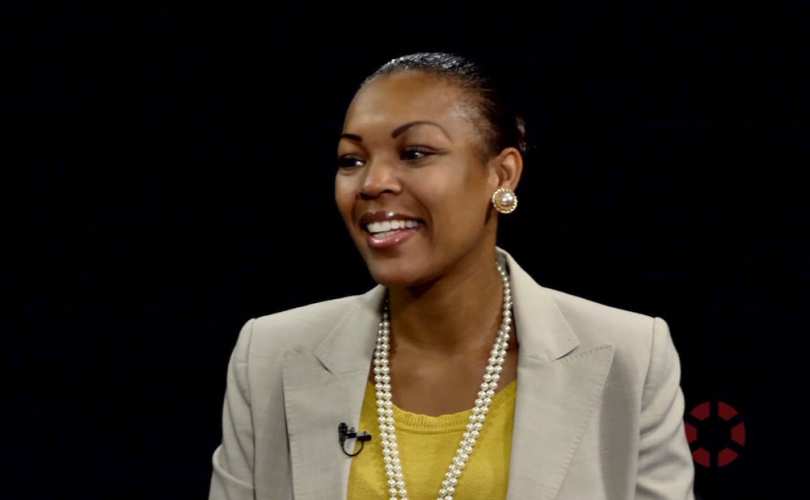
private-a-minute-with-maya-dilla_810_500_55_s_c1Maya Dillard Smith, head of the Georgia ACLU, resigned her position last week citing her organization’s unwillingness even to discuss any perspective or opinion out of sync with its own advocacy for transgender bathrooms.

The Huffington Post and other far left outlets responded, predictably, by attacking Ms. Smith and completely missing the point.  This is not about predators coming into public bathrooms.  That approach was from the start a tactical blunder by conservatives (which, sadly, is all too common).

The real issues here are governmental overreach and the right to privacy.  Just as the minority deserves protection from oppression by the majority, so too does the majority deserve protection from the predilections of the minority.

This is where the ACLU so consistently gets it wrong.  Social conventions are not all oppressive.  Just the opposite: they create the standards and boundaries of personal conduct that allow civil society to function.  Tearing them down willy-nilly because someone might find them discomfiting leads to social anarchy, from which everyone ultimately suffers.

But even that wasn’t the point behind Ms. Smith’s resignation.  It was the ACLU’s outright refusal to acknowledge the legitimacy of any position other than its own.

This is the problem that is plaguing the Western World and tearing our civilization apart.  The zombie-like groupthink that turns every adversary into a neanderthal or a Nazi undermines the whole notion of a democratic society.  We have to be able to discuss and debate, and to accept that reasonable people can disagree.  As long as a culture of political dogma prevails, endorsed and enabled by so many in high office and the media, our society will continue to crumble.

But for now, we have an unlikely hero.  Kudos to Maya Smith for taking a true stand on true principle, for not selling out, for not trying to have it both ways (ala Kim Davis), and for not being afraid of the hail of vitriol she knew she would bring upon herself from her former allies.

May she inspire others to follow her example.

Is it too late to let freedom ring once more?

July4v2Facebook has confessed that stories appearing on its supposedly-unbiased “Trending Topics” were manipulated. Rather than risk allowing its one billion active users exposure to the corrosive influence of conservative commentators, Facebook’s “news curators” decided to doctor the list of headline stories to favor left-wing political leanings.

In other breaking news, the sky is still blue, the grass is still green, and the loudest proponents of freedom are still laboring mightily to impose their vision of freedom on others.

Freedom of speech has been on life-support for decades already, wracked by the infectious scourge of groupthink, political correctness, and moral equivalence. College newspapers have routinely been stolen by students and even administrators for espousing politically incorrect views. Speakers of all ideological stripes have been shouted down, sometimes even by groups they support. Recently, a petition circulated among Yale students to repeal the First Amendment (including, ironically, the right to petition) collected 50 signatures in one hour.

The real death of free speech stems from the death of credibility. News organizations have abandoned even the pretense of objectivity or accuracy. The line between reporting and editorializing is consciously and persistently blurred. Elected officials and presidential candidates show such utter disregard for the truth that they don’t even attempt to disguise their prevarications, much less apologize when caught in the act.

But it’s the corruption of language itself that may pose the greatest danger to what remains of the institution once called Truth.

Click here to read the whole article.

The Danger of Democracy

how-well-do-you-know-the-american-revolution-2-25235-1435703192-19_dblbigThe prospect of a presidential race between the two most unpopular candidates in American electoral history should give us serious pause to reflect upon the inherent precariousness of any democratic system.

On the one hand, democracy protects a people from the whims and excesses of despotism by creating a system of accountability and popular will.  On the other, it places power in the hands of the masses, who may be uninformed and easily manipulated; as Robert A. Heinlein once wrote, does history record any case in which the majority was right?

A lot of people seem to agree.  Even now that the outcome appears inevitable in both primary races , opposition to the status quo has grown so intense that, in both parties, the voices of pragmatism are being drowned out by the battle cry of revolution.

Each rebel camp is a bizarre mirror-image of the other.  On the Republican side, the party orthodoxy is rejecting the presumptive nominee for being indifferent to its values and unfit to lead.  On the Democratic side, a surging upstart movement rallies around an untethered independent while decrying the corruption of the party orthodoxy itself.

Both insurgent groups are threatening to turn to third-party candidates.  Leaders on both sides are warning that such a move would be political suicide, and history supports their fears.  Third-party campaigns backfired for Teddy Roosevelt in 1912, Strom Thurmond (nearly) in 1948, Ross Perot in 1992, and Ralph Nader in 2000.  So isn’t it better to vote for the lesser of two evils than to give away the election by grasping at straws?

That’s a good question.

Read the whole column here.

Taking Pride in Prejudice

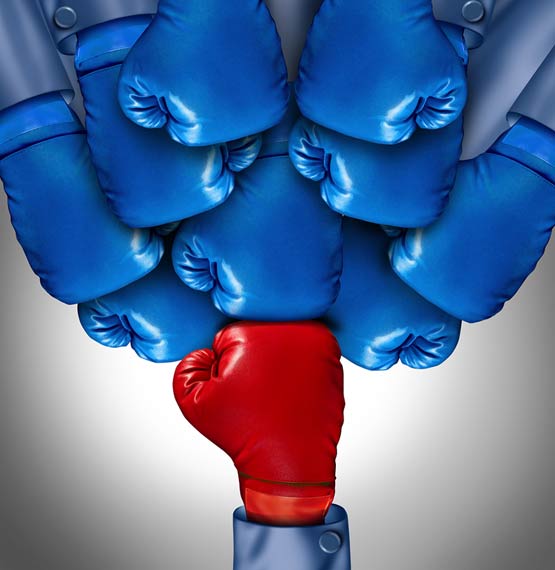
principled_adversity_ganged_up_on_coverPrejudice [prejuh-dis]. Noun. 1. an unfavorable opinion or feeling formed beforehand or without knowledge, thought, or reason. 2. any preconceived opinion or feeling, either favorable or unfavorable. 3. unreasonable feelings, opinions, or attitudes, especially of a hostile nature, regarding an ethnic, racial, social, or religious group.


According to these definitions from Dictionary.com, it’s clear that there are two essential components to prejudice: first, it is a form of opinion, not fact; second, it must be unreasonable or preconceived.

Please follow closely here: this implies that, for any opinion to avoid being prejudicial, the one holding that opinion must be able to articulate three things: 1) why he believes his opinion is correct; 2) why those who believe otherwise think they are correct; and 3) why those with whom he argues are wrong.

This is a matter of simple logic. First, if I can’t explain what I believe, then my beliefs are — by definition — prejudicial. Second, if I can’t explain someone else’s opinion, then rejecting that opinion is — also by definition — prejudicial. And third, if I can’t explain why I disagree with someone else’s opinion, that is — again, by definition — prejudicial.

But who am I kidding? We live in a world of sound bites and slogans, a world in which image trumps substance, in which feelings trump logic, in which the loudest voice drowns out all opponents and the most inflammatory rhetoric attracts the largest audiences. The new morality that rages against prejudice is mostly smoke-and-mirrors; indeed, the people who cry out against prejudice the loudest are the most prejudicial people of all.

Click here to read the whole article.

Panama Papers: the New Ashley-Madison

Photo Credit: Kacper Pempel

Photo Credit: Kacper Pempel

So now it all comes down to Costa Rica.

With the American elections devolving into the absurdity of a bad reality-show, it has become simply too embarrassing to continue living in the United States.  When Ted Cruz starts to look moderate and even-keeled in comparison to every other viable candidate, you know it’s time to find a new place to live.

Of course, Israel would be my next choice.  But I have two children living in Israel now, and the last thing twentysomethings want is for mom and dad to move in down the street while they’re trying to discover who they are and decide what they want to do when they grow up.

(The fact that I’m still trying to figure out what I want to do when I grow up does not make things better.)

I could move to Canada, of course, but fleeing across the northern border is such a cliche I wouldn’t be able to live with myself.  And Mexico is too risky; after all, what happens if I decide I want to come back and Donald Trump won’t let me in?

Europe is in chaos, Asia is too crowded, Africa is too hot, and  Australia is too close to the South Pole.  Brazil and Venezuela teeter on the brink of catastrophe, threatening to pull the entire South American continent down with them.

So I found myself left with only two possibilities: Panama and Costa Rica.  But after last week’s headlines, Panama is off the table as well.

The revelations in the Panama Papers have exposed a dark side of human nature almost beyond human imagination.

Click here to read the whole article.

Political Correctness:  the root of all evil

Attachment-1Dear Future President:

If you want to fix the country, you can start with the root cause of all that ails our country:

Political Correctness.

The truth is that political correctness is not a new idea at all; it is simply the new label for an old, established moral postulate once accepted by all.

The word civility shares its linguistic root with the word civilization.  It means taking into consideration the comfort of others before expressing what I think or doing what I want.  It means remembering that other people have rights before assert my own.  It means reflecting upon how my actions are going to affect my community and recognizing that I have a responsibility to a society that is more than the sum of autonomous individuals.

So what was wrong with the term civility that the concept needed rebranding as political correctness?  Most likely, it was the connotation of political ideology that spawned this illegitimate offspring of cultural nobility.

Read the whole article here.

In this series, professionals provide advice for the next U.S. president.
#nextpresident

Marriage of Convenience

WAGON WRAP 5We are what we pretend to be, so we must be careful about what we pretend to be.
― Kurt Vonnegut

The orderly rolled my gurney to a stop before an imposing double doorway. “Okay,” he said, “This is where you get your kiss.” I couldn’t tell if he was speaking to me or to my wife.  In any case, my wife kissed me and laughed and cried all at once. Then I was rolling again.

I arrived in surgery and scooted over onto the operating table.  I joked with the anesthesiologist.  He found my vein on the first try.  I recited Psalms to myself and wondered distantly why I wasn’t scared out of my wits.

They sliced me open, broke my sternum, compressed my lungs like empty sugar bags, and stopped my heart to patch the hole between its upper chambers with a piece of my pericardium while redirecting the blood that flowed through an anomalous vein.

I don’t remember that part.

I also don’t remember my hands clawing the air, straining against nylon straps, struggling to tear the ventilator mask from my face and the dressing from my chest.  My wife stifled a cry when she saw me in recovery.  Apart from the convolutions of my fingers, the pallor of my face starkly mirrored the countenance of death.

“He looks so good,” the nurse told her.

When I did regain consciousness the next day, numbed by morphine and dazed by the residue of anesthesia, I asked my cardiologist if he could release me that afternoon.  “I have to catch a flight to Jacksonville this evening,” I said.

I was trying to be funny.  He thought I was delirious.

EXPECT THE UNEXPECTED

[ File # csp3608269, License # 1131644 ] Licensed through http://www.canstockphoto.com in accordance with the End User License Agreement (http://www.canstockphoto.com/legal.php) (c) Can Stock Photo Inc. / Eraxion

Lacking prescience, however, I had no excuse for the cavalier attitude with which I approached this whole business.  No matter how distinguished my surgeon’s credentials, and no matter how casually he explained away the operation as routine (with the probability of success better than 99%), cardiac surgery remains as heart-stopping as it sounds:  they carve open your chest and, during an extended period of clinical death, cut and paste around your most vital organ before sewing you back together.

Call it what you like; it hardly ranks among the more attractive forms of elective surgery.

Yet “elective surgery” was how the doctor had described it.  After all, I had virtually no symptoms, and my condition might not advance for twenty years.  Then again, deterioration could begin within months, or even weeks.  And so, at my cardiologist’s insistence, I opted to exchange the distant prospect of lingering death for the immediate promise of physical pain followed by months-long recovery.

That was what I expected.  Instead, from beginning to end, while my wife and children and parents were dealing with their respective emotional traumas, the greatest discomfort I suffered throughout the entire episode came not from the incision, not from anesthesia withdrawal, not even from the mild pneumonia I contracted during recovery, but from a persistent hangnail that nagged me from the day after surgery until I returned home and exorcised it with my cuticle clippers.

THERE IS A LESSON

The great tennis player Arthur Ashe, after contracting AIDS via blood transfusion, was reported to have said, “If I ask why this has happened to me, then I must also ask concerning all the good that I have had in my life.”

Indeed, Mister Ashe, may you rest in peace — you should have asked both questions, as should we all.

If life is all One Great Accident, then there is no why.  But the exquisitely textured fabric of our universe, the elegant design of our world, and the transcendent nobility of Man when he listens to the calling of his soul — all these testify to the genius of an invisible Conductor who guides the symphony of Creation.

And if there is a plan behind the apparent chaos, then whatever happens for good or for bad should prompt us to ask, “Why?”

Click here to read the whole essay, from my column in the inaugural issue of The Wagon Magazine