Home » Posts tagged 'Culture Wars' (Page 7)
Tag Archives: Culture Wars

The Limits of Imagination
Yesterday, Jews around the world celebrated the Festival of Purim. In Jerusalem, the same celebration takes place today. So I’m taking the opportunity to revisit these thoughts from 2009.
 According to a survey — before the recent economic downturn — about 20 percent of Americans believe themselves to be among the wealthiest one percent of the nation. Another 20 percent anticipate that they will one day claim membership among the wealthiest one percent. In other words, two out of every five Americans believe that they are or will possess enough wealth to be in the top one out of a hundred.
One might describe this kind of rosy optimism as wishful thinking. One might better describe it as delusional.
The potency of imagination powers the engine of human achievement. Whether we aspire to fight for civil rights, to seek a cure for cancer, to write the great American novel, or to win the New York marathon, we never take the first step until we envision our own success, no matter how certain or improbable our chances of success may be. But as the line between reality and fantasy grows increasingly blurry in Western society, imagination does not spur us on toward success but prods us blindly toward the precipice of self-destruction.
Such was the myopia of the Jewish people under Persian rule 2,365 years ago when King Ahasuerus and his viceroy, the wicked Haman, conspired to annihilate the Jewish people. The Jews had thought to appease the king by attending his party, a banquet conceived to celebrate their failure to return to Israel after 70 years of exile. They thought to appease Haman by bowing down to him and the idolatrous image he wore upon a chain hanging from his neck. They thought appeasement and compromise and contrition would preserve the comfortable life they had grown used to in exile, far from their half-forgotten homeland.
Despite all their efforts, the axe fell. But the executioner’s blow never landed, checked in mid-swing by the divine hand, which concealed itself within a long series of improbable coincidences.
In the world of superficial cause-and-effect, the Jews appeared to owe their salvation to the random workings of fate. But it was no coincidence that their reversal of fortunes hinged upon the very moment when the invocations of Mordechai and Esther rallied their people to cast off the yoke of assimilation, no matter how imprudent such an act of defiance may have seemed.
It wasn’t wishful thinking that turned the hearts of the Jews back toward their Creator; it was the clarity that remained after all their schemes had failed and they were left staring into the cold, harsh light of reality.
Today, however, the light of reality shines neither cold nor harsh enough to make us open our eyes. Millions rally for an illusory peace to be won by appeasement before an expanding international culture of terrorism. Voices cry out against the leaders of democracy and in support of the enemies of mankind, urging us to walk the path of peace by laying down our arms before our enemies. Their anthem, it seems, echoes from a generation built on dreams and surviving on pure fantasy:
Imagine there’s no countries,
It isn’t hard to do,
Nothing to kill or die for,
No religion too,
Imagine all the people
Living life in peace…
Like Marxism and countless other utopian visions, it’s a lovely notion. Like its title, however, it is a dream existing only in imagination. Like its author, it is nothing but fantasy destined for tragedy.
Imagine no possessions,
I wonder if you can,
No need for greed or hunger,
A brotherhood of man,
Imagine all the people
Sharing all the world…You may say I’m a dreamer,
But I’m not the only one,
I hope some day you’ll join us,
And the world will live as one.
The world will indeed live as one, but not by wishing or imagining utopia into existence. Simple answers to complex problems rarely yield lasting solutions.
The holiday of Purim teaches us that peace comes only with the triumph of good over evil, a triumph that must be bought and paid for by standing up, speaking out and, when necessary, taking action against evil.


World Peace through Shared Servings
 We’ve all heard that you are what you eat. Now we learn that you may be what others eat.
A University of Chicago study found that people are more inclined to trust one another and more likely to come to agreement when eating the same kind of food. Although researchers can’t explain why, a series of experiments demonstrates a dramatic increase in cooperation and collegiality when people are talking not just over lunch, but over the same lunch.
Experts have been telling us for years that children flourish in proportion to the frequency of family dinners. The more time parents and children spend together at the table, the more likely children are to succeed in school, to develop positive self-image, and to enjoy better physical and emotional health.
The natural assumption has been that family interaction increases children’s feelings of love and security, which leads to a deeper appreciation of family values. That’s almost certainly true.
But there may be an additional factor. At most family dinners, whatever is on the menu is what everyone eats. And that, apparently, makes a big difference.

Telling evil from evil
 My home town of St. Louis made headlines across the country last week. Some of it was bad news; some of it was good news.
And some of it might have been fake news.
The bad news was the travesty of desecration: vandals toppled of 154 headstones in a Jewish cemetery during the night of 21 February. The Jewish community has far too much history of indignity and intimidation over decades and centuries to not react with horror, anger, and fear.
The good news was the community response. Citizens of St. Louis from across the religious and political divide came together in an inspiring show of support. Hundreds showed up last Wednesday to participate in a collective cleanup effort, including Missouri Governor Eric Greitens and Vice President Mike Pence. A crowd-funding campaign initiated by the Muslim community raised $75,000. People responded to a profane act of hate with solidarity, compassion, and brotherhood.
But what if they were missing the point?

In Memorium
Originally published by the St. Louis Post-Dispatch on Father’s Day, 2001.
 I was ten or twelve years old. My father and I had arrived at the stadium early, and I felt a thrill of excitement as we stood up for the Star Spangled Banner. Down on the field, our home team, the Los Angeles Rams, stood in a line holding their helmets under their arms. And in the row in front of us, a middle aged man stood with his hat perched casually upon his head.
“Hey, Buddy,” my father said. “Take off your hat.”
The man didn’t respond. “Hey you,” my father said, louder, “take off your hat.”
The man grunted an unintelligible, though clearly dismissive remark.
“You unpatriotic SOB,” growled my father; he didn’t abbreviate, either.
“Dad!” I whispered, mortified and afraid, but also faintly confused. My father had never before demonstrated any dramatic displays of patriotism.
The national anthem ended, the game began, and I guess I forgot about the incident because I never discussed it with my father, never asked him to explain an indignation that seemed entirely out of character.
But now I’m a father myself, and I don’t find my father’s action thirty years ago perplexing at all.
Why should we take off our hats for the national anthem? Why should we stand up for the flag? Why should we address strangers as “Sir” or “Madam,” wear coats and ties to church or synagogue, and give up our seats to the elderly?
It’s a matter of respect. Respect for people. Respect for institutions. Respect for wisdom and values and human dignity.
 Unfortunately, respect has been going out of fashion for a long time. Sex scandals and no-fault divorce have eroded respect for marriage and commitment. Partisan politics has eroded respect for leadership. Inflated grades and deflated standards have eroded respect for teaching. Abortion-on-demand and doctor-assisted suicide have eroded respect for life. “Reality television” has eroded respect for ourselves.
Which was our first step onto this slippery slope? Maybe it was the noble ideal of social equality, set spinning so wildly out of control that we began to equate respect with elitism. Maybe the information glut convinced us that we know as much about medicine as our doctors, as much about cars as our mechanics, and as much about education as our children’s teachers. Maybe our relentless pursuit of leisure time has made us too selfish to value age and experience, too lazy to act civilly toward our neighbors.
When respect is not earned, it disintegrates; when respect is exploited, it implodes. Indeed, after his desperate quest for legacy, Bill Clinton was best remembered at the time of his departure as the American president who made his underwear preferences a matter of public policy, who pilfered the White House china, and for whom a large percentage of once-self-respecting Americans so casually excused perjury in federal court. Barack Obama will leave behind the first video of an American president making faces in the mirror in preparation for an historic selfie.
But we should never rely on respect to percolate down from the top; it is our responsibility to grow it up from the grass roots. It is the job of parents to teach their children to say “please” and “thank you,” to not interrupt and not talk with their mouths full, to speak civilly and give up their seats to the elderly, to pick up their own litter and maybe even someone else’s. By doing so, parents instill in their children an intuitive sense of respect for others, even if their children may not understand why all these social minutiae are indispensable.

???????
But too many parents have abdicated that job, either because they’re not around enough or because they never learned to be respectful themselves.
The Talmud says that where there are no leaders, strive to be a leader yourself. In today’s increasingly fatherless society, teachers, scout leaders, and little league coaches have a greater obligation than ever to teach respect by showing respect for others — and so do we all every time we walk down the street or through the supermarket aisle.
A journey of a thousand miles begins with a single step. And a journey through life begins with a step in the right direction. Help a child take that step and, many steps later, his success will speak his thanks louder than words.
Every Father’s Day offers a reminder to say every day: Thanks, Dad.


Adios, Amigos!
 I’ve never made secret my disaffection for Donald Trump. But within the dark clouds of his campaign and presidency, one bright ray of sunshine may be getting ready to pierce through the gloom:
Even before our new president began settling into the White House, a grassroots movement was already underway, gradually building momentum toward the singular goal of California seceding from the union.
According to the Washington Post, the activist group Yes California has responded to the Trump presidency by mobilizing its minions, which now constitute 53 chapters statewide, determined to gather the half-million votes necessary for getting the measure on the state ballot in 2018. I encourage readers to donate generously.
And here I offer these sage words of advice to the secessionists: look south.

A View from the Frontlines
 Reporter Hunter Stuart describes how a strong dose of reality forced him to reconsider his biases and preconceptions.
In the summer of 2015, just three days after I moved to Israel for a one-and-a-half year stint freelance reporting in the region, I wrote down my feelings about the Israeli-Palestinian conflict. A friend of mine in New York had mentioned that it would be interesting to see if living in Israel would change the way I felt about it. My friend probably suspected that things would look differently from the front-row seat, so to speak.
Boy was he right.

Profit is not enough
 “Cybercrime is out of control.”
So says Caleb Barlow, Vice President at IBM Security. And if you’re already worried about credit card fraud and Russian hacking, you may not want to read any further.
On the other hand, there’s a lesson for all of us from the world of virtual villainy.
Most of us have come to accept internet espionage, phishing emails, and scam artists as part of life, the virtual equivalent of political kickbacks, muggings, and drive-by shootings. We don’t like them; but the real world is not a perfect world, so we learn to take the bad with the good.
In a recent Ted Talk, Caleb Barlow offered a terrifying and surreal account of criminal organizations operating like professional, legitimate businesses, with English-speaking help desks and fake banking websites. They operate anonymously on the Dark Web, which most of us relate to as something from a Kiefer Sutherland thriller.
But it’s real. So real, in fact, that if you stumbled across a dark website you’d think you were shopping on Amazon or checking reviews on Angie’s List.

Walking the Talk
 If Diogenes couldn’t find an honest man 24 centuries ago in ancient Greece, it’s hard to imagine his search would prove more fruitful in modern-day Washington, D.C. or, lamentably, in modern-day America.
It’s not hard to understand why. In our age of personal gratification, truth has become more than merely inconvenient. It has become an utter nuisance.
Conservatives have been eager – and correctly so – to shine the light of hypocrisy on Sally Yates, the acting Attorney General fired by Donald Trump last week for refusing to enforce his recent executive order on refugees. Ms. Yates might have argued against the order’s constitutionality; instead, she based her decision primarily on personal bias.
Celebrated by the left for her stand on principle, what Ms. Yates really did was to violate her oath of office by failing to fulfill her duties. It’s her job to uphold the law, not her individual values. If conscience prevented her from performing her duties, she would have resigned in protest. But that would have required true principle. So much easier to merely participate in another round of partisan gamesmanship.
This brings us back to Kim Davis, the Kentucky clerk who refused to grant marriage licenses to same-sex couples back in 2015. She too claimed to stand on principle by refusing to honor her oath of office.
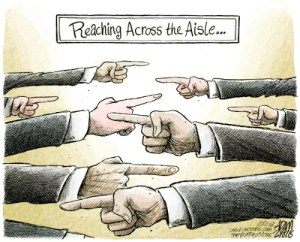 So why are the same voices that castigated Ms. Davis hailing Sally Yates as a hero? And where were the critics of Ms. Yates when Kim Davis was making herself a martyr in name only?
Jedediah Bila posed that very question on The View, prompting Whoopi Goldberg to go ballistic and invoke the popular refrain, it’s not the same thing.
Nowadays, principle is just a synonym for equivocation.
 Yonason Goldson