Home » Posts tagged 'Ethics' (Page 14)
Tag Archives: Ethics


Walking the Talk
 If Diogenes couldn’t find an honest man 24 centuries ago in ancient Greece, it’s hard to imagine his search would prove more fruitful in modern-day Washington, D.C. or, lamentably, in modern-day America.
It’s not hard to understand why. In our age of personal gratification, truth has become more than merely inconvenient. It has become an utter nuisance.
Conservatives have been eager – and correctly so – to shine the light of hypocrisy on Sally Yates, the acting Attorney General fired by Donald Trump last week for refusing to enforce his recent executive order on refugees. Ms. Yates might have argued against the order’s constitutionality; instead, she based her decision primarily on personal bias.
Celebrated by the left for her stand on principle, what Ms. Yates really did was to violate her oath of office by failing to fulfill her duties. It’s her job to uphold the law, not her individual values. If conscience prevented her from performing her duties, she would have resigned in protest. But that would have required true principle. So much easier to merely participate in another round of partisan gamesmanship.
This brings us back to Kim Davis, the Kentucky clerk who refused to grant marriage licenses to same-sex couples back in 2015. She too claimed to stand on principle by refusing to honor her oath of office.
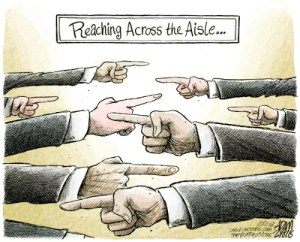 So why are the same voices that castigated Ms. Davis hailing Sally Yates as a hero? And where were the critics of Ms. Yates when Kim Davis was making herself a martyr in name only?
Jedediah Bila posed that very question on The View, prompting Whoopi Goldberg to go ballistic and invoke the popular refrain, it’s not the same thing.
Nowadays, principle is just a synonym for equivocation.


Radio Interview with Steve Curtis — Ethics of the Day
Listen to my interview this Monday on Wake Up with Steve Curtis on KLZ Denver.

Click here for The Ethics of our Day.


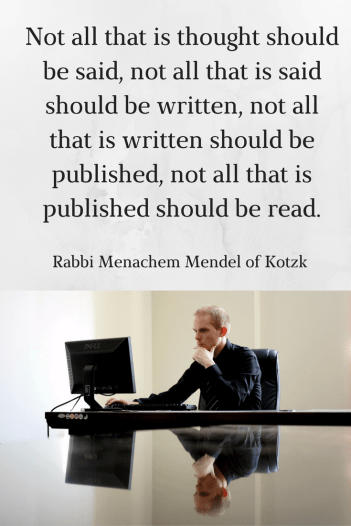
Is there a difference between “opinion” and “bias”?
 On Tuesday 3 January — apparently in response to a hail of letters accusing the paper of editorial bias — the St. Louis Post-Dispatch ran a full-page editorial attempting to justify their approach to opinion pieces. I responded as follows:
Dear Editors,
In last Tuesday’s defense of your paper’s opinion pages, you claim that your reporting is free from editorial influence. Many would dispute this point, but I wish to address a more objectionable assertion in your argument.
You write: “Where you will absolutely find bias is on the opinion pages.” This remark is as astonishing as it is disconcerting.
Bias and opinion are not synonyms. Bias is by definition emotional, often to the point of irrational. Opinion expresses a principled position, ideally based on accurate information and sound reasoning.
Daniel Patrick Moynihan famously observed that you’re entitled to your own opinion but not your own facts. A responsible news organization, however, is duty bound to make sure that its opinion pieces are fact-based and logically developed. This requires an understanding of both sides of an issue and the commitment to intellectual integrity. Only then is an opinion deserving of publication.

Write your Headline before you Run your Story
 “It seemed like a good idea at the time.”
How often have we heard someone say that? How many times have we said it ourselves? And it almost always comes as a response to the same question:
“What were you thinking?”
Our minds have a funny way of convincing us that our ideas will succeed on strength of creativity, sincerity, ingenuity, and necessity. We might have identified the true source of the problem; we might have formulated a real solution; we might be 100% committed to making things better.
But none of that is enough without two critical components:
Implementation and perception.

 Yonason Goldson