Home » Posts tagged 'Good and Evil' (Page 11)
Tag Archives: Good and Evil


Lighting our way to the Palace of the King
 There is a story of a prince, a true prodigal son, whose antics and excesses taxed his father’s patience until the king, with no other recourse, sent his son penniless into exile to learn responsibility and humility.
The prince wandered from place to place, half-starving, unqualified for any craft or labor, until he finally found work as a shepherd in a distant land. The job of shepherding was not overly difficult, but the sun burned the prince’s back by day, the wind froze him at night, and the rain soaked through his clothes in winter.
Other shepherds built little huts to protect them from the elements, but whenever the poor prince tried to build himself a hut it toppled over in the first strong breeze.
Years went by, until at last the prince heard that the king was coming to the province where he lived. There was a custom in the kingdom that people would write their wishes upon scraps of paper and throw them at the king’s carriage. Any requests that the king picked up a read would be granted immediately. So the prince positioned himself along the parade route and, as the king’s carriage passed, he took careful aim and tossed his note.
The paper fell at the king’s feet. He unrolled it and, recognizing his son’s handwriting, he began to weep. For the note asked if the king would give the prince a little hut to protect him from the sun and the wind and the rain.
“My son could have asked to return to the palace,” cried the king, “but he no longer knows he is a prince.”
So it was in the days of the Maccabees, when the Jewish people were so steeped in the physical aestheticism and indulgences of Greek culture that many of them forgot that they were in exile, forgot that they were inheritors of a priceless spiritual legacy, forgot that they were children of the King.
But a few didn’t forget. A few risked their lives to honor the Sabbath, to circumcise their sons, to study the Torah of their fathers and grandfathers, to preserve the divine spark that had guided their ancestors for a thousand years. And, when their moment came, those few took up arms against their oppressors and fought for the privilege of living as Jews. They recaptured the Holy Temple and, as they rekindled the menorah, divine light flooded the streets and courtyards of Jerusalem, pushing off the darkness of exile, waking the people from cultural forgetfulness, inspiring a generation to remember its ancient roots cast its aspirations once more toward the heavens.
Today, 2,180 years later, we too live in an age of spiritual darkness, when the loudest and most persistent voices in our surrounding culture cry out to expunge every mention of the divine, to condemn every moral judgment, to sanctify every perversion in the name of “tolerance.” We live in an era of unprecedented material comfort and convenience, tranquilizing our bodies and our minds so that we can easily stifle the yearning of our souls.
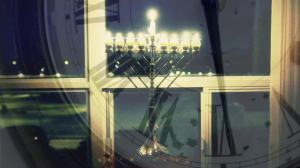 But when the days are shortest and the nights are coldest, just then can a little light shine forth and dispel much darkness. Like a lighthouse guiding a ship home, the lights of the Chanukah menorah can draw us back from the abyss of spiritual oblivion. And as we add candle upon candle and light upon light, the growing radiance of the menorah reminds us of the divine flame that has guided us through the darkness of exile and saved us from the darkness of assimilation for generation after generation.
If we, like the Hellenist Jews, allow the material values of contemporary culture to shape our thinking and guide our actions, then we have truly forgotten who we are. Like the prince whose soul longed for nothing but a little hut to protect him from the sun and the rain, we will be destined to live out our days in futility.
But if we cling to all that which is noble within us, if the values of our tradition drive us to perform acts of kindness and charity, to devote a few moments each day to heartfelt and meditative prayer, to treat neighbors and strangers alike with respect, to set an example of morality and character for our children — then we will have rekindled the spark of divinity inside us, and we will have earned the privilege to have our Father, the King, bring us home.
Originally published in 2003 by Jewish World Review

Liar, liar, house on fire
 In its never-ending quest for editorial balance and integrity, the venerable New York Times gave equal time to Israeli and Palestinian news channels in its reporting of the devastating fires sweeping through Israel.
Israeli news expressed the widely-held opinion that arson is behind the unprecedented rash of urban and forest conflagrations, the latest tactic of Palestinian terrorism.
Palestinian news reported that fires in Israel are started primarily by discarded cigarette butts and children playing with matches, with the remainder caused by electrical malfunction.
An Arab spokesman observed that Israel should take measures to ensure that these causes are addressed to prevent future fires. He failed to explain why fires anywhere near this scale have been unknown for the entire 68 year history of the State of Israel.
Thank you once again, New York Times, for honoring your famous motto:
All the news that fits, we print.



How we move forward
 Too many voters held their noses yesterday as they entered the polling booth to vote for the candidate they considered least toxic. A smaller number could only make peace with their conscience by voting for some unexceptional third-party candidate. Then there were those who couldn’t bring themselves to vote at all.
Will the country survive this winter of our discontent? Only time will tell. But the question that lingers in the aftermath of electoral acrimony is this: are we going to start this all over again in two more years?
Sadly, we just might. Back in January, David Gelertner proposed in the Weekly Standard that the problem with the political left is that liberalism has become their new religion. For most people, religion is not a rational but an emotional commitment that emerges from some amorphous inner voice or feeling. And when people cannot defend their religious beliefs intellectually, they lash out with disproportionate ferocity at anyone who challenges those beliefs. Mr. Gelertner argues that the irrational dogmatism of many liberals bears less resemblance to political discourse and more to the religious fervor of blind faith.
He’s right, of course. But he’s wrong when he contends that this is overwhelmingly a phenomenon of the left.

My Interview with Bill Martinez
 Listen in on my conversation about political correctness and the culture wars with nationally syndicated radio host Bill Martinez on 10/19.
The War to End all Wars
This Sunday evening, Jews around the world will begin their observance of the week-long festival of Sukkos. There’s much to learn from this celebration that concludes the annual cycle of Jewish holidays. So I’m returning to these thoughts from September, 2001, which remain more relevant than ever.
 Once upon a time there were three little pigs. One built a house of straw, until the big, bad wolf blew it down and gobbled him up. One built a house of sticks, until the big, bad wolf blew it down and gobbled him up. But one built a house of bricks and was safe from all the huffing and puffing of the big, bad wolf.
Society teaches values to successive generations through its children’s stories. The story of the Three Little Pigs is one of our most enduring fables, teaching the importance of good planning and disciplined effort. But it also carries with it a more subtle message, that safety rests in our own hands and our own labors, that security can be bought for the price of a pile of bricks and a bucket of mortar. This ideal, if it was ever true, went up in flames together with New York City ‘s skyline and Washington’s military nerve center on September 11.
More appropriate now than the Three Little Pigs is Robert Burns’s adage about “the best laid schemes of mice and men.” Indeed, the World Trade Center towers were each designed to absorb the impact of a Boeing 727; what the architects failed to factor in was how the fuel carried aboard a transcontinental airliner would create an inferno capable of compromising the structural strength of steel support beams. Of course, we don’t blame the architects; none of us imagined the acts of incomprehensible evil that brought down those towers.
Which is precisely the point. We cannot imagine the design and the reach of evil. We can make our best effort, erect walls of brick around ourselves and roofs of steel over our heads, but we will never be completely safe. The world is too unpredictable an arena, the mind of the wicked too dark a cavern.
As if to drive home the instability of temporal existence, observant Jews around the world will disrupt their normal lives this week by moving out of their homes into little stick houses to live as our ancestors lived in the desert after their exodus from Egypt. But more than an attempt to recreate the experience of a fledgling nation traveling toward its homeland, the holiday of Sukkos offers us an opportunity to attune our minds to a most fundamental principle of Judaism — that however great our strength and the might of our own hands, however elaborate and well conceived our plans, life strews unexpected obstacles in our path that can scuttle our most certain victories and demolish our most solid edifices.
 A sukkah may be built of virtually any material: wood, brick, steel, canvas, or even string may be used to construct its walls. But no matter how stable or how precarious its walls, the roof of a sukkah must be composed of s’chach, thin strips of wood or leaves, through which the light of the stars can shine at night. And when one sits in the sukkah and looks up at the s’chach — the barest representation of a roof, which will not protect him from even the lightest rainfall — he is inspired by the recollection of his ancestors who trusted in the protection of the Almighty, the One who took them out from under the rod of their oppressors and guided them through the inimical desert before bringing them safely home.
In his visionary writings, the prophet Ezekiel describes a great battle on the eve of the messianic era, when the all forces of evil in the world combine themselves into a great army called by the name Gog and Magog. The brilliant eighteenth century thinker Rabbi Samson Rafael Hirsch interprets the prophet’s vision not as a military battle but as an ideological war between the philosophy of gog — “roof”– and the philosophy of sukkah, where those convinced that their fate lies in the power of their own hands and their own resources will attack the values of those who recognize the limits of human endeavor to influence the world.
In the immediate wake of the World Trade Center destruction, cries rang out for vengeance and military retribution. Since then, more measured voices have asserted that this war will be like no other, without defined enemies or defined borders, without clear strategies or decisive victories. This is an unfamiliar kind of crisis, where we find our capacity to respond in our own defense or to secure our own future profoundly diminished in a new world order.
So now the citizens and leaders of the world’s last remaining superpower must grapple with the uncertainties of a violent present and a murky future. Some will respond by declaring that we must work harder to take control of our own fate. Others will concede that we will never be secure again. And they will be right: no building, no bunker, no shelter made of brick or concrete or iron will guarantee our safety from the perverse imagination of extremists who can rationalize indiscriminate mass murder.
 Yet for all that, the Jew sitting in his sukkah will look up at the heavens and be at peace. He will recognize that the best laid schemes often come to naught and that, after doing all that can be done, we are best off leaving our fate in the hands of the One who placed the stars in their courses, the One from whom protection ultimately comes for those who trust not in their own strength, but in the source of all strength.
As the winds of autumn blow with the first hint of winter, we may shiver with cold but never with fear. The illusion of the roof we can see reminds of the invisible reality of the wings of the Divine presence. We neither abandon ourselves to fate nor try to seize hold of it, but turn with confidence to face the future, secure in the knowledge that we have prepared ourselves as best we can to meet whatever life holds in store for us.

Walking in Circles
 As the two contenders for the job of Leader of the Free World continue to confirm our worst fears about their competence and character, it’s worth revisiting these thoughts from 2010 about how we keep ending up in the same place.
“The whole world is a narrow bridge,” taught the great Chassidic master Rabbi Nachman of Breslav (1772 -1810), in one of his most famous aphorisms, “but the main thing is to have no fear at all.”
According to German scientist Jan Souman, however, it seems that we have good reason to be afraid. After exhaustive research devoted to the study of walking, Dr. Souman has amassed a mountain of evidence proving that human beings possess a natural inclination to travel in circles.
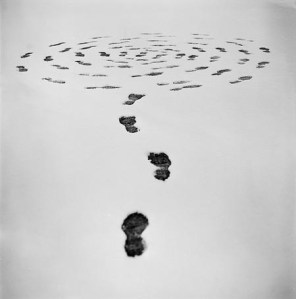
Like some impious prankster, Dr. Souman took his subjects out to empty parking lots and open fields, blindfolded them, and instructed them to walk in a straight line. Some of them managed to keep to a straight course for ten or twenty paces; a few lasted for 50 or a hundred. But all of them ended up circling back toward their points of origin.
Not many of them. Not most of them. Every last one of them.
“And they have no idea,” says Dr. Souman. “They were thinking that they were walking in a straight line all the time.”
Dr. Souman’s research team explored every imaginable explanation. Some people turned to the right while others turned to the left, but the researchers could find no discernable pattern. Neither left-handed nor right-handed subjects as a group demonstrated any propensity for turning one way over the other; nor did subjects tested for either right- or left-brain dominance. The team even tried gluing a rubber soul to the bottom of one shoe to make one leg longer than the other.
“It didn’t make any difference at all,” explains Dr. Souman. “So again, that is pretty random what people do.”
In fact, it isn’t even limited to walking. Ask people to swim blindfolded or drive a car blindfolded and, no matter how determined they may be to go straight, they quickly begin describing peculiar looping circles in one direction or the other.
And if, as the research indicates, human brains are hardwired to lead us in circles, why does Rabbi Nachman insist that “the main thing is to have no fear at all”?
 After all, a narrow bridge is a dangerous place to walk in circles.
Perhaps the answer lies in the words of King Solomon: G-d made man straight, but mankind sought many intrigues (Ecclesiastes 7:29).
The sages teach us that, in his original form, Adam towered above every other manner of creation and radiated a light of spiritual illumination. The inner purity of the First Man shone forth through the physical body that clothed his supernal soul, and the godliness that defined his essence drove him forward in unwavering pursuit of his divine purpose.
But Adam allowed his desire for spiritual elevation to confound his reason, rationalizing that by consuming the forbidden fruit he could internalize the influence of evil and thereby conquer it from within. Despite his noble intentions, by violating the divine word Adam strayed from his straight course and lost himself amidst the winding paths of a crooked world.
The history of Adam’s descendants testifies to the crookedness of man. The moral corruption of the generation of the Flood, followed by rebellion in the formof the Tower of Babel, marked mankind’s steady drift away from the path of Truth. The incipient Jewish nation, even before they had the opportunity to receive G-d’s Law at Sinai, twisted their spiritual yearning into worship of the Golden Calf and condemned themselves to wander directionless in the desert for 40 years.
Only upon entering their land did the Jews have another chance to find their way back to the straight and narrow. But again they lost their sense of purpose, refusing to accept upon themselves a leader who might steer them back on course toward a renewed national mission. And so the prophet declares that, “In those days there was no king; every man did what was upright (yashar) in his own eyes” (Judges 21:25).
The Hebrew word yashar, rendered here as upright, translates literally as straight. Indeed, no matter how much the Jews may have then convinced themselves of the straightness of their path, they were truly wandering in circles.

Dr. Souman explains what might otherwise seem obvious, that there is a simple solution to the circular inclinations of the internal human compass. With external clues, like a mountaintop or other promontory on the horizon, people have no trouble at all traveling a straight line.
Perhaps now we are ready to appreciate the meaning of Rabbi Nachman’s metaphor. We walk through life as if blindfolded, unable to see either the true nature of the world or the true purpose of our existence, bemused by all the material vanities that surround us and vie for our attention. The world is indeed a narrow bridge, with the winds of fad and fancy buffeting us on every side, relentlessly threatening to topple us into the abyss of spiritual oblivion if we place one foot off the path to either side.
But if we raise our eyes above the fray, if we pull the blindfold from our eyes and set our sights upon the mountaintop that beckons us across 3300 years of history, then we can march confidently into the future with no fear of straying from the true course that promises to lead us safely home.

Give a little, get back a lot
 Remember what they taught you when you were a kid:
It’s better to give than to receive.
Sure, it sounds nice. But no one really believes it.
After all aren’t these our basic assumptions about human nature and the ways of the world?
- No good deed goes unpunished (Clair Boothe Luce).
- When a fellow says, “It is not the money but the principle of the thing,” it`s the money (Kin Hubbard).
- Where large sums of money are concerned, it is advisable to trust nobody (Agatha Christie).
- If you wish to be a success in the world, promise everything, deliver nothing (Napoleon).
- The end of the human race will be that it will eventually die of civilization (Ralph Waldo Emerson).
It may be a cynical way of looking at life, but we had better learn to live with it if we want to get ahead.
Or do we?

An Ode to Almustafa
 If memory serves — after all, it has been 32 years — I was somewhere between New Orleans, Louisiana, and Waycross, Georgia. It was late winter, but the southern air was mild and the sun brightened the sky.
Hitchhiker’s weather, to be sure.
I was waiting at a rest stop with my thumb stuck out when a pickup towing a large camper lumbered to a halt in front of me. I climbed in and uttered my heartfelt thanks.
The driver, wearing a red flannel coat in hunter’s plaid, surprised me by identifying himself as a pastor on vacation. He asked the usual questions — where was I headed, where was I from, why was I traveling this way — then launched into his story.
There are two ways hitchhikers pay for their rides. One is by talking, by entertaining a driver lonely from the road and weary of recorded music or talk radio. The other is by listening, by letting drivers unburden themselves without the cost of therapy, secure in the knowledge that their disclosures will vanish into the air the moment the passenger exits the vehicle … comfort of strangers and all that.
Clergy have gotten a bad rap in recent years — much of it their own doing. Corruption is bad enough from politicians and business executives, but we have every right to expect more from our religious leaders. The entire edifice of theology suffers from every single act of spiritual infidelity.
But there are still many sincere men of the cloth, and my benefactor appeared faithful to the integrity of his office. He saw his mission not only to minister but to shepherd his flock toward pastures sown thick with the morality and ethics of scripture, to challenge them to challenge themselves and prod them to pay closer attention to the calling of their conscience.
And sadly, like spiritual leaders from Moses until today, he had found ample cause for disappointment.
 Yonason Goldson